When a 948TE Cherokee or a Chrysler 200 comes in with a whine, a slow engagement into Drive, and a fistful of ratio codes, somebody usually says "pump" before the scan tool is even plugged in. Sometimes they are right. More often the pump is fine and it is being starved, fed through a leaking tube, or outvoted by a worn pressure regulator bore in the valve body. On the ZF 9HP48 that distinction matters, because getting to the pump means pulling the transmission and splitting the bell housing.
Below: how the pump is built, what wears, which symptoms point at it, and what to replace. Chrysler builds its own version as the 948TE; parts are not always interchangeable, so confirm the unit before ordering (Transmission Digest, Part 1).
The short version: The 9HP48 uses a chain-driven, remote-axis, dual-chamber vane pump mounted in the bell housing and driven off four flats on the converter hub. Real pump failures come from chain and drive wear, debris-scored vanes, and starvation from low fluid or a bad filter seal. A whine that follows engine rpm in Park is the pump's signature. Low or erratic pressure with a quiet pump usually means worn regulator bores in the valve body instead. Check TCM software against FCA bulletins 21-034-14 and 21-043-15 before tearing anything down.


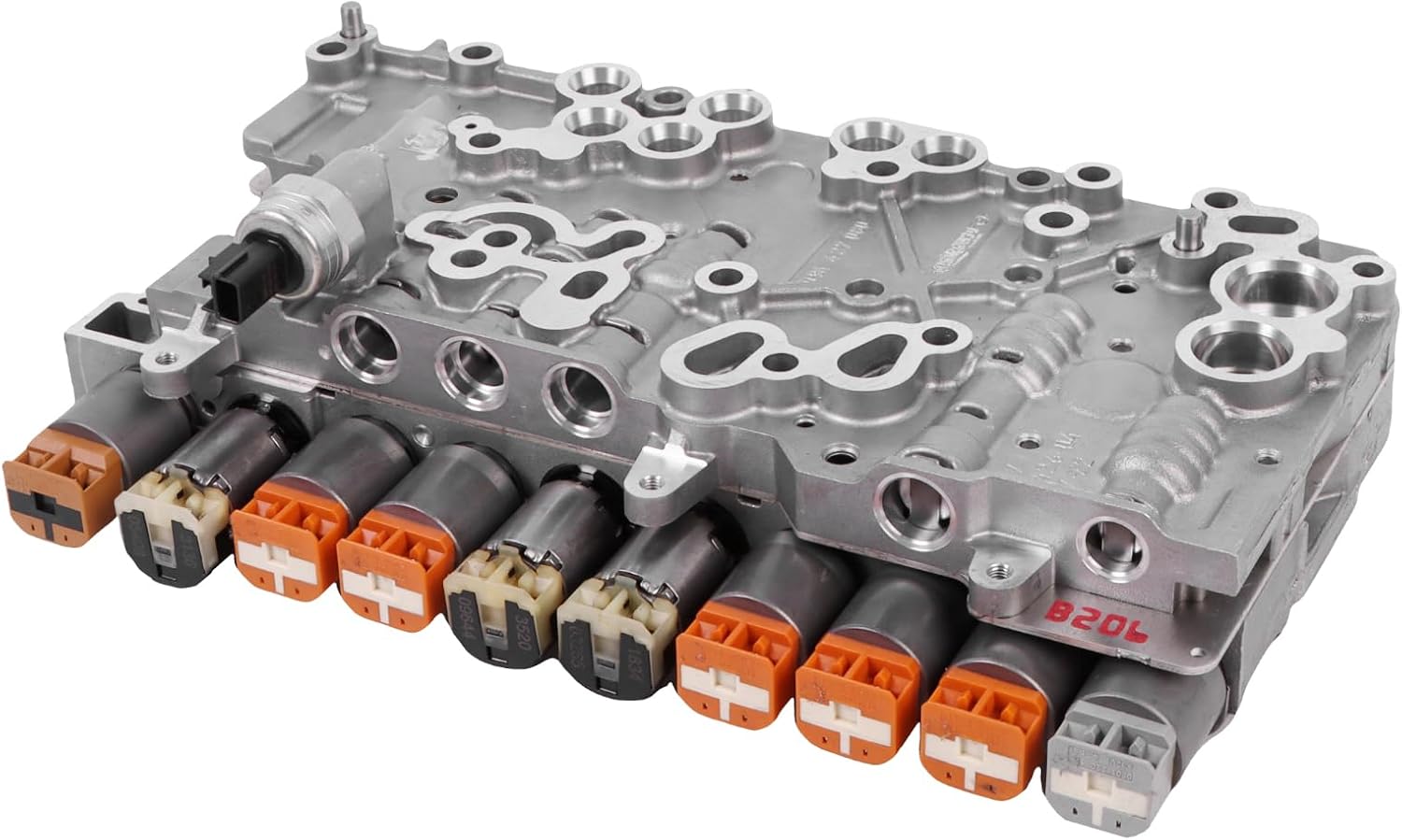
How the 9HP48 Pump Is Built and Driven
Transmission Digest's teardown describes it as a chain-driven remote axis pump, similar to the 8HP pump: a dual-chamber vane-type pump positioned at the base of the pump housing, inside the bell housing alongside the stator support and the filter assembly (Transmission Digest, Part 1). The drive gear has four flats that mesh with the converter hub, and the chain runs from there down to the pump. The pump body seals to its housing with two O-rings.
ZF's own engineers explain why they went this way. Their SAE technical paper on the 9HP48 says that, for the first time, two positive-locking dog clutches were applied alongside an axially parallel vane cell pump, both chosen to cut drag torque and help the unit hit its efficiency targets (SAE 2013-01-1276, Gaertner and Ebenhoch, ZF Friedrichshafen AG). The point of the design is efficiency: less parasitic loss spent pumping oil than a conventional pump sitting on the input axis. The tradeoff for a technician is that the pump is small, it lives on a chain, and it has very little margin when it is starved.
A few other details in the same housing affect pump diagnosis:
- No external filter access. There is no bottom pan, so the filter cannot be serviced from outside (Transmission Digest, Part 1). The Filtran filter's outlet neck plugs into the pump housing with an O-ring.
- Filter bypass tube for stop-start. Instead of an auxiliary electric pump, the 9HP uses a bypass tube from the valve body to the filter outlet so pressure comes up immediately on restart. Only one clutch has to reapply after an auto-stop, by design.
- Spring-loaded drain-back valve at the base of the pump housing.
- O-ringed connecting tubes. The valve body connects directly to the pump housing and the filter assembly through a series of tubes, all sealed with O-rings (Transmission Digest, Part 2). A hard or cut O-ring here leaks pump output before it ever reaches a clutch.
What Actually Fails
Chain and drive wear
Transmission Digest notes the pump chain is similar to the 6T70's and says to always check it for wear. A stretched chain or worn sprocket makes noise first, then rides poorly on the teeth. Look hard at the four drive flats and the converter hub that turns them. If the hub flats are rounded, a new pump will not fix anything; the converter has to be addressed too.
Vane and chamber scoring
Vane pumps do not tolerate debris. Friction material from a slipping clutch or metal from a worn dog clutch spline gets pulled straight through the filter's bypass path and into the pump. Scored vane tips or a grooved cam ring lose volume, and the loss is worst when the fluid is hot and thin. Transmission Digest calls for close inspection of both dog clutches for spline wear (Part 2).
Starvation and aeration
This is the most common way a healthy pump gets condemned. Low fluid, a cracked filter neck O-ring, or a leaking connecting tube lets the pump pull air. You get foaming, a buzzing whine, and pressure that collapses on turns and hard stops. Transmission Digest also flags an external hydraulic line at the back of the case that can blow out with age (Part 1). Lose enough fluid there and the pump is the next casualty.
The impostor: worn regulator bores
Sonnax documents wear in the 948TE / ZF9HP48 pressure regulator bores. Oscillating valve wear opens up valve-to-bore clearance and lets critical pressure exhaust, which Sonnax lists as causing low line pressure, high line pressure, erratic line pressure and clutch failure, along with cooler and lube flow restrictions, depending on where the wear is (Sonnax, kit 85740-15K). A pump that makes full volume cannot overcome a regulator that dumps it. That is why the valve body gets checked before the pump gets replaced.
Symptoms That Point at the Pump
- Whine that follows engine rpm, not road speed. The pump turns any time the converter hub turns. If the noise is present in Park and Neutral and climbs with the tach, start at the pump and chain.
- Delayed engagement that gets worse hot. Worn vanes leak internally more as viscosity drops. A unit that engages fine cold and takes two seconds hot is losing volume somewhere.
- Ratio and engagement codes across several gears. When one clutch is bad, you get one gear's ratio code. When supply pressure is low, codes show up for multiple ranges. The 9HP's A and F dog clutches are moved by oil pressure (the A dog through a valve fed from the center of the input shaft; the F dog sleeve has its own apply and release sealing rings), so low supply can also show up as a dog clutch that will not engage cleanly (Transmission Digest, Part 2).
- Slow or harsh restarts after an auto-stop. The stop-start strategy depends on pressure coming up immediately through the bypass tube. A weak pump or leaking tube O-ring shows up here before it shows up anywhere else.
Diagnosis: Scan Tool First, Then the Bench
1. Check the software before the hardware
The 948TE received several early calibration updates, and Transmission Digest advises confirming all reprogram and relearn updates have been performed before doing repairs (Part 1). Two FCA bulletins on file with NHTSA are worth knowing:
- 21-043-15 (June 2015, 2014 KL Cherokee 3.2L, sales codes DFH/DFJ) addresses a MIL with codes including P0711 (TFT sensor range/performance), P072F (stuck in gear 4), P076F and P0734 (gear 7 and gear 4 incorrect ratio), P0810 (clutch position control error), P1CC9 (unable to engage gear) and P061B. The procedure tells you to record the Clutch Fill and Fast Fill counters in wiTECH before flashing.
- 21-034-14 (November 2014, 2015 KL Cherokee and UF Chrysler 200 built on or before October 20 and October 24, 2014) enables the wiTECH Transmission Quick Learn, improves downshift response, and notes that the flash clears the adaptive values so the learn must be performed afterward.
If the vehicle is in range and has not been flashed, do that first.
2. Fluid level and condition
Set the level with the specified fluid, at the specified temperature, using the service procedure; a cold check means nothing on this unit. Chrysler specifies Mopar ZF 8 & 9 Speed ATF for the 948TE. Since the filter is buried, a fluid sample is your window into the pump: glitter means metal from the chain, dog clutches or pump; black, fuzzy fluid means friction material. Either one changes the job from "pump" to "overhaul."
3. Data to log on a road test
- Engine rpm versus input speed in each gear. Flare on upshifts or slip under load in multiple gears suggests supply pressure, not a single clutch.
- Transmission fluid temperature. Note exactly when the symptom starts. Pump wear shows up hot.
- Commanded gear versus calculated ratio. Log the ratio codes and which gears they set in.
- Clutch fill and fast fill counters (wiTECH), recorded before clearing anything.
4. Isolate the noise
In Park, raise engine speed slowly to 2,500 rpm. A whine that tracks rpm is the pump, chain or converter. Noise that follows road speed instead belongs to the transfer gear or differential, both on tapered roller bearings (Transmission Digest, Part 2).
5. On the bench
Before you condemn the pump, vacuum-test the regulator bores. Sonnax says a bore that will not hold the recommended minimum in-Hg at the indicated ports needs reconditioning with its oversized valve kit. Then inspect the pump: chain stretch, sprocket teeth, the four drive flats and the converter hub, vane tips and the chamber surfaces, both pump body O-rings, the drain-back valve, and every connecting tube O-ring.
| What you find | Most likely cause | Fix |
|---|---|---|
| Whine tracks engine rpm in Park, fluid clean | Chain or sprocket wear, worn drive flats | Pump chain and drive; inspect converter hub |
| Slow hot engagement, aerated fluid, level low | Starvation from a leak or filter neck seal | Fix leak, filter and O-rings, correct fill |
| Erratic or low pressure, quiet pump, vacuum test fails | Worn pressure regulator bore | Recondition bore or replace valve body |
| Codes on a 2014-2015 unit, never flashed | Calibration | Flash per 21-043-15 / 21-034-14, then learn |
| Metal or friction debris in the sample | Internal failure feeding the pump | Full overhaul, pump replaced, cooler flushed |
Replacing the Pump the Right Way
- Remove the transmission. Pull the ribbed valve body cover (it uses a molded seal and crimped, torque-limited bolts), remove the valve body, then split the bell housing from the case (Transmission Digest, Part 1). The bell housing gasket is rubber-coated steel; replace it.
- Replace the pump, chain and sprocket as a set. A new pump on a stretched chain is a comeback. Install new pump body O-rings and check the drain-back valve.
- Replace the filter and every connecting tube O-ring. The filter is only reachable with the bell housing off, so it is never optional on this job.
- Inspect the converter hub. Damaged drive flats on the hub will eat the new drive gear. Replace the converter if the hub is worn; the converter hub rides in a bearing, and its seal is held in by a snap ring.
- Address the valve body. If the regulator bores failed the vacuum test, recondition or replace the valve body now. When the valve body or TCM is replaced, the learn procedure matters.
- Flush the cooler and lines.
- Fill, flash, learn. Fill with the specified fluid, set the level hot, confirm the TCM is current, and run the adaptation or Quick Learn your service information calls for.
Prevention
Fluid level is the whole game. Fix leaks early, including the external line at the back of the case, use the correct ZF 9-speed fluid, and fix a slipping clutch before its debris reaches the pump.
Doing the Bell Housing Job?
The 9HP48/948TE filter and gasket kit covers the parts you cannot reach any other way. Pair it with ZF 9HP-spec fluid so the new pump starts life on clean oil.
See the 9HP48 filter kit →FAQ
What does a failing 9HP48 pump sound like?
The classic sign is a whine that rises and falls with engine rpm, not road speed. The pump is driven by a chain off the converter hub, so it turns whenever the engine runs. If the noise is there in Park and Neutral and follows the tach when you rev it, the pump, its chain or its drive is the first suspect. Noise that only changes with vehicle speed points at the transfer gear or differential instead.
Can you replace the 9HP48 pump without removing the transmission?
No. The remote-axis pump, its drive chain, the stator support and the filter all live inside the bell housing. The transmission has to come out and the bell housing has to be split from the case to reach them, and the valve body comes off first. Because the job is that deep, most shops replace the filter, pump O-rings, chain and every bell housing seal at the same time.
Can low fluid damage the 948TE pump?
Yes. The 948TE has no bottom pan and the filter is internal, so a low level often goes unnoticed until the pump starts drawing air. Aeration causes noise, foaming and low output, which shows up as delayed engagement and slipping when hot. Fix every leak, including the external hydraulic line at the back of the case, and set the level with the correct fluid at temperature.
Is it the pump or the valve body when line pressure is low?
Often it is the valve body. Sonnax documents wear in the 9HP48 / 948TE pressure regulator bores that lets critical pressure exhaust, causing low, high or erratic line pressure and clutch failure. Vacuum testing the regulator bores and checking the filter and fluid level should come before condemning the pump.
Sources
- Transmission Digest, “ZF9HP48 FWD Nine Speed, Part 1”: chain-driven remote-axis dual-chamber vane pump, drive gear with four flats on the converter hub, chain similar to 6T70, two pump O-rings, drain-back valve, filter bypass tube for stop-start, no bottom pan, external hydraulic line at the rear of the case, bell housing removal. transmissiondigest.com
- Transmission Digest, “ZF9HP48 FWD Nine Speed, Part 2”: O-ringed connecting tubes from the valve body to the pump housing and filter, hydraulic apply of the A and F dog clutches, dog clutch spline wear, transfer gear and differential on tapered roller bearings. transmissiondigest.com
- SAE Technical Paper 2013-01-1276, L. Gaertner and M. Ebenhoch (ZF Friedrichshafen AG), “The ZF Automatic Transmission 9HP48 Transmission System, Design and Mechanical Parts”: axially parallel vane cell pump and two dog clutches used to reduce drag torque. saemobilus.sae.org
- Sonnax, Oversized Pressure Regulator Valve Kit 85740-15K (948TE / ZF9HP48 / Honda-Acura 9-speed): regulator bore wear, resulting low/high/erratic line pressure and clutch failure, vacuum test criteria. sonnax.com
- FCA US LLC Service Bulletin 21-043-15 (June 19, 2015), “Flash: Transmission Shift and Diagnostic Enhancements,” 2014 KL Cherokee 3.2L with 948TE: DTC list and recording Clutch Fill and Fast Fill counters before the flash. Hosted by NHTSA. static.nhtsa.gov
- Chrysler Group LLC Service Bulletin 21-034-14 (November 1, 2014), “Flash: 948TE 9 Speed Shift Enhancements And Quick Learn Enable,” 2015 KL Cherokee and UF 200: applicability by build date, adaptive values cleared by the flash. Hosted by NHTSA. static.nhtsa.gov