Most AOD leak jobs start the same wrong way: somebody sees fluid on the pan, throws a gasket at it, and the leak comes right back, sometimes worse. On this transmission that is almost expected, because fluid runs downhill along the case and the converter housing before it drips, so the puddle under the car and the actual failed seal are often six inches apart. Ford's own AOD leak-diagnosis section deals with this directly, with a specific cleaning and dye-test procedure and a short list of exact spots, in order, with real torque numbers for the ones you can just tighten.
This guide walks through that procedure and every leak point Ford lists for the AOD, plus two leaks that never show up on the floor at all because they happen inside the valve body. If your AOD is already running hot from one of these, read our AOD overheating guide next, since a long-standing external leak and a hardened-seal internal leak tend to arrive together. Every torque spec and procedure below is cited under Sources.
Why the puddle lies to you
Ford's leak-diagnosis section for the 1993 AOD opens with a point most DIYers skip: in the converter housing area, where the leak shows up tells you what it is, because different leak sources deposit fluid in different places before it drips. A leaking front pump seal lip runs fluid along the impeller hub to the back of the impeller housing, and normally only deposits inside the converter housing near its outside diameter. A leak at the pump seal OD or the pump body follows that same path. A leak at the front pump-to-case bolts shows up only inside the converter housing, never on the back of the converter itself. A leaking converter drain plug, or a cracked weld where the converter attaches to the flywheel, shows fluid at the converter's outside diameter, the back of the flywheel, and inside the housing near the flywheel. Three different failures, three different fluid trails, and if you clean it all off and guess instead of tracing it, you can replace a seal that was never the problem.
Ford's actual procedure:
- Check the dipstick. Factory fluid is red; Motorcraft notes its MERCON V is dyed red specifically so leaks are easy to spot. If it's not, note that before you do anything else, since dark or burnt fluid changes what you're chasing.
- Clean and dry the converter housing, the front of the flywheel, the drain plug, and the surrounding area completely.
- Run the engine to normal operating temperature and look for fresh fluid.
- Raise the vehicle, run the engine at idle and slightly above idle, and briefly shift into Drive and Reverse a few times to build line pressure while you watch.
- Use white tissue paper against suspect areas. It shows fluid color and lets you see exactly where it's coming from, rather than where it ended up.
- If a weld at the converter-to-flywheel attachment is suspect, pull the converter and test it with a dedicated leak detector (Ford's tool is the Rotunda 021-00054) rather than guessing from the outside.
Before you blame the transmission at all, rule out the engine. Ford specifically notes that a leaking rocker cover, a leaking oil galley plug, a bad crankshaft seal, or a bad engine oil pressure sender can all let engine oil run down to the converter housing and look exactly like a transmission leak. Power steering fluid can also blow back onto the bellhousing from the front of the engine and get misread the same way.
If the leak won't show itself even with the engine running and the vehicle raised, use dye. Ford's mix is specific: premix 2.5 ml (about 1/2 teaspoon) of dye powder per 0.23 liter (about 1/2 pint) of fluid, run it, then inspect with a black light. Guessing at the dye ratio under- or over-saturates the fluid and either hides the leak or stains everything in the pan, so measure it.
The leak points Ford lists, with actual torque specs
Once you know where to look, most of these are a tighten, a new O-ring, or a new gasket, not a rebuild. Ford's warning on every one of them: never exceed the torque spec trying to stop a leak. Overtightening a pan bolt, a fitting, or a plug past spec is what turns a $15 gasket job into a stripped case.
| Leak point | Fix | Torque / spec |
|---|---|---|
| Oil pan gasket | Tighten retaining bolts evenly; replace gasket if it's cut or hardened | 8-13.5 Nm (71-119 lb-in) |
| Fluid filler (dipstick) tube | Install a new O-ring, press the tube fully into the case, confirm the bracket is aligned and attached | No torque spec listed; seat by hand, don't force |
| Cooler line-to-case fitting | Tighten; if it still leaks, replace the fitting | 31 Nm (23 lb-ft) existing fitting; 24-31 Nm (18-23 lb-ft) on a new fitting |
| Radiator cooler fittings | Same approach as the case fitting | Same range as above |
| Speedometer cable connection | Replace the rubber seal at the transmission | Not torque-specified; seal replacement only |
| Throttle valve / manual lever shaft seals | Replace either or both if leaking | Seal replacement only |
| Case pipe plugs (AOD has four: three on the RH side, one on the LH) | Tighten; replace any plug that still leaks after tightening | 8-16 Nm (6-12 lb-ft) |
| Converter drain plug | Remove with a six-point wrench, coat threads with Teflon pipe sealant (or equivalent), reinstall | 11-38 Nm (8-28 lb-ft) |
The radiator's internal transmission cooler deserves its own check if you see fluid in the coolant, or coolant in the fluid. Disconnect both lines, remove the radiator cap to relieve pressure, and apply 345-517 kPa (50-75 psi) of air to the cooler circuit. If it won't hold pressure, or you see bubbles, the cooler itself has failed internally and needs to be replaced, not just reflushed. Running a failed internal cooler risks taking out the whole transmission with contaminated fluid, so don't skip this check just because the external fittings are dry.
Leaks that never touch the garage floor
Everything above is an external leak: fluid leaves the case and you can see it. The AOD also has two well-documented internal leak points that cost you line pressure without ever dripping, because the fluid just moves from a high-pressure circuit to a low-pressure one inside the valve body instead of escaping the case.
The first is the throttle valve (TV) plug and sleeve. The AOD has no computer, so line pressure is set entirely by TV pressure from the cable-actuated TV plug. Sonnax describes the failure plainly on a worn unit: the TV plug wears its sleeve until feed oil leaks past the plug to exhaust, which drops line pressure across the board. The listed symptoms are overheated clutch and overheated band, because everything that should be clamping with full force is now clamping soft. Sonnax's drop-in kit (76989K) replaces the worn bore with an O-ringed sleeve rather than requiring the whole valve body to be bored and bushed.
The second is the pressure regulator boost valve. Sonnax's description for the AOD boost valve kit is the same mechanism: severe wear of the boost sleeve allows boost oil to leak internally, and the listed result is low line pressure rise, soft slide shifts, delayed engagement into Reverse, and direct clutch failure. The fix is a replacement sleeve kit (76990-04K for the large-ratio, heavy-duty version), not a new case.
Neither of these will show up on a dye test, because the fluid never leaves the transmission. If you've chased every external leak point above, tightened everything to spec, and the unit still shows low line pressure, a flare into overdrive, or clutches that run hot, the valve body's internal bores are the next place to look, not another gasket.
What to use when you refill it
Ford's 1993 specification for the AOD is MERCON ATF. That fluid is no longer made: Ford Technical Service Bulletin 06-14-4 states that MERCON automatic transmission fluid ceased production after July 1, 2007, and that any application calling for MERCON can now be serviced with MERCON V, with MERCON ATF while supplies last, or with a fluid dual-labeled MERCON/MERCON V. Motorcraft's own MERCON V product sheet confirms it as the current recommendation for vehicles that originally specified MERCON. Do not substitute Type F, and don't use any fluid additive or "leak stop" treatment in place of an actual seal repair, since the AOD's friction elements are calibrated around a specific fluid, not a doctored one.
Fill level matters here too. Check our overheating guide for the exact hot fill procedure, since an overfilled AOD foams and loses fluid out the vent, which can look like a new leak right after you've fixed a real one.
Need parts for this job?
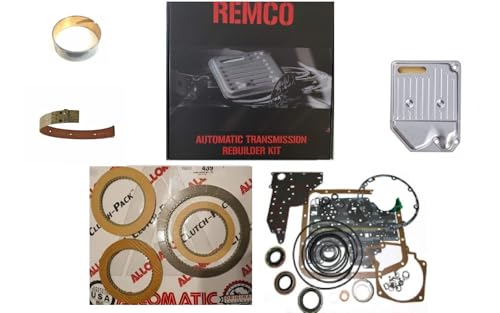
Our AOD parts page has the aftermarket and TransGo valve bodies, the master rebuild kit with clutches and band, and the TV cable kit, all on our own checkout.
Shop the part for this fix: front pump seal kit at CoreTransmissionParts
If your leak traced back to the converter housing area, this AOD-family front pump overhaul kit covers the pump seal, gasket and O-ring in one order. It's listed under the shared 4R70W family catalog, so confirm your exact pump casting before ordering.
View the front pump seal kitFAQ
What are the most common places an AOD leaks fluid?
Ford's own AOD leak-diagnosis section points to the oil pan gasket, the fluid filler tube O-ring, the cooler line fittings at the case and radiator, the speedometer cable seal, the throttle valve and manual lever shaft seals, the four case pipe plugs, the converter drain plug, and the front pump seal and pump-to-case bolts in the converter housing area. Check the easy ones (pan, filler tube, cooler fittings) before you pull anything apart.
How do you actually find where an AOD is leaking from?
Ford's procedure is to clean and dry the converter housing, flywheel area and drain plug, run the engine to normal operating temperature, then raise the vehicle and run it at idle and slightly above idle while shifting briefly into Drive and Reverse to build pressure, watching for fresh fluid with white tissue paper. For a leak that will not show itself, Ford specifies premixing 2.5 ml (about 1/2 teaspoon) of dye powder per 0.23 liter (about 1/2 pint) of fluid and inspecting under a black light.
What is the correct torque for an AOD oil pan?
Ford specifies 8-13.5 Nm (71-119 lb-in) for the AOD pan retaining bolts. That is a fairly light spec by design, and Ford's own manual warns not to exceed the torque spec to try to stop a leak, because overtightening strips the case threads or crushes the gasket, which makes the leak worse.
Can a worn AOD valve body cause a leak that never shows up on the garage floor?
Yes. The AOD's throttle valve plug and boost valve both ride in aluminum sleeves that wear with mileage. Sonnax describes the TV plug wearing its sleeve until feed oil leaks past it to exhaust, and the boost valve sleeve wearing until boost oil leaks the same way. Both are leaks of line pressure inside the valve body, not fluid on the ground, and both show up as soft shifts, overheated clutches, or a slipping overdrive band rather than a wet spot under the car.
What fluid should go back into an AOD after a leak repair?
Ford's 1993 specification is MERCON. Ford Technical Service Bulletin 06-14-4 states that MERCON automatic transmission fluid was discontinued in 2007 and that any application requiring MERCON can now be serviced with MERCON V or a dual-usage MERCON/MERCON V fluid. Do not use Type F in an AOD.
Related guides
- AOD Overheating: Causes and Prevention
- AOD Valve Body Symptoms
- AOD Slipping Under Load: Root Causes and Fixes
- AOD Fluid Change Cost
- AOD Common Problems and Fixes
Sources
- Ford Motor Company, 1993 Mustang Workshop Manual, Section 07-01B (AOD), Fluid Leak Diagnosis. Backs the converter-area fluid-path logic (pump seal vs. pump-to-case bolts vs. drain plug/weld), the clean-run-inspect procedure, the dye test ratio (2.5 ml per 0.23 L), the pan gasket torque (8-13.5 Nm / 71-119 lb-in), the cooler fitting torque (31 Nm / 23 lb-ft), the pipe plug torque (8-16 Nm / 6-12 lb-ft), and the converter drain plug torque (11-38 Nm / 8-28 lb-ft). SPB71B06
- Ford Motor Company, 1993 Mustang Workshop Manual, Section 07-01B, Transmission Fluid Cooler Flow Check. Backs the internal-cooler air pressure test (345-517 kPa / 50-75 psi) and the advice to rule out a failed radiator cooler before reflushing it. SPB71B13
- UnderhoodService (Babcox Media), "Ford Announces More Stringent Specification Replacement for MERCON Automatic Transmission Fluid." Backs Ford Customer Service Division's replacement of MERCON with MERCON V as the service fluid for any application that originally specified MERCON (which includes the AOD), the stricter anti-oxidation, anti-wear and anti-shudder requirements of MERCON V, and the expiration of remaining MERCON production licenses by mid-2007. underhoodservice.com
- Motorcraft (Ford Customer Service Division), MERCON V Automatic Transmission and Power Steering Fluid product page (archived July 22, 2024; the live motorcraft.com page now blocks automated access). Backs MERCON V as the fluid Ford recommends for vehicles that require either MERCON V or MERCON, its red dye for leak detection, and the warning not to use it where MERCON LV, ULV, SP or Type F is specified. motorcraft.com (archive.org copy)
- Sonnax, AOD Throttle Valve Plug Kit (76989K). Backs the TV plug/sleeve wear mechanism, the internal feed-oil leak to exhaust, and the overheated clutch/band symptom set. sonnax.com
- Sonnax, AOD Boost Valve Kit (76990-04K). Backs the boost sleeve wear mechanism, the internal boost-oil leak, and the resulting low line pressure rise, soft slide shifts, delayed Reverse engagement and direct clutch failure. sonnax.com