An AOD that runs hot does not fail all at once. It varnishes, the seals harden, line pressure sags, the overdrive band starts to slip a little on the 3-4 shift, and the slip makes more heat. By the time the owner notices a flare into overdrive or a burnt smell on the dipstick, the damage has been building for thousands of miles. The good news is that almost everything that makes an AOD overheat is something you can check with a pressure gauge, a funnel and a thermometer, before the unit comes out.
This guide covers why the AOD makes heat where it does, the six overheating causes Ford lists in its own workshop manual and how to test each one, and the habits and parts that keep fluid temperature where it belongs. It is written for daily drivers and weekend cars as much as tow rigs. If you pull a trailer, read our AOD towing upgrades guide after this one. Specs and page references are listed under Sources at the bottom.


Where an AOD makes its heat
Every automatic makes most of its heat in two places: the torque converter while it is slipping, and any clutch or band that slips while it applies or holds. The AOD is unusual because of how it handles the first one.
Ford's engineering paper introducing the AOD (SAE 800004, 1980) lays it out. In third gear the AOD splits torque: 40 percent of engine power goes through the converter hydrodynamically and the other 60 percent goes mechanically, straight from the converter cover through a small solid input shaft to the direct clutch. In fourth, engine power bypasses the converter completely and follows a direct mechanical path to the driveshaft. There is no lockup clutch inside the converter. The lockup happens inside the transmission, through that second input shaft.
That has two practical consequences for heat:
- Overdrive is the coolest gear an AOD has. In fourth there is zero converter slip. If it is running hot at a steady highway cruise in overdrive, the converter is not the cause unless its stator is seized (more below). Look at fluid level, cooler flow and band slip first.
- Third is a partial-slip gear. With 40 percent of the power still going through the fluid coupling, a long run in D (overdrive locked out) makes more converter heat than the same speed in overdrive. That is fine on a grade, where it keeps the band from cycling, but it is not how you want to cruise on flat road. Ford's own description says the D position "may be used when driving up or down mountainous roads." It is a tool for hills, not a default.
The other heat source is slip at the friction elements. On an AOD the one that suffers first is the overdrive band, because it holds the reaction member in fourth and it is small for the job. Anything that lowers line pressure lowers band apply force, and a band that slips a few percent at cruise generates heat continuously.
Know your numbers: normal vs. dangerous temperature
Ford's workshop manual lists normal AOD operating temperature as 150-170°F (66-77°C), the temperature at which the fluid should sit in the cross-hatch on the dipstick. That is where a healthy unit lives in mixed driving. TCI publishes the thresholds above that:
| ATF temperature | What it means |
|---|---|
| 150-170°F | Ford's normal AOD operating range for a level check |
| 175-225°F | TCI's ideal range under load |
| About 240°F | Additives start to cook and varnish forms (TCI) |
| About 260°F | Seals begin to harden, leading to internal and external leaks (TCI) |
| About 295°F | Clutches begin to slip as the oil breaks down (TCI) |
| 300°F and up | TCI says a typical transmission dies within about 2,000 miles |
The number that matters on an AOD is 260°F. Hardened seals are what turn an overheating problem into a pressure problem. The servo seals, the direct clutch seals and the sealing rings on the input shafts all start leaking, pressure drops, and the unit begins slipping on its own even after you fix whatever made it hot in the first place. Keep the fluid under 225°F under load and you stay clear of that whole chain.
You cannot manage what you cannot see. A transmission temperature gauge with the sender in the converter-out (to cooler) line shows the hottest oil in the system. That is the reading to watch.
Ford's six overheating causes, and how to test each one
The 1993 Mustang workshop manual has a "Transmission Overheats" entry in its AOD symptom chart. It lists six causes, in this order. We test them in roughly the same order, because the first ones are free.
1. Improper fluid level
Low fluid is obvious: the pump draws air, pressure drops, things slip. Overfilling is the one people miss. Ford's diagnosis section says a fluid level that is too high causes the fluid to become aerated, and that aerated fluid causes low control pressure and can be forced out the vent. The manual's fluid check page adds that overfilling results in foaming and loss of fluid through the vent. Foamy fluid carries heat poorly and compresses in the circuits, so an overfilled AOD can run hot and slip at the same time.
The trap is checking it cold. Ford says fluid set correctly at 70-95°F will read in the cross-hatch once it reaches 150-170°F. If you top it up to the hot mark on a cold morning, you have overfilled it. The manual also says that after extended high-speed driving, city traffic, hot weather or towing, let the fluid cool for about 30 minutes before you trust the reading. And it tells you to look at the fluid: it should be dark reddish, not brown or black, and the odor can indicate an overheating condition or clutch or band failure.
Use the right fluid. Ford's 1993 manual calls for MERCON (ESR-M2C163-A2 at the time). Today Motorcraft MERCON V is Ford's recommendation for vehicles that call for MERCON. Motorcraft specifically says not to use it where Type F is recommended, so do not pour Type F into an AOD because it is an old Ford.
2. Incorrect engine idle
This one surprises people, but it is on Ford's list for a reason. The AOD sits in first gear at a stoplight with the converter stalled against the brakes. Every extra hundred rpm of idle is more fluid being sheared in the converter with nowhere to go, and on a carbureted swap or an engine with a vacuum leak, idle in gear can be well above spec. A high idle also creeps the car harder, so the driver rides the brake harder. Set idle to the engine's spec in Drive before you chase anything inside the transmission.
3. Clutch or band application and the pressure control system
This is the big one. The AOD has no computer. Line pressure comes from TV (throttle valve) pressure, and TV pressure comes from the TV cable. If TV pressure is low, line pressure is low, the overdrive band and the direct clutch apply with less force, and they slip under load. Ford's answer is the control pressure test: a 300 psi gauge on the line pressure tap, a 0-100 psi gauge on the TV tap, readings at idle and at wide-open-throttle stall in each range.
Before the gauge test, check the TV cable setting. Per Ford, with fluid at 100-150°F, selector in Neutral (never Park) and the TV gauge tool inserted in the cable, TV pressure at idle should be 30-40 psi, and it should drop below 5 psi with the tool removed. Our towing guide covers that procedure in detail.
If the cable is right and TV pressure is still low or unstable, suspect the TV plug and sleeve in the valve body. Sonnax describes the failure plainly: the throttle valve plug wears its sleeve, letting TV feed oil leak past the plug to exhaust, which results in low line pressure. The symptoms Sonnax lists for it include overheated clutch and overheated band. Their drop-in kit (76989K) replaces the worn sleeve with an O-ringed one. On a high-mileage AOD valve body, we treat this bore as worn until proven otherwise.
The other leak that produces heat is the overdrive servo pin bore. Sonnax explains that excess clearance between the pin and the case bore leaks release oil, which lowers forward clutch pressure and can let the overdrive band drag in 1st, 2nd and 3rd. A dragging band is a brake. It makes heat in every gear it is not supposed to be applied in. Sonnax's O-ringed pin kit (76833) seals it.
4. Restriction in the cooler or lines
Ford gives a simple cooler flow check. With linkage, fluid level and control pressure confirmed in spec first:
- Pull the dipstick and put a funnel in the filler tube.
- Disconnect the cooler return line at the case and run a hose from it into the funnel.
- Start the engine, set 1,000 rpm in Neutral, and watch the flow once the air bleeds out. It should be liberal.
If it is not, Ford points to low pump capacity, main circuit leakage, or cooler restriction. Check both steel lines to the radiator and any rubber lines to an auxiliary cooler, and feel every bend. Ford specifically warns that a kinked cooler line restricts flow and can result in overheating or lack of lubrication. That last part matters: on most automatics, including the AOD, the oil coming back from the cooler feeds the lube circuit that keeps the bushings, thrust washers and planetary gears alive. A restricted cooler starves lube as well as holding in heat. To separate a transmission problem from a cooler problem, Ford says to check flow at the case converter-out fitting.
After any failure, assume the radiator cooler is full of debris. Flush it, and check it for internal leaks by applying 50-75 psi of air to the fittings with the radiator cap off. If it will not hold pressure, replace it. Ford gives the case cooler-line fitting torque as 23 lb-ft (31 Nm), or 18-23 lb-ft on a new fitting, and warns against overtightening to stop a leak.
5. Seized converter one-way roller clutch
The stator in the converter has a one-way clutch. It locks to multiply torque at low speed and freewheels once the converter reaches coupling speed. If it seizes, the stator can no longer freewheel. The converter keeps redirecting fluid against a stationary stator at speeds where it should be spinning free, and that churning turns into heat, most noticeably at steady cruise in third. This is the one overheating cause that also shows up as poor fuel economy and a car that feels sluggish above about 30 mph. Ford's fix is to replace the one-way clutch, which in practice means a rebuilt converter. Never reuse the converter from a unit that overheated.
6. Dirty or sticking valve body
Varnish from past overheating makes valves stick. A sticking shift valve can delay or hang a shift, a sticking TV or boost valve can hold line pressure low, and either one makes the unit slip and cook. Ford's remedy is to clean, service or replace the valve body. If the fluid is already dark and smells burnt, pulling the valve body for a cleaning and a TV sleeve kit is cheaper than a second rebuild. See our AOD valve body symptoms post for the shift patterns that point to specific valves.
Prevention: what keeps an AOD cool
- Set fluid level hot, with the right fluid. MERCON-type fluid (Motorcraft MERCON V today), checked at 150-170°F on level ground, in the cross-hatch and no higher.
- Verify TV pressure after any engine, throttle body or cable change. 30-40 psi with the tool in, under 5 psi with it out. This is the single biggest factor in AOD band life.
- Cruise in overdrive, use D for hills. Overdrive has no converter slip at all. Use D on grades and in heavy wind when overdrive hunts, then go back to overdrive.
- Add an auxiliary cooler in series. Hayden recommends keeping the stock radiator cooler in the circuit and adding the air-to-oil cooler after it on the return line. The radiator tank knocks down the peak temperature and warms the fluid in winter, and the add-on cooler finishes the job before the oil goes back to the case.
- Install a temperature gauge with the sender in the converter-out line, and back off when it heads past 225°F.
- Change fluid and filter on schedule. Our AOD fluid change guide covers intervals and cost. The AOD pan has no drain plug, so a pan drop only changes part of the fluid. Shorter intervals make up for that.
- Fix a slip immediately. A slipping band makes heat, heat hardens seals, hard seals leak pressure, low pressure makes more slip. Catch it at the first flare into overdrive.
When it has already cooked
If the fluid is black and smells burnt, or you find band material in the pan, the question is no longer prevention. Hardened seals do not come back, and a glazed overdrive band will not hold. At that point the job is a rebuild with a fresh band and full seal kit, a new or rebuilt converter, a flushed or replaced cooler, and a cleaned valve body with the TV sleeve addressed. Skip the cooler flush and the debris from the old unit goes straight into the new one. Our AOD rebuild cost guide breaks down what that runs.
Shop the part for this fix: larger-apply servo piston kit at CoreTransmissionParts
A slipping overdrive band is where most AOD heat damage starts. This AOD-family servo piston kit (1980-up) gives more apply force on the band. Pull your servo cover and confirm the size you have before ordering.
View the servo piston kitNeed parts for this job?
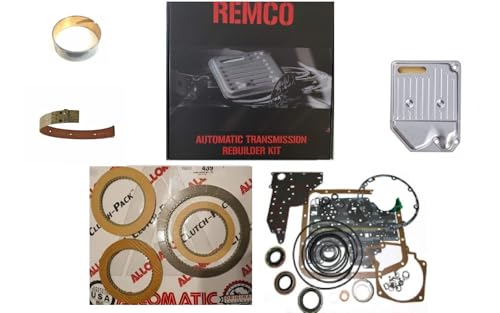
Our AOD parts page has master rebuild kits with clutches and band, complete 1980-93 valve bodies and TV cable kits. Add-on coolers, cooler flush and transmission temperature gauges are in the shop too, all on our own checkout.
FAQ
What temperature should an AOD transmission run at?
Ford's workshop manual gives 150-170 degrees F as normal AOD operating temperature, which is where the fluid should read in the dipstick cross-hatch. TCI puts the ideal range under load at 175-225 degrees F. Past about 240 degrees F the fluid starts to varnish, and past about 260 degrees F the seals begin to harden.
Why does my AOD overheat?
Ford's AOD symptom chart lists six causes: improper fluid level, incorrect engine idle, improper clutch or band application or pressure control, a restriction in the cooler or lines, a seized converter one-way roller clutch, and a dirty or sticking valve body. Low TV pressure from a misadjusted cable or a worn TV plug sleeve is the most common one we see, because it lowers line pressure and lets the overdrive band slip.
Can overfilling an AOD cause overheating?
Yes. Ford says a fluid level that is too high makes the fluid aerated and foamy, which causes low control pressure and can push fluid out the vent. Low pressure means slipping, and slipping means heat. Always set the level with the fluid at 150-170 degrees F, not cold.
Is it better to drive an AOD in D or overdrive to keep it cool?
Overdrive on flat road. Per Ford's SAE 800004 paper, fourth gear bypasses the torque converter entirely, while third gear still sends 40 percent of the power through the converter. Use D on grades or when the transmission hunts between third and fourth, then go back to overdrive.
What fluid does a Ford AOD use?
The 1993 Ford manual specifies MERCON automatic transmission fluid. Motorcraft MERCON V is Ford's current recommendation for vehicles that call for MERCON. Do not use Type F in an AOD.
Related guides
- AOD Towing Upgrades and Cooling
- AOD Slipping Under Load: Root Causes and Fixes
- AOD Valve Body Symptoms
- AOD Fluid Change Cost
- AOD Common Problems and Fixes
Sources
- Dabich, S., "Ford Motor Company Automatic Overdrive Transmission," SAE Technical Paper 800004, 1980. Backs the 40 percent hydrodynamic / 60 percent mechanical split in third gear and the full mechanical bypass of the converter in fourth. saemobilus.sae.org
- Ford Motor Company, 1993 Mustang Workshop Manual, Section 07-01B (AOD), Description and Symptom Chart. Backs the D (overdrive lockout) position for mountain driving and the six "Transmission Overheats" causes. SPB71B01, SPB71B03
- Ford 1993 Mustang Workshop Manual, Section 07-01B, fluid level and condition checks. Backs the 150-170 degrees F operating temperature, 70-95 degrees F cold setting, overfill foaming and aeration causing low control pressure, the 30-minute cool-down, MERCON specification and fluid color and odor. SPB71B04, SPB71B05
- Ford 1993 Mustang Workshop Manual, Section 07-01B, leak diagnosis and cooler flow check. Backs the 1,000 rpm Neutral flow check, kinked lines causing overheating or lack of lubrication, the converter-out check, the 50-75 psi radiator cooler air test and the 23 lb-ft fitting torque. SPB71B13, SPB71B06
- Sonnax, AOD Throttle Valve Plug Kit 76989K and Overdrive Servo Pin Kit 76833. Backs the worn TV sleeve causing low line pressure with overheated clutch and band symptoms, and the servo pin bore leak that drags the overdrive band. sonnax.com (76989K) and sonnax.com (76833)
- TCI Automotive, Transmission Life Expectancy. Backs the 175-225 degrees F ideal range and the 240, 260 and 295 degrees F damage thresholds, plus the 2,000-mile figure at 300 degrees F. tciauto.com
- Motorcraft (Ford Customer Service Division), MERCON V Automatic Transmission and Power Steering Fluid product information. Backs MERCON V as Ford's recommendation for vehicles requiring MERCON and the warning against use where Type F is specified. fcsdchemicalsandlubricants.com
- Hayden Automotive, Transmission Oil Cooler Kit Installation Procedure (8P103). Backs the in-series auxiliary cooler recommendation after the radiator cooler on the return line. haydenauto.com (8P103)