The AOD was designed as a fuel-economy transmission, not a tow rig. Ford built it for Crown Victorias, Town Cars, Mustangs, Thunderbirds and half-ton F-Series and E-Series trucks, and every one of those got used to pull a boat or a camper at some point. The unit can live a long life behind a trailer, but only if you manage heat and line pressure. Most AODs that die while towing die the same way: the overdrive band cooks, the forward clutch follows it, and the owner says it "just started slipping one day."
This guide covers what Ford itself said about towing with an AOD, how much heat the fluid can actually take, the cooler install that does the most good for the money, and the internal upgrades worth doing when the unit is already on the bench. Specs and page references are under Sources at the bottom.

What Ford said about towing with the AOD
Ford's 1993 RV and Trailer Towing Guide (form RVS 93-300) is the best period document for this. Three things in it matter for AOD owners.
Lock out overdrive when it hunts. Under "Driving with an Automatic Overdrive Transmission," Ford warns that towing, especially in hilly areas and with heavier trailers, can cause excessive shifting between overdrive and the next lower gear, and recommends locking out overdrive on certain transmissions. On an AOD that means moving the selector from the overdrive position to D. Third gear on an AOD is a split-torque gear, so it still sends part of the power through the direct clutch mechanically, and it keeps the overdrive band from applying and releasing every time the grade changes. Ford's own tip is to use overdrive when it is not hunting, for fuel economy. That is how we run them too: overdrive on flat highway, D on grades and in wind.
The cooler was part of the package. Ford required the Heavy-Duty Trailer Towing Package on the Crown Victoria for trailers over 2,000 lb, and that package listed an auxiliary transmission oil cooler along with extra cooling and a power steering cooler. The guide also recommended an aftermarket auxiliary transmission oil cooler for long-distance, high-speed towing with an automatic on the Crown Victoria, Thunderbird and Mustang light-duty applications. On F-Series trucks towing 2,000 to 3,500 lb, Ford required Super Engine Cooling or the Trailer Towing Package, and the truck Trailer Towing Package included the auxiliary automatic transmission cooler only with certain powertrain combinations. In other words, plenty of AOD trucks left the factory with nothing but the cooler in the radiator tank.
Respect the car limits. The same guide caps trailer frontal area at 20 square feet for Mustang applications, and says any new vehicle should be driven at least 500 miles before it tows. The frontal-area limit is about drag. A tall box trailer behind a Fox-body with an AOD is a heat problem before it is a horsepower problem.
How hot is too hot
Ford's workshop manual lists normal AOD operating temperature for a level check as 150-170°F, reached after 15 to 20 miles of city driving. Towing takes it well past that. TCI publishes a useful breakdown of what happens as ATF temperature climbs:
| ATF temperature | What happens (per TCI) |
|---|---|
| 175-225°F | Ideal operating range |
| About 240°F | Additives begin to cook and varnish starts forming |
| About 260°F | Polyacrylate seals begin to harden, leading to internal and external leaks |
| About 295°F | Clutch plates begin to slip as the oil breaks down further |
| About 315°F | Seals and clutches effectively burn out; carbon forms in the oil |
TCI adds that a typical transmission will die within about 2,000 miles if it sees 300°F or more. The AOD has a specific weakness here. Once seals harden, the leak that hurts first is often the overdrive servo pin at the case bore, which we cover below. A leaking servo circuit bleeds off apply pressure, the band slips, the slip makes more heat, and the unit goes downhill fast.
If you tow with an AOD, install a temperature gauge. Put the sender in the cooler line coming out of the transmission (converter out) so you see the hottest oil. A gauge tells you when to lock out overdrive or slow down before the fluid starts varnishing.
Upgrade 1: an auxiliary cooler, plumbed in series
This is the cheapest upgrade and it does the most. Baumann Electronic Controls lists a cooler install among their AOD durability upgrades precisely because it does not require pulling the transmission.
The stock AOD cooler is a tank inside the radiator, so transmission heat goes into the engine coolant. Hayden's installation instructions explain the problem: under extra weight or stop-and-go traffic, the transmission heats the water that was supposed to cool the engine. Hayden recommends the in-series installation, where the stock radiator cooler stays in the circuit and the add-on cooler goes after it on the return line. The radiator tank takes the peak heat off first and brings cold fluid up to temperature in winter, and the air cooler takes it down further before it goes back to the case.
How to do it right:
- Find the return line. Hayden's method: run the engine for two minutes, then feel both steel lines near the radiator. The cooler of the two is the return line. That is the line you break into.
- Mount the cooler in front of the radiator and A/C condenser where it gets real airflow, using the foam pads between the cooler and the core. Keep it away from fan blades, belts and pulleys. Hayden calls for at least 3/4 inch of clearance to the fan when the cooler sits between the radiator and the fan.
- Use real transmission cooler hose. Hayden's kit uses 11/32 inch high-temperature hose and warns against substituting other hose. Avoid sharp bends. Ford's manual specifically says to feel every bend in the rubber lines to an auxiliary cooler for kinks, because a kink restricts flow and can cause overheating and lack of lubrication.
- Size it for the trailer. Cooler makers rate their units by GVW. Go bigger than you think. For an AOD truck pulling a camper, a 20,000 to 24,000 GVW plate-and-fin cooler is a sensible floor. A bigger cooler costs little extra and gives you more margin.
Check the cooler circuit before you add to it
An auxiliary cooler can't fix a restricted circuit. Ford's manual gives a simple cooler flow check. Confirm the linkage, fluid level and control pressures are in spec. Remove the cooler return line at the case, run a hose from it into a funnel in the filler tube, and hold 1,000 rpm in Neutral. Once the air bleeds out, flow should be "liberal." If it is not, Ford points to low pump capacity, main circuit leakage or a cooler restriction. To tell a transmission problem from a cooler problem, check the flow at the case converter-out fitting.
If the transmission has ever failed, the radiator cooler is full of clutch and band material. Ford says a contaminated unit requires cleaning the torque converter and the entire cooling system. You can also check the radiator cooler for leaks by pulling the lines and applying 50-75 psi of air to the fittings, with the radiator cap off. If it will not hold pressure, replace it. Ford gives the case cooler-line fitting torque as 23 lb-ft (31 Nm). If the fitting still leaks, replace it and torque the new one to 18-23 lb-ft. Do not crank it tighter to stop a leak, or you can damage the case threads.
Upgrade 2: get the TV cable right
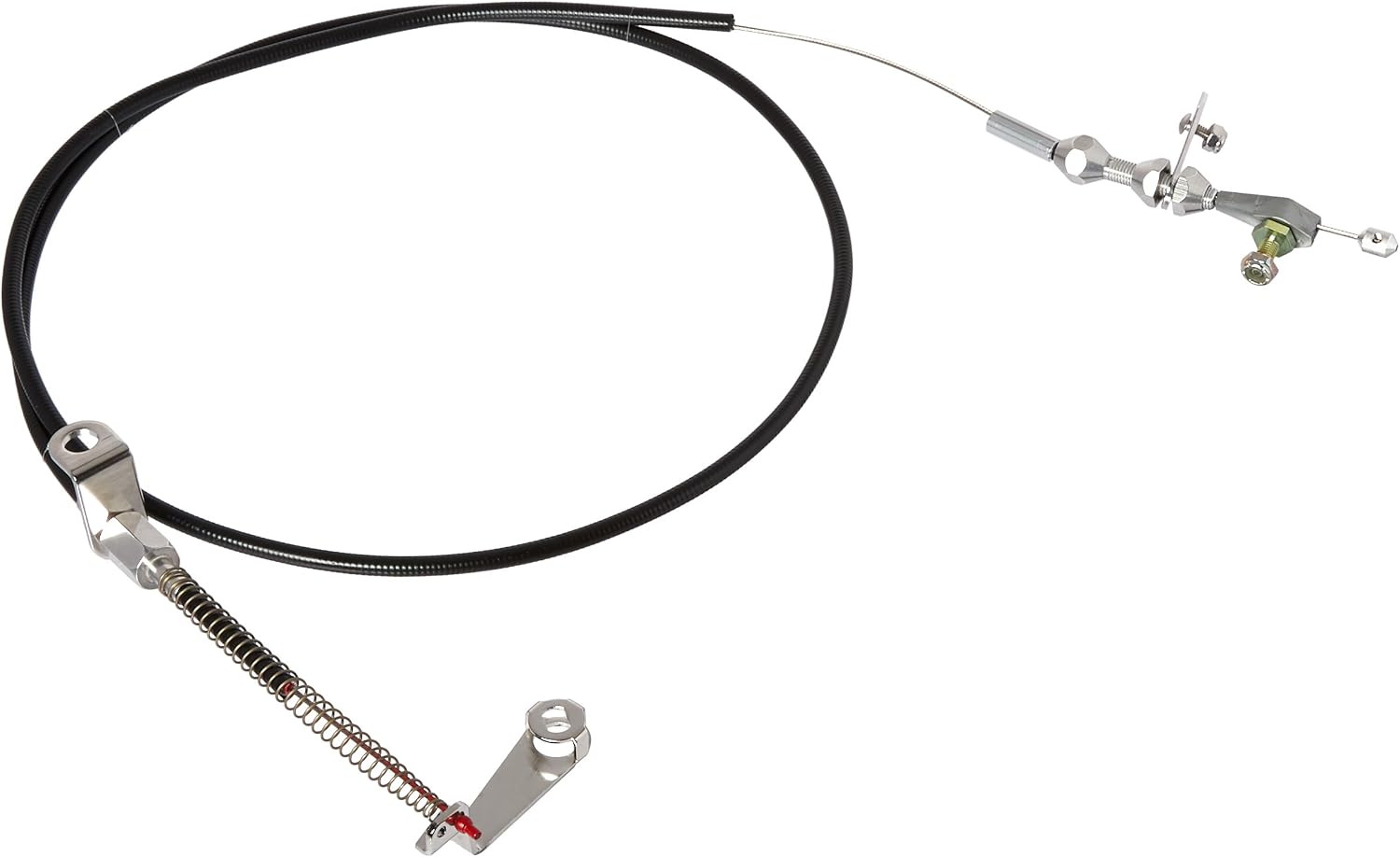
This is not a parts upgrade, but it matters more than any part in the unit. The AOD has no computer. Line pressure comes from the TV cable, and low TV pressure means low line pressure, which means slipping bands and clutches under a trailer. Baumann warns that an improperly set TV system will produce "one deep fried AOD."
Ford's gauge procedure from the 1993 Mustang manual:
- Fluid at 100-150°F. Parking brake on, selector in Neutral. Ford says never check or set TV pressure in Park.
- Connect a 0-60 psi gauge to the TV port. Insert the TV gauge tool (T86L-70332-A) between the crimped slug and the notched rod on the cable. At idle in Neutral, TV pressure should read 30-40 psi.
- Remove the tool. TV pressure must drop to at or near zero, less than 5 psi.
If the truck has had a throttle body, engine or transmission swap, or the TV cable has been replaced, check this before the first trip with a trailer. On a swap with an aftermarket cable, the cable kit has to match the throttle geometry, and Baumann notes the TV valve can hang if a cable pushes it beyond factory travel.
Upgrade 3: the overdrive servo and its pin
The overdrive band is what fails when an AOD tows. Two parts decide how well it holds.
Servo size
Ford built three overdrive servos. Per Baumann, the "B" servo applies about 30 percent more band force than the small "C," and the "A" servo about 50 percent more than the C and 16 percent more than the B. Ford used the A only in 1992-93 trucks and the Thunderbird Super Coupe. If your unit has a C servo and it tows, a larger servo is a sensible upgrade. Pull the cover and identify what is there before ordering.
For more holding power, Sonnax's Super Hold servo kit (76890-17KP) has the largest apply area of any AOD servo. Its apply force is close to the Ford A servo at low line pressure and climbs well past it as pressure rises. It includes optional cushion springs to take out harshness and help with the 3-4 shift timing concerns a bigger servo can create.
Servo pin bore leak
This is the hidden killer. Sonnax explains that excessive clearance between the servo pin and the case bore leaks release oil. That lowers forward clutch pressure and can let the overdrive band drag in 1st, 2nd and 3rd gears. The symptoms Sonnax lists are 3-4 and 4-3 shift concerns, overdrive band failure and forward clutch failure. Their pin kit (76833) replaces the OE pin with one carrying an O-ring that seals against the case bore. On any AOD that is going to tow, it goes in during the rebuild.
Upgrade 4: the rebuild items that matter for towing
If the unit is out, these are the items we prioritize for a tow build:
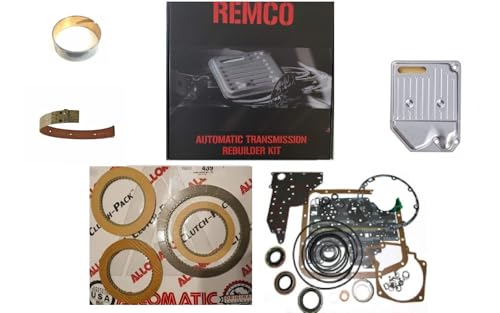
- Fresh overdrive band, and the wide band if the drum allows. Most AODs use the narrow band. A 2-inch band requires the matching wide drum, so measure the drum's band surface before you order.
- Control pressure test before and after. Ford's test uses a 300 psi gauge on the line tap and a 0-100 psi gauge on the TV tap, read at idle and at WOT stall. It also includes a direct clutch check. A difference of 15 psi or more between direct clutch pressure and line pressure (read at the forward clutch tap) will prevent a normal 3-4 shift. A leaking direct circuit makes 3rd and 4th slip under load, and those are the gears you tow in.
- Converter. Ford's own overheating list for the AOD includes a seized converter one-way roller clutch. A stator that will not freewheel makes heat at cruise, so if the old unit ran hot, replace or rebuild the converter along with the transmission. Do not reuse it.
- Clean valve body. Ford's overheating diagnosis also lists a dirty or sticking valve body and improper band or clutch application, both checked with the control pressure test.
Driving habits that keep an AOD alive under a trailer
- Lock out overdrive (selector in D) on grades, in headwinds, and any time it hunts between 3rd and 4th.
- Watch the temperature gauge. If converter-out temperature heads past about 225°F, slow down, drop to D, or pull over and idle in Neutral to let the coolers work.
- Check the fluid correctly. Ford says that after extended high-speed driving, city traffic, hot weather or trailer towing, you must let the fluid cool about 30 minutes before a level reading is accurate. Use the fluid Ford specifies. Ford's manual warns that the wrong fluid can cause malfunction or failure.
- Look at and smell the fluid. Ford says it should be dark reddish, not brown or black, and that the odor can point to overheating or clutch or band failure.
- Stay inside the weight ratings. Keep tongue weight at 10-15 percent of trailer weight for trailers over 2,000 lb, as Ford's guide specifies, and stay under the GCWR for your vehicle.
For fluid service costs and intervals, see our AOD fluid change cost guide. If it is already slipping with a load behind it, start with AOD slipping under load.
Shop the part for this fix: 2-inch wide overdrive band at CoreTransmissionParts
The wide overdrive band is the classic durability upgrade for an AOD-family unit that tows. It only fits with the matching wide drum, so measure your drum before you order. The full AOD-family line is in the collection.
View the 2-inch overdrive bandNeed parts for this job?
Our AOD parts page has master rebuild kits with clutches and band, complete 1980-93 valve bodies and TV cable kits, and our cooler lineup covers add-on and stacked-plate coolers for the in-series install above, all on our own checkout.
FAQ
Should I tow with an AOD in overdrive?
Only when it is not hunting. Ford's 1993 towing guide says towing, especially in hills and with heavier trailers, can cause excessive shifting between overdrive and the next lower gear, and recommends locking out overdrive in that case. On an AOD, move the selector to D on grades and in headwinds, and use overdrive on flat highway for fuel economy.
Does an AOD need an auxiliary transmission cooler for towing?
Yes, for any real towing. Ford required the Heavy-Duty Trailer Towing Package, which included an auxiliary transmission oil cooler, on the Crown Victoria for trailers over 2,000 lb, and recommended an aftermarket auxiliary cooler for long-distance, high-speed towing with Crown Victoria, Thunderbird and Mustang automatics. Plumb it in series after the radiator cooler on the return line.
How hot can AOD transmission fluid get before damage starts?
TCI puts the ideal ATF range at 175-225 degrees F. Around 240 degrees F additives start to cook and varnish forms, around 260 degrees F seals begin to harden, and around 295 degrees F clutches begin to slip. TCI says a typical transmission will die within about 2,000 miles at 300 degrees F or more.
What should AOD TV pressure be?
Per Ford's 1993 Mustang manual, with the fluid at 100-150 degrees F, the selector in Neutral and the TV gauge tool inserted in the cable, TV pressure at idle should be 30-40 psi. With the tool removed it must drop to less than 5 psi. Never check or set it in Park.
Which overdrive servo is best for towing with an AOD?
Bigger is better for holding. Baumann rates the Ford B servo at about 30 percent more band force than the C, and the A servo at about 50 percent more than the C. Sonnax's Super Hold kit 76890-17KP has the largest apply area of any AOD servo. Whatever servo you run, also install an O-ring servo pin such as Sonnax 76833 to stop the pin bore leak that starves the forward clutch and drags the band.
Related guides
- AOD Overheating: Causes and Prevention
- AOD Slipping Under Load: Root Causes and Fixes
- AOD Won't Shift Into Overdrive
- AOD Common Problems and Fixes
- AOD Fluid Change Cost
- AOD Identification Guide
Sources
- Ford Motor Company, 1993 RV and Trailer Towing Guide (RVS 93-300). Backs the overdrive lockout recommendation for towing, the Crown Victoria Heavy-Duty Trailer Towing Package with auxiliary transmission oil cooler, the aftermarket cooler recommendation for Crown Victoria, Thunderbird and Mustang automatics, the F-Series cooling requirements, the 20 sq. ft. Mustang frontal-area limit, the 500-mile break-in and the 10-15 percent tongue weight rule. xr793.com (scan of Ford RVS 93-300)
- Ford Motor Company, 1993 Mustang Workshop Manual, Section 07-01B (AOD), Diagnosis and Testing: symptom chart, fluid level and condition checks. Backs the AOD overheating causes (fluid level, pressure control, cooler restriction, seized converter one-way clutch, sticking valve body), the 150-170 degrees F check temperature, the 30-minute cool-down after towing, and dark reddish fluid color. SPB71B03, SPB71B04, SPB71B05
- Ford 1993 Mustang Workshop Manual, Section 07-01B, leak diagnosis, control pressure test and cooler flow check. Backs the 23 lb-ft cooler line fitting torque (18-23 lb-ft on a new fitting), the 50-75 psi radiator cooler air test, the 300 psi / 100 psi gauge control pressure test with the 15 psi direct clutch limit, and the 1,000 rpm Neutral cooler flow check including auxiliary cooler hose kinks. SPB71B06, SPB71B11, SPB71B13
- Ford 1993 Mustang Workshop Manual, Section 07-01B, Adjustments: TV control pressure linkage check. Backs the 0-60 psi gauge and T86L-70332-A tool procedure, 100-150 degrees F fluid, Neutral not Park, 30-40 psi with the tool in place and less than 5 psi with it removed. SPB71B54
- TCI Automotive, Transmission Life Expectancy. Backs the 175-225 degrees F ideal ATF range and the 240, 260, 295 and 315 degrees F damage thresholds, plus the 2,000-mile failure figure at 300 degrees F. tciauto.com
- Sonnax, Super Hold Servo Kit 76890-17KP and Overdrive Servo Pin Kit 76833 (Ford AOD). Backs the largest-apply-area servo with progressive apply force and cushion springs for 3-4 timing, and the servo pin to case bore release-oil leak that causes overdrive band drag and forward clutch failure. sonnax.com (76890-17KP) and sonnax.com (76833)
- Baumann Electronic Controls, Performance Guide: AOD Upgrades. Backs the cooler install as a no-teardown durability upgrade, the TV system warning, and the A, B and C overdrive servo force comparisons and applications. becontrols.com/aodsupgr.shtml
- Hayden Automotive, Transmission Oil Cooler Kit Installation Procedure (8P103). Backs the in-series recommendation, the stock cooler heating engine coolant, the return-line identification method, mounting and fan clearance, and 11/32 in. high-temperature hose. haydenauto.com (8P103)