An AOD that will not go into fourth is one of the most common complaints on the old Ford automatic, and it has a short list of causes. The AOD is fully hydraulic. There are no shift solenoids, no computer commanding the 3-4 shift and no trouble codes to read. The shift happens when governor pressure, which rises with road speed, overcomes throttle valve (TV) pressure and spring force on the 3-4 shift valve. Once the valve moves, oil is sent to the overdrive servo, which applies the overdrive band. Anything that breaks that chain (the selector, the TV system, the governor, the valve, the servo or the band) leaves you stuck in third.
The symptom tells you which half of the chain to look at. A unit that never tries to shift has a control problem. A unit that shifts and then neutrals out has an apply problem. Specs and references are listed under Sources.
First question: does it try to shift or not?
Road test it warm, in the Overdrive position, on a flat road, with a light throttle. Hold a steady cruise speed and watch the tach. You will see one of three things:
- It never shifts. RPM stays at the third-gear number no matter how long you cruise. There is no flare and no neutral. This points at the selector, the TV system, the governor or a stuck 3-4 shift valve.
- It shifts, then the engine races. RPM drops for a moment, then climbs with no increase in speed, as if it went into neutral. Let off and it may drop back into third. This points at the overdrive band or the servo that applies it.
- It shifts very late, only at light throttle, or only sometimes. This is usually TV pressure set high or oil leaking out of the governor circuit.
BE Controls, a builder that has sold AOD valve bodies for decades, draws the same line in its troubleshooting guide: a stuck 3-4 shift valve means the unit will not shift into overdrive but will not neutral out, while a worn overdrive band means it shifts, neutrals out and revs freely without accelerating. A stuck servo or a servo with badly damaged seals feels exactly like a worn band.
One more split helps. In the AOD, the direct clutch is applied in both third and fourth. If third also slips or neutrals, the problem is not the overdrive circuit at all. That is the direct clutch or the direct shaft, and it is covered in our AOD common problems guide.
Check 1: the selector is actually in Overdrive
The AOD selector has two drive positions. Ford's 1993 Mustang owner guide describes Overdrive (the circled D) as the normal driving position, where the transmission upshifts through first, second, third and fourth. The plain D position is Overdrive Lock Out, which works the same way except there will be no shift into overdrive. The guide suggests it for hills and extra engine braking.
So an AOD in D is supposed to stay out of fourth. If the shift linkage is worn or out of adjustment, the manual valve in the valve body can sit in the D detent even though the indicator reads Overdrive. Worn column-shift bushings are a common cause. Make sure the indicator lines up with the detent the manual valve is actually in, and adjust the linkage at the transmission lever if it does not.
Check 2: TV linkage and TV pressure
The TV system tells the AOD how hard you are pressing the throttle. More throttle means more TV pressure, which does two jobs: it raises line pressure and it pushes back against governor pressure on the shift valves, so shifts come later. That is why Ford's procedure sets TV with a pressure gauge rather than by feel (see the TCI reprint of the Ford spec in Sources). It also explains why TV problems burn parts: Sonnax lists uncontrollable shift timing, low line rise, overheated clutches, an overheated band and TV pressure imbalance as the symptoms of a worn AOD throttle valve plug sleeve, which leaks TV feed oil to exhaust (Sonnax 76989K). If the TV bore fails a vacuum test, the gauge readings will not hold steady no matter how you set the cable.
For a no-overdrive complaint, the problem is TV pressure that is too high. BE Controls notes that if the TV cable is not connected, the transmission defaults to full TV pressure. At full TV, the governor has to beat maximum spring and TV force to move the 3-4 valve, so the shift comes very late or not at all. The same thing happens with a TV rod bent or adjusted long, a cable stretched or clipped wrong after an engine swap, or a TV plug stuck in the high position in the valve body.
Reading TV pressure with a gauge
Do not adjust an AOD TV by feel. Put a gauge on it. Ford's TV adjustment procedure, reproduced in TCI's AOD instructions, goes like this:
- Tee a 100 psi gauge into the TV port on the transmission case, with enough hose to read it from the driver's seat.
- Warm the engine to operating temperature, with transmission fluid around 100-150 F, curb idle set to spec and the throttle off fast idle. Parking brake on, selector in Neutral, A/C off.
- Rod linkage (carbureted units): insert gauge block D84P-70332-A, or a homemade block 0.390-0.404 in. thick, between the throttle lever and the adjusting screw on the TV linkage lever. TV pressure should read 28-38 psi. Set it as close to 33 psi as you can. Each turn of the screw in raises pressure about 1.5 psi.
- Cable linkage (EFI units): insert gauge tool T86L-70332-A between the crimped slug on the cable and the plastic fitting on the throttle lever. TV pressure should read 30-40 psi, with 33 psi as the target. Set it with the white toggle lever on the cable adjuster behind the throttle body bracket.
- Pull the gauge block or tool out and let the linkage return to idle. TV pressure must now be less than 5 psi. If it is not, the linkage is holding the TV plug in, and the procedure says to back off the adjustment and recheck until both readings are in spec.
That last reading is the one that finds most no-overdrive cars. If TV pressure at idle, with the block out, reads well above 5 psi, the transmission thinks you are on the throttle all the time. It will shift late, feel firm, and often never make the 3-4. Readings that stay high no matter how you adjust the linkage point at the TV plug and sleeve in the valve body.
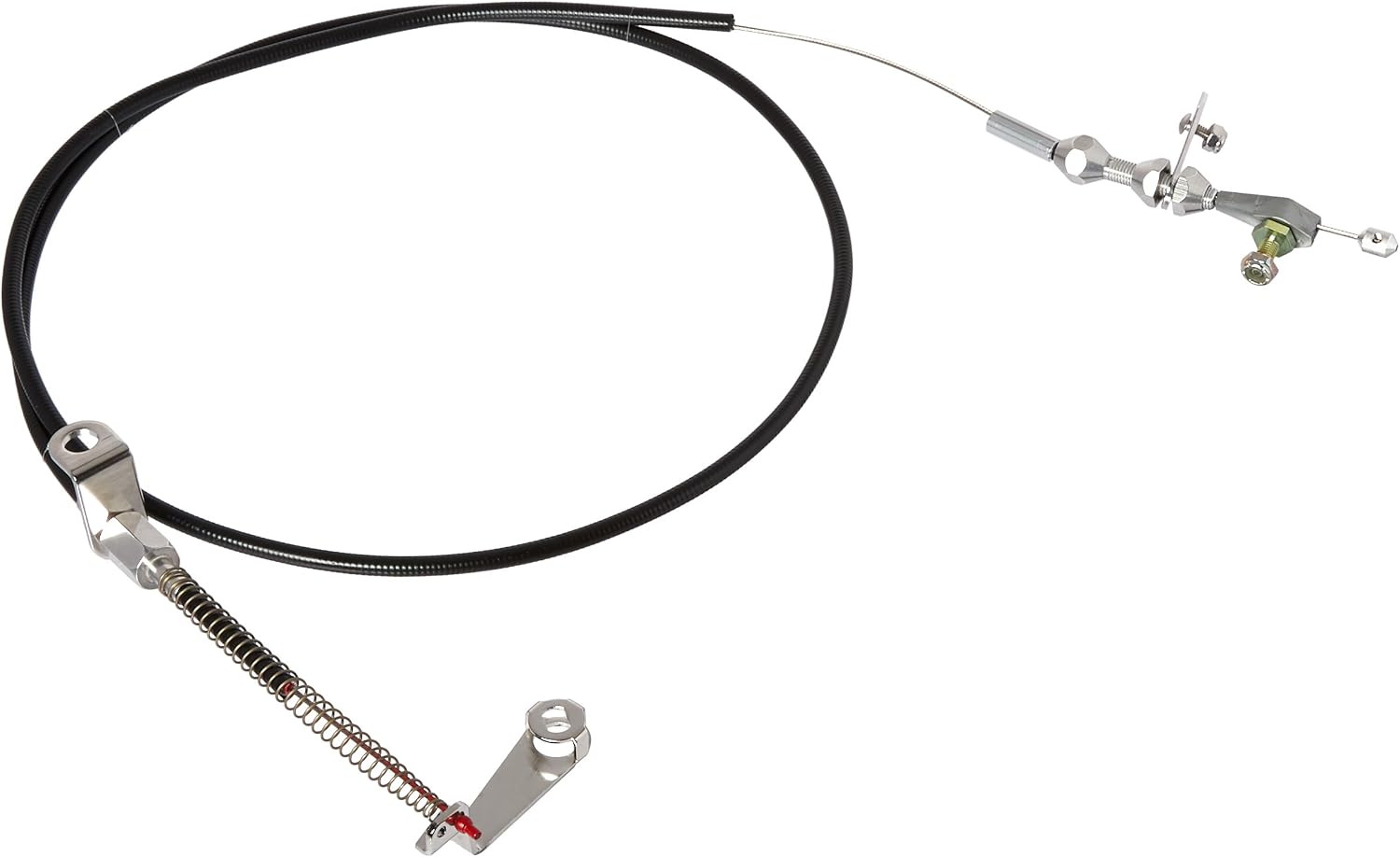
Engine swaps are where this goes wrong most, since rod and cable linkages are not interchangeable. A dedicated AOD cable kit like the Lokar KD-2AODU above still has to be set with a gauge.
Check 3: the governor
Governor pressure is the other half of the shift equation. It rises with output shaft speed, and it is what finally moves the 3-4 valve against TV pressure. Low governor pressure makes every shift late, and the 3-4 is the one that suffers first because it needs the most governor pressure to happen.
BE Controls points out that a sticking governor will cause a delayed or no upshift, depending on how bad the sticking is. The AOD governor rides on the output shaft, so getting to it means pulling the extension housing on a 2WD unit. When you have it out, check that the valves move freely in their bores, the weights are not binding, and the screen is clean. Dirt and varnish from old fluid are the usual cause.
Governor oil also leaks out in the valve body. Sonnax says AODs often have shift timing complaints because worn valve end plugs let governor and accumulator circuit oil escape, and that as these end plugs wear, circuit oil is lost and shift timing suffers. Its governor circuit end plug kits replace the end plugs for the 1-2 shift, 2-3 shift, 3-4 shift valve and sleeve, overdrive servo regulator and several other valves with O-ringed aluminum plugs. The two kits are split by year: 76999-04K for mid-1983 and earlier AODs, and 76999-05K for mid-1983 and later. If upshifts are late across the board and the TV readings are good, this is a strong suspect.
Check 4: a stuck 3-4 shift valve
If the selector is right, TV reads 33 psi on the block and under 5 psi at idle, and the governor is clean, the 3-4 shift valve itself is the next stop. Varnish, debris from a failed band or clutch, or a worn bore can hold it in the third-gear position. The symptom is the clean one BE Controls describes: no overdrive, no neutral, no flare. It just stays in third.
Pull the valve body and check that the 3-4 valve drops freely in a clean, dry bore. If the body is full of band debris or several bores are worn, a replacement valve body is faster than chasing every valve.
Check 5: the overdrive band and servo
This is the apply side, and it is behind most AODs that shift into fourth and then neutral out. The overdrive band holds in fourth, and the overdrive servo applies it. Sonnax lists the failures in this circuit clearly. Its overdrive servo pin kit, 76833, targets excessive clearance between the servo pin and the case bore, and leakage of release oil. Listed symptoms include 3-4 and 4-3 shift concerns, overdrive band failure and forward clutch failure, and overdrive band drag in first, second and third.
That last one is worth understanding. When the servo pin bore wears, oil leaks where it should not. The band can drag in the lower gears, which heats it and wears it before it ever gets used in fourth. By the time the driver notices no overdrive, the band is often burned. Sonnax's replacement pin adds an O-ring to seal against the case bore.
On a unit that has been through it, the fix is a new overdrive band, a servo that seals, and a repaired servo bore. For hard use, Sonnax's Super Hold servo kit, 76890-17KP, has the largest apply area of any AOD servo, with apply force that climbs as line pressure rises. Sonnax includes optional cushion springs with it to minimize 3-4 shift timing concerns that can come with a larger servo. A bigger servo is a builder's upgrade, not a substitute for fixing TV pressure. Low TV pressure means low line pressure, and that is how bands get burned in the first place.
What you will find in the pan
A burned overdrive band leaves fine dark friction material in the pan and a burnt smell in the fluid. A clean pan points back to the control side (Checks 1-4).
The order that saves time
| Symptom | Most likely cause | Check |
|---|---|---|
| Never shifts to 4th, no flare | Selector in D, TV too high, governor, stuck 3-4 valve | Linkage detents, TV gauge, governor, valve body |
| Shifts to 4th, then engine races | Worn overdrive band or leaking servo | Pan contents, servo, band |
| 3-4 very late, only at light throttle | TV pressure high, governor oil leak | TV at idle under 5 psi, end plugs |
| 3rd and 4th both slip | Direct clutch or direct shaft | Not an overdrive circuit problem |
| No 4th after an engine swap | Wrong or unadjusted TV linkage | Correct cable or rod, set with a gauge |
Work it in this order: fluid level and condition, selector detents, TV pressure with a gauge, a road test to split no-shift from neutral-out, then the governor, then the valve body, then the servo and band. The first three cost nothing but time and a gauge. Most AODs that come in with no overdrive and a clean pan get fixed at Check 2.
The SAE paper that introduced the AOD in 1980 describes fourth gear as a direct mechanical path that bypasses the torque converter. It is the gear that makes a 5.0 Mustang or a Crown Victoria livable on the highway.
Shop the part for this fix: AOD-family parts at CoreTransmissionParts
Sonnax valve body kits, servo parts and hard parts for the AOD family (AOD, AODE, 4R70W). Many parts there are AODE/4R70W-only, so check year and fitment before you order for an AOD.
Browse AOD-family parts at CoreTransmissionPartsNeed parts for this job?
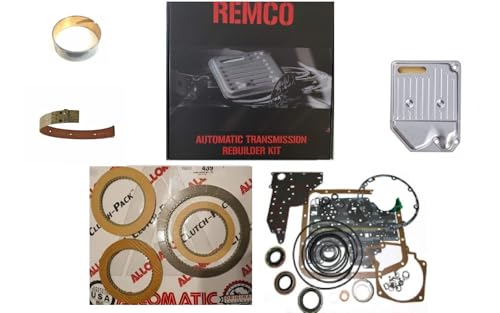
Our AOD parts page has TV cable kits, 1980-93 valve bodies and master rebuild kits with clutches and the overdrive band, all on our own checkout. Set TV pressure first. If the gauge reads right and the pan is full of band material, the rebuild kit is the fix.
FAQ
Why won't my AOD shift into overdrive?
The most common causes are the selector sitting in D (Overdrive Lock Out) instead of Overdrive, TV pressure set too high or a disconnected TV cable, a sticking governor, a stuck 3-4 shift valve, or a worn overdrive band or leaking servo. If it never tries to shift, look at the controls. If it shifts and then revs up like neutral, look at the band and servo.
Can a TV cable cause no overdrive in an AOD?
Yes. A disconnected or misadjusted TV cable sends the transmission to full TV pressure, which delays upshifts so much the 3-4 may never happen. With the gauge tool in, TV pressure should be 30-40 psi (33 target), and with it out at idle it must be under 5 psi.
What does it mean when my AOD shifts into 4th and the engine revs up?
That is the overdrive band slipping. Either the band is worn or burned, or the servo that applies it is stuck or leaking. Pull the pan: dark friction material and a burnt smell usually confirm a burned band.
Does the AOD have a shift solenoid?
No. The AOD is fully hydraulic. Shifts are controlled by governor pressure, TV pressure and the shift valves, with no solenoids and no trouble codes. The electronically controlled AODE and 4R70W that followed it use shift solenoids, so solenoid advice for those units does not apply to an AOD.
Related guides
- AOD Valve Body Symptoms and Testing
- AOD Common Problems and Fixes
- AOD Harsh Shift Causes and Fix
- AOD Slipping Under Load: Causes and Fixes
- AOD Fluid Change Cost
- AOD vs AODE: Differences
- AODE vs 4R70W Differences
Sources
- Ford Motor Company, 1993 Mustang Owner Guide, automatic transmission selector positions. Backs Overdrive as the normal position with upshifts through fourth, and D as Overdrive Lock Out with no shift into overdrive. https://www.fordservicecontent.dealerconnection.com/pubs/content/~WSPB/~MUS~LEN/20/SPB71B01.HTM
- TCI Automotive, "Ford AOD Throttle Valve Adjustment" (Ford procedure). Backs the 100 psi gauge on the TV port, 100-150 F fluid temperature, gauge block D84P-70332-A or 0.390-0.404 in., 28-38 psi rod spec with 33 psi target and 1.5 psi per turn, gauge tool T86L-70332-A and 30-40 psi cable spec, and the under 5 psi idle reading. https://static.summitracing.com/global/images/instructions/tci-431000.pdf
- Sonnax, Overdrive Servo Pin Kit 76833. Backs servo pin to case bore clearance and release oil leakage causing 3-4 and 4-3 concerns, overdrive band and forward clutch failure, and band drag in first through third. https://www.sonnax.com/parts/1663-overdrive-servo-pin-kit
- Sonnax, Governor Circuit End Plug Kit 76999-05K. Backs worn valve end plugs leaking governor and accumulator circuit oil and causing erratic shift timing, the plug list including the 3-4 shift valve and overdrive servo regulator, and the mid-1983 year split with 76999-04K. https://www.sonnax.com/parts/2417-governor-circuit-end-plug-kit
- Sonnax, Super Hold Servo Kit 76890-17KP. Backs the largest AOD servo apply area, progressive apply force, and the optional cushion springs for 3-4 shift timing. https://www.sonnax.com/parts/2383-super-hold-servo-kit
- SAE Technical Paper 800004, "Ford Motor Company Automatic Overdrive Transmission." Backs the 1980 introduction and fourth gear as a direct mechanical path that bypasses the torque converter. https://www.sae.org/publications/technical-papers/content/800004/
- Sonnax, Throttle Valve Plug Kit 76989K (Ford AOD). Backs the throttle valve plug wearing its sleeve and leaking TV feed oil to exhaust, the symptom list (uncontrollable shift timing, low line rise, overheated clutch, overheated band, TV pressure imbalance), and the vacuum-test criterion for replacement. https://www.sonnax.com/parts/2410-throttle-valve-plug-kit
- BE Controls, "Troubleshooting the AOD Transmission" (builder reference, not counted as a primary authority). Backs the stuck 3-4 valve vs worn band symptom split, the stuck or leaking servo symptom, full TV pressure with the cable disconnected, and sticking governor causing late or no upshifts. https://www.becontrols.com/ourfaqs/aodtroubleshoot_1.htm