A harsh-shifting AOD is almost always telling you something about pressure. The AOD is a fully hydraulic four-speed. There is no computer softening the shifts, no pressure control solenoid and no trouble codes. Shift feel comes down to how much pressure is applying each clutch and band, and how fast that oil gets there. On this unit, most of that pressure is set by one mechanical input: the throttle valve (TV) linkage from the throttle body or carburetor to the transmission.
That is why the first thing to check on a harsh AOD is not inside the case. It is the TV linkage and a pressure gauge. Below is the diagnosis in the order that finds the problem fastest, with the Ford TV pressure specs and the valve body and accumulator parts that cause harsh shifts when the linkage checks out. Specs and references are listed under Sources.

Why shift feel on an AOD is a pressure problem
Dennis Madden laid out the rules of shift feel in ATRA's GEARS magazine, and they apply directly to the AOD. The higher the line pressure, the firmer the shift. The faster the oil moves to the apply piston, the firmer the shift. The slower an accumulator strokes, the firmer the shift. Cushion springs and wave plates, the steel plate surface, the friction material and the ATF type round out the list.
On an AOD, TV pressure sits on top of that list. TV pressure rises with throttle opening, and it does two jobs. It boosts line pressure so the clutches and bands hold under load, and it pushes against governor pressure on the shift valves so upshifts come later when you are on the throttle. If the transmission thinks you are at heavy throttle when you are not, you get both effects at once: line pressure that is too high for the load, and shifts that come late at higher RPM. That combination is the classic harsh AOD. It bangs into gear, it bangs through the upshifts, and it usually shifts later than it should.
The opposite problem, TV pressure that is too low, feels soft instead of harsh. Soft, slipping shifts are the ones that burn direct clutches and overdrive bands, so while you are chasing harshness, do not overcorrect into the other ditch. That failure is covered in our AOD slipping under load guide.
Step 1: sort the symptom
Road test it warm and note exactly when the harshness happens. The pattern points to the cause:
- Harsh engagement into Drive and Reverse, harsh upshifts, and late shifts. TV pressure is high. Linkage adjustment, a stuck TV valve, or an idle speed that is too high.
- Harsh and late upshifts that change or wander from day to day. Worn TV plug and sleeve in the valve body, which Sonnax describes as uncontrollable shift timing and TV pressure imbalance.
- Only one shift is harsh (for example, the 2-3 or the 3-4), the others are fine. That shift's accumulator or apply circuit, or a shift kit or servo change made during a previous rebuild.
- Harsh only right after a rebuild or a swap. Linkage not set, TV lever not transferred correctly, a missing check ball, or a cushion spring left out.
- Harsh only after a fluid service. Wrong fluid or an overfill.
Step 2: check idle speed and the TV linkage first
The TV linkage is referenced to the throttle at idle. Ford's TV adjustment procedure, reproduced in TCI's AOD instruction sheet, starts by checking curb idle speed and setting it to specification, with the anti-diesel throttle solenoid positioner not energized. If the idle is high, the throttle lever is already partly open, the TV linkage is already pulling on the TV valve, and the transmission sees throttle input at a stop. It will slam into Drive and Reverse, and no amount of linkage adjusting will fix it until the idle is right. Check for a stuck idle speed control, a vacuum leak, or a throttle stop someone turned in.
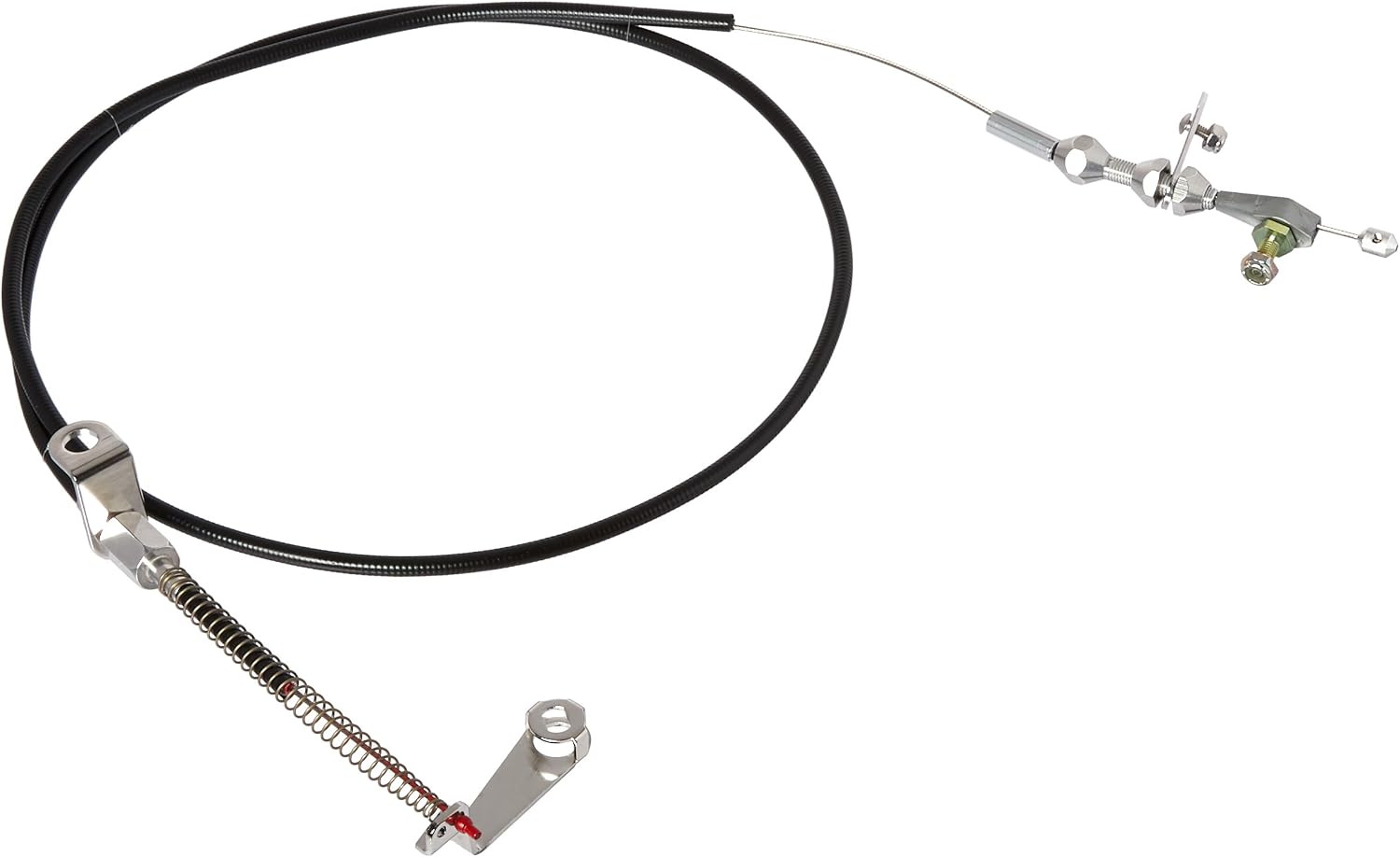
Then look at the linkage itself. Carbureted AODs use a rod, and EFI AODs use a cable. They are not interchangeable, and engine swaps are where most AOD TV problems start. BE Controls reports a specific failure with aftermarket TV cables: during adjustment, the TV valve gets pushed in farther than the factory cable would allow and sticks in the high-pressure position. Its troubleshooting guide also notes that a used valve body can have a wear ridge from the original range of travel, which is enough to hang the TV valve up. A TV valve stuck high means maximum TV pressure at all times, and every shift and engagement will be harsh and late.
If the car came to you after a swap, also confirm the TV control lever on the transmission is the correct one for the linkage. B&M's AOD installation instructions tell the installer to remove the TV control lever from the old transmission for use on the new one, which is a clue that mismatched levers are a real-world problem.
Step 3: put a gauge on TV pressure
Do not set an AOD TV linkage by feel. Ford's procedure, per the TCI sheet, is precise and it only takes a 100 psi gauge and a gauge block.
| Item | Rod linkage (carbureted) | Cable linkage (EFI) |
|---|---|---|
| Gauge | 100 psi gauge on the TV port | 100 psi gauge on the TV port |
| Conditions | Curb idle to spec, engine at operating temp, trans fluid about 100-150 F, Neutral, parking brake on, A/C off | Engine at operating temp, trans fluid 100-150 F, Neutral, parking brake on |
| Gauge tool | Block D84P-70332-A, or a shop block 0.390-0.404 in. thick | Cable gauge tool T86L-70332-A |
| TV pressure, tool installed | 28-38 psi, set as close to 33 psi as possible | 30-40 psi, set as close to 33 psi as possible |
| Adjustment | Screw at the throttle lever, about 1.5 psi per turn (in raises, out lowers) | White toggle lever and slider behind the throttle body bracket |
| TV pressure, tool removed at idle | Under 5 psi | Under 5 psi |
For a harsh-shift complaint, the reading that matters most is the last one. With the block or tool out and the engine idling in Neutral, TV pressure must drop below 5 psi. If it does not, the linkage is holding the TV valve in, and the transmission thinks you are on the throttle at a stop. On rod linkage, the procedure is to back the adjusting screw out until TV pressure is under 5 psi, then reinstall the block and confirm you are still in the 28-38 psi window. On cable linkage, reset the slider to a lower number, not less than 28 psi, and recheck.
If you cannot get both readings in spec no matter how you adjust the linkage, the problem is inside the valve body. A TV valve that sticks, or a TV plug and sleeve that leak, will not follow the linkage.
Step 4: the TV plug and sleeve in the valve body
The AOD TV plug is hardened steel and runs in an aluminum sleeve. Sonnax explains that the plug wears against the sleeve with repeated operation and creates a gap that lets pressurized oil escape. Its listed complaints for AOD throttle valve plug kit 76989K are uncontrollable shift timing, low line rise, overheated clutch, overheated band and TV pressure imbalance. The O-ring style kit replaces both the plug and the sleeve with a tightly toleranced sleeve sealed by O-rings. A factory-style version without O-rings, 76989-03K, is also listed.
A worn TV plug and sleeve can show up as harshness one day and slipping the next, because TV pressure is no longer tracking the linkage. The gauge will tell you: TV pressure that jumps, drifts, or will not return to under 5 psi at idle with a correct linkage points at the valve body.
While the valve body is apart, check the boost valve. Sonnax's AOD boost valve kit 76990K lists soft slide shifts, delayed Reverse, low line rise and direct clutch failure, caused by wear of the pressure regulator boost sleeve. That is the soft side of the pressure problem, but a valve body with a worn TV plug usually has a worn boost sleeve too. Fixing one without the other leaves you with a transmission that feels harsh at part throttle and soft at full throttle.
Step 5: one harsh shift, not all of them
When TV pressure is in spec and only one shift is harsh, look at the circuit for that shift. Every AOD shift is cushioned by an accumulator or by the way the apply circuit is built. GEARS magazine's rule applies here: the slower the accumulator strokes, the firmer the shift. An accumulator that cannot stroke at all, because it is stuck, bottomed out, installed with the wrong spring, or missing its cushion, stops cushioning the apply and the shift slams in.
- Harsh 2-3. The 2-3 shift applies the direct clutch. Inspect the 2-3 accumulator piston and bore in the case. Sonnax's 76836A 2-3 accumulator piston is a direct OE replacement with bonded rubber seals, and its listed AOD symptoms (2-3 flare, direct clutch failure and 3-4 neutral) show how much this circuit controls the 2-3. A piston that is binding in a scored bore will not stroke smoothly. If the bore is damaged, Sonnax's 2-3 accumulator piston kit 76890-21K uses press-in sleeves and a matched piston to salvage the case without machining.
- Harsh 3-4. The 3-4 applies the overdrive band through the overdrive servo. If a previous builder installed a larger servo, it can make the 3-4 firm. Sonnax's Super Hold servo kit 76890-17KP has the largest apply area of any AOD servo and includes optional cushion springs specifically to minimize 3-4 shift timing concerns. If one of these went in without the cushion springs, that is your harsh 3-4.
- Harsh after a valve body job. Check the separator plate and check ball locations against the correct layout for the year. A check ball left out or placed in the wrong pocket changes how fast oil reaches an apply piston. Per GEARS, faster oil means a firmer shift.
Step 6: shift kits and fluid
A lot of harsh AODs are harsh on purpose. Shift kits and performance valve bodies firm up shifts by raising pressure, enlarging feed orifices and blocking or stiffening accumulators. That is fine in a street car that was built for it. It is not fine in a Town Car or an F-150 that someone bought used. Pull the pan and look for a shift kit tag, drilled separator plate holes or aftermarket springs before you start chasing a defect.
Fluid matters too. GEARS lists ATF type among the factors that change shift feel, and Ford keeps its ATF specs separate for a reason. Motorcraft's MERCON V product sheet says it is for automatic transmissions previously serviced with MERCON, and it should not be used where Type F is recommended. The reverse mistake, Type F in a unit built for MERCON-family fluid, is a common way to get a grabby, harsh shift after a quick-lube fluid change. Overfill causes trouble as well: B&M's AOD instructions warn that overfilling can cause fluid foaming, shifting problems and leakage from the case vent. Check the level hot and running, after cycling the selector through the range.
Diagnosis summary
| Symptom | Most likely cause | What to check |
|---|---|---|
| Harsh engagement into D and R | High idle or TV linkage pulling at idle | Curb idle to spec, TV under 5 psi at idle |
| All shifts harsh and late | TV pressure high, TV valve stuck high | TV gauge: 33 psi with tool, under 5 psi without |
| Harsh one day, soft the next | Worn TV plug and sleeve, worn boost sleeve | TV reading drifts with correct linkage; valve body |
| Only the 2-3 is harsh | 2-3 accumulator piston binding or bore damage | Accumulator piston, seals, bore |
| Only the 3-4 is harsh | Oversized servo without cushion springs | Servo type, cushion springs |
| Harsh after a fluid change | Wrong fluid or overfill | Fluid type, hot level check |
| Harsh after a rebuild or swap | Linkage not set, wrong TV lever, check balls, shift kit | Gauge the TV, check the valve body layout |
Work it in this order: idle speed, fluid level and type, TV linkage with a gauge, then the valve body, then the individual accumulator circuits. The first three cost almost nothing, and most harsh AODs we see are fixed at the gauge. The ones that are not usually need a valve body with a new TV plug and sleeve and boost valve.
One warning from experience. A harsh AOD is uncomfortable, but it is usually not the one that fails. The one that fails is the AOD someone "fixed" by backing the TV off until it felt smooth, without a gauge. Low TV means low line pressure under load, and that is how direct clutches and overdrive bands get burned. That is why Ford's TV procedure, reproduced in TCI's instruction sheet 431000, gives a tight 28-38 psi window with a 33 psi target at the TV port instead of leaving it to feel. Set it to 33 psi and let the numbers decide.
Shop the part for this fix: AOD-family parts at CoreTransmissionParts
Sonnax valve body kits, accumulator and servo parts, and hard parts for the AOD family (AOD, AODE, 4R70W). Many parts there are AODE/4R70W-only, so check year and fitment before you order for a 1980-93 AOD.
Browse AOD-family parts at CoreTransmissionPartsNeed parts for this job?
Our AOD parts page has TV cable kits, 1980-93 valve bodies, Motorcraft MERCON V and master rebuild kits, all on our own checkout. Gauge the TV first. If the linkage is right and the readings still will not come into spec, the valve body is the fix.
FAQ
What causes an AOD to shift hard?
The most common cause is high TV pressure from a misadjusted TV rod or cable, a high idle, or a TV valve stuck in the high-pressure position. High TV raises line pressure and delays upshifts, so every shift comes late and hard. Worn TV plugs and sleeves in the valve body, a binding accumulator, a shift kit or the wrong fluid can also cause harsh shifts.
What should AOD TV pressure be?
With the Ford gauge block or cable gauge tool installed, TV pressure should be 28-38 psi on rod linkage or 30-40 psi on cable linkage, set as close to 33 psi as possible. With the tool removed and the engine idling in Neutral, TV pressure must be under 5 psi. Check it with the transmission fluid at about 100-150 F.
Why does my AOD slam into Drive and Reverse?
Harsh engagement usually means the transmission is seeing throttle input at idle. Check curb idle speed first, then check that TV pressure drops under 5 psi at idle with the gauge tool removed. If the idle and linkage are right and it still slams, look for a stuck TV valve or a worn TV plug and sleeve in the valve body.
Can I fix a harsh AOD by backing off the TV cable?
Only if a pressure gauge shows TV is actually too high. Backing the TV off by feel can drop line pressure below spec, which makes the clutches and bands slip under load. That burns the direct clutch and overdrive band, which is far more expensive than a harsh shift.
Related guides
- AOD Delayed Engagement: Causes and Fix
- AOD Valve Body Symptoms and Testing
- AOD Won't Shift Into Overdrive
- AOD Slipping Under Load: Causes and Fixes
- AOD Common Problems and Fixes
- AOD Fluid Change Cost
- AOD vs AODE: Differences
Sources
- TCI Automotive instruction sheet 431000, "Ford AOD Throttle Valve Adjustment" (Ford procedure). Backs the curb idle check with the throttle solenoid positioner not energized, the 100 psi gauge on the TV port, 100-150 F fluid, gauge block D84P-70332-A or 0.390-0.404 in., 28-38 psi rod spec with a 33 psi target and 1.5 psi per turn, gauge tool T86L-70332-A with the 30-40 psi cable spec, and the under 5 psi reading at idle with the tool removed. https://static.summitracing.com/global/images/instructions/tci-431000.pdf
- ATRA GEARS magazine, Dennis Madden, "The Harsh Realities: Understanding the Systems of Shift-Feel and Shift Quality." Backs the shift-feel rules: higher line pressure, faster oil flow and slower accumulator stroke each make a firmer shift, plus cushion springs, plate surface, friction material and ATF type. https://gearsmagazine.com/magazine/the-harsh-realities-understanding-the-systems-of-shift-feel-and-shift-quality/
- Sonnax, Throttle Valve Plug Kit 76989K (Ford AOD). Backs the steel TV plug wearing its aluminum sleeve, oil loss, and the listed complaints: uncontrollable shift timing, low line rise, overheated clutch, overheated band and TV pressure imbalance. https://www.sonnax.com/parts/2410-throttle-valve-plug-kit
- Sonnax, Boost Valve Kit 76990K (Ford AOD). Backs pressure regulator boost sleeve wear and the complaints of soft slide shifts, delayed Reverse, low line rise and direct clutch failure. https://www.sonnax.com/parts/2413-boost-valve-kit
- Sonnax, 2-3 Accumulator Piston 76836A. Backs the direct OE replacement piston with bonded seals and the AOD symptoms of 2-3 flare, direct clutch failure and 3-4 neutral; the related 76890-21K kit backs press-in sleeve repair of damaged 2-3 accumulator bores. https://www.sonnax.com/parts/2380-2-3-accumulator-piston
- Sonnax, Super Hold Servo Kit 76890-17KP. Backs the largest AOD servo apply area and the optional cushion springs supplied to minimize 3-4 shift timing concerns. https://www.sonnax.com/parts/2383-super-hold-servo-kit
- Motorcraft / Ford Customer Service Division, MERCON V ATF product details (XT-5-QMC). Backs MERCON V for transmissions previously serviced with MERCON, and not using it where Type F is recommended. https://fcsdchemicalsandlubricants.com/products/transmission-fluid/productdetails?id=2
- B&M Racing (Holley), Ford AOD transmission installation instructions. Backs transferring the TV control lever to the new transmission, and the warning that overfilling causes foaming, shifting problems and case vent leakage. https://documents.holley.com/114501_instructions.pdf
- BE Controls, "Troubleshooting the AOD Transmission" (builder reference, not counted as a primary authority). Backs aftermarket TV cable adjustment pushing the TV valve in farther than the factory cable and sticking it in the high-pressure position, and valve body wear ridges hanging up the TV valve. https://www.becontrols.com/ourfaqs/aodtroubleshoot_1.htm