You drop the selector into Drive and nothing happens. The engine idles, you wait, and one, two, sometimes three seconds later the AOD finally clunks into gear. Maybe only in the morning, maybe only in Drive. That pause is the transmission telling you exactly which circuit is losing oil, if you know how to read it.
A healthy AOD in our shop pulls into gear in well under a second once it is warm. Anything longer means the apply piston is taking too long to fill and stroke, and that happens for only a handful of reasons: not enough oil getting to the pump, not enough pressure coming out of it, or pressure leaking away somewhere between the pump and the clutch. Ford's AOD workshop manual lists those reasons in its diagnosis chart, and this guide works through them in test order.

First question: is it Drive, Reverse, or both?
Before touching a wrench, figure out which ranges are late. The AOD uses different friction elements for forward and reverse, so the pattern points straight at a circuit. Ford's 1993 Mustang workshop manual (Section 07-01B) breaks delayed engagement into separate rows in its diagnosis chart for exactly this reason.
| What you see | Circuit it points to | Ford's listed causes |
|---|---|---|
| Delayed Drive, Reverse OK | Forward clutch apply circuit | Fluid level, manual linkage, low main pressure (leakage), stator support seal rings No. 3 and No. 4, burnt forward clutch, forward clutch check ball or piston seals, valve body bolts, dirty valve body, plugged filter, damaged pump |
| Delayed Reverse, Drive OK | Reverse clutch and low-reverse band | Fluid level, manual linkage, low pressure in reverse, stator support seal rings No. 1 and No. 2, burnt reverse clutch, reverse clutch piston seals, valve body bolts, dirty valve body, plugged filter, damaged pump |
| Delayed Reverse and no engine braking in manual 1 | Low-reverse band and servo | Fluid level, burnt low-reverse band, leaking low-reverse servo piston seal, damaged planetary one-way clutch, end play too tight |
| Slow initial engagement, all ranges | Supply side: fluid, pump, pressure | Improper fluid level, linkage, contaminated fluid, improper clutch and band application or low main control pressure |
The practical takeaway: if both Drive and Reverse are slow, start at the supply end (fluid, filter, pump, pressure regulator, valve body). If only one direction is slow, the pump is making pressure fine and you are hunting a leak in that one apply circuit.
How the AOD engages Drive, and where the oil can get lost
In Drive the AOD applies the forward clutch, and in first gear the planetary (low) one-way roller clutch holds the reaction. Ford's component tips in the same manual section put it plainly: a bad forward clutch or planetary one-way clutch shows up as no engagement in the forward ranges, or slip in forward. The reverse clutch shows up as slip or no engagement in R, which can also be caused by the low-reverse band or servo.
Oil for the forward clutch leaves the pump, passes through the manual valve in the valve body, travels through the case and up into the stator support, and crosses into the rotating forward clutch cylinder past two sealing rings (Ford's No. 3 and No. 4 rings). From there it pushes the forward clutch piston, which is sealed by its own inner and outer seals and has a check ball in the cylinder to let oil exhaust when the clutch releases. The AOD case adds one more leak path: the 2-3 accumulator bores in the case, which carry forward and direct clutch oil. Sonnax documents that worn and scored 2-3 accumulator bores bleed off forward clutch oil and cause low line pressure in forward, with a telltale symptom of no forward engagement unless engine rpm is raised.
That last symptom is worth remembering. When the unit will not pick up Drive at idle but grabs if you bump the throttle, the pump is making enough oil at higher rpm to overcome a leak it cannot keep up with at idle. Ford's control pressure section says the same thing from the other direction: pressure loss from a less-than-major leak is more likely to show up at idle than at wide-open throttle, where the pump is delivering full volume.
Step 1: Fluid level and condition (do this first, every time)
Ford lists improper fluid level as the first cause in every delayed-engagement row, and it is the cheapest one to rule out. The manual specifically warns that underfill can cause loss of engagement or slipping, and that it is most evident in cold weather or when the vehicle is parked or driven on a hill. The pickup sits in a shallow pan, and when the fluid sloshes away from it the pump gulps air.
- Check it hot. Ford's procedure: vehicle level, engine idling, foot on the brake, run the selector through every range, back to Park, and read the dipstick. At operating temperature (150-170°F, dipstick hot to the touch) the level belongs in the cross-hatch area.
- Do not overfill either. Ford notes that fluid that is too high gets aerated and foamy, which causes low control pressure. Foam compresses, and a piston fed foam strokes slowly. Overfill can give you the same delay as underfill.
- Look at it. Ford says the fluid should be dark reddish, not brown or black. Wipe the dipstick on a white tissue and look for specks. Burnt odor and friction material in the fluid mean a clutch has already been slipping, and the delay is probably mechanical damage rather than something a top-off will cure.
- Use the right fluid. The 1993 manual calls for MERCON-spec fluid (Ford part E6AZ-19582-B at the time) and warns that other fluids can cause malfunction. Today that means a MERCON V fluid such as Motorcraft XT-5-QMC. Never Type F in an AOD.
The morning-only delay: converter drainback
If the AOD engages slowly only after sitting overnight and is fine the rest of the day, think drainback. With the engine off, fluid can drain out of the torque converter back into the pan. On the first start the pump has to refill the converter before the circuits see full pressure, and Drive waits. Ford's manual gives the clue: if the fluid level reads high before the engine is started but is correct during a normal hot check, check the drainback valve in the stator support and check the pump bushing, and service or replace the pump if required. A worn pump bushing lets the converter hub wobble and leak, which also costs pump volume. Sonnax notes that the OE AOD pump bushing is machined in place and that drop-in replacement bushings are often not thick enough, leaving too much hub-to-bushing clearance. Their finish-in-place bushing 36002-01 is built to restore correct clearance and lists low pump volume among the symptoms it cures.
Step 2: Linkage, idle and the TV cable
Manual shift linkage. Ford calls this a CRITICAL adjustment: the (D) detent in the transmission has to line up exactly with the stop in the column or console. If it does not, Ford warns that hydraulic leakage at the manual valve can cause delayed engagement and slipping. A manual valve sitting half a detent off feeds the forward circuit through a partly covered port and dumps some of it to exhaust. Match the shift lever detents to the transmission detents; if they match, only the indicator is off.
Engine idle and TV cable. These usually cause the opposite complaint. Ford notes that idle speed that is too high causes creep and harsh engagements, and that a TV cable disconnected at the transmission puts TV pressure at maximum, giving extremely delayed, harsh upshifts and a harsh idle engagement. Set idle to spec before judging engagement time. If harshness is your real complaint, our AOD harsh shift guide covers the TV system in detail.
Step 3: Control pressure test
If fluid and linkage check out, put gauges on it. Ford's procedure uses a 0-300 psi (2000 kPa) gauge on the main line pressure tap on the left side of the case just above the control levers, and a 0-100 psi gauge on the TV pressure tap on the right side of the case. Run the engine until hot, set the parking and service brakes firmly, and record line pressure at idle in every range, with the throttle off the fast idle cam. Reverse should read higher than the other ranges. Compare your readings to the Special Specifications figures for your application.
Then read the pattern. Ford's chart translates it directly:
| Reading | Ford's possible causes |
|---|---|
| Low in (D), D and 1 only | Forward clutch leakage, overdrive servo leakage, loose valve body bolts, sticking main oil regulator valve |
| Low in R only | Reverse clutch leakage, low-reverse servo leakage, loose valve body bolts |
| Low at idle in all ranges | Low fluid level, restricted filter, loose valve body bolts, pump leakage, case leakage, valve body leakage, excessively low idle, fluid too hot, sticking main oil regulator valve |
| OK at idle, low at WOT | Internal leakage, pump leakage, restricted inlet screen, TV linkage, sticking TV, TV limit or main regulator valve |
Ford adds a caveat every builder has learned the hard way: clutch and servo leakage may not show up on a pressure test at all. The pump has a lot of volume, and orifices between the pump and the gauge can hold pressure at the tap even with a leak downstream. Normal pressure plus a delayed Drive does not clear the forward clutch circuit. It means the next step is air checks.
Ford's stall test (specified stall rpm is in the same Special Specifications booklet) also checks the holding ability of the forward clutch, reverse clutch, low-reverse band and planetary one-way clutch. Hold the throttle open no longer than five seconds, and run the engine at 1,000 rpm in Neutral for about 15 seconds between ranges to cool it. If rpm climbs past the maximum, lift immediately. Something is slipping.
Step 4: Pan down, valve body out, air checks
With the pan down, look first. Ford's delayed-engagement rows all list valve body bolts loose or too tight, with a spec of 9-11 Nm (80-97 lb-in). Overtightened bolts warp the body against the separator plate and create cross leaks. A plugged filter is also on the list, and the pan contents tell you whether you have clutch material, band material, or aluminum from a pump.
Then air test. Ford's procedure uses test plate T82L-7006-A with a new main control-to-case gasket, plate screws torqued to 80-97 lb-in, and regulated air at 40 psi (276 kPa), going up to 90 psi (620 kPa) if you have trouble hearing the clutches apply. Apply air to each passage on the plate:
- Forward clutch: a dull thud, or piston movement you can feel on the case. A hiss with no thud, or a weak thud, points at the No. 3 and No. 4 stator support rings, the forward piston seals or the check ball.
- Reverse clutch: a dull thud, and you may see the reverse clutch drum move.
- Overdrive and low-reverse servos: the band should visibly tighten and release.
Ford's manual also notes that a no-drive condition can exist even with correct fluid pressure because of an inoperative clutch or band, which is exactly what the air check isolates. If the air test is clean and pressure is low only in the forward ranges, pull the 2-3 accumulator and look at the bores. Scoring there is the case-side leak described above. Sonnax's 2-3 accumulator piston kit 76890-21K uses press-in sleeves and a matched piston to restore forward line pressure and salvage the case without machining, and it fits the AOD as well as the AODE, 4R70W and 4R75W.
What fixes what
| Finding | Fix |
|---|---|
| Low or high fluid, wrong fluid | Correct the level hot with MERCON V, find any leak |
| Morning-only delay, level high before start | Drainback valve and pump bushing service, or pump rebuild |
| Linkage off the (D) detent | Readjust linkage, replace worn linkage bushings |
| Plugged filter, dirty or sticking valve body | Filter and pan service; clean or replace the valve body and find the contamination source |
| Valve body bolts loose or overtight | Retorque to 80-97 lb-in; replace the body if warped |
| Weak forward clutch air check | Teardown: stator support rings, forward piston seals, check ball, frictions and steels |
| Low pressure in forward, accumulator bores scored | 2-3 accumulator sleeve kit |
| Burnt clutch material in the pan | Full rebuild; a burnt forward clutch rarely fails alone |
A note on sealing rings. When you replace the No. 3 and No. 4 rings, inspect the stator support and the ring lands in the forward clutch cylinder. Rings seal against their bores, and a grooved bore will leak with brand-new rings. The same goes for the bushings that keep the input shaft centered: when they wear, the rings stop sealing evenly and apply oil bleeds off.
Shop the part for this fix: Sonnax finish-in-place pump bushing at CoreTransmissionParts
A worn pump bushing costs pump volume and lets the converter drain back overnight, one of Ford's listed causes of a slow first engagement. Sonnax 36002-01 fits the AOD, AODE and 4R70W and is finished in place to restore the correct hub clearance.
View the Sonnax pump bushingNeed parts for this job?
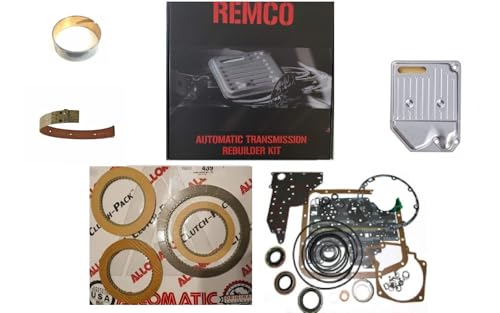
Our AOD parts page has master rebuild kits with clutches, seals and band, complete 1980-93 valve bodies, and line pressure gauge kits for the testing steps above, all on our own checkout.
FAQ
Why does my AOD take a few seconds to go into Drive?
A delay means the forward clutch piston is filling slowly because oil is short or leaking. Ford's diagnosis chart lists low fluid, misadjusted manual linkage, low line pressure, leaking stator support seal rings No. 3 and No. 4, forward clutch piston seal or check ball leaks, loose or overtight valve body bolts, a plugged filter and a damaged pump. Start with a hot fluid level check, then linkage, then a line pressure test.
Why is my AOD slow to engage only in the morning?
That pattern usually means the torque converter drained back into the pan overnight, so the pump has to refill it before the clutch sees full pressure. Ford says that if the fluid reads high before starting but correct on a normal hot check, check the drainback valve in the stator support and the pump bushing, and service the pump if needed.
Can low transmission fluid cause delayed engagement in an AOD?
Yes. Ford's manual warns that underfill can cause loss of engagement or slipping, most noticeable in cold weather or when parked or driving on a hill. Overfill causes trouble too: foamy, aerated fluid lowers control pressure. Set the level hot, at 150-170 degrees F, in the dipstick cross-hatch.
My AOD engages Reverse fine but Drive is delayed. What does that mean?
Because Reverse works, the pump and main pressure are probably fine and the leak is in the forward clutch circuit. Ford points to the No. 3 and No. 4 stator support seal rings, the forward clutch piston seals and check ball, or a burnt forward clutch. Sonnax also traces low forward pressure to worn 2-3 accumulator bores in the case. An air check with the valve body off isolates it.
Will a pressure test always find the leak?
No. Ford notes that clutch and servo leaks may not show up on a control pressure test because the pump has high volume and orifices can hold pressure at the gauge tap. A small leak is more likely to show at idle than at wide-open throttle. If pressure looks normal but engagement is still late, pull the valve body and air check the circuits.
Related guides
- AOD Slipping Under Load: Root Causes and Fixes
- AOD Harsh Shift Causes
- AOD Valve Body Symptoms
- AOD Common Problems and Fixes
- AOD Fluid Change Cost
Sources
- Ford Motor Company, 1993 Mustang Workshop Manual, Section 07-01B (AOD), Diagnosis Charts and component tips. Backs the delayed forward, delayed reverse and slow initial engagement causes, the stator support seal ring numbers, the 9-11 Nm (80-97 lb-in) valve body bolt spec, and the forward clutch, reverse clutch and one-way clutch symptom mapping. SPB71B03, SPB71B15
- Ford 1993 Mustang Workshop Manual, Section 07-01B, fluid level and fluid condition checks. Backs the hot check procedure, 150-170 degrees F operating temperature, underfill causing loss of engagement in cold weather or on hills, overfill aeration causing low control pressure, the MERCON fluid spec, and the drainback valve and pump bushing check. SPB71B04, SPB71B05
- Ford 1993 Mustang Workshop Manual, Section 07-01B, shift linkage, idle and TV cable checks. Backs the (D) detent critical adjustment, manual valve leakage causing delayed engagement, high idle causing harsh engagement, and TV cable disconnect symptoms. SPB71B08, SPB71B07, SPB71B10
- Ford 1993 Mustang Workshop Manual, Section 07-01B, control pressure test, stall test and air pressure checks. Backs the gauge locations, the pressure diagnosis chart, the note that leaks may not show on a pressure test, stall test limits, and the T82L-7006-A test plate with 40-90 psi air. SPB71B11, SPB71B12, SPB71B17
- Sonnax, 2-3 Accumulator Piston Kit 76890-21K. Backs forward clutch oil leakage through worn 2-3 accumulator bores causing no forward unless rpm is increased and low line pressure in forward, and AOD fitment. sonnax.com (76890-21K)
- Sonnax, Pump Bushing 36002-01. Backs the machined-in-place OE AOD pump bushing, undersized drop-in replacements causing excess hub clearance, and low pump volume as a symptom. sonnax.com (36002-01)