The AOD and the C4 meet on the same bench more often than any other pair of Ford automatics. Fox-body Mustangs, Granadas, Cougars and older street cars came with a C4. The AOD showed up in 1980 behind the 5.0L and 5.8L. Most of the questions are the same few: what changed, what the AOD needs that the C4 never did, and whether a C4 car can take an AOD for overdrive.
They are different designs, not an old and new version of one unit. The C4 is a Simpson-type three-speed run by a vacuum modulator. The AOD is a Ravigneaux-type four-speed with a split-torque third gear and a fully mechanical fourth, and its line pressure follows a throttle valve (TV) linkage instead of vacuum. This guide puts the factory numbers side by side: C4 figures from Ford's 1975-76 Car Shop Manual, AOD figures from Ford's 1993 Mustang workshop manual. Sources are listed at the bottom.
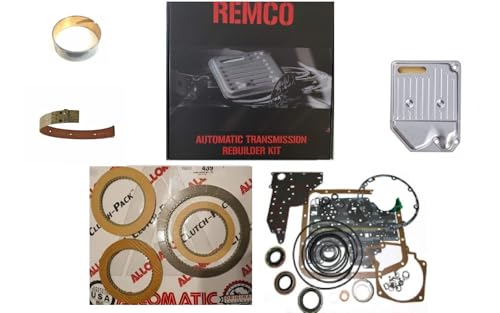
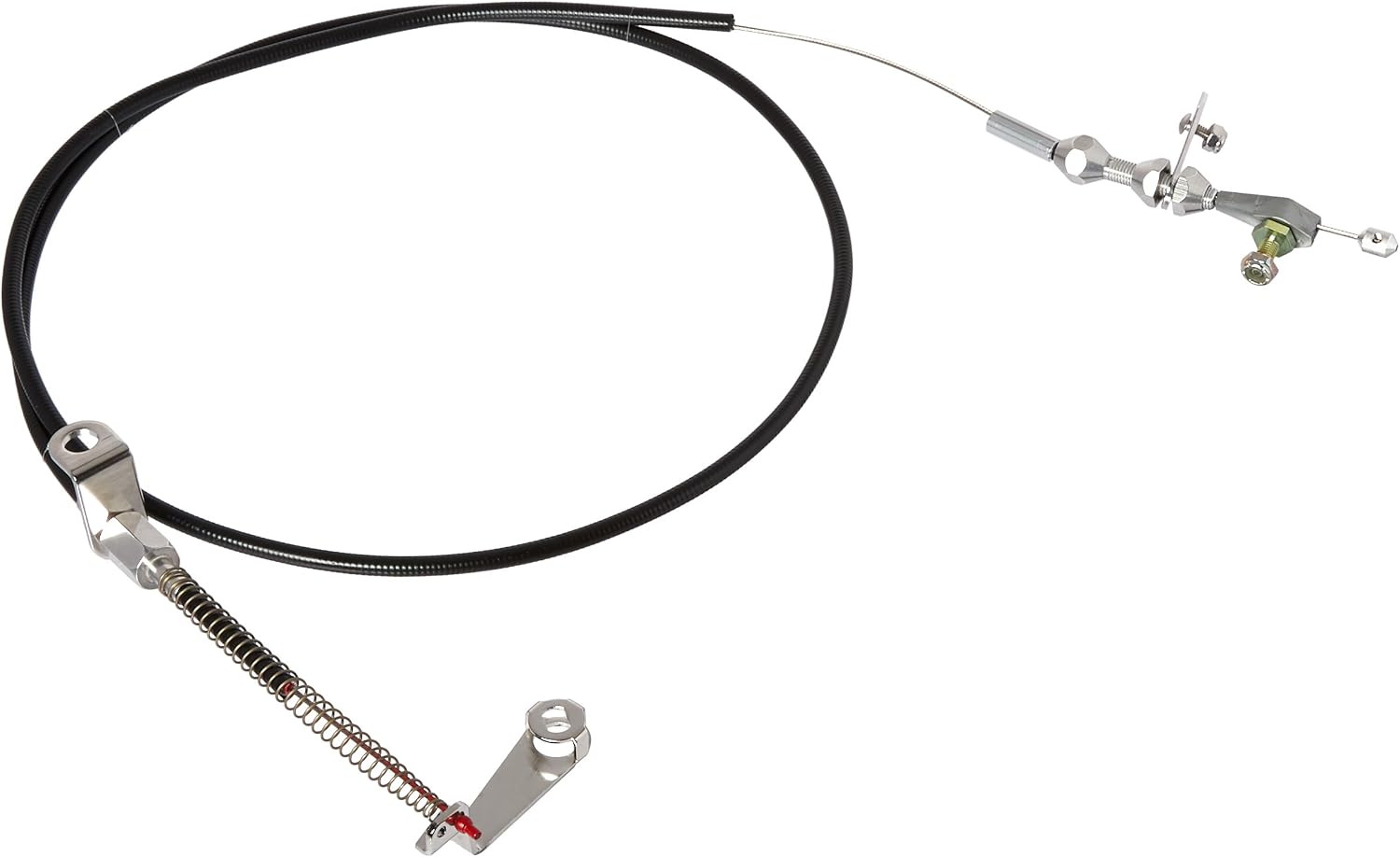
Quick Answer: AOD vs C4
- Speeds: the C4 is a three-speed (2.46 / 1.46 / 1.00, reverse 2.18 per ATRA's ratio chart). The AOD is a four-speed (2.40 / 1.47 / 1.00 / 0.67, reverse 2.00).
- Converter: the C4 drives everything through the converter. In the AOD's third gear, 60 percent of engine torque goes mechanically through a direct drive shaft and 40 percent through the converter. In fourth, all of it bypasses the converter, per Ford's SAE paper 800004.
- Pressure control: the C4 reads engine vacuum through a modulator diaphragm. The AOD reads throttle position through a TV cable or rod, and that one adjustment sets its line pressure.
- Fluid: the C4 takes 7-1/4 to 10-1/4 U.S. quarts depending on the car. The 1993 AOD holds 12.3 quarts of MERCON-type fluid.
- Service adjustments: the C4 has two adjustable bands (intermediate and low-reverse). The AOD has no external band adjustment. Its low/reverse servo travel is set with selective pistons during the rebuild.
How the C4 Works
Ford's 1975-76 manual describes the C4 as "a torque converter, planetary gear train, two multiple disc clutches, a one-way clutch and a hydraulic control system." The two clutches are the forward clutch and the reverse-high clutch. The two bands are the intermediate band, which holds second gear, and the low-reverse band. The one-way clutch carries first gear in Drive, so the 1-2 shift is just the intermediate band applying with no clutch handoff to time.
Shift timing and firmness come from a governor on the output shaft and a vacuum diaphragm (modulator) on the case. Low vacuum under load raises line pressure and pushes shifts later. A leaking diaphragm does the opposite and can pull fluid into the engine. Ford's check is to pull 18 inches of vacuum on the unit with a distributor tester and see that it holds. Dual-area diaphragms are tested through the EGR port, with the manifold port open.
The C4 identification tag sits under the lower front intermediate servo cover bolt. Model codes start with PE (PEE, PEJ, PEB and others). The tag tells you the plate count, the diaphragm and the service parts, so record it before you order anything.
How the AOD Works
The AOD uses a single Ravigneaux gearset. Ford's 1993 apply chart breaks it down like this:
- First (Drive): forward clutch, held by the planetary one-way roller clutch.
- Second: forward clutch plus the intermediate clutch, held by the intermediate one-way roller clutch.
- Third: forward, intermediate and direct clutches.
- Fourth (overdrive): intermediate clutch, direct clutch and the overdrive band. The forward clutch releases.
- Reverse: reverse clutch and low/reverse band.
- Manual low: adds the low/reverse band in first and the overdrive band in second, for engine braking.
What sets the AOD apart is the direct drive shaft. Its front splines into the converter cover damper and its rear drives the direct clutch. That is how third gear gets its 60/40 mechanical split and how fourth gets a mechanical 1:1 path through the gearset to the 0.67 output, with no TCC solenoid and no computer. Ford's own manual warns that a light whine in fourth is normal, because the planetary gearset is working in overdrive.
The trade-off is that the overdrive band and the direct clutch carry the whole load in fourth. Both depend entirely on line pressure, and AOD line pressure depends entirely on the TV setting.
Specs Side by Side
- Gear ratios (ATRA chart): C4 2.46 / 1.46 / 1.00, R 2.18. AOD 2.40 / 1.47 / 1.00 / 0.67, R 2.00.
- Fluid capacity: C4 refill runs from 7-1/4 qt (Pinto, Bobcat, Mustang) to 10-1/4 qt (351 Torino, Montego, Cougar, Ford/Mercury), and a dry unit starts with 5 qt. The AOD is 12.3 U.S. qt (11.6 L), and a pan drop takes about 3 qt.
- Fluid type: Ford's 1993 AOD manual specifies Synthetic MERCON Multi-Purpose ATF, E6AZ-19582-B (ESR-M2C163-A2), "or equivalent," and warns that other fluids can cause malfunction. For a C4, use the fluid stamped on its dipstick.
- End play: C4 0.008-0.042 in., set with selective thrust washers. The AOD's selective washer sits on the stator support, color-coded green through blue (0.050-0.123 in.).
- Converter end play: C4 turbine and stator 0.023 in. max new, 0.050 in. max used. AOD 0.050-0.077 in. new, up to 0.100 in. used.
- Pan bolts: AOD 71-119 lb-in. Valve body to case 80-97 lb-in, and Ford lists loose or overtightened valve body bolts as a cause of low pressure and a missing 3-4 shift.
- Converter to flywheel: AOD 20-34 ft-lb. Transmission to engine 40-50 ft-lb.
Clutch packs
The C4 plate count changes with the model code. Ford's table lists PEA, PEE and PEF forward clutches with 4 steels and 5 frictions, and reverse-high clutches with 4 and 4. PEJ-B runs only 2 and 3 forward. Forward free-pack clearance is 0.025-0.050 in., and the reverse-high selective snap rings run 0.050-0.054 up to 0.092-0.096 in.
The 1993 AOD lists the forward clutch at 5 steels and 5 frictions plus a waved plate next to the piston (0.050-0.089 in. clearance). The reverse clutch is 3 steels and 4 frictions (0.040-0.075 in.), the direct clutch 6 and 6 (0.060-0.092 in.), and the intermediate clutch 3 and 3, measured as a stack height of 1.634-1.646 in.
Band and servo setup
On the C4, bands are adjusted in the car. Fit a new locknut, tighten the adjusting screw to 10 ft-lb, then back the intermediate band off exactly 1-3/4 turns and the low-reverse band 3 full turns. Hold the screw and torque the locknut.
The AOD has no band adjusting screws. Low/reverse servo piston travel must be 0.112-0.237 in., corrected with selective pistons whose rod lengths are 2.936 in. (1 groove), 2.989 in. (2 grooves) and 3.043 in. (3 grooves). The 1993 5.0L HO overdrive servo is the 2.5 in. code B piston with 0.066-0.210 in. stroke. If you skip the travel check on an AOD rebuild, a fresh band can wear out quickly.
TV Adjustment: Where AOD Rebuilds Fail
Ford's manual says the AOD's TV lever "actuates the internal TV control mechanism which regulates the TV control pressure." When the cable is correct, the transmission lever sits at its internal idle stop when the throttle is at idle. If the TV is set low, every shift is soft and late, and the overdrive band and direct clutch slip until they burn. If it is set high, every shift is harsh and delayed.
The factory check for the 1993 5.0L cable:
- Bring fluid to 100-150 F. Set the parking brake and put the lever in NEUTRAL. Ford says not to check or set TV in PARK.
- Tee a 0-60 psi gauge into the TV port. Push gauge tool T86L-70332-A between the crimped slug and the notched rod. TV should read 30-40 psi at idle.
- Remove the tool. TV must drop to near zero, under 5 psi.
- If it is off, move the plastic block on the notched rod. One notch is about 2 psi and 1 mm is about 2.5 psi. Ford's target is 33 psi.
For a full control pressure test, Ford puts a 300 psi gauge on the line tap (case left side, above the levers) and a 0-100 psi gauge on the TV tap (right side). Read idle and WOT in every range. Reverse should read higher than the other ranges. The manual's diagnostic chart matches each low reading to a leak: low in R points to the reverse clutch or low/reverse servo, low in D to the forward clutch or overdrive servo, and OK at idle but low at WOT to pump or internal leakage, a restricted inlet screen or a sticking TV valve.
For a missing or slipping 3-4, run Ford's direct clutch pressure test. Put gauges on the forward clutch tap and the direct clutch tap and drive it. If direct clutch pressure is 15 psi or more below line pressure, a normal 3-4 shift can't happen. Look for a leak in the direct clutch circuit before you blame the valve body.
Stall test reading
Hold the throttle no more than five seconds in each range, then run the engine at 1,000 rpm in neutral for about 15 seconds to cool. Ford's chart reads it like this: high stall only in OD and D means the planetary one-way clutch. High in OD, D and 1 means the forward clutch. High in R only means the reverse clutch or the low/reverse band and servo. Low stall points at the converter stator one-way clutch or engine performance.
Valve Body Generations and Known Fixes
Sonnax's identification chart splits AOD valve bodies into two groups. The 1980-88 units have a 3-4 shift accumulator. On 1989-93 units it was dropped, except behind the 5.8L. Match a replacement valve body to the case and engine.
In the valve body, Sonnax's AOD layout lists a throttle valve plug kit (76989-03K) for uncontrollable shift timing, low line rise and overheated clutches and bands. It lists a boost valve kit (76990-03K, or 76990-04K with a larger ratio) for soft slide shifts, delayed reverse and direct clutch failure. Its 36002-01 finish-in-place pump bushing is listed for the AOD as well as the AODE, 4R70W, C6 and E4OD, and it addresses front seal leaks, pump noise and low pump volume. Those match the AOD wear pattern: worn TV and boost valve bores lower line pressure exactly when the direct clutch and overdrive band need it most.
Can You Put an AOD Where a C4 Was?
It is one of the most common overdrive swaps for an older small-block Ford, because the AOD needs no computer. It shifts from governor and TV pressure, and fourth gear is mechanical lockup. The work is in the details, not the electronics:
- TV linkage is the swap. The C4 needed a vacuum line and a kickdown rod. The AOD needs a TV cable or rod that moves the transmission lever off its idle stop exactly as the throttle opens. Set it with a gauge to the factory 30-40 psi window. If it is set by feel, expect a burned overdrive band within a few thousand miles.
- Driveshaft and crossmember: the cases are different lengths and the mounts sit in different places. Measure the driveshaft and the mount position before you order anything.
- Converter and flexplate: the AOD converter drives the direct drive shaft through the cover damper, so a C4 converter will not work. Bolt it to the flexplate at 20-34 ft-lb, and confirm the 0.050-0.077 in. converter end play on a rebuilt unit.
- Shifter and neutral start switch: the AOD adds an overdrive position. The column or floor detent and the neutral start switch wiring have to match it.
- Gearing: first gear is almost the same (2.40 vs 2.46). The gain is the 0.67 fourth, which cuts cruise rpm by a third compared with the C4's 1:1 third.
Which One Should You Build?
For a car that sees short trips, or a build where simplicity matters most, a C4 is easy to work on. It has two adjustable bands, vacuum control and no fourth gear to set up. For highway miles, the AOD's 0.67 overdrive and mechanical lockup are worth the extra work, as long as the build covers the basics: selective servo travel, correct clutch clearances, a good pump bushing, fresh TV and boost valve bores, and TV pressure set on a gauge.
Sonnax 36002-01 pump bushing at CoreTransmissionParts
Sonnax lists this finish-in-place pump bushing for the AOD as well as the AODE and 4R70W. It addresses front seal leaks, pump noise and low pump volume on a high-mileage AOD.
View the 36002-01 bushing → AOD-family parts →Need parts for this job?
AOD master rebuild kits, complete AOD valve bodies and TV linkage parts, all with secure checkout on our site.
Shop AOD parts → 1980-1993 AOD master kit →FAQ
Is the AOD stronger than a C4?
They are built for different jobs. The C4 is a light-duty three-speed. The AOD was built behind the 5.0L and 5.8L with a split-torque third gear and a mechanical fourth. A stock AOD fails mainly when its TV pressure is set wrong, because low line pressure burns the overdrive band and direct clutch. Set up correctly, it handles a stock or mildly built small-block well.
Do I need a computer to run an AOD in place of a C4?
No. The AOD is fully hydraulic. A governor and throttle valve pressure control the shifts, and fourth gear is mechanical lockup through the direct drive shaft, so there is no TCC or shift solenoid to drive. It does need a correctly set TV cable or rod, and the shifter has to match the added overdrive position.
How much fluid does an AOD take compared to a C4?
Ford's 1993 Mustang manual lists the AOD at 12.3 U.S. quarts (11.6 L), with about 3 quarts after a pan and filter change. The 1975-76 Ford manual lists C4 refills from 7-1/4 quarts (Pinto, Bobcat, Mustang) to 10-1/4 quarts (351 cars), and 5 quarts to start a dry unit. Set the final level on the dipstick.
How do you set AOD TV pressure?
With fluid at 100-150 F and the lever in NEUTRAL, not PARK, tee a 0-60 psi gauge into the TV port and insert gauge tool T86L-70332-A. TV should read 30-40 psi, with 33 psi as Ford's target. With the tool removed, it should fall below 5 psi. Each notch on the cable block moves it about 2 psi.
How do you adjust C4 bands?
Install a new locknut, tighten the adjusting screw to 10 ft-lb, then back off the intermediate band exactly 1-3/4 turns and the low-reverse band 3 full turns. Hold the screw while you torque the locknut. The AOD has no external band adjustment; its low/reverse servo travel is set with selective pistons during the rebuild.
Sources
- Ford Motor Company, 1993 Mustang Workshop Manual, Section 07-01B Automatic Transmission AOD: Description, Diagnosis and Testing. Covers the AOD range and forced-downshift behavior, the normal fourth-gear whine, the control pressure test ports and the low-pressure cause chart, the 15 psi direct clutch pressure test, valve body bolt torque as a no-3-4 cause, and the stall test procedure and chart. description, symptom chart, pressure tests, stall test
- Ford Motor Company, 1993 Mustang Workshop Manual, Section 07-01B AOD: Specifications, Fluid Service and TV Adjustment. Covers the clutch and band apply chart, the plate counts and clearances, the selective servo pistons and thrust washers, overdrive servo code B, converter end play, the 12.3 qt capacity, the torque table, Synthetic MERCON E6AZ-19582-B (ESR-M2C163-A2), the 3 qt pan refill, and the TV pressure procedure (30-40 psi with the tool, under 5 psi without, 33 psi target, 2 psi per notch). specifications, drain and refill, TV cable, TV pressure
- Dabich, S., "Ford Motor Company Automatic Overdrive Transmission," SAE Technical Paper 800004 (1980). Covers the AOD's split torque in third (40 percent hydrodynamic, 60 percent mechanical), the fully mechanical overdrive path that bypasses the converter, and the 1980 launch vehicles. SAE Mobilus
- Ford Motor Company, 1975-1976 Car Shop Manual, Volume V Chassis (FPS 365-126-76A), Part 17-05 C4 Automatic Transmission (archived scan). Covers the C4 component description, ID tag location and PE model codes, the vacuum diaphragm leak test, band adjustment (10 ft-lb, back off 1-3/4 and 3 turns), refill capacities by vehicle and the 5 qt dry fill, the clutch plate table, end play, converter end play and selective snap rings. archive.org
- ATRA, Automatic Transmission Gear Ratio Chart (bulletin 2006-01_58, PDF). Covers the AOD/AODE ratios (2.40, 1.47, 1.00, 0.67, reverse 2.00) and the C4 ratios (2.46, 1.46, 1.00, reverse 2.18). ATRA (PDF)
- Sonnax, "Ford AOD, FIOD Valve Body Identification" and "AOD Valve Body Layout". Cover the 1980-88 valve bodies with a 3-4 shift accumulator, the 1989-93 valve bodies without it (except on 5.8L), the 76989-03K TV plug kit and 76990-03K/-04K boost valve kits with the symptoms each addresses, and the 36002-01 pump bushing AOD fitment. valve body ID, valve body layout
Shop at CoreTransmissionParts →