Most "AOD specs" pages online stop at the four gear ratios. That is fine if you are picking a rear gear, but it does nothing for you when the unit is on the bench and you need the forward clutch clearance, the thrust washer that goes with your end play reading, or what the pan bolts torque to. This page puts all of it in one spot, pulled from Ford's own 1993 Mustang workshop manual (Section 07-01B, the last model year of the hydraulic AOD) and cross-checked against Baumann Engineering's gear-set data and SAE's original 1980 AOD paper.
One caution before the numbers. Ford kept the line pressure and stall speed specs in a separate Special Specifications booklet that varied by engine and calibration, and the workshop manual says so directly. We do not print a single "AOD line pressure" number here because there isn't one that is right for every car. Where the manual gives a hard number, it is below.


AOD gear ratios
The AOD is a four-speed built on a single Ravigneaux planetary gear set, and it came from the factory with what builders call the standard ratio set. Baumann Engineering's AOD/AODE/4R70W performance guide lists the standard and wide-ratio numbers side by side:
| Gear | Standard AOD (1980-1993) | Wide ratio (4R70W gear set) |
|---|---|---|
| 1st | 2.40:1 | 2.84:1 |
| 2nd | 1.47:1 | 1.55:1 |
| 3rd | 1.00:1 | 1.00:1 |
| 4th (overdrive) | 0.67:1 | 0.70:1 |
Two points matter here. First, per Baumann, AODE units built through 1995 share the AOD's standard ratios, except the 1994-95 Thunderbird, 1994-95 F and E Series trucks and the 1993-95 Lincoln Mark VIII, which already had the wide-ratio set. From 1996 on, Ford built only the wide-ratio 4R70W. So a "late AOD-family" unit is not automatically a 2.40 first gear.
Second, the wide-ratio swap acts like a steeper rear gear only in first. Baumann's rule of thumb: multiply your axle ratio by 1.183 to get the equivalent standard-set axle ratio in first gear, so a 3.27 axle with the wide set pulls like a 3.87 off the line while cruising at nearly the same overdrive rpm. The 2.84 divided by 2.40 is where that 1.183 comes from.
What those ratios mean at the tach
Because the AOD's fourth gear is a straight mechanical path with no converter slip (more on that below), cruise rpm is easy to calculate: rpm = mph x axle ratio x gear ratio x 336 / tire diameter in inches. Our own worked numbers for a 25.7-inch tire at 65 mph:
| Axle ratio | 3rd (1.00) | 4th (0.67) |
|---|---|---|
| 2.73 | about 2,320 rpm | about 1,550 rpm |
| 3.08 | about 2,620 rpm | about 1,750 rpm |
| 3.73 | about 3,170 rpm | about 2,120 rpm |
Baumann also gives a real-world full-throttle shift reference: most factory AOD Mustangs shift 1-2 at about 4,900 rpm (plus or minus 200) and 2-3 at roughly 4,500 rpm. If yours shifts far below that at wide-open throttle, look at the TV cable adjustment before you blame the governor.
How power flows: split torque and mechanical overdrive
The ratios alone do not explain the AOD. Ford engineer Sam Dabich's SAE paper 800004, presented when the AOD launched in the 1980 Lincoln Continental, Mark VI, full-size Ford and Mercury, Thunderbird and Cougar XR-7, describes the two things that made it different. In third gear, 40 percent of engine power goes through the torque converter hydrodynamically and 60 percent goes mechanically through a direct connection between engine and transmission. In fourth, engine power bypasses the converter completely.
That is why the AOD has two input shafts: a hollow main shaft driven by the converter turbine, and a smaller direct-drive shaft splined to the converter cover. It is also why Ford's manual calls a light whine in fourth gear normal: the planetary set is still working in overdrive, unlike a three-speed at 1:1.
Clutch and band application chart
This is Ford's application chart from the SPECIFICATIONS page, reorganized so you can read it by gear. If you know what is applied in each range, a stall test or road test tells you which element is slipping.
| Range / gear | Applied or holding |
|---|---|
| (D) or D, 1st | Forward clutch applied, planetary one-way roller clutch holding |
| (D) or D, 2nd | Forward clutch, intermediate friction clutch applied; intermediate one-way roller clutch holding |
| (D) or D, 3rd | Forward clutch, intermediate clutch and direct clutch applied |
| (D), 4th | Intermediate clutch, overdrive band and direct clutch applied |
| Manual Low, 1st | Forward clutch applied, planetary one-way clutch holding, low/reverse band applied |
| Manual Low, 2nd | Forward clutch, intermediate clutch and overdrive band applied; intermediate one-way clutch holding |
| Reverse | Reverse clutch and low/reverse band applied |
Notice the forward clutch drops out in fourth. The overdrive band holds the reverse sun gear while the direct clutch drives the carrier, which is why a worn or under-applied overdrive band shows up as a 3-4 flare or slip. Ford's range description also spells out the forced downshifts: floor it between 55 and 25 mph and it drops to second; below 25 mph it drops to first. In manual 1 above about 25 mph it holds second and will not drop to first until speed falls below that.
Clutch pack specs
These are the 1993 production numbers. Earlier units can differ in plate count (Baumann notes the original AOD used a five-plate cast iron direct drum, some 1988-91 units a six-plate cast drum, and 1992-and-later units a stamped steel drum), so count what came out of your unit before you order plates.
| Pack | Steels / frictions | Clearance (Ford spec) | Selective snap rings (in.) |
|---|---|---|---|
| Forward clutch | 5 / 5, plus a waved plate next to the piston | 0.050-0.089 in. (1.27-2.26 mm) | 0.060-0.064, 0.074-0.078, 0.088-0.092, 0.102-0.106 |
| Reverse clutch | 3 / 4 | 0.040-0.075 in. (1.02-1.91 mm) | 0.060-0.064, 0.074-0.078, 0.088-0.092, 0.102-0.106 |
| Direct clutch | 6 / 6 | 0.060-0.092 in. (1.5-2.3 mm) | 0.050-0.054, 0.064-0.068, 0.078-0.082, 0.092-0.096 |
| Intermediate clutch | 3 / 3 | Ford lists a 1.634-1.646 in. (41.504-41.808 mm) measurement | 0.067-0.071, 0.077-0.081, 0.087-0.091, 0.097-0.101 |
On the bench, set the forward clutch toward the tight side of its range. It carries torque in first, second and third, and it is one of the packs that fails most often on a tired AOD. Loose clearance means a longer piston stroke, a later engagement and more slip during the apply.
Servos, end play and converter specs
Low/reverse servo
Piston travel spec is 0.112-0.237 in. (2.845-6.020 mm). Ford corrects it with a selective piston rather than a band adjuster. Rod length is measured from the piston surface to the end of the rod, and the pistons are identified by grooves: 2.936 in. (1 groove), 2.989 in. (2 grooves) and 3.043 in. (3 grooves).
Overdrive servo
The 1993 5.0L HO with multiport injection uses the 2.5-inch "B" code overdrive servo with a stroke of 0.066-0.210 in. (1.676-5.332 mm). Other engines used other codes, and the servo size is one of the most common AOD upgrades because a larger servo clamps the overdrive band harder.
Transmission end play
End play is set with a selective thrust washer on the stator support at the back of the pump. Measure the depth, then pick the washer:
| Measured depth | Washer thickness | Color code |
|---|---|---|
| 1.483-1.500 in. | 0.050-0.054 in. | Green |
| 1.501-1.517 in. | 0.068-0.072 in. | Yellow |
| 1.518-1.534 in. | 0.085-0.089 in. | Natural |
| 1.535-1.551 in. | 0.102-0.106 in. | Red |
| 1.552-1.568 in. | 0.119-0.123 in. | Blue |
Converter end play
0.050-0.077 in. on a new or rebuilt converter, up to 0.100 in. on a used one. Past that, replace the converter rather than reusing it.
Fluid type and capacity
Ford lists AOD fluid capacity as 11.6 liters, or 12.3 US quarts (10.2 Imperial quarts), dry. A pan drop and filter change takes about 3 quarts (2.8 L), after which you check the level hot. The 1993 manual calls for Synthetic MERCON Multi-Purpose ATF, Ford part E6AZ-19582-B (spec ESR-M2C163-A2). Today that means a MERCON V fluid, which Motorcraft says covers vehicles that originally called for MERCON. Do not reuse or clean the filter: Ford says the filter element will contaminate the transmission.
AOD torque specs
The fasteners you touch most often, straight from Ford's torque table:
| Fastener | Torque |
|---|---|
| Oil pan to case | 71-119 lb-in (8-13.5 Nm) |
| Filter to valve body | 80-123 lb-in (9-14 Nm) |
| Valve body to case | 80-97 lb-in (9-11 Nm) |
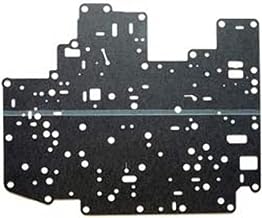
| Separator plate to valve body | 80-97 lb-in (9-11 Nm) |
| Front pump to case | 16-20 lb-ft (22-27 Nm) |
| Stator support to pump body | 12-16 lb-ft (16-22 Nm) |
| Extension housing to case | 16-20 lb-ft (22-27 Nm) |
| Governor body to counterweight | 54-61 lb-in (6-7 Nm) |
| Cooler connectors to case | 18-23 lb-ft (24-31 Nm) |
| Converter to flywheel | 20-34 lb-ft (27-46 Nm) |
| Transmission to engine | 40-50 lb-ft (55-68 Nm) |
| Inner manual lever to shaft | 20-27 lb-ft (26-37 Nm) |
| Neutral start switch to case | 8-11 lb-ft (11-15 Nm) |
| Converter drain plug | 8-28 lb-ft (11-38 Nm) |
The valve body bolts deserve special attention. Ford's pressure diagnosis chart lists loose valve body bolts as a cause of low pressure in nearly every range, and overtightening warps the body and binds valves. Use an inch-pound wrench, not a feel.
Line pressure and stall testing
Ford tests line pressure with a 300 psi (2,000 kPa) gauge on the main line tap on the left side of the case just above the control levers, and TV pressure with a 0-100 psi gauge on the right side tap. Readings are taken hot, at idle (zero TV) and at wide-open throttle at full stall, and Reverse always reads higher than the other ranges. For the direct clutch, Ford's pass/fail is simple: more than 15 psi (103 kPa) between direct clutch pressure and forward clutch tap pressure will prevent a normal 3-4 shift.
The stall test is run in (D), D, 1 and R, never holding the throttle more than five seconds, with about 15 seconds at 1,000 rpm in Neutral between ranges to cool the converter. High stall in (D) and D only points at the planetary one-way clutch; high in all forward ranges points at the forward clutch; high in R only points at the reverse clutch or the low/reverse band and servo. Low stall usually means a converter stator one-way clutch problem or a weak engine.
Valve body identification
Sonnax's AOD valve body ID chart splits the hydraulic AOD into two bodies: 1980-88 with a 3-4 shift accumulator (Sonnax number F096) and 1989-93 without it (F097). Ford dropped the 3-4 shift accumulator in 1989 except on 5.8L applications. If you are replacing a valve body, match the year range or you will have a mismatch with the case and separator plate.
Shop the part for this fix: AOD forward clutch steel plate at CoreTransmissionParts
Setting forward clutch clearance to Ford's 0.050-0.089 in. spec starts with flat, correct-thickness steels. This 0.069 in., 34-tooth forward clutch steel (Sonnax 76405) fits the AOD, AODE and 4R70W from 1990 on.
View the forward clutch steelNeed parts for this job?
Our AOD parts page has master rebuild kits with clutches, seals and band, complete 1980-93 valve bodies, and the shift and TV cable hardware, all on our own checkout.
FAQ
What are the gear ratios of a Ford AOD transmission?
The standard AOD ratios are 2.40:1 in first, 1.47:1 in second, 1.00:1 in third and 0.67:1 in overdrive. The 4R70W wide-ratio gear set that can be swapped in runs 2.84, 1.55, 1.00 and 0.70. AODE units through 1995 mostly kept the standard AOD ratios.
How much fluid does an AOD transmission hold?
Ford lists 12.3 US quarts (11.6 liters) for a dry unit. A pan drop and filter change takes about 3 quarts. Check the level hot with the engine running and top off from there rather than pouring in a fixed amount.
What fluid does a Ford AOD use?
The 1993 Ford manual specifies Synthetic MERCON Multi-Purpose ATF, part E6AZ-19582-B. MERCON has since been replaced by MERCON V, which Motorcraft says is the recommendation for vehicles that originally called for MERCON. Do not use Type F in an AOD.
What is the AOD forward clutch clearance?
Ford specifies 0.050-0.089 inch for the forward clutch with five steels, five frictions and a waved plate next to the piston. Clearance is set with selective snap rings from 0.060 to 0.106 inch. We aim for the tight half of the range on a rebuild.
Does the wide-ratio 4R70W gear set change highway rpm in an AOD?
Barely. Third gear stays 1.00:1 and overdrive changes only from 0.67 to 0.70, so cruise rpm rises by a few percent. The big change is first gear, which acts like a rear axle about 18 percent steeper per Baumann's 1.183 factor.
Related guides
- AOD Identification Guide
- AOD vs AODE Differences
- AOD Towing Upgrades and Cooling
- AOD Won't Shift Into Overdrive
- AOD Rebuild Cost
Sources
- Ford Motor Company, 1993 Mustang Workshop Manual, Section 07-01B (AOD), Specifications. Backs the clutch pack plate counts, clearances and selective snap rings, low/reverse servo travel and selective pistons, the 5.0L HO overdrive servo code and stroke, the end play thrust washer chart, the clutch and band application chart, converter end play, the 11.6 L / 12.3 qt fluid capacity and the full torque table. SPB71B55
- Ford 1993 Mustang Workshop Manual, Section 07-01B, Description and fluid drain and refill. Backs the (D), D and 1 range operation, the 55-25 mph and below-25 mph forced downshifts, the normal fourth gear whine, the Synthetic MERCON E6AZ-19582-B (ESR-M2C163-A2) fluid call-out, the 3 quart pan refill and the do-not-clean filter warning. SPB71B01, SPB71B18
- Ford 1993 Mustang Workshop Manual, Section 07-01B, control pressure and stall tests. Backs the 300 psi main line and 0-100 psi TV gauge locations, pressure specs living in the Special Specifications booklet, the 15 psi direct clutch pressure limit, the loose valve body bolt pressure causes and the stall test procedure and diagnosis chart. SPB71B11, SPB71B12
- Dabich, S., "Ford Motor Company Automatic Overdrive Transmission," SAE Technical Paper 800004, 1980. Backs the 1980 launch applications, the 40 percent hydrodynamic / 60 percent mechanical split in third gear and full converter bypass in fourth. saemobilus.sae.org
- Baumann Electronic Controls, Performance Guide Section 3: AOD/AODE/4R70W Upgrades. Backs the standard (2.40, 1.47, 1.00, 0.67) and wide-ratio (2.84, 1.55, 1.00, 0.70) gear tables, the 1.183 axle-equivalent factor, AODE ratio applications through 1995, the direct drum history and the factory AOD Mustang full-throttle shift points. becontrols.com
- Sonnax, "Ford AOD, FIOD Valve Body Identification." Backs the F096 (1980-88, with 3-4 shift accumulator) and F097 (1989-93, without) valve body split and the 5.8L exception. sonnax.com
- Motorcraft (Ford Customer Service Division), MERCON V Automatic Transmission and Power Steering Fluid product information. Backs MERCON V as Ford's recommendation for vehicles that call for MERCON and the warning against use where Type F is specified. fcsdchemicalsandlubricants.com