The EPC solenoid is the one part in an E4OD that decides how hard every clutch and band gets squeezed. There is no throttle valve cable and no vacuum modulator on this unit. When the EPC circuit goes bad, the truck tells you in one of two very different ways: it either bangs into every gear like a shift kit gone wrong, or it goes soft, slips, and the engine suddenly feels like it lost two cylinders. Knowing which way it failed tells you where to put the meter.
This guide covers how the E4OD's electronic pressure control works, the symptoms of each EPC failure mode, the codes, the resistance and signal tests, and the valve body problems that look exactly like a bad solenoid. Specs and code definitions come from the ATSG 4R100 manual (the 4R100 is the updated E4OD and uses the same pressure control layout), the pressure chart and connector pinout from ATRA's E4OD/4R100 quick reference, and valve wear data from Sonnax. Sources are at the bottom.
How the EPC solenoid sets line pressure
The EPC solenoid is a variable force solenoid. The computer does not switch it on and off like the shift solenoids. It varies the current through it, and the solenoid turns that current into a signal pressure. That signal goes to the line pressure modulator valve in the valve body, which works against the main regulator valve in the pump to raise or lower mainline pressure.
The relationship runs backwards from what most people expect. More current means less pressure. Zero current means maximum pressure. Ford patented this approach for its electronic transmissions in the late 1980s (U.S. Patent 4,833,946, assigned to Ford Motor Company), and the reason is simple failsafe logic: if the wire breaks or the computer dies, the clutches still get full pressure and the truck can still move without burning itself up.
The computer sets that current constantly. ATSG's apply chart marks EPC as modulated in every gear, and the PCM calculates the pressure it wants from throttle position, engine load (MAF, or the accelerator pedal sensor on diesels), turbine and output speed, fluid temperature and range selector position. That is why so many unrelated sensor faults change how an E4OD shifts. ATSG's code chart lists a MAF fault as causing "High EPC pressure. Firm shifts," a range sensor fault as a slight increase in EPC pressure, and even an A/C switch fault as nudging EPC up or down.
The EPC circuit is also where the case has its safety valve. ATSG's checkball layout for the 4R100 case shows eight 5/16-inch rubber checkballs plus a separate EPC blow-off ball and spring, a 0.250-inch steel ball, that caps the EPC circuit. If that ball and spring are left out or installed in the wrong pocket during a rebuild, EPC pressure control is compromised from the first drive.
Symptoms by failure mode
ATSG's code chart spells out what each electrical failure does to the truck. The difference between open and short is the whole diagnosis:
| Failure | What the pressure does | What the driver feels |
|---|---|---|
| EPC circuit open, or PCM driver failed (P1746) | Maximum EPC pressure | Harsh engagements into Drive and Reverse, every upshift firm, may flash the overdrive (TCIL) light |
| EPC circuit shorted (P1747) | Minimum EPC pressure | Soft or slipping shifts, and the PCM limits engine torque with partial fuel shut-off and heavy misfire. Flashing TCIL. |
| EPC signal intermittent short (P1760) | Minimum EPC pressure while the short is present | Comes and goes: normal shifts, then a soft, flaring shift and a stumble, often over bumps or with heat |
| EPC circuit fine, modulator sleeve worn | EPC oil leaks, or plunger hangs | Intermittent harsh shifts, soft 1-2 and 2-3, low line rise (per Sonnax) |
Harsh everything: the open circuit
An open EPC solenoid, a broken wire, or a dead driver inside the computer all look the same to the valve body: zero current, maximum pressure. The truck slams into Drive and Reverse, and every upshift is firm from the first mile of the morning. The shifts still happen at the right time, because the shift solenoids are fine. That combination, correct shift points but every shift hard, is the classic open-EPC complaint.
Gutless and misfiring: the short
This one sends people chasing the engine. With the EPC circuit shorted, the computer sees it is driving high current, which means low line pressure. Rather than let a heavy truck slip its clutches to death, the PCM protects the transmission by cutting fuel to some cylinders. ATSG describes this as limiting engine torque with partial fuel shut-off and heavy misfire.
A Transmission Digest case by Jesse Zacarias and Roy Delfran shows how badly this can fool a shop. A 2002 F-550 with a 7.3-liter diesel and a 4R100 came in with the overdrive light flashing intermittently and the truck going gutless on acceleration. It had P1747 (pressure control solenoid short circuit) and a pedal position sensor code. The previous shop had already replaced the solenoid pack and the accelerator pedal sensor, and neither fixed it. Using an oscilloscope at PCM pin 81 and a pressure transducer to watch EPC and line pressure at the same time, they traced it to a failed EPC driver inside the PCM. A new PCM fixed the truck. The takeaway: an EPC short code can be the computer, not the pack.
The codes
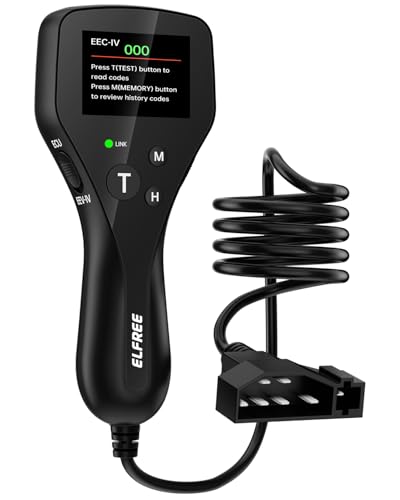
1989-95 E4OD trucks run EEC-IV. Early trucks give two-digit codes; later EEC-IV trucks give three-digit service codes, and 624 and 625 are the EPC circuit codes on those. Pull the key-on engine-off test, the continuous memory codes and the engine-running test. An intermittent short often shows up only in continuous memory.
1996-97 trucks are OBD-II. The EPC codes in ATSG's chart are P1746 (open circuit or failed EPC driver in the PCM), P1747 (short circuit, or PCM), and P1760 (intermittent short). Note that ATSG's own wording for P1747 is "EPC shorted circuit failure, or PCM." The computer is on the list from the start.
Don't ignore the non-transmission codes. Because EPC pressure is calculated from engine load and throttle inputs, a bad MAF or TPS can make the transmission shift firm with nothing wrong in the EPC circuit at all. Fix engine sensor codes first, then judge shift feel.
Testing the EPC solenoid and circuit
1. Resistance at the solenoid body
ATSG's test is done key off with the meter on ohms. The EPC solenoid is tested across pins 11 and 12 of the solenoid body connector and should read 3.0-5.0 ohms. For comparison, the shift solenoids, coast clutch solenoid and on/off TCC solenoid all read 20-30 ohms, and a PWM TCC solenoid reads 10-20 ohms. The EPC is the only low-resistance coil in the pack, so a reading near 20 ohms means you are on the wrong pins.
- Open (infinite): solenoid coil or internal pack wiring open. Expect harsh shifts.
- Well under 3 ohms, or continuity to the case: shorted. Expect soft shifts and torque cut.
- In spec: the coil is electrically fine. That does not prove the solenoid's valve is not sticking, and it says nothing about the harness or the PCM.
2. Signal at the case connector
ATRA's connector chart for the E4OD case connector puts the EPC solenoid on terminals L (-) and M (B+). With the harness connected, backprobe L and M with a high-impedance voltmeter or a signal monitor and road test. The signal should change as throttle opening and range change. A signal that never moves, or no signal at all, means the computer is not controlling pressure. ATSG's pin table routes the EPC control wire to PCM pin 81 and the solenoid power feed to PCM pins 71 and 97, so if the signal is missing at the case, check continuity from L back to pin 81 before you condemn the computer.
Inspect the case connector while it is apart. Corroded pins, spread terminals and a broken lock tab are common on these trucks, and a connector that opens on a bump reads exactly like an intermittent EPC fault.
3. Line pressure gauge
The meter tells you about the circuit. The gauge tells you what the valve body is actually doing. ATRA's chart shows the line pressure tap on the side of the case near the ID tag. Use a gauge that reads at least 300 psi. ATRA's E4OD/4R100 specs:
| Range | Idle (psi) | Stall (psi) |
|---|---|---|
| P, N | 50-65 | - |
| R | 70-100 | 245-290 |
| OD, 2 | 50-65 | 165-185 |
| 1 | 70-100 | 175-210 |
ATSG's later 4R100 chart lists lower stall figures (220-240 psi in Reverse, 136-156 psi in OD and 2), so use the chart that matches the unit you have. ATSG also warns not to stall test if idle pressure is already low, and never to hold wide-open throttle for more than 5 seconds.
How to read it:
- High at idle in every range, and no line rise with throttle: the pressure is already maxed. With no EPC signal, it is the circuit, the solenoid or the PCM. With a good signal, look at the pump's main regulator and the modulator valve.
- Normal at idle, but little or no rise toward stall: EPC oil is not reaching or not acting on the modulator. That is the worn sleeve case below, or a leaking EPC circuit.
- Normal most of the time, then a spike or a drop on the road: a valve hanging in a worn bore, or an intermittent short. Tee the gauge where you can see it from the seat and watch it on the drive.
When the solenoid is fine: valve body causes
Worn line pressure modulator sleeve
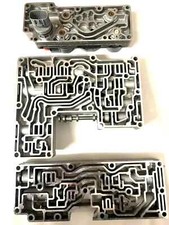
This is the one that gets a good solenoid pack replaced. Sonnax lists "intermittent harsh shifts," soft 1-2 and 2-3 shifts, low line rise and low EPC pressure as symptoms of a worn line pressure modulator sleeve on the E4OD and 4R100. The sleeve wear lets EPC oil leak past it, which gives soft shifts, and lets the plunger hang up, which gives harsh ones. The same truck can do both in one day. Sonnax's 36948-05K kit replaces the plunger valve and sleeve and adds an O-ring to stop EPC oil loss. Sonnax's E4OD/4R100 vacuum test guide lists the same valve and sleeve with the same symptoms, and shows where to vacuum test it, so a bench test on the bench will confirm it before you order parts.
Wrong plunger after a rebuild
Sonnax makes the modulator plunger in 0.331, 0.372, 0.427 and 0.500-inch diameters, and states that a larger plunger raises both line pressure and EPC pressure. Their selection guide warns that the accumulator control body is very sensitive to changes and that a 0.500-inch kit often gives much firmer shifts than expected. A truck that has been harsh since a rebuild or shift kit may have a plunger that is too big for its engine, not a bad EPC solenoid.
Main regulator valve and sleeve
The EPC and modulator only push on the main regulator. If the regulator itself is worn, pressure control is lost no matter what the solenoid does. Sonnax's vacuum test guide lists the outboard main regulator valve and sleeve with soft shifts and delayed Reverse, and the inboard regulator valve with codes 62, 628 and 1744 and engine stall on engagement into Reverse.
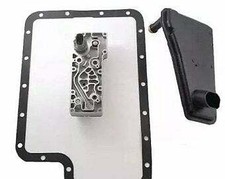
Shop the part for this fix: E4OD/4R100 solenoid block pack, 1995-97
The EPC solenoid is part of the solenoid body and is not sold separately, so a failed EPC coil means a complete pack. This one fits the 1995-97 non-PWM units.
See the 1995-97 solenoid block pack at CoreTransmissionPartsThe fix, in order
- Pull all codes, including continuous memory, and clear up any engine load or throttle sensor faults first.
- Inspect the case connector for corrosion, loose pins and a broken lock tab. Repair the harness side before anything else.
- Ohm the EPC solenoid at pins 11 and 12: 3.0-5.0 ohms. Open or shorted means a new solenoid pack. ATSG is clear that the solenoids are not serviced individually.
- Check the signal at L and M on a road test. Good solenoid, no signal, wiring good to pin 81: suspect the PCM driver, especially with P1746 or P1747.
- Put a gauge on it. Good signal and still wrong pressure means the valve body or pump: modulator sleeve, plunger size, main regulator.
- On a rebuild, confirm the EPC blow-off ball and spring are in the case and that the modulator plunger matches the truck.
After any EPC or valve body repair, verify line pressure again at idle and stall, then road test with the gauge. Shift feel should firm up smoothly with throttle, not jump from soft to harsh.
Need parts for this job?
Our E4OD parts page has solenoid packs, valve bodies, pumps and rebuild kits sorted by year range, plus an EEC-IV code reader for the pre-1996 trucks, all on our own checkout.
FAQ
What are the symptoms of a bad EPC solenoid on an E4OD?
It depends on how it fails. An open EPC circuit gives maximum line pressure, so every engagement and shift is harsh. A shorted circuit gives minimum pressure, soft or slipping shifts, and the computer cuts engine torque with partial fuel shut-off, which feels like a gutless, misfiring truck. Either way the overdrive light may flash.
What should an E4OD EPC solenoid read in ohms?
ATSG's spec is 3.0-5.0 ohms across pins 11 and 12 of the solenoid body connector, measured key off. The shift, coast clutch and on/off TCC solenoids read 20-30 ohms, so the EPC is the one low reading in the pack.
Can you replace just the EPC solenoid on an E4OD?
Not as a factory service part. ATSG notes the solenoids in the solenoid body are not serviced individually, so the fix for a failed EPC solenoid is the complete solenoid pack. Check the case connector and harness before you buy one.
What codes point to the EPC solenoid on an E4OD?
On 1996-97 OBD-II trucks, P1746 is the EPC open circuit and P1747 is the EPC short circuit. P1760 is an intermittent short. Earlier EEC-IV trucks use three-digit service codes 624 and 625 for the EPC circuit.
Can a good EPC solenoid still cause pressure problems?
Yes. Sonnax lists a worn line pressure modulator sleeve as a cause of intermittent harsh shifts, soft 1-2 and 2-3 shifts, low line rise and low EPC pressure, because EPC oil leaks past the sleeve or the plunger hangs. A pack that ohms good does not clear the valve body.
Related guides
- E4OD Harsh Shift Causes and Fix
- E4OD Shift Solenoid Symptoms and Replacement
- E4OD Limp Mode Causes and Fix
- E4OD Valve Body Symptoms
- E4OD Slipping: Causes and Fix
Sources
- ATSG (Automatic Transmission Service Group), Ford 4R100 Technical Service Information (2003). Backs the EPC open/short failure modes (maximum pressure and harsh shifts vs. minimum pressure with partial fuel shut-off and misfire), P1746, P1747 and P1760, the sensor faults that raise EPC pressure, the 3.0-5.0 ohm EPC spec at pins 11 and 12 and the 20-30 / 10-20 ohm specs for the other solenoids, the non-serviceable solenoid body, PCM pins 81, 71 and 97, the EPC blow-off ball and spring, and the 4R100 pressure chart and stall test cautions. https://atoc.ru/uploads/manual/5fb798e27b192.pdf
- ATRA, E4OD/4R100 Quick Reference (2009). Backs the case connector pinout with EPC on terminals L and M, the backprobe signal check, the line pressure tap location, and the idle and stall line pressure chart. https://atracom.blob.core.windows.net/bulletins/quick/ford/e4od/e4od_quick_ref.pdf
- Transmission Digest, Jesse Zacarias and Roy Delfran, "EPC Code Causing Loss of Power" (2009). Backs the 2002 F-550 4R100 case: P1747, flashing overdrive light, gutless acceleration, partial fuel shut-off, testing at PCM pin 81 with a transducer, and the failed PCM driver. https://www.transmissiondigest.com/epc-code-causing-loss-of-power/
- Sonnax, Line Pressure Modulator Plunger Valve Kit 36948-05K. Backs the worn modulator sleeve causing EPC oil leakage and plunger hang-up, and the symptoms: intermittent harsh shifts, soft 1-2 and 2-3, low line rise and low EPC pressure. https://www.sonnax.com/parts/2106-line-pressure-modulator-plunger-valve-kit
- Sonnax, "How to Choose the Right E4OD/4R100 Line Pressure Modulator Plunger Valve Kit." Backs the 0.331, 0.372, 0.427 and 0.500-inch plunger sizes, larger plungers raising line and EPC pressure, and the warning about overly firm shifts. https://www.sonnax.com/tech_resources/1165-how-to-choose-the-right-e4od-4r100-line-pressure-modulator-plunger-valve-kit
- Sonnax, E4OD/4R100 Vacuum Test Guide. Backs the modulator valve and sleeve test location and symptoms, and the main regulator valve symptoms (soft shifts, delayed Reverse, codes 62, 628 and 1744, stall on Reverse engagement). https://d2q1ebiag300ih.cloudfront.net/uploads/tech_resource/639/E4OD-4R100_VacTestGuide.pdf
- U.S. Patent 4,833,946, "Variable force solenoid pressure control for an automatic transmission," Ford Motor Company (1989). Backs the variable force solenoid principle and maximum pressure at zero solenoid force as a failsafe. https://patents.google.com/patent/US4833946A/en