A TH350 that will not back up is one of the most common calls on these old GM three-speeds, and it is one of the easier ones to narrow down before the pan comes off. The TH350 is fully hydraulic. There is no computer, no solenoid and no code to pull, so everything you learn comes from how the car drives in each range, a line pressure gauge, and compressed air. That sounds primitive, but the apply chart does most of the work for you.
Reverse needs two clutches to apply at the same time. Each of those clutches also works in a forward gear you can test on the road. Figure out which forward gear is also sick and you usually know which clutch, and which repair, you are looking at.

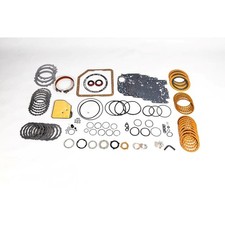
How the TH350 Makes Reverse
The TH350 uses a Simpson compound planetary gearset with five holding devices: the forward clutch, the direct clutch, the intermediate clutch with its intermediate overrun band, the low/reverse clutch, and two one-way clutches. In reverse, the direct clutch drives the sun gear through the sun gear shell, and the low/reverse clutch holds the rear planetary carrier. With the carrier held and the sun turning, the rear ring gear and output shaft turn backward. GEARS magazine (ATRA) puts it simply: the rear planetary transmits power in first gear and reverse.
That leaves two shared parts to keep in mind:
- Direct clutch: applied in 3rd gear and in reverse.
- Low/reverse clutch: applied in reverse and in manual 1 (Lo), where it gives you engine braking. In Drive-range first gear the low roller clutch does the holding instead, which is why a car with a dead low/reverse clutch still pulls away fine in Drive.
The forward clutch is not used in reverse at all, so a TH350 that drives forward in every gear and only refuses reverse has a narrower problem than most owners fear.
Step 1: The Free Checks
Fluid level and condition
Check the level hot, in Park, on level ground. A TH350 that is a couple of quarts low will often pick up the pickup tube on a hard reverse engagement first, because reverse wants the most oil volume and the most pressure. Smell and look at the fluid on the stick. Dark fluid with a burned smell and friction material in the pan means a clutch pack has already cooked, and no adjustment will bring it back. Refill with a DEXRON-licensed ATF; our TH350 fluid type and capacity guide has the details.
Shift linkage
The manual valve in the valve body is positioned by the shift linkage through the detent lever. If the column or floor linkage is out of adjustment, the selector can show R while the manual valve sits partway between Reverse and Neutral. You get a weak, slipping reverse or none at all, while Drive feels normal because the detents are wider there. GM's 1976 light truck service supplement (ST-330-76) warns that running the transmission out of full detent reduces oil pressure and partially engages the affected clutch, which can cause failure within a few miles. Put the selector in R, crawl under the car, and confirm the transmission lever is fully in its reverse detent. While you are there, look for a wet shift shaft. A leaking manual shaft seal is a common TH350 drip, and Sonnax sells a shift shaft and seal kit (35801-02K) for scored shafts that keep eating seals.
Step 2: Split the Problem With the Apply Chart
Road test the car in every range and write down what you get. This one test tells you where to spend your time.
No reverse AND no 3rd gear
The direct clutch is the common part. If the car shifts 1-2 and then flares or neutrals on the 2-3, and also will not back up, the direct clutch pack is burned, the direct piston seals are cut or hardened, the direct drum is cracked, or oil is leaking out of the feed to the drum through worn bushings or sealing rings. All of those mean a teardown. The direct clutch drum and its piston are the usual suspects on a high-mileage unit.
No reverse, 3rd gear is good, no engine braking in manual 1
The low/reverse clutch is the common part. Pull the selector into 1 at about 20 mph and let off the gas. If the car coasts like it is in neutral instead of slowing on compression, and it also will not back up, the low/reverse clutch is not applying. That is a burned low/reverse pack or leaking low/reverse piston seals.
No reverse, 3rd is good, manual 1 engine braking is good
Both clutches work in their forward gear, so look at what is different about reverse: it needs both clutches applied together, and it needs boosted line pressure. That points at the reverse oil circuit and line pressure.
- Direct piston outer seal. The TH350 direct piston carries three lip seals: inner, center and outer. Third gear applies the piston using the inner area; reverse feeds the outer area as well to get more clamping force for the higher reverse torque. A leaking outer seal can kill reverse while 3rd still feels fine.
- Intermediate servo bore. Sonnax notes that on the spring side of the TH350 intermediate servo piston, line pressure is present in R, N and D. The bore scores from repeated cycling, and excess leakage past the piston gives low line pressure and delayed engagement. Sonnax's 35709-01K sleeve kit lists "low line pressure in Reverse" among the symptoms it cures.
- Reverse boost valve and sleeve. Sonnax states that in the TH350 and TH350C the OE boost valve sleeve wears from the steel valve reciprocating in the aluminum sleeve, and that wear gives low line pressure, soft 1-2 and 2-3 shifts and/or a soft reverse engagement or shudder. That is their 35754-01K boost valve kit.
- 1-2 accumulator bore. Sonnax's TH350 listing ties a worn 1-2 accumulator bore to low line pressure, 1-2 slip, delayed forward and delayed reverse.
Reverse when cold, gone when hot
This is a leak, not a broken part. Hot ATF is thinner and pushes past worn clearances that held when it was cold. A worn servo bore, a worn boost sleeve, worn bushings in the direct drum feed, and old seals that have taken a set all show up this way. A pressure gauge on a hot transmission is the best way to tell which. If reverse is not gone but just slow to grab, see our TH350 delayed engagement guide.
Step 3: Line Pressure Test
Tee a 300 psi gauge into the line pressure tap on the side of the case and warm the fluid to operating temperature. Record line pressure at idle in Drive and in Reverse, then at a higher engine speed against the brakes in each range. For reference, GM's ST-330-76 lists about 85 psi Drive and 129 psi Reverse with the modulator connected at 12 in. Hg absolute, and 167 psi Drive and 254 psi Reverse with the vacuum tube disconnected at 1200 rpm, for a 350 V-8. The reverse boost valve is there to raise line pressure in reverse, so reverse should read clearly higher than Drive. Two readings tell you a lot:
- Reverse pressure is no higher than Drive, or it drops as the fluid heats: look at the boost valve sleeve, the intermediate servo bore and the 1-2 accumulator bore. These leaks drop pressure in every range, but you feel them first in reverse.
- Pressure is normal in reverse but the car still will not back up: the oil is getting there and the clutch is not holding. That is a burned pack or a leak inside the drum or piston, past the point where the gauge is reading.
A disconnected or leaking vacuum line to the modulator raises pressure, and a ruptured modulator lowers it. Rule out the modulator before blaming the valve body. Our TH350 pressure testing guide walks through the full procedure.
Step 4: Air Check the Clutches
With the pan and valve body off, you can air check the direct and low/reverse circuits through the case passages using low-pressure, dry, regulated air. A healthy circuit gives you a solid thump as the piston applies and very little hiss. A loud hiss with no thump is a cut seal, a cracked drum, or a missing or broken sealing ring. Air pushed through the low/reverse feed is strong enough to move the piston; TCI's TH350 valve body instructions (kit 321500) say the best way to remove the low/reverse piston, once its spring retainer is compressed and the retaining ring is out, is to apply air to the reverse feed hole under the valve body.
Step 5: The Repair
Low/reverse clutch
The low/reverse piston sits in the back of the case and is notched to clear the parking pawl, so the pawl has to come out before the piston will. It uses three seals that form two separate apply areas. On reassembly, every seal has to be there and none can be rolled; leave one out and you lose part of the apply area. Replace the frictions and steels, and match the friction count to the piston you have. As GEARS points out in a racing context, TH350 pistons differ by original engine application, and an 8-cylinder piston carries all five frictions in this pack while a 6-cylinder piston is set up for fewer.
Direct clutch
Inspect the drum for cracks, especially around the lugs and the piston bore, and check its bushing and the sealing rings that feed it. Replace all three piston lip seals. One warning on used and built units: performance builders sometimes leave the center seal out of the direct drum on purpose. ATI's TH350 transbrake instructions list removing the center seal from the direct drum as part of their build. That changes how the drum applies, so if you are diagnosing a unit someone else built, check whether the center seal is there before you decide it is "missing."
Clearances
Set clutch pack clearance to the spec in your rebuild kit or service manual for the piston and friction count you are running. Performance specs are tighter than stock: ATI calls for .050 to .060 inch on both the direct and reverse packs in their five-friction transbrake build, and says the clearance is critical. Too much clearance makes for a late, soft reverse engagement; too little causes drag.
Fix the oil leak, not just the clutch
If the clutch burned because pressure was low, a new pack will burn too. Sleeve a scored intermediate servo bore, replace a worn boost valve and sleeve, and check the accumulator bore while the valve body is out. Those parts are cheap compared to doing the job twice.
Quick Diagnostic Order
- Check fluid level hot and look at the fluid. Burned fluid with debris means a clutch has already failed.
- Confirm the transmission lever is fully in its reverse detent.
- Road test: is 3rd good? Is manual 1 engine braking good?
- No reverse plus no 3rd: direct clutch. No reverse plus no manual 1 braking: low/reverse clutch.
- Both good: pressure test in Drive and Reverse, hot. Look at the boost sleeve, servo bore, accumulator bore and the direct piston outer seal.
- Air check the circuits with the valve body off before you pull the unit.
View the servo sleeve kit →
FAQ
Why does my TH350 have no reverse but drives fine?
Reverse on a TH350 needs two clutches at once: the direct clutch and the low/reverse clutch. If 3rd gear is still good, the direct clutch is probably healthy, which points at the low/reverse clutch, its piston seals, or a reverse oil leak such as a worn intermediate servo bore or reverse boost sleeve.
What does it mean when a TH350 has no reverse and no 3rd gear?
The direct clutch is the only part that works in both 3rd and reverse, so losing both together almost always means a burned direct clutch pack, a cut direct piston seal, a cracked direct drum, or a leak in the oil feed to that drum. Plan on a teardown.
Can a TH350 lose reverse only when it gets hot?
Yes. Hot fluid is thinner and leaks past worn parts more easily. A scored intermediate servo bore, a worn reverse boost sleeve, worn bushings in the direct drum feed, or hardened piston seals can all hold when cold and leak enough when hot to kill reverse.
Can a shift kit fix no reverse on a TH350?
Only if the cause is low line pressure from worn valve body or boost parts. A shift kit or boost valve kit will not seal a cut piston seal or bring back a burned clutch pack. Confirm the cause with a pressure gauge and an air check first.
Sources
- GEARS Magazine (ATRA) — "Success is Measured in Inches... Not Miles!" Backs the rear planetary carrying power in first and reverse, and the piston and friction-count differences in the TH350 low/reverse and direct clutches. gearsmagazine.com
- Sonnax — TH350/TH350C Intermediate Servo Sleeve Kit, Part No. 35709-01K. Backs line pressure on the spring side of the servo in R, N and D, bore scoring from cycling, and low line pressure in Reverse and delayed engagement from the leak. sonnax.com
- Sonnax — TH350/TH350C Boost Valve Kit, Part No. 35754-01K. Backs boost sleeve wear from the steel valve in the aluminum sleeve and the low line pressure, soft shift and reverse engagement or shudder symptoms. sonnax.com
- Sonnax — GM TH350 unit parts listing. Backs the 1-2 accumulator bore wear symptoms (low line pressure, delayed forward and reverse) and the 35801-02K shift shaft and seal kit for leaking manual shafts. sonnax.com
- ATI Performance Products — T350 Transbrake Part No. 353080 installation instructions. Backs removal of the direct drum center seal in a performance build, five frictions in the direct and reverse packs, and the .050-.060 inch clearance spec. atiracing.com (PDF)
- TCI Automotive, "TCI 321500 TH-350 TransBrake Valve Body" installation instructions, Step 10. Backs compressing the low/reverse piston spring retainer, removing the retaining ring, and using air at the reverse feed hole under the valve body to remove the low/reverse piston, plus replacing all OEM lip seals at that stage. TCI instructions (PDF)
- General Motors — 1976 Chevrolet Light Truck Service and Overhaul Supplement, ST-330-76, Section 7A Turbo Hydra-Matic 350. Backs the out-of-detent caution (reduced oil pressure and partial clutch apply) and the TH350 oil pressure figures for Drive and Reverse with the modulator connected and disconnected. 73-87chevytrucks.com (PDF)