Every clutch, band and valve in a Turbo 350 runs on oil from one place: the front pump. When the pump gets weak, the whole transmission gets weak at the same time. That is the main clue. A bad clutch pack usually hurts one range. A bad pump hurts everything, it is worse hot, and it often makes a noise that follows engine speed, not road speed.
Below: how the pump works, which symptoms point to it, how to prove it with a gauge, what to check on the bench, and GM's reassembly specs. Numbered sources are at the bottom.
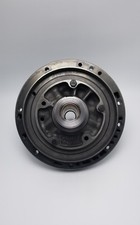
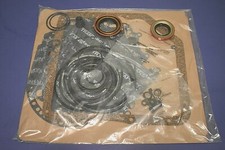

How the TH350 Pump Works and Why It Fails
The TH350 uses a gear-type pump: an inner drive gear, an outer driven gear and a crescent between them, all in a pocket in the cast pump body. GM's 1975 manual describes it simply: a gear-type pump pressurizes the hydraulic system that operates the friction elements and automatic controls [1]. The drive gear has two tangs that engage slots in the converter hub, so the pump turns at engine speed any time the engine is running.
The pump does more than make pressure. The pump body holds the converter hub bushing, the front seal and the cooler bypass valve (a spring, check ball and pressed-in seat). The pump cover carries the stator shaft and its bushings, the intermediate clutch piston, and the hub that feeds the forward and direct clutches through sealing rings [1]. A leak at any of those points shows up as a pressure or engagement problem.
Most TH350 pumps fail in one of four ways:
- Bushing wear lets the hub move off center. Sonnax says worn babbitt pump bushings let the converter hub and inner pump gear run off center, which damages the pump gears and the housing crescent [3].
- Converter damage to the drive gear. GM's no-drive diagnosis chart lists "pump drive gear - tangs damaged by converter" as a cause of low oil pressure [1]. This is usually a converter that was not fully seated when the transmission went in, or a gear installed upside down. GM says the drive gear has offset tangs and must go in tang face up to avoid damaging the converter [1].
- Suction-side problems. The pump can only move the oil it gets. GM lists a blocked filter and porosity in the case intake bore as low-pressure causes [1], and notes that air bubbles on the dipstick point to an air leak in the suction side, which causes erratic operation and slipping [1].
- Internal leaks in the pump assembly. Broken or missing hub sealing rings, a mispositioned pump-to-case gasket, or a stuck pressure regulator all bleed off pressure that the gears are making [1].
TH350 Pump Failure Symptoms
These are the complaints I tie to the pump, roughly in order of how often I see them:
- Slow or no engagement in both Drive and Reverse. A weak pump takes longer to fill the forward and direct clutches. When it is bad hot and fine cold, suspect the pump first, because hot oil leaks past worn gear clearances faster.
- Slipping in every range at once. A burned forward clutch slips in Drive. A pump problem slips in Drive, Low and Reverse together because line pressure is low everywhere.
- A whine that follows engine RPM. Rev it in Park or Neutral. If the whine rises and falls with engine speed while the car is sitting still, the noise is in something that turns with the engine: the pump, the converter or the flexplate. Gear noise from the planetaries changes with road speed, not engine speed.
- Front seal leak that keeps coming back. GM's leak list for the front of the case starts with the pump seal, but it notes why seals fail: a lip cut by the converter hub, a pump bushing that moved and damaged the seal, or a plugged oil return hole [1]. A new seal on a worn bushing will leak again within weeks.
- Fluid coming out the vent. Along with overfill and water in the fluid, GM lists foreign material between the pump and case or between the pump cover and body, and a mispositioned pump-to-case gasket [1].
- No reverse or slipping reverse. GM's chart lists broken or missing pump hub to direct clutch sealing rings as a cause [1]. Reverse needs the highest pressure in the unit, so it often shows a pump or pump-hub problem first.
Two problems get blamed on the pump but are not pump problems. A stator roller clutch that freewheels gives poor launch but normal behavior above about 30-35 mph. A stator that stays locked limits top speed and overheats the converter [1]. Both are converter problems, and a new pump will not fix either one.
Prove It With a Pressure Gauge Before You Pull It
Do the basics first. GM's diagnosis sequence is: check and correct the fluid level, check the detent cable, check the vacuum line and fittings, check the manual linkage, then road test with a gauge on the line pressure tap [1].
Look at the dipstick before you do anything else. Bubbles mean air is getting into the suction side. Milky pink fluid means water [1]. Either one can cause low pressure without anything wrong in the pump itself.
Then put a gauge on it. GM's 1976 light truck supplement gives these line pressure values for a TH350 behind a 350 V8 [2]:
| Test condition | Drive | L1 / L2 | Reverse |
|---|---|---|---|
| 1200 RPM, brakes on, modulator vacuum line disconnected | 167 psi | 166 psi | 254 psi |
| 12 in-Hg absolute manifold pressure, modulator connected | 85 psi | 105 psi | 129 psi |
Values vary by engine and model. How I read the result:
- Low in every range: the problem is shared by all ranges. That means the filter, the intake bore, the pump gears, or the pressure regulator. Pull the pan first. A blocked filter is cheaper than a pump.
- Normal in Drive, low only in Reverse: look at the Reverse circuit. That includes the pump hub sealing rings to the direct clutch, the direct and low-reverse piston seals and the No. 1 check ball [1].
- Pressure drops as the fluid gets hot: this is the classic worn pump. Gear and pocket clearance that holds cold oil cannot hold thin hot oil.
- Pressure high or will not respond to vacuum: look at the modulator, the vacuum supply and the modulator valve before you suspect the pump. GM lists the modulator causes ahead of the pump for both high and low pressure [1].
Finally, drop the pan. Bronze or gray metal mixed with the fluid usually means bushing or gear wear. GM's converter check says that if converter end clearance is .050 in. or more and the oil looks like it was mixed with aluminum paint, the converter is replaced [1].
What to Look For on the Bench
With the pump out and apart (five cover-to-body bolts [1]), check these items in order:
- Gears and pocket. GM's procedure is to inspect the pump gears and cover for wear or scoring [1]. Look for a polished arc on the crescent and scoring where the outer gear has been riding on the pocket wall. Both mean the gear ran off center. A scored pocket is the reason to replace the pump body instead of rebuilding it.
- Drive gear tangs. Look for chewed or mushroomed tangs. Damaged tangs mean the converter was not fully engaged at some point, so check the new converter's hub and drive slots too.
- Converter hub bushing. GM says to check it for nicks, severe scoring or wear [1]. Test it on the converter hub you are going to run. If the hub rocks in the bushing, replace it.
- Stator shaft bushings. There are three: the front and two in the rear (upper and lower) [1]. Wear here lets the turbine shaft move and wears the sealing rings.
- Hub sealing rings. GM uses three hook-type rings for the direct clutch and two Teflon rings for the forward clutch. If the Teflon rings need replacement, GM's service replacement is metal hook-type rings [1]. Also check the three pump cover hub lube holes for restriction [1].
- Cooler bypass valve. The spring, check ball and seat in the pump body [1]. A stuck bypass changes cooler flow and can cook the fluid.
Bushings, Seals and Reassembly Specs
Many TH350 pumps can be saved with a bushing, a seal and careful assembly if the pocket and gears are clean. GM's bushing installation spec: press the new converter hub bushing in from the gear pocket face until it is flush to .010 in. below the opposite (front seal) face. The front stator shaft bushing goes 1/4 in. below the top of the stator shaft. The upper rear stator bushing goes 1-1/32 in. below the oil pump delivery sleeve, and the lower rear goes flush to .010 in. below the chamfer [1].
For the hub bushing I use a modern replacement over babbitt. Sonnax's 34034T-01 replaces OE 29511860. It is a steel-backed bimetal bushing with a PTFE lining, .615 in. wide, for a 1.873 in. shaft in a 2.001 in. bore. It fits TH350 and TH350C [3]. For high-heat builds, Sonnax's bronze 34234B-01 is aimed at turbocharged racing use. Sonnax says it has three times the melting point of babbitt [4].
GM's service literature gives these assembly specs:
| Item | Spec | Source |
|---|---|---|
| Pump cover to pump body bolts (5) | 15 lb-ft (1975 spec table; the procedure step says 18) / 17 lb-ft (1976 truck) | [1], [2] |
| Pump assembly to case | 20 lb-ft (1975 Buick) / 18-1/2 lb-ft (1976 truck), new washer-type seals, tightened alternately | [1], [2] |
| Direct clutch to pump end play | .030-.079 in., set with zero, one or two .017 in. shims | [1] |
| Converter to flywheel bolts | 30 lb-ft (1975 Buick) / 35 lb-ft (1976 truck) | [1], [2] |
| Pan to case | 13 lb-ft (1975 Buick) / 130 in-lb (1976 truck) | [1], [2] |
Some points from GM's procedure that make or break the job:
- Leave the cover-to-body bolts finger tight. Pull the halves into line with the pump aligning strap (J-21368), and only then torque them [1]. A misaligned pump binds the gears and wears a new bushing quickly. A front pump alignment band does the same job.
- Use a new square-cut O-ring on the pump outside diameter and a new pump-to-case gasket. Lube the case bore and use guide pins [1].
- GM's check: if the input shaft will not turn while you pull the pump in, the direct and forward clutch plates are not indexed. Fix that before the pump is drawn down [1].
- Drive the front lip seal in with a proper driver and the pump supported on wood blocks so the face is not damaged [1].
How to Keep a TH350 Pump Alive
- Service the filter on time. GM's 1976 truck supplement calls for draining the pan and cleaning the strainer every 30,000 miles. For heavy city traffic in hot weather, commercial use, long idling or towing, the interval is 15,000 miles [2]. A clogged filter starves the pump.
- Use the right filter and gasket. The Raybestos 515615 covers 1969-1986 TH350s and replaces OE 8640848. The 515-series filter does not include a gasket, so order the cork or nitrile gasket separately or buy the 7615 kit [5].
- Seat the converter. Make sure the converter is fully engaged in the pump drive gear before the bellhousing bolts pull the transmission to the block. Damaged tangs from a half-seated converter are a common pump failure.
- Never put a new pump behind a bad converter. Check hub condition and end clearance. A rough hub cuts the new seal, and debris from a failing converter wears a new bushing.
Shop the part for this fix: TH350 remanufactured pump
If the pocket or crescent is scored, a remanufactured 1969-1979 non-lockup TH350 pump assembly is usually faster than chasing a damaged body. For a pump that only needs a bushing, CoreTransmissionParts also stocks the Sonnax 34034T-01.
View the TH350 pump →Sonnax 34034T-01 pump bushing • All TH350 parts at CoreTransmissionParts
FAQ
What are the symptoms of a bad TH350 pump?
A weak TH350 pump usually causes slow or soft engagement in both Drive and Reverse, slipping in every range at once, and problems that get worse as the fluid gets hot. Many also whine with engine RPM even in Park or Neutral. A front seal that keeps leaking can also point to a worn pump bushing.
How do I test a TH350 pump without taking it apart?
Put a pressure gauge on the line pressure tap. GM's 1976 truck supplement lists about 167 psi in Drive and 254 psi in Reverse at 1200 RPM with the modulator vacuum line disconnected on a 350 V8. Low pressure in every range points to the filter, intake, pump or pressure regulator. Low pressure only in Reverse points to that circuit.
Can a TH350 pump be rebuilt or should it be replaced?
If the gears and pocket are not scored, the pump can usually be rebuilt with a new converter hub bushing, front seal, O-ring, sealing rings and gasket. If the crescent or pocket is scored from the gear running off center, replace the pump body or install a remanufactured pump assembly.
What is the torque spec for TH350 pump bolts?
GM's 1975 Buick manual lists 20 lb-ft for pump to case and 15 lb-ft for pump cover to pump body in its spec table. The 1976 Chevrolet truck supplement lists 18-1/2 lb-ft and 17 lb-ft. Align the pump halves with an alignment strap before you torque the cover bolts, and use new washer-type seals on the pump-to-case bolts.
Why does my TH350 whine in Park?
A whine that rises and falls with engine RPM while the car is sitting still comes from parts that turn with the engine: the front pump, the torque converter or the flexplate. Low fluid or air in the suction side can make the pump whine too, so check the level and look for bubbles on the dipstick first.
TH350 pumps, overhaul kits, pump alignment bands, filters and rebuild parts. Shipped fast from the USA.
Shop TH350 parts →Sources
- General Motors / Buick — 1975 Chassis Service Manual, Section 7C, Turbo Hydra-Matic 350-375B (PDF). Backs the gear-type pump description, pump components (cooler bypass valve, stator shaft, intermediate clutch piston, hub sealing rings, lube holes), the diagnosis sequence, air bubbles and milky fluid, the no-drive and low-pressure chart (blocked filter, drive gear tangs damaged by converter, intake bore porosity, pump-to-case gasket), the front seal and vent leak causes, the stator diagnosis, the .050 in. converter end clearance check, the tang-up drive gear, the bushing installation depths, the alignment strap procedure, the 20 lb-ft pump-to-case and 15/18 lb-ft cover bolt torques, the .030-.079 in. end play with .017 in. shims, and the 30 lb-ft converter and 13 lb-ft pan bolts. teambuick.com (PDF)
- General Motors / Chevrolet — 1976 Light Truck Service Overhaul Supplement (ST-330-76), Section 7A and Specifications (PDF). Backs the TH350 line pressure values (167/166/254 psi at 1200 RPM with the modulator disconnected; 85/105/129 psi at 12 in-Hg), the 30,000 / 15,000 mile service intervals, and the 17 lb-ft cover, 18-1/2 lb-ft pump-to-case, 35 lb-ft converter and 130 in-lb pan torques. 73-87chevytrucks.com (PDF)
- Sonnax — Pump Bushing 34034T-01. Backs the statement that worn babbitt pump bushings let the converter hub and inner pump gear run off center and damage the gears and crescent, and the bushing's OE number (29511860), PTFE-lined steel-backed bimetal construction, dimensions and TH350/TH350C fit. sonnax.com
- Sonnax — Pump Bushing 34234B-01 (bronze). Backs the bronze bushing's three-times-higher melting point than babbitt and its use in high-heat turbocharged racing applications. sonnax.com
- Raybestos Powertrain — 515615 GM TH350 Transmission Filter, 1969-1986. Backs the filter application, OE 8640848 replacement, and that the 515-series filter ships without a gasket (kit 7615 includes one). raybestospowertrain.com