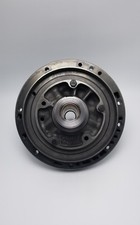
If your Turbo 350 is slow to grab Drive and Reverse once it gets warm, slips in every range at the same time, or whines with engine speed while the car is parked, the front pump is the first suspect. This is a remanufactured pump for the 1969-1979 non-lockup TH350 used behind small blocks and inline sixes in Chevelles, Novas, Camaros, Firebirds, Cutlasses and Chevy and GMC half-ton trucks. It was fully torn down, cleaned, inspected and machined, then built back up with new gears, new bushings, a new front seal, a new outside O-ring, a new gasket and all new screws, so it goes in as a complete assembly rather than a reseal of your worn one.
What the pump does in a TH350
The TH350 uses a gear-type pump: an inner drive gear and an outer driven gear separated by a crescent, running in a pocket machined into the pump body. Two tangs on the drive gear lock into the converter hub, so the pump turns whenever the engine runs. Everything else in the transmission depends on that oil. The pump cover also carries the stator shaft, the intermediate clutch piston and the hub that feeds the forward and direct clutches through sealing rings. That is why a tired TH350 pump does not hurt one gear. It drags down line pressure everywhere, and it gets worse as the fluid thins out with heat.
Symptoms of a worn TH350 pump
- Delayed engagement into both Drive and Reverse, fine cold and worse hot
- Slipping in Drive, Low and Reverse together instead of one range
- A whine that rises and falls with engine RPM in Park or Neutral
- A front seal that keeps leaking after replacement because the hub bushing has worn and lets the converter hub wander
- Weak or missing Reverse, which needs the highest pressure in the unit
- Bronze or gray metal in the pan from bushing and gear wear
The TH350 has no computer and sets no trouble codes, so diagnosis is done with a gauge and your eyes.
How to confirm the pump is the problem
Set the fluid level first and look at the dipstick. Bubbles point to an air leak on the suction side, and milky fluid means water; either one lowers pressure with a good pump. Check the modulator and vacuum line, then put a gauge on the line pressure tap. Pressure that is low in every range, and drops further as the fluid warms, is the worn-pump pattern. Pressure low only in Reverse points more toward the pump hub sealing rings and the direct clutch circuit. Our TH350 pump failure symptoms guide lays out GM's pressure specs and the full test sequence, and the delayed engagement guide covers the cheaper causes, like a plugged filter, to rule out first.
Fitment
This pump is for the 1969-1979 non-lockup TH350. It is not for the TH350C lockup version that GM phased in from late 1979, which needs a lockup-style pump. Within the non-lockup years, pumps were built with either a thrust bearing or a thrust washer at the front of the direct clutch drum. Look at the one you remove and tell us which style you need when you order, or send your year and VIN and we will match it. All of our Turbo 350 parts are on the TH350 collection page.
Install notes
- Use a new pump-to-case gasket and the new square-cut O-ring supplied, lube the case bore, and draw the pump in evenly on guide pins. If the input shaft will not turn as the pump comes down, the clutch plates are not indexed; stop and fix it.
- Torque the pump-to-case bolts to GM's spec (about 18-20 lb-ft depending on the manual) with new washer-type seals, tightening alternately.
- Check direct-clutch-to-pump end play on reassembly and correct it with shims as needed.
- Inspect the converter hub where it rides in the new bushing. A grooved or chewed hub will ruin the new seal and bushing, and damaged drive slots mean the converter was not fully seated before.
- Refill with a licensed DEXRON VI ATF and set the level by the dipstick, engine running, at operating temperature.
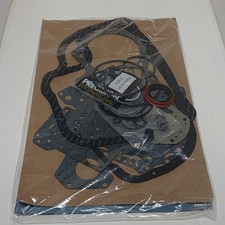
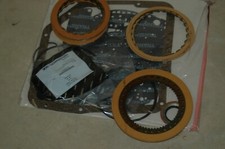
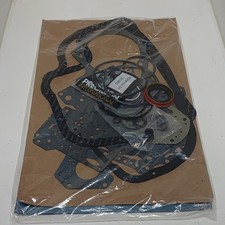
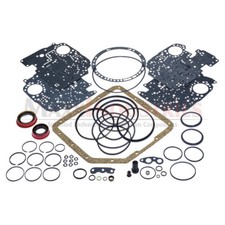
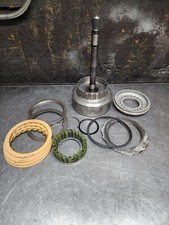
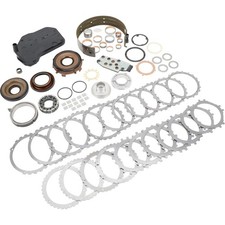
If the pump came out because the unit is tired overall, do the job once: an overhaul kit covers the seals and gaskets throughout, and a remanufactured input drum is worth having on hand if the forward drum shows scoring or cracked feed holes.