Drop a TH400 into Drive or Reverse and get a pause before it takes up — a beat, maybe two, before the truck actually moves — and the first instinct is to assume the worst: burnt clutches, a dying pump, a transmission on its way out. Sometimes that is exactly what it is. But the TH400 is a hydraulically and mechanically controlled transmission with no electronics in the loop, which means every delayed-engagement complaint traces back to one of a short list of physical circuits, and most of them are cheap to confirm and cheap to fix.
This guide works through the circuits in the order they actually fail on this unit, how to tell them apart with a pressure gauge instead of guessing, and what each one costs to put right. Full source list at the bottom.

Rule Out Fluid First
Before touching a wrench, check the obvious: fluid level and condition. A TH400 that is low on fluid aerates it at the pump pickup, and aerated fluid cannot build or hold line pressure the way solid fluid does — the symptom is identical to a worn boost valve or regulator, but the fix is a fluid service, not a teardown. Old, oxidized fluid that has gone dark and smells burnt has lost the frictional and viscosity properties it needs to apply clutches promptly. And a hardened or flattened pickup tube O-ring pulls air into the pump inlet exactly like a cracked pickup tube would. GM’s own 1975 TH400 service section makes the same point before any diagnosis starts: many transmission malfunctions trace back to low oil level, an incorrect dipstick, or an improper reading of the dipstick, so check the level with the unit hot, on level ground, the way the maintenance section describes.
The TH400 was factory-specified for GM's DEXRON fluid, later DEXRON II and DEXRON III under GM specification 6297M. Valvoline's own DX-3 product sheet confirms the lineage: their ATF DX-3 is formulated to meet GM 6297M for a DEXRON III fluid. Current GM-licensed DEXRON VI is back-serviceable wherever those earlier DEXRON specs were called for, so it is the correct modern fill — just make sure whatever is in the pan now is not contaminated, aerated, or badly degraded before you start chasing a mechanical cause.
Cause 1: Boost Valve Wear (Most Common)
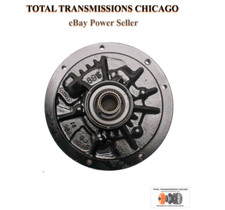
The TH400's boost valve lives in the pump cover and works with the pressure regulator valve to raise line pressure under load and during Reverse. It is a steel valve reciprocating inside an aluminum sleeve, and like any reciprocating valve in a soft bore, it wears the sleeve's inside diameter over tens of thousands of cycles.
Sonnax, whose hard-part kits exist specifically to correct this wear, describes the failure directly: vehicles with GM 400 and 425 transmissions frequently develop poor line rise with soft 1-2 and 2-3 shifts and Reverse engagement difficulties, caused by the reciprocating boost valve wearing the inside diameter of the boost sleeve. Once that clearance opens up, oil that is supposed to enter the modulated throttle valve orifice and raise line pressure instead leaks past the worn valve and exhausts through the Reverse orifice or straight to the sump — so instead of boosting pressure for a firm, prompt Reverse engagement, the circuit bleeds off exactly when it needs to hold.
The tell on this one is that it skews toward Reverse and toward the 1-2 and 2-3 shifts specifically, rather than every range equally. This is not just a Sonnax-only read on the problem: Transmission Digest's coverage of ATI's own replacement pressure regulator and boost valve for the T400 describes the identical symptom split independently, crediting a worn boost valve circuit with soft shifts, slow line pressure rise, and reverse issues, while pointing to the pressure regulator valve specifically for high or uncontrollable line pressure, slow reverse engagement, and slow converter feed. Two separate aftermarket suppliers building parts around the same two symptom patterns is a good sign the mechanism is real and not a one-shop theory.
The fix is a boost valve kit installed in the pump cover, a job that does not require splitting the case if the pump is already out for other work. If the sleeve bore itself is worn beyond what an oversized kit can correct, the pump cover (or the full pump assembly) needs to be replaced rather than re-kitted.
Cause 2: Pressure Regulator Valve Wear
The pressure regulator (PR) valve sets and controls overall line pressure, and it shares the same pump-cover neighborhood as the boost valve. When its bore wears, the symptom picture flips: instead of low, soft pressure, Sonnax's own kit for this bore lists high and uncontrollable line pressure, delayed converter charge, and poor Reverse engagement as the result.
That combination — pressure that is erratic or too high in some ranges, combined with a slow-filling torque converter and a sluggish Reverse — is the signature that separates a PR valve problem from straightforward boost valve wear. Both live in the same casting, so a pump that is being rebuilt for one should get both circuits checked rather than just the one with the obvious complaint.
Cause 3: Case Bushing Walkout and Governor Damage
This is the cause that looks nothing like a hydraulic problem until you trace it back far enough. The TH400's case bushing supports the output shaft where it passes into the extension housing, and per Sonnax, the OE case bushing on this transmission (and on the 4L80-E and 4L85-E units that share its case architecture) has a well-documented tendency to walk out of its housing bore over time.
When it walks, two things happen. First, the output shaft loses its support at that point, which by itself can produce vibration and case damage. Second — and this is the part that connects to delayed engagement — a walked bushing can ruin the governor gear that the output shaft drives. The governor is what tells the valve body how fast the vehicle is moving so it can time shifts correctly; it is a purely mechanical, speed-sensing component on this transmission, with nothing electronic standing in for it. Damage the governor gear and you get shift timing that is erratic, delayed, or simply wrong, even though the valve body, pump, and clutches are all otherwise healthy.
The fix Sonnax sells for this is a no-walk-out case bushing, specifically designed with a retention flange that keeps it from migrating out of the bore the way the factory part does. If the governor gear itself shows visible wear or chipped teeth by the time you find this, replace the governor along with the bushing — a new bushing does nothing for a gear that is already damaged.
How to Actually Diagnose It
The TH400 predates onboard diagnostics by decades, so there is no scan tool PID or trouble code to lean on. The right tool is a mechanical line pressure gauge threaded into the transmission's pressure test port on the case.
- Warm the fluid to operating temperature first. A cold-fluid pressure reading will not match the condition that is actually causing the customer's complaint, especially with a boost valve leak that worsens as fluid thins with heat.
- Check line pressure in Park and Neutral at idle as a baseline.
- Shift to Drive and to Reverse, each at idle and again at a brief, controlled stall test, watching both how high the pressure reads and how quickly it gets there. A slow climb to pressure, especially in Reverse, points at boost valve leakage. Pressure that overshoots, undershoots, or bounces around points more toward the PR valve.
- If pressure looks correct in every range but the shift timing itself is still off — early, late, or inconsistent from one stop to the next — stop suspecting the pump and start suspecting the governor and case bushing instead.
What the numbers should be. GM’s 1975 Buick service manual (Section 7D, Turbo Hydra-Matic 400) gives approximate line pressures with the gauge on the case tap, service brakes holding, engine at 1000 rpm and the modulator vacuum line connected: 60-90 psi in Drive, Neutral and Park, about 150 psi in L1 or L2, and 95-150 psi in Reverse. With the modulator vacuum line disconnected and the engine at 1200 rpm, the same table lists roughly 150 psi in Drive and 244 psi in Reverse at sea level, dropping as altitude rises (about 222 psi in Reverse at 4,000 feet). Exact numbers vary by application and model code, so treat these as the ballpark, not a spec for every TH400. A unit that reaches those figures but takes a beat to get there in Reverse is the boost valve pattern above; one that never makes them points you at the pump, the regulator or the modulator and its vacuum line, which GM says to check for holes, cracks and dents and for leaking rubber connections at both ends.
A vacuum and pressure gauge kit built for this transmission's modulator and test ports takes the guesswork out of getting a clean reading, and is worth having on the bench before you start pulling pans on a delayed-engagement complaint rather than after.
Pressure tested and know which circuit it is?
Boost valve kits, pumps, shift kits and valve bodies for the TH400 — in stock and shipped fast from the USA.
Shop TH400 parts →FAQ
What causes delayed engagement in a TH400?
Most commonly, wear on the boost valve inside the pump cover. Per Sonnax, GM 400 and 425 transmissions frequently develop poor line rise with soft 1-2 and 2-3 shifts and delayed or shuddering Reverse engagement because the reciprocating boost valve wears the inside diameter of its sleeve, letting oil that is supposed to raise line pressure leak past the valve and exhaust through the Reverse orifice or straight to the sump instead. A worn pressure regulator valve bore and a case bushing that has walked out of its bore and damaged the governor gear are the next two most common causes.
Is delayed engagement always a sign of internal transmission damage?
No. Before assuming a worn pump or case, rule out low fluid level, the wrong fluid type, and a hardened or missing pickup tube O-ring, since all three starve or dilute line pressure and produce the same symptom as a worn valve. A fluid and filter service with a correct refill resolves a surprising number of delayed-engagement complaints on a TH400 with no internal wear at all.
How do you diagnose which circuit is causing delayed engagement?
With a mechanical pressure gauge threaded into the TH400's line pressure test port, since this is a pre-electronic, governor-and-vacuum-modulator-controlled transmission with no scan tool PIDs to read. Check line pressure at idle in Park, then in Drive and Reverse at idle and at a controlled stall test, and compare what you see to a known-good baseline for the unit. Low, slow-rising pressure in Reverse specifically points at the boost valve and pump cover; low pressure in every range points more toward the pressure regulator valve or a general pump supply problem.
Can a case bushing really cause a shifting problem on a TH400?
Yes, indirectly. The TH400's output shaft case bushing has a well-documented tendency to walk out of its housing bore over time. Per Sonnax, once it walks, it leaves the output shaft unsupported and can ruin the governor gear that the shaft drives. Since the governor is what tells the valve body what speed the vehicle is traveling, a damaged governor gear produces erratic, mistimed, or delayed shifts even though the valve body itself is undamaged.
What fluid does a TH400 need, and can the wrong fluid cause delayed engagement?
The TH400 was factory-specified for GM's DEXRON (later DEXRON II and DEXRON III, GM spec 6297M) automatic transmission fluid. Current GM-licensed DEXRON VI is formulated to be back-serviceable wherever those older DEXRON specs were called for, so it is the correct modern fill. Using a fluid that is too thin, too old and oxidized, or aerated from a low level will all soften and delay engagement, which is exactly why ruling out fluid condition comes before any teardown.
Sources
- Sonnax — TH400 pump-area parts catalog (boost valve kits 34910-01K/34910-05K, pressure regulator valve kit 34910-03K). Backs the boost valve wear mechanism (oil leaking past a worn boost valve through the Reverse orifice or to the sump, causing low line rise, soft 1-2/2-3 shifts and delayed/shuddering Reverse), and the pressure regulator valve wear symptom set (high/uncontrollable line pressure, delayed converter charge, poor Reverse engagement). sonnax.com/units/453-th400 (pump area)
- Sonnax — TH400 case-area parts catalog (no-walk-out case bushing 34006-SP, governor). Backs the case bushing walkout problem: the OE bushing migrating out of its housing bore, leaving the output shaft unsupported and able to ruin the governor gear the shaft drives. sonnax.com/units/453-th400 (case area)
- Valvoline — ATF DX-3 Product Information Sheet. Backs the TH400's factory DEXRON/DEXRON III fluid specification lineage under GM 6297M, and the DEXRON VI back-serviceability referenced for the modern refill. Valvoline ATF DX-3 PI Sheet (PDF)
- Transmission Digest — "ATI Introduces Pressure Regulator Valve, Boost Valve Kit for T400," October 20, 2023. Independently backs the same two-circuit symptom split as the Sonnax parts above: a worn pressure regulator valve causing high/uncontrollable line pressure, slow reverse engagement and slow converter feed, and a worn boost valve circuit causing soft shifts, slow line pressure rise and reverse issues. transmissiondigest.com
- General Motors / Buick — 1975 Chassis Service Manual, Section 7D, Turbo Hydra-Matic 400 Automatic Transmission (PDF). Backs the factory point that many malfunctions trace to low oil level or improper dipstick reading, the approximate line pressures with vacuum connected at 1000 rpm (60-90 psi Drive/Neutral/Park, 150 psi L1/L2, 95-150 psi Reverse), the vacuum-disconnected 1200 rpm table by altitude (150 psi Drive and 244 psi Reverse at sea level, 222 psi Reverse at 4,000 ft), and the modulator vacuum line and hose checks. teambuick.com (PDF)