A TH400 that has been sitting on old fluid for years usually shows up at the shop for one of two quotes: a pan drop with a new filter, or a "flush" through the cooler lines. Owners ask which is better. The honest answer depends less on the machine and more on what the transmission is — a 1960s-to-1990 fully hydraulic three-speed with a big pan, a gear pump, a strainer, and no computer — and on what condition the fluid and pump are in right now.
This guide walks through what each method actually replaces inside a Turbo 400, what GM's service literature says about flush machines, why a weak TH400 pump makes an exchange machine less effective than people expect, and the service I default to on a high-mileage unit. Every number below comes from GM's own literature, the parts makers' published charts, or ATRA's GEARS Magazine. The full source list is at the bottom.


The Short Answer
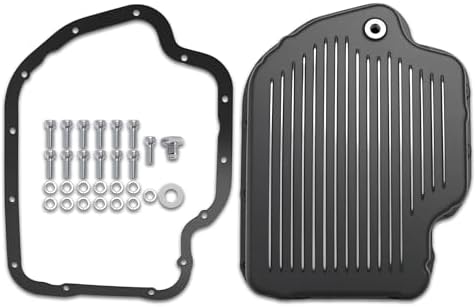
For a TH400, a drain-and-fill with a new strainer and gasket is the service GM documents, the one that lets you see what is in the pan, and the one that renews the filter. A single pan drop only replaces roughly a third to 40 percent of the fluid in the system, so on a neglected unit you repeat it. A cooler-line exchange reaches more fluid in one visit, but it skips the strainer, hides the pan debris from you, and depends entirely on how much the transmission's own pump can push through the cooler circuit. On a tired TH400, that is not much.
What a Pan Drop Actually Replaces on a TH400
GM's 1976 light truck service supplement (ST-330-76) gives the number for a routine service: after draining the sump, add approximately 7.5 U.S. pints (3.75 quarts) of fluid to bring the level back to the dipstick mark. That is all a stock-pan TH400 gives up when you pull the pan.
Now look at what stays behind. TCI's published fluid capacity chart lists the TH400 at 6 quarts with a stock pan, converter not included, and its converter chart lists a new converter at 3 quarts for 10 inches, 3.5 for 11 inches, 4 for 12 inches and 5 for 13 inches. Put a 12-inch-class converter on a stock-pan unit and the system holds roughly 10 quarts before you count the cooler and lines.
| Where the fluid is | Approximate quarts | Reference |
|---|---|---|
| Drained by a stock pan drop | 3.75 | GM ST-330-76 |
| Transmission with stock pan (no converter) | 6 | TCI capacity chart |
| Converter, 11 in. / 12 in. / 13 in. | 3.5 / 4 / 5 | TCI converter chart |
| Cooler and lines | Varies with radiator tank, line length, auxiliary cooler | Measure your own |
So a single pan drop on a typical TH400 replaces something like 3.75 of 10-plus quarts — call it 35 to 40 percent. GEARS Magazine's writeup on high-mileage fluid service puts a general pan drop at about half; the TH400's large converter is why it lands a little lower on this unit. The rest of the old fluid lives in the converter, the drums, the valve body passages and the cooler circuit, and it mixes with what you put in as soon as the engine starts.
What repeated drains get you
Assume each drain pulls about 37 percent of the total and the fluid mixes completely between services. After one drain-and-fill you are at about 37 percent new fluid. A second one, after a short drive, brings it to about 60 percent. A third gets you to roughly three quarters. That arithmetic is the whole reason the "drain and fill twice" advice exists: it gets most of the way to a full turnover without ever hooking a machine to the cooler lines, and every quart that goes in is one you measured.
A deep pan changes the ratio. TCI's 228000 cast aluminum deep pan adds roughly two quarts of sump, so each future drain pulls a bigger share. If you are converting to a deep pan, a pan with a drain plug, or both, do it on the first service so every later service benefits.
What GM Says About Flush Machines
GM's position is written down. Corporate Bulletin 04-06-01-029K (October 2024), which covers 2025-and-prior GM passenger cars and trucks with gasoline engines, states that external transmission fluid exchange or flush machines are not recommended and that use of external machines "may affect the operation or durability of the transmission." Its instruction is direct: "Transmission fluid should only be replaced by draining and refilling" per GM Service Information. The same bulletin notes that GM's analysis of returned parts exposed to aftermarket flushes showed indications of potential damage and shortened durability.
The bulletin is written for modern dealer service, but the model-year language reaches all the way back, and GM never published an exchange procedure for the TH400 in the first place. Its own 1976 literature gives exactly one fluid service for this transmission: drain the sump, replace the strainer, refill, and check the level. Gasoline or diesel, GM's documented TH400 service is the pan drop.
The bulletin does recognize one kind of flushing: transmission cooler flushing after a catastrophic failure, alongside radiators and A/C lines. That is a repair step, not maintenance, and it is covered below.
Why an Exchange Machine Can Underperform on a Worn TH400
Most shop exchange machines do not have their own pump pushing fluid through the transmission. They tap into a cooler line and let the vehicle's own pump, running at idle, push old fluid out while the machine feeds new fluid in at the same rate. On a TH400 that means the exchange is only as fast as the cooler circuit flows at idle.
That flow is not a fixed number. Sonnax publishes SonnaFlow cooler-flow charts measured in gallons per minute, and its TH400 "poor" chart — a unit with a weak pump or restricted filter — shows cooler flow that is reasonable at a steady cruise but falls off sharply as engine rpm drops, getting close to nothing at idle. The TH400's gear pump is fixed-displacement: its output follows engine speed, and wear in the pump body, gears and bushing shows up first as poor low-rpm flow.
Two practical consequences:
- The machine runs long and exchanges less. On a healthy unit the idle exchange moves along. On a high-mileage unit with a worn pump or a strainer that is already loaded up, the same machine trickles, and the fluid it is "exchanging" may be channeling through the path of least resistance rather than turning over the converter.
- The strainer is the bottleneck either way. An exchange does not touch the strainer. If the pickup is partially restricted, you just paid to push fresh fluid through a dirty screen. Our TH400 filter and pan service guide covers why GM warned its own dealers in 1968 that this strainer has no bypass and starves the pump when it clogs.
The Debris Question
The argument against flushing an old transmission is not folklore, but it is often overstated. GEARS Magazine's high-mileage article lays out the mechanism plainly: fresh fluid has strong detergency, and a full exchange can loosen deposits that then move to valves and passages, while a partial service that mixes new and old fluid dislodges less. It recommends adding an in-line magnetic filter to the cooler return line when servicing a higher-mileage unit, and checking that the vehicle actually backs up before you touch the fluid at all.
On a TH400 the "solenoid" part of that warning does not apply — there are no shift solenoids, no TCM and no adaptive tables to relearn. Shift timing comes from the governor, the vacuum modulator and the valve body. That cuts both ways. The unit does not care about a TCM adapting to new fluid, but a sticking 1-2 or 2-3 shift valve, a hanging modulator valve, or a governor valve with a bit of varnish on it is purely mechanical, and loose debris finds those bores first. A pan drop leaves the varnish where it is and lets the new fluid's additives work on it gradually over a few services.
Read the Pan Before You Decide
This is the part of a drain-and-fill no exchange machine can give you. Before you clean the pan:
- Fine gray-black film, nothing else: normal wear. Service it and move on.
- Fibrous friction material: a clutch pack or band is wearing faster than normal. Do a line pressure check before you call it fixed. See our TH400 pressure testing guide.
- Shiny metal flakes or bronze-colored particles: a bushing, thrust washer or gear is coming apart. New fluid will not help, and an exchange will just move that metal around. That unit is a teardown candidate.
- Burnt smell, dark fluid, glazed debris: the unit has already overheated. Expect fresh fluid to expose slipping that the old fluid was masking.
My Default TH400 Service
- Test drive first. Confirm reverse and all three forward ranges engage and shift. If reverse is weak or missing on old fluid, document it and talk to the owner before any service. GEARS cites shops that ended up replacing transmissions after a fluid change on a unit that would not reverse out of the bay.
- Drop the pan warm. Loosen all bolts, pull all but two at one end, and let it tip and drain. Inspect the debris as above.
- Replace the strainer and its pickup O-ring every time. A hard, flattened O-ring pulls air into the pump and acts like a clogged strainer.
- Clean the pan and rail, new gasket, torque in a crisscross pattern. The case is aluminum; follow the gasket or pan maker's torque spec and never chase a leak by overtightening.
- Refill with about 3.75 quarts of a GM-licensed DEXRON-VI, start the engine in Park, cycle through each range, and set the final level on the dipstick at operating temperature.
- On a neglected unit, repeat after a few hundred miles of normal driving. A third service is reasonable if the fluid still comes out dark.
- Add a magnetic in-line filter on the cooler return line on any high-mileage TH400, per the GEARS recommendation.
Interval after that: GM ST-330-76 calls for fluid and strainer every 15,000 miles under severe service (heavy city traffic at 90°F, hilly or mountain driving, frequent towing, commercial use) and every 60,000 miles otherwise. A TH400 in a tow rig, a one-ton, or a hot rod that sees the strip is severe service by GM's own definition.
Fluid: One Spec Either Way
GM's 1976 literature specified DEXRON II for the TH400. You cannot buy DEXRON II by that name, and you do not need to: Valvoline's DEXRON-VI product information sheet states that its GM-licensed DEXRON-VI is "fully back-serviceable" and can be used wherever DEXRON-II or DEXRON-III is recommended. Our TH400 fluid type and capacity guide covers why Type F shows up in race TH400s and why it does not belong in a stock street unit.
When the Cooler Does Need Flushing
If the TH400 failed and is coming out — burnt clutches, metal in the pan, a broken pump — the cooler circuit has to be dealt with before the replacement goes in. Debris trapped in the radiator tank cooler or the lines will flow straight back into a fresh unit. That is the "catastrophic failure" case GM's bulletin recognizes. Flush the cooler and lines in both directions until the fluid runs clean and you have confirmed flow, or replace the cooler outright. Our cooler flush after failure guide walks through it.
FAQ
Is it better to flush or drain and fill a TH400?
For most TH400s, drain and fill. It is the only fluid service GM documented for this transmission, it replaces the strainer, and it lets you inspect the pan for friction material or metal. On a neglected unit, repeat the drain-and-fill two or three times instead of switching to a machine.
How much fluid does a TH400 pan drop replace?
About 3.75 quarts. GM's 1976 service supplement calls for roughly 7.5 U.S. pints after draining the sump, while the transmission holds about 6 quarts with a stock pan plus 3.5 to 5 quarts in the converter, so one pan drop replaces roughly 35 to 40 percent of the total fluid.
Can a flush damage an old TH400?
It can on a high-mileage unit with dirty fluid. Fresh fluid's detergency can loosen deposits that then lodge in shift valves, the governor or the modulator valve bore, and an exchange machine never replaces the strainer. On a TH400 with a worn pump, an exchange also moves fluid slowly because it relies on the transmission's own cooler flow at idle.
What fluid should go in a TH400?
A GM-licensed DEXRON-VI. GM originally specified DEXRON II for the TH400, and licensed DEXRON-VI is back-serviceable wherever DEXRON II or III is recommended. Save Type F for dedicated race builds with matching frictions.
How often should a TH400 fluid and filter be changed?
GM's 1976 literature calls for fluid and strainer every 15,000 miles under severe service, which includes towing, hilly driving, heavy city traffic in hot weather and commercial use, and every 60,000 miles otherwise. Most TH400s still on the road today, in trucks, tow rigs and hot rods, fall under severe service.
TH400 filter and gasket sets, drain-plug and deep pans, and coolers for a proper drain-and-fill — shipped fast from the USA.
Shop TH400 parts →Sources
- General Motors — Corporate Bulletin No. 04-06-01-029K (October 2024), "Unscheduled Supplemental Services (Including Flushing Services and Additives)." Backs the statement that external transmission fluid exchange or flush machines are not recommended, that fluid should only be replaced by draining and refilling per Service Information, the returned-parts finding on aftermarket flushes, and the recognition of cooler flushing after catastrophic failures. Covers 2025 and prior GM passenger cars and trucks with gasoline engines. static.nhtsa.gov (PDF)
- General Motors — 1976 Chevrolet Light Truck Service Overhaul Supplement (ST-330-76), Turbo Hydra-Matic 400 fluid service. Backs the 7.5 U.S. pint (3.75 quart) refill after draining the sump, the DEXRON II fluid specification, and the 15,000-mile severe-service / 60,000-mile normal-service fluid and strainer interval with GM's severe-service definitions. 73-87chevytrucks.com (GM PDF)
- TCI Automotive — Fluid Capacity charts. Backs the 6-quart TH400 capacity with stock pan, the new-converter capacities by diameter (3 qt at 10 in., 3.5 at 11 in., 4 at 12 in., 5 at 13 in.), and the note that a previously run converter retains fluid. tciauto.com
- Sonnax — SonnaFlow Chart: TH400 (Poor). Backs the cooler-flow behavior of a TH400 with a weak pump or restricted filter, with flow falling off sharply as engine rpm drops toward idle. sonnax.com
- GEARS Magazine (ATRA) — Pat Burrow, "Is It Safe to Change Transmission Fluid in High-Mileage Vehicles?" (December 2024). Backs the roughly-half replacement figure for a pan drop, the detergency and dislodged-deposit risk of a full exchange, the in-line magnetic cooler return filter recommendation, and the advice to confirm reverse before servicing. gearsmagazine.com
- Valvoline — DEXRON-VI ATF Product Information Sheet. Backs GM licensing of the fluid and its back-serviceability wherever DEXRON-II or DEXRON-III is recommended. go.lupinsys.com (Valvoline PDF)