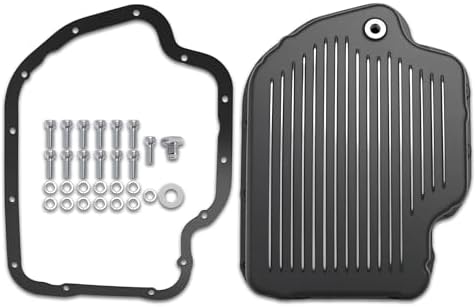
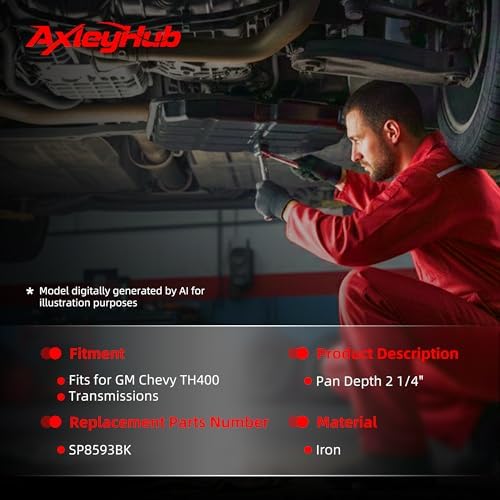
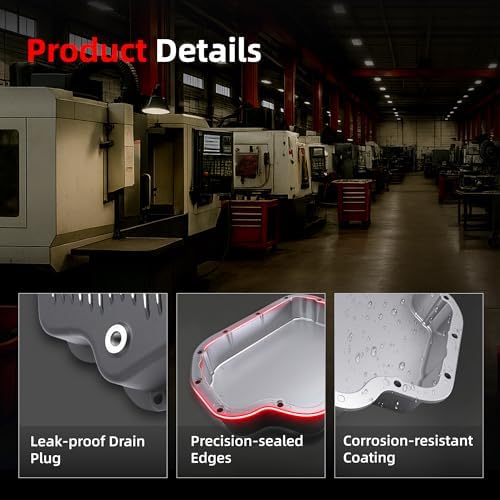
If every fluid change on your Turbo 400 ends with ATF running down your arm, or the pan has been bent by a jack, a curb or road debris and now weeps at the rail no matter how many gaskets you try, this is the part. It is a finned black replacement oil pan for the GM Turbo Hydra-Matic 400 (TH400, later called the 3L80) with a drain plug already installed, plus a pan gasket and a set of bolts and washers. It crosses to reference number SP8593BK and keeps the factory depth, so it fits the stock filter and pickup and hangs no lower than the pan you are taking off.
What the oil pan does in a TH400
The TH400 is a sump design: the pan holds the fluid supply, and the filter and intake pipe sit down in it, feeding the front pump through an O-ring seal in the case. The factory pan has no drain. To service the unit you loosen the bolts and let fluid pour over the rail, which is messy, makes it hard to look at what came out, and tempts people to skip services. With a plug you drain it hot into a clean container, read the fluid and debris, then drop a nearly empty pan to change the strainer. Because the pan rail is also the sealing surface for the whole bottom of the case, a distorted rail is one of the most common TH400 leak points.
Symptoms that point to the pan
- Steady drip or wet film along the pan rail after a gasket has already been replaced
- Dented or creased pan bottom, or a rail that rocks when the pan is set on a flat surface
- Stripped or pulled-through bolt holes from overtightening
- No practical way to drain fluid for regular service on a tow rig or hot rod
- Low fluid causing delayed engagement or slipping, often traced back to a slow pan leak
GM's own TH400 service manual lists three causes of a pan leak: bolts not torqued correctly, a damaged or badly installed gasket, and a gasket face that is not flat. If the first two are already ruled out, the pan is the problem.
How to confirm before you buy
Clean the case and pan with brake cleaner, drive until the fluid is hot, and look again. Fluid that shows first at the pan rail is a pan or gasket leak; fluid that starts higher, at the modulator, cooler line fittings or the shift shaft, will only run down to the pan and fool you. Our TH400 filter and pan service guide walks through the drop, cleanup and what to read in the debris. If the fluid shows heavy clutch material or metal, step through the TH400 common problems guide before spending money on a pan.
Fitment
This pan fits the GM TH400 / Turbo 400 / 3L80 three-speed automatic used in GM trucks, motorhomes, muscle cars and full-size cars from the mid-1960s through about 1990, plus the many swap and street-rod builds that use one. The TH400 pan pattern did not change over that run, but it is easy to confuse with a TH350 or 4L80E pan, so check your unit with our TH350 vs TH400 identification guide. The listing gives the depth as a stock 2-1/4 in; other references for this pattern quote about 2-3/8 in, so treat it as stock depth and check clearance at the crossmember and exhaust on lowered cars. If you want more fluid capacity instead, look at the TCI 228000 deep pan. Not sure what you have? Send the year, the vehicle and the VIN. More parts for this unit are on our TH400 parts page.
Install notes
- Drain what you can through the old pan, then remove bolts in stages and let the back corner drop first.
- Scrape the aluminum case rail with plastic or brass, not steel. Any gouge becomes a leak path.
- Change the strainer and the intake pipe O-ring while the pan is off. The TCI 228500 filter and pan gasket set covers both jobs in one order.
- Set the gasket dry. Torque the 5/16 in pan bolts in a cross pattern to the factory 12 lb-ft and the 1/4 in filter retainer bolt to 10 lb-ft. Overtightening is what bends rails in the first place.
- Snug the drain plug firmly with its washer; check it again after the first heat cycle.
- Refill with Dexron-type ATF, run it through each range, and set the level hot in Park on level ground.
If the pan is coming off because the unit is slipping or shifting soft, plan on the parts that fix the cause, such as the TH400 shift improver kit or a full overhaul kit.