A ZF 6HP that drips on the shop floor is rarely a mystery. Behind BMWs, Jaguars, Land Rovers and Audis the same handful of spots show up again and again, and ZF and BMW have both published service information on the worst of them. The catch is that fluid on a 6HP travels. It runs along the pan rail, collects on the underbody panel and drips from the lowest point, which is often nowhere near the source.
Below are the common spots in rough order of how often I find them, what makes each one fail, and what ZF and the OEMs say to replace. One rule runs through all of it: the 6HP has no dipstick, so every leak repair ends with a temperature-gated level check, or you have swapped one problem for another.


Find the source before you buy a single part
Fluid trails on a 6HP almost always run rearward and downward. The pan is the lowest point of the case, so it collects fluid from everything above it, and the underbody panels on most of these cars catch the drips and spread them out. Three habits save a lot of wasted gaskets:
- Clean it, then make it leak. Degrease the bellhousing, the area around the connector, the pan rail and the cooler line fittings. Drive it to full operating temperature and look again before the fluid has time to run. Fresh ATF is wet and clean; old seepage is caked with road dirt.
- Use dye on stubborn ones. A UV dye pass shows exactly where the fluid exits. Use a dye that is safe for the transmission and keep the dose small; ZF's lubricant list TE-ML 11 is blunt that additives of any kind added to the oil are not permitted, so do not use a "stop leak" product as a diagnosis or a fix.
- Know what else lives nearby. On xDrive and 4WD applications the transfer case bolts right behind the 6HP, and its input seal can wet the back of the transmission case. Engine oil from a rear main seal or oil pan gasket also shows up at the bellhousing. Confirm the fluid is ATF and confirm which housing it is coming out of.
1. The mechatronic guide sleeve (the big one)
The external transmission harness plugs into the mechatronic through a plastic guide sleeve that passes through the case wall just above the pan. The sleeve carries O-rings: one seals against the case, the other against the connector. When those O-rings harden with heat and age, fluid weeps out around the connector and runs down onto the pan, which is why so many sleeve leaks get diagnosed as pan gasket leaks.
With the engine off the fluid level may sit below the sleeve, so a car can look dry in the morning and drip after a long drive. Look for fluid on the connector body and the case around it, not just on the pan.
What BMW and ZF say
BMW addressed this in its bulletin on mechatronic sealing sleeve seepage for 6HP-equipped E53, E60-E66, E85 and E90-E93 models, summarized in the trade press as "Leaky Bimmer." The key points:
- Oil wetness around the sleeve is not a reason to replace it. Replace the sleeve when the leak shows real fluid loss, such as fluid collecting on the underbody panel.
- The repair is the sealing sleeve (BMW 24 34 7 588 725) plus a new pan gasket, with a drain and refill. On plastic-pan units BMW also calls for a new drain plug.
- Lubricate both sleeve O-rings with transmission fluid and push the sleeve fully into the case before closing the locking tab.
- After installation, the gap between the harness connector and the case should be no more than 3 mm, and the connector should lock without excessive force. A gap of roughly 7-8 mm means the sleeve is not seated.
That last point matters more than the leak. A sleeve that is not fully seated can cause intermittent communication faults between the mechatronic and the harness (BMW lists fault codes 5079 and 507A and the transmission emergency program), and forcing the connector can permanently damage the pins in the mechatronic connector X8500. Those pins cannot be repaired, so a rushed sleeve job can turn an $85 seal kit into a mechatronic replacement.
ZF's own Service Information 50324, "Guide Sleeve Mechatronics for ZF Automatic Transmission 6HP," gives the generic sequence: disconnect the battery, release the bayonet catch on the plug and pull it, remove the pan, release the sleeve's locking device and pull the sleeve, lightly oil the seals on the new sleeve with ZF LifeguardFluid, insert it in the correct position, engage the lock, reconnect the plug until the bayonet engages, refit the pan to torque in sequence, fill, check the level, test drive and check leak tightness. ZF also flags ESD protection: do not touch the mechatronic contacts.
2. The pan gasket and the plastic pan
The 6HP was built with three pan materials, and each has its own torque and filter arrangement per ZF Service Information 50145:
| Pan material | Pan bolt torque | Filter | Leak notes |
|---|---|---|---|
| Aluminum | 4 Nm + 45° | Separate part | Gasket and sealing surface; do not overtighten |
| Plastic | 10 Nm | Integrated in the pan | Pan can warp; gasket groove must be clean |
| Steel plate | 12 Nm | Separate part | Check flange for bends from jacking |
Plastic pans are the common leaker. Heat cycles warp the flange, and once the gasket has taken a set it will not reseal on a distorted pan. BMW's sleeve procedure includes two details that apply to any plastic-pan gasket job: clean the gasket groove in the pan, and keep the sealing surface oil-free when the pan goes back on. BMW also states that if a leak returns at the plastic pan gasket, the pan and gasket are replaced together. Since the filter is molded into the plastic pan anyway, replacing the pan assembly is usually the right call on a high-mileage unit.
Most repeat pan leaks come from bolt order and torque. Tighten crosswise from the center out, and use a torque-angle gauge for the aluminum pan's 4 Nm plus 45-degree spec.
3. Drain and filler plugs
Both plugs use sealing rings that are meant to be replaced every time. ZF's oil change bulletin lists these values for the BMW 6HP19/21/26/28, Jaguar 6HP26 and Land Rover 6HP26X:
| Plug | Thread / hex | Torque |
|---|---|---|
| Drain plug | M24 x 1, 10 mm hex | 8 Nm |
| Filler plug | M18 x 1.5, 8 mm hex | 35 Nm ± 3.5 Nm |
| VW 6HP19A drain / filler | M10 x 1 / M30 x 1.5 | 12 Nm / 80 Nm |
Note how low the drain plug value is on most applications. A reused seal and a plug run up "good and tight" into a plastic pan is a cracked boss waiting to happen. If the drip is a steady bead at the drain plug on a plastic pan, inspect the threads and boss before blaming the seal.
4. Cooler line connections at the case
The cooler lines plug into the side of the case with O-ring sealed fittings. When those O-rings harden or get nicked during a previous repair, you get a wet patch on the side of the case that runs down onto the pan rail on that side.
BMW's handling of the same connection on the later 8HP is instructive. In SI B24 02 15, BMW traced fluid loss at the cooler line connections to damaged O-rings caused by unfavorable connection tolerances, and told technicians to replace the O-rings and the cooling lines, warning that replacing only the O-rings may cause a repeat failure. That bulletin is for the 8HP, not the 6HP, but the lesson carries over: if a 6HP cooler fitting leaks again after new O-rings, look at the line end itself for a worn, bent or corroded spigot, and replace the line.
Check the cooler hoses up front too. Some 6HP applications run a thermostat valve in the cooler circuit that ZF says only opens at 75°C or more, so a hose that leaks only after a long highway run may be on that hot side.
5. The overflow vent: a leak that is really an overfill
This one sends people chasing seals that are fine. ZF's Service Information 50145 warns that if the oil level is too high, the excess oil leaks out of the transmission through the overflow when heated, and that escaping oil can ignite on hot parts such as the exhaust. Wet fluid around the vent after a recent service, especially one done with an exchange machine or by "filling until it seemed right," points to the level, not a seal.
The fix is to set the level properly. Per ZF: confirm idle at 650-950 rpm, fill until fluid runs from the filler hole with the engine off, cycle through the gears per the application's version, then at 30-35°C transmission oil temperature add fluid until it runs out, and close the plug once it reaches about 40°C and only single drops come out. The oil must never exceed 50°C during the check. Our ZF6HP flush vs drain-and-fill guide walks the full procedure.
The flip side: ZF states that a level that is too low damages the transmission. A unit that has been dripping for months is probably low, which shows up as slipping and flare before any warning light.
6. Converter seal and output seal
Fluid at the bottom of the bellhousing that is confirmed as ATF, not engine oil, usually means the torque converter hub seal at the front of the pump. Fluid at the tail usually means the output shaft seal, or on AWD units, the transfer case input seal mentioned above.
Both need the transmission or the driveline partly out, so get the diagnosis right first. On the front seal, a seal that failed at moderate mileage is often a symptom: excessive clearance between the converter hub and the pump bushing lets the hub move and walk the seal lip. A new seal on a worn hub or bushing leaks again. Inspect the hub for grooving and the bushing for wear, and do the sleeve and pan while the unit is out.
Internal leaks: the ones that never hit the floor
Not every 6HP leak is external. The mechatronic is fed through sealing tubes and an adapter between the case and the valve body, and when those seals harden, fluid pressure leaks internally instead of onto the ground. The symptom is shift quality: slow or harsh engagements, flare and drifting adaptations. ZF Aftermarket now packages 6HP mechatronic sealing kits containing guide sleeves, adapters, double-ring gaskets and sealing tubes specifically for mechatronic removal and repair. If the mechatronic comes out for any reason, those seals get replaced; reusing them is false economy. Our ZF6HP limp mode guide covers the shift-quality side of that diagnosis.
Refill and verify after any leak repair
- Fluid: ZF's TE-ML 11 assigns ZF LifeguardFluid 6 (ZF No. S671 090 255) to most of the family, including the 6HP19, 6HP21, 6HP26, 6HP28 and 6HP32, with listed exceptions such as the Audi Q7 6HP19X and the 6HP28AF that take LifeguardFluid 8. Check your code in the ZF6HP fluid type and capacity guide.
- Level: set it by temperature as above, not by how much came out.
- Leak check: ZF's last step in SI 50324 is to check leak tightness after the test drive. Do it hot, with the car level, and look again a day later.
Shop the part for this fix: 6HP26 guide sleeve and connector seal kit
The sleeve is the most common 6HP leak, and this 7-piece sleeve and connector seal kit covers it in one box while the pan is down.
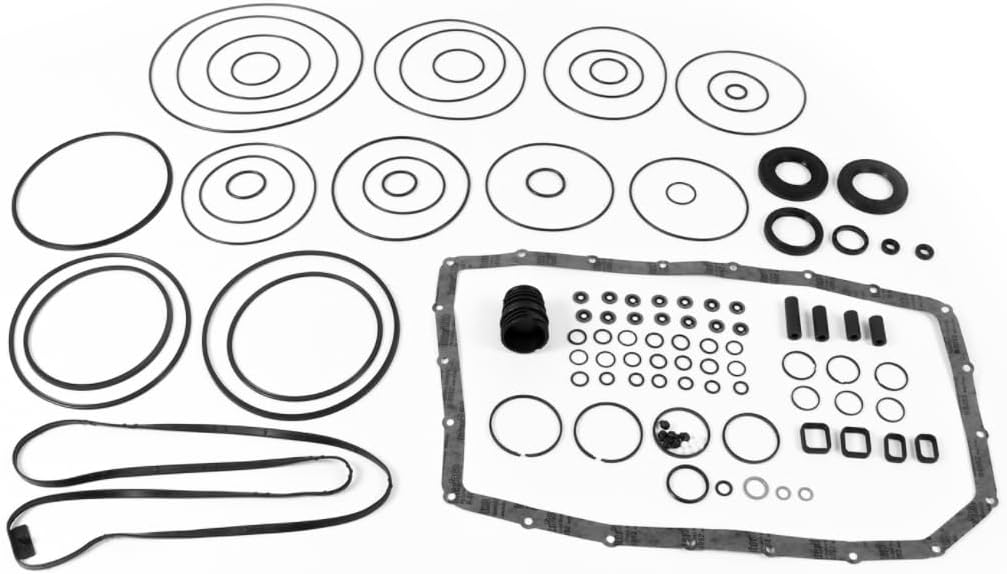
View the seal kit at Core Transmission Parts → All rebuild kitsZF6HP guide sleeve seal kits, pan and filter kits, overhaul gasket sets and genuine LifeguardFluid 6 for the refill.
Shop ZF6HP parts →Related guides
- ZF6HP Filter and Pan Service Guide
- ZF6HP Flush vs Drain-and-Fill
- ZF6HP Fluid Type and Capacity
- ZF6HP Overheating Prevention
- ZF6HP Limp Mode: Causes and How to Diagnose It
FAQ
Where does a ZF6HP transmission usually leak?
The most common spot is the mechatronic guide sleeve, the plastic sleeve where the external harness connector passes through the case above the pan. After that come the pan gasket or plastic pan, the drain and filler plug seals, the cooler line O-rings at the case, and the torque converter seal at the bellhousing. Fluid also runs back along the pan rail, so the wettest spot is often not the source.
How do I know if the 6HP mechatronic sleeve is leaking?
Look for fresh fluid on the connector itself and on the case directly around it, not just on the pan. BMW's bulletin on the sleeve points out that light oil wetness around the sleeve is normal seepage and does not justify the repair; a real leak shows as fluid collecting on the underbody panel or dripping. Fluid in the connector pins together with transmission communication faults is a strong sign too.
Can I just replace the 6HP pan gasket to stop a leak?
Only if the gasket is the source. On plastic pans the gasket groove has to be cleaned and the sealing surface kept oil-free, and BMW says that if a leak comes back at a plastic pan gasket the pan itself should be replaced. ZF's procedure also calls for new seals on the drain plug and filter every time the pan comes off, and the correct pan bolt torque for the pan material.
Why is my ZF6HP leaking from the vent after a fluid service?
It is almost always overfilled or the level was set too cold. ZF warns that if the level is too high, the excess oil leaks out through the overflow once it heats up and can ignite on the exhaust. Re-check the level by the temperature procedure, adding fluid at 30-35 C and closing the plug at about 40 C, never above 50 C.
Is it safe to drive a ZF6HP with a fluid leak?
A light seep can be monitored, but the 6HP has no dipstick, so you cannot see the level dropping. ZF states that a low oil level damages the transmission, and a sleeve leak can also let fluid reach the mechatronic connector. Fix an active drip promptly and set the level correctly afterward rather than driving on a guess.
Sources
- ZF Friedrichshafen AG — Service Information 50324 EN, "Guide Sleeve Mechatronics for ZF Automatic Transmission 6HP" (09.2018). Backs the guide sleeve replacement sequence: bayonet plug release, locking device, oiling the new sleeve seals with LifeguardFluid, pan torque in sequence, level check, test drive and final leak-tightness check, plus the ESD warning. aftermarket.zf.com (PDF)
- ZF Friedrichshafen AG — Service Information 50145 EN, "Oil change kit for ZF 5HP/6HP automatic transmission" (03.2023). Backs the overfill warning (excess oil leaks through the overflow when hot and can ignite on the exhaust), the low-level damage warning, new seals on filter, pan and drain plug, pan bolt torque by pan material, drain and filler plug sizes and torques, the 650-950 rpm idle check, the 30-35°C / 40°C / 50°C level procedure and the 75°C thermostat-valve note. aftermarket.zf.com (PDF)
- Vehicle Service Pros — "Leaky Bimmer" (July 2012), summarizing BMW's mechatronic sealing sleeve seepage bulletin. Backs the sleeve part number 24 34 7 588 725, the wetness-vs-real-leak criterion, sleeve and pan gasket replacement, O-ring lubrication and full seating before locking, the 3 mm connector gap check, fault codes 5079/507A, the X8500 pin damage warning, the plastic-pan groove cleaning and drain plug replacement, and replacing the plastic pan if the gasket leak returns. vehicleservicepros.com
- BMW of North America — SI B24 02 15, "8HP: Transmission Fluid Loss from Cooler Lines Connections" (June 2015), via NHTSA. Backs the cooler-line O-ring failure cause (unfavorable connection tolerances) and the instruction to replace the O-rings and the lines, since O-rings alone may cause a repeat failure. static.nhtsa.gov (PDF)
- ZF Friedrichshafen AG — List of Lubricants TE-ML 11. Backs the ban on additives of any kind and the LifeguardFluid 6 (S671 090 255) vs LifeguardFluid 8 assignment by 6HP code. aftermarket.zf.com (PDF)
- Aftermarket International — "ZF Aftermarket strengthens its portfolio with new sealing kits for mechatronics" (April 2025). Backs the contents of ZF's 6HP/8HP mechatronic sealing kits (guide sleeves, adapters, double-ring gaskets, sealing tubes) and their use during mechatronic exchange or repair. aftermarketinternational.com