P0778 is a narrow code, but on the ZF6HP19/26/32 family it needs more context than the generic definition gives you. This transmission case went into more unrelated brands running more different control software than almost anything else on the road -- BMW, Jaguar, Land Rover, Audi, VW and others, each with its own TCU calibration. The SAE-generic definition is the same everywhere: Pressure Control Solenoid B Electrical, an electrical-circuit fault on one of the linear solenoids that regulate line and clutch pressure, as opposed to a hydraulic performance deviation. Which physical solenoid gets labeled "B" by the diagnostic trouble code, though, is decided by each automaker's own control-module software, not by a single ZF-wide chart. That distinction changes how you approach the diagnosis, and it's the first thing worth sorting out before you reach for a wiring diagram built for the wrong brand.
This guide covers how to confirm you're actually looking at a Generation 1 unit (the 6HP19, 26 and 32), the real bench spec for testing the solenoid circuit, why that spec alone won't catch the most common failure mode, and a documented real-world case where an "electrical" transmission code traced back to a bad ignition coil.
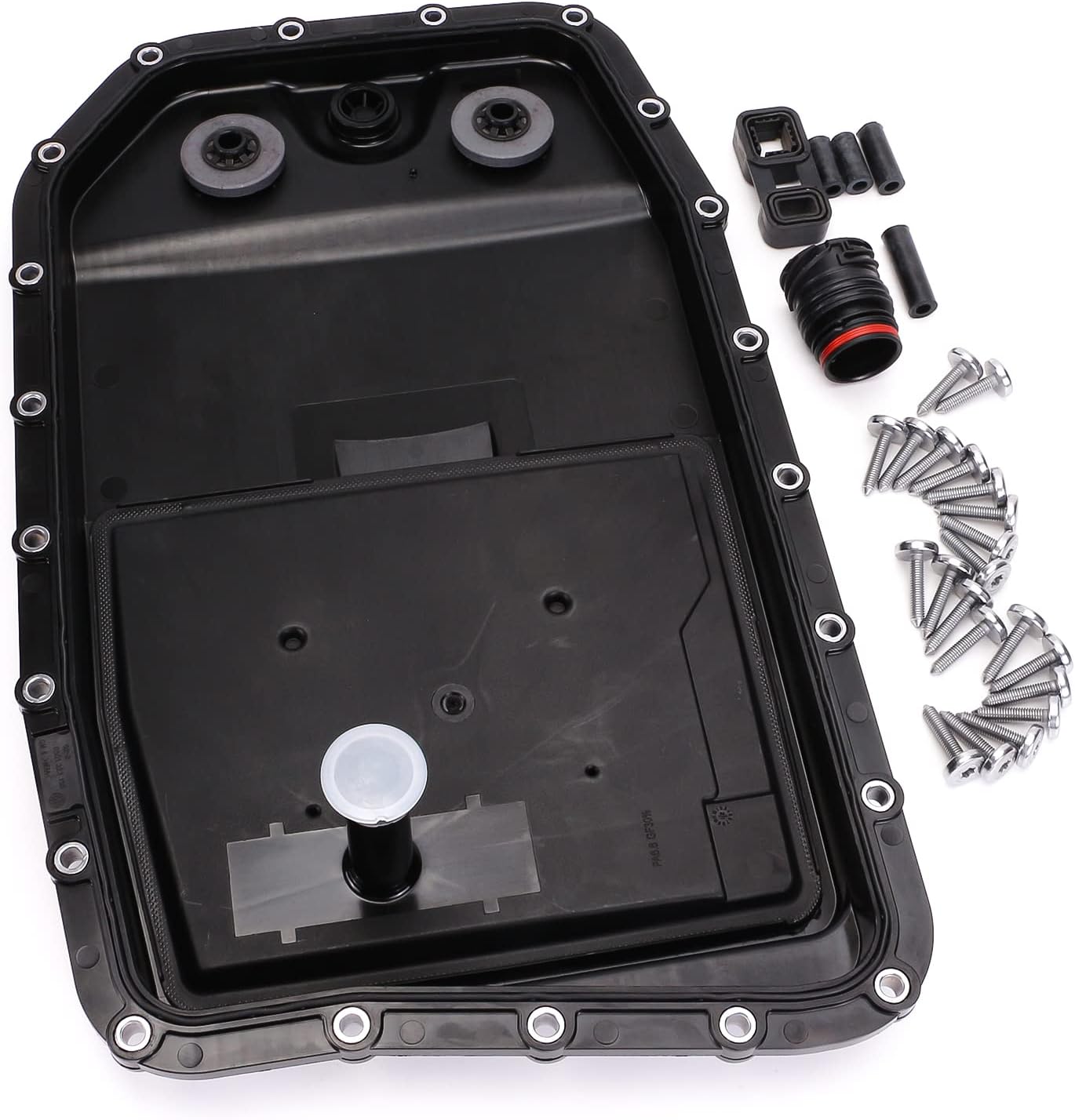
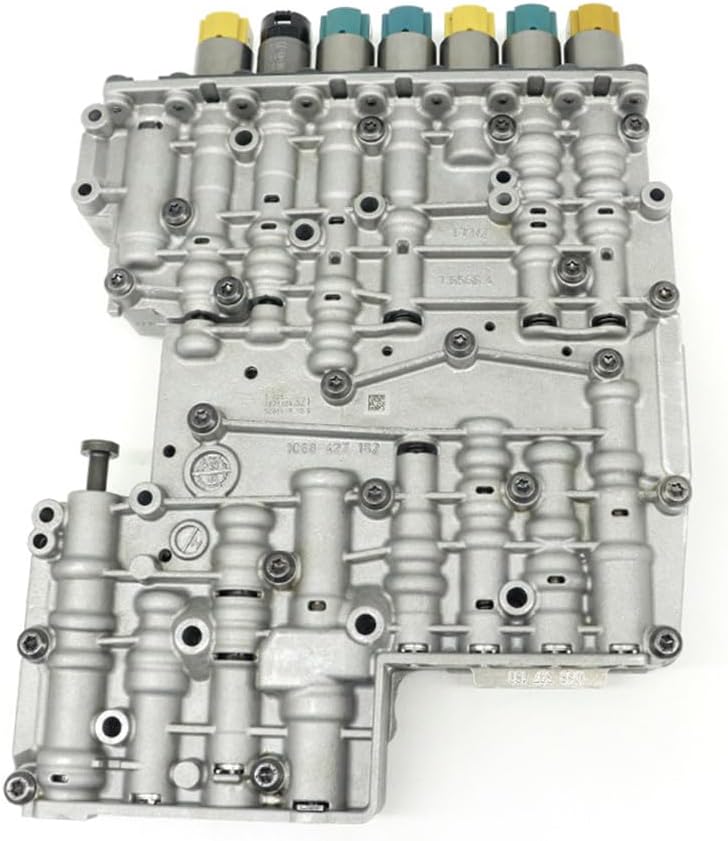
Confirm You're Looking at a Generation 1 Unit
Before you test anything, confirm which half of the ZF6HP family you actually have. Sonnax's published identification guide for this platform splits it into two generations by case side: Generation 1 covers the ZF6HP19, 26 and 32, built 2002 through 2005, and Generation 2 covers the ZF6HP21, 28 and 34, built 2006 and later. In 2006 the mechatronic unit was upgraded to increase oil flow and shorten shift duration, and that revision changed enough internally that pressure regulator valves and sleeves between the two generations are not interchangeable. A 6HP26 is always Gen 1 by definition, but double-check this on the valve body casting rather than assuming by displacement or model year alone, since some BMW six- and seven-series cars with six accumulators use a different-sized pressure regulator valve, most commonly on units built with the A053/B053 separator plate -- a sub-variant within Gen 1 that uses different valve sizes and locations than non-053 Gen 1 units.
There's a second split that matters just as much for solenoid count: Gen 1 units come in an "M" version, with a manual valve for Park/Reverse/Neutral/Drive, and an "E" version, where that function is solenoid-controlled instead. The M version runs seven solenoids -- six EDS (linear, pressure-control-type) solenoids plus one MV solenoid. The E version adds two more solenoids dedicated to electrically controlling the shift into and out of Park, for nine total. Mixing up which version you're working on before you order a solenoid kit or count pins on a connector is a fast way to waste a diagnosis.
Why "Position B" Isn't the Same Wire On Every Chassis
Sonnax's own internal documentation for this solenoid family doesn't use generic A-through-H lettering at all. It labels the Gen 1 solenoid bank as EDS1 through EDS6 (the linear, duty-cycle-controlled solenoids that regulate clutch and line pressure) plus MV1, MV2 and MV3 (on/off solenoids, with MV1 unique to Gen 1 -- that position is renumbered EDS7 on Gen 2 units). In the same symptom chart, Sonnax identifies EDS2 as the solenoid controlling the "Clutch B" pressure regulator valve -- but that "B" refers to the physical B clutch pack inside the transmission, a hydraulic-element letter, not the generic OBD-II solenoid letter your scan tool is reporting. The two naming systems can coincide on some vehicles and not on others, because the generic P0778 "B" designation is something each automaker's TCU firmware assigns during calibration, not a fixed ZF-wide standard.
Practically, that means a 6HP26 behind a BMW EGS module, a Jaguar/Land Rover TCM, and an Audi 0B5-family controller can each wire "Pressure Control Solenoid B" to a different physical connector pin and a different EDS position. Pull the wiring diagram for your specific chassis and model year before you put a meter on a pin you're assuming is correct from a generic diagram -- the wrong assumption here is the single most common way to spend an afternoon testing a solenoid that was never the one in question.
The Bench Spec: What a Healthy Solenoid Reads
Once you've identified the correct circuit, Sonnax's installation and testing booklet for this Gen 1 family gives an explicit, documented spec: 5.0 ohms at 20°C (68°F), measured with the mechatronic circuit board removed so you're reading the coil in isolation. A separate Sonnax instruction sheet, written for the solenoid test manifold kit used on this same platform, gives a slightly wider 5 to 6 ohm range at 68°F for the orange, blue and yellow capped solenoids used here -- a close, overlapping figure from a different testing context, so treat roughly 5 ohms as your working center point and a reading clearly outside that window, not a tenth of an ohm either way, as confirmation of a real coil fault.
Both documents carry the same caution: do not use an ohmmeter with more than 0.6 volts of test supply, since a higher-voltage meter can return a false reading or stress the winding. Sonnax also explicitly advises against attempting circuit testing through the 16-pin connector -- get to the solenoid directly, with the circuit board removed, rather than trying to back-probe pins at the harness connector.
Don't Stop at Resistance: Check the Mechanical Seal
A resistance reading in spec doesn't clear the solenoid. Sonnax's own product documentation for this exact family of solenoids -- shared across the ZF6HP19/21/26/28/32/34 and the related Ford 6R60/6R75/6R80/6R100 -- states plainly that an inability to maintain an internal mechanical seal, not an open or shorted coil, is the leading cause of solenoid failure. A solenoid can bench-test at a clean 5 ohms and still be bad, because resistance tells you about the coil, not about whether the solenoid can hold hydraulic pressure internally.
Sonnax sells a dedicated tool for this: the 95430-VTK solenoid test manifold kit, used with the VACTEST-01K vacuum test stand. You insert the solenoid into the color-matched manifold -- orange, blue or yellow, matching the ZF6 solenoid cap colors -- apply vacuum, and read the gauge. Per Sonnax's instructions, a good solenoid holds over 21 in-Hg; any reading below 20 in-Hg means the solenoid is compromised and should be replaced. A solenoid with a borderline internal seal can produce an erratic current or voltage signature on its circuit that the control module reads as an electrical fault, even though the real problem is mechanical wear rather than a wiring or coil defect -- which is exactly the kind of case where a "new solenoid" that was never vacuum-tested doesn't fix the code.
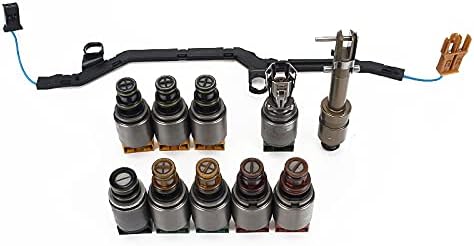
ZF 6HP26 Transmission Solenoid Kit with Harness, 11-Piece
If the connector and harness check out, the coil resistance is confirmed in spec, and the vacuum test still shows a compromised seal, replace the solenoid pack rather than one coil -- the TCM's learned flow rate per position makes a full-kit swap the more reliable fix.
View the 11-piece solenoid kit with harness →Reusing Solenoids? Keep Them In Their Original Bore
If you pull the valve body and any of the original solenoids test good, Sonnax's documentation is specific on reinstallation: the TCM adapts a learned flow rate to each solenoid based on its physical bore position, so a reused solenoid should go back into the exact bore it came out of. Mixing up positions, even among solenoids that look identical, can create a shift-quality complaint that looks like a new failure but is really a mismatched flow-rate adaptation. After any solenoid or valve body service, reset the adapts or clear keep-alive memory -- the control module is capable of some self-adaptation without a full reprogram, but starting from a clean adaptation baseline avoids chasing a phantom problem that's really just the TCM relearning.
A Real-World Lesson: "Electrical" Doesn't Always Mean the Transmission
Transmission Digest published a shop case directly on point for this exact unit. A 2009 BMW with a ZF6HP26 kept dropping back into Park, with no transmission fault codes set at all. The shop's first move -- replacing the rubber bridge seal between the valve body and the pump -- didn't fix it. The actual cause turned out to be a cylinder 1 misfire from a failing ignition coil; once the coil was replaced, the transmission complaint was also resolved. The write-up attributes this to high-voltage interference from the bad coil reaching the mechatronic's inputs.
That case wasn't a P0778 specifically, but the lesson transfers directly: an "electrical" fault that a control module logs against a transmission circuit doesn't automatically mean the fault originates inside the transmission. Before you spend money on a solenoid pack or a valve body for an electrical code, check engine-side electrical health -- misfires, a failing coil, a corroded or missing ground -- especially on a circuit that routes anywhere near ignition-system wiring. It's a cheap check relative to a valve body teardown, and on this platform it has a documented track record of being the actual fix.
Already in the Valve Body? Check the Pressure Regulator Bore
If you're tearing down the valve body to replace a confirmed-bad solenoid, it's worth checking the pressure regulator bore while you're in there -- a separate, common Gen 1 wear point that produces overlapping symptoms: erratic line pressure, flare or harsh shifts, slips in forward and reverse, and TCC slip. Sonnax sells an oversized pressure regulator valve kit for non-053 Gen 1 units and a separate kit for units built with the 053 separator plate; the two are not interchangeable. Confirm the separator plate's stamped identification number against Sonnax's published application chart before ordering, since the wrong kit for your plate code simply won't fit or seal correctly.
Fluid and Torque Reference
ZF's own aftermarket parts catalog lists ZF LifeguardFluid 6 as the specified fluid across the 6HP19/26/28/32 family, with the fluid's friction behavior tuned specifically to these transmissions -- don't substitute a generic "universal" ATF. Sonnax's own fluid reference for this platform lists the ZF fluid number as S671 090 0255, cross-referenced to Shell's M-1375.4 formulation.
| Spec | Value |
|---|---|
| Fluid (ZF) | ZF LifeguardFluid 6, part S671 090 0255 (Shell M-1375.4) |
| Complete fill, approx. | 9.5 qt. / 9 L |
| Service fill, approx. | 4.2 qt. / 4 L |
| Solenoid coil resistance | 5.0 ohms at 20°C/68°F, circuit board removed |
| Solenoid vacuum test (95430-VTK) | Pass: holds over 21 in-Hg • Fail: below 20 in-Hg |
| Mechatronic-to-case / valve body half bolts | 8 Nm / 71 in-lb |
| Metal oil pan-to-case | 14 Nm / 10 ft-lb |
| Plastic oil pan-to-case | 10 Nm / 89 in-lb |
| Pump bolts to case | 10 Nm / 89 in-lb |
| Output shaft flange nut | 60 Nm / 44 ft-lb |
After any solenoid, valve body or fluid service, run a partial drive-cycle relearn: bring the fluid to operating temperature (roughly 80°C/175°F per Sonnax's guidance for this family), then perform six light throttle-up and coast-down shift cycles. Skipping this step is a common reason a correctly repaired unit still shifts rough on the test drive.
Diagnostic Order: What to Check, In What Sequence
- Confirm the generation and version. Read the valve body casting and separator plate code to verify Gen 1 (6HP19/26/32) versus Gen 2, and confirm M-shift versus E-shift before counting solenoids or ordering parts.
- Pull your chassis's own wiring diagram. Don't assume a generic ZF6 diagram applies to your specific brand and model year -- confirm which physical pin your TCU actually calls "Pressure Control Solenoid B" before testing.
- Rule out engine-side electrical faults. Check for misfires, a failing ignition coil, or a corroded ground near the harness run -- a documented real-world cause of "electrical" transmission complaints on this platform.
- Inspect the connector and harness. Check pins for corrosion or push-back and the harness for chafe before condemning the solenoid coil.
- Bench-test the solenoid resistance. Roughly 5 ohms at 68°F with the circuit board removed, using an ohmmeter under 0.6V.
- Vacuum-test the solenoid's internal seal. Over 21 in-Hg is good; below 20 in-Hg means replace it, even if the resistance read fine.
- Repair or replace accordingly -- a wiring repair for a confirmed circuit fault outside the coil, a full solenoid kit for a confirmed coil or seal failure (returning any reused solenoids to their original bores), or a valve body if the pressure regulator bore is also worn.
- Run the drive-cycle relearn after any repair: fluid at operating temperature, six light throttle-up and coast-down cycles.
Worked in that order, an electrical code on this transmission gets diagnosed as what it actually is -- a specific circuit problem, which might be a wire, a connector, an unrelated engine-side fault, or a genuinely failed solenoid -- instead of becoming an expensive guess that starts and ends at "replace the solenoid."
Shop ZF6HP26 solenoid kits, valve bodies, connector seal kits and ZF-spec fluid — shipped fast from the USA.
Shop ZF6HP parts →FAQ
What's the difference between P0778 and P0776, P0777 or P0779 on a ZF6HP26?
All four codes describe the same generic circuit, Pressure Control Solenoid B, but different failure types. P0776 is a performance code: the TCM commanded a pressure and the hydraulic result didn't match, which can happen on a perfectly healthy electrical circuit if a valve body bore is worn. P0777 is stuck-on. P0779 is intermittent. P0778 means the control module's driver circuit itself saw an electrical fault -- an open, a short to ground, a short to voltage, or a current reading outside the expected window -- which points you at wiring, a connector, or a solenoid coil rather than at hydraulic wear.
Is a ZF6HP26 the same solenoid layout as a ZF6HP28?
No. Sonnax's own identification guide splits this family into Generation 1 (ZF6HP19, 26 and 32, built 2002-2005) and Generation 2 (ZF6HP21, 28 and 34, built 2006 and later), with a mechatronic upgrade in Gen 2 that increased oil flow and shortened shift duration. The two generations use different-sized pressure regulator valves and sleeves that are not interchangeable, and the solenoid numbering differs: Gen 1 has a dedicated MV1 solenoid that Gen 2 does not, with that position renumbered EDS7 instead. Confirm your generation from the valve body casting before ordering solenoid or valve body parts.
What should the pressure control solenoid read on a multimeter for this code?
Sonnax's installation and testing booklet for this Gen 1 family specifies 5.0 ohms at 20°C (68°F), checked with the mechatronic circuit board removed so you're reading the coil in isolation rather than through the TCM's circuitry. A separate Sonnax instruction sheet for the solenoid test manifold kit gives a close 5 to 6 ohm range at 68°F for the orange, blue and yellow capped solenoids used on this platform. Both documents also warn against using an ohmmeter with more than 0.6 volts of test supply, since a higher-voltage meter can return a false reading.
Can an electrical problem somewhere else on the car cause a transmission solenoid code?
Yes, and it's a documented failure mode on this exact transmission. Transmission Digest covered a 2009 BMW with a ZF6HP26 that kept dropping back into park with no transmission fault codes set at all. A shop replaced the bridge seal between the valve body and the pump with no change, then found and repaired a cylinder 1 misfire caused by a failing ignition coil -- which cleared the shift complaint. The write-up attributes the fault to high-voltage interference from the bad coil reaching the mechatronic's inputs, a reminder to check engine-side electrical health before condemning a transmission solenoid circuit.
Does P0778 mean the solenoid itself is bad and needs to be replaced?
Not necessarily, and resistance alone won't tell you. Sonnax's own documentation for this solenoid family states that an inability to hold an internal mechanical seal, not an open or shorted coil, is the leading cause of failure -- a solenoid can bench-test at a perfect 5 ohms and still be bad. Vacuum-test it with Sonnax's 95430-VTK manifold kit and VACTEST-01K stand: a good solenoid holds over 21 in-Hg, and a reading below 20 in-Hg means it should be replaced. Check the connector, harness and ground path too, since an electrical-fault code can come from wiring rather than the solenoid.
Sources
- Sonnax — ZF6-6R60-ZIP Kit Identification Guide & Installation/Testing Booklet, ZF6HP19/26/32 (Gen. 1) & Ford 6R60/6R75/6R80 (2009-2014). Backs the Gen 1/Gen 2 split and timeline, the M-shift vs. E-shift solenoid counts, the EDS1-6/MV1-3 solenoid naming and the EDS2 "Clutch B" regulator valve label, the 5.0-ohm at 20°C/68°F resistance spec with circuit board removed, the under-0.6V ohmmeter caution, the 16-pin connector testing caution, the learned-flow-rate/solenoid-bore caution, torque specs, and fluid fill capacities and part number. cdn.transend.us (Sonnax document)
- Sonnax — Solenoid Test Manifold Kit 95430-VTK Instructions. Backs the vacuum-seal test method and tooling (95430-VTK with VACTEST-01K), the 21 in-Hg pass / below-20 in-Hg fail thresholds, the 5-6 ohm at 68°F resistance range for orange/blue/yellow capped solenoids, and the statement that internal mechanical sealing failure, not electrical failure, is the leading cause of failure in this solenoid family. cdn.transend.us (Sonnax document)
- Sonnax — "ZF6HP19-26-32 Generation 1, Ford 6R60-6R75-6R80, ZF6HP21-28-34 Generation 2 Identification Guide." Backs the Gen 1/Gen 2 case-side identification method and the A053/B053 separator plate caveat for six-accumulator BMW applications. sonnax.com
- Sonnax — Oversized Pressure Regulator Valve Kit, Part 3445. Backs the pressure regulator bore wear symptoms (erratic line pressure, flare/harsh shifts, slips, TCC slip) and the non-053 vs. 053 separator plate kit distinction. sonnax.com
- ZF Friedrichshafen AG — ZF Aftermarket Portal, Oil & Oil Change Kits. Backs ZF LifeguardFluid 6 as the specified fluid for the 6HP19/26/28/32 family. aftermarket.zf.com
- Transmission Digest — "BMW ZF 6HP26 Keeps Going Back into Park." Backs the real-world 2009 BMW case where a bad ignition coil and cylinder 1 misfire, not a transmission fault, produced a shift complaint traced to electrical interference reaching the mechatronic. transmissiondigest.com