The ZF8HP is marketed as a fill-for-life transmission, and on paper that is true — ZF's own documentation calls it lifetime oil. But ZF qualifies that claim in writing, in the same document: it recommends an oil change at 150,000 km, roughly 93,000 miles, and sooner under heavy load, high heat, or when a vehicle's history is unknown. A high-mileage trade-in, a towing rig, or a transmission that has never had a documented service is exactly the case ZF is describing, and that is where a pan and filter service actually earns its keep.
The part people get wrong is not whether to do the job. It is the details: which pan is actually on the unit, what torque the bolts take, which fluid goes back in, and how the level gets checked afterward. Get any of those wrong and a routine service turns into a comeback. This is the procedure straight from ZF's own service documentation and Stellantis's factory bulletin for the Chrysler-badged version, not a forum guess.
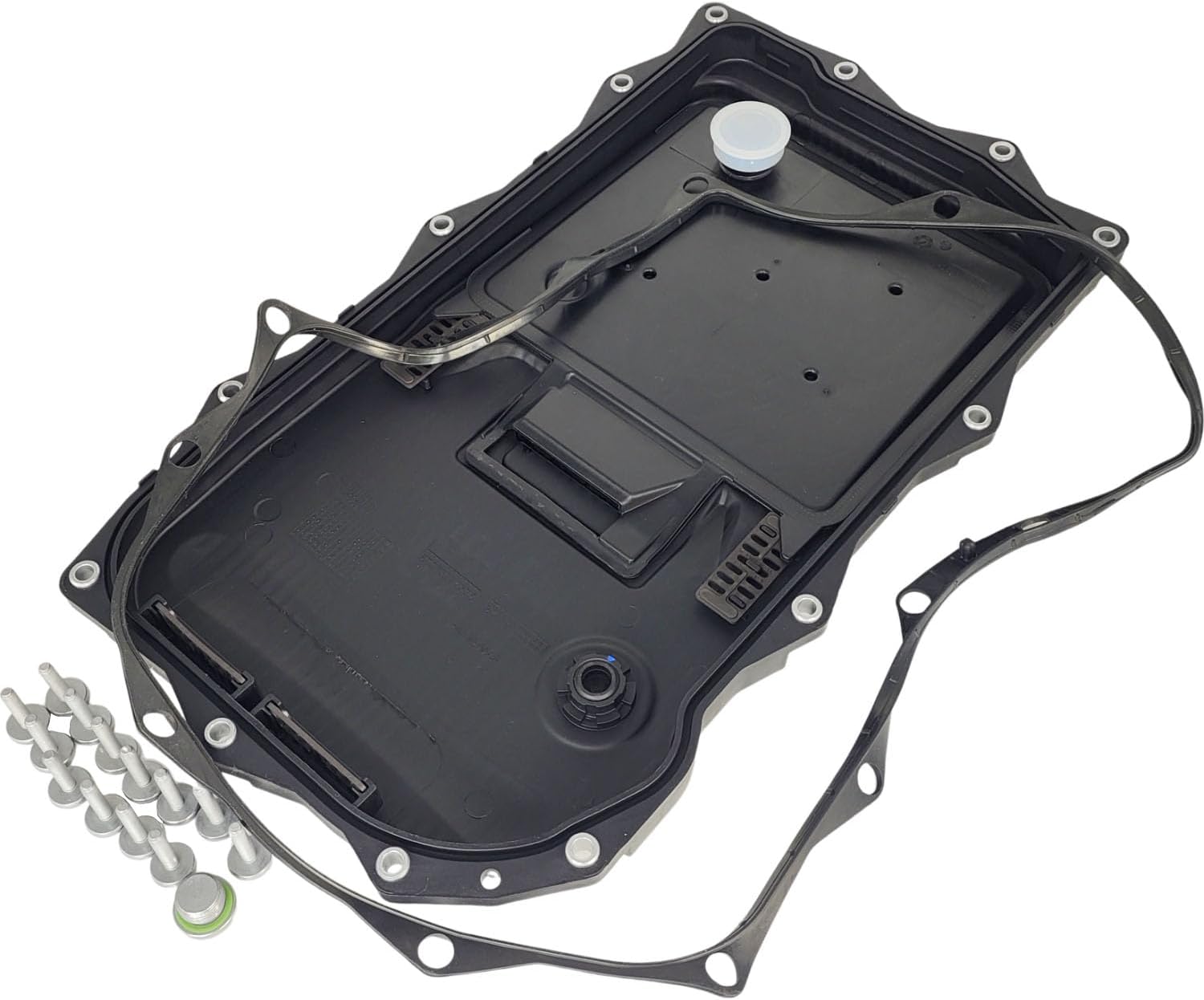
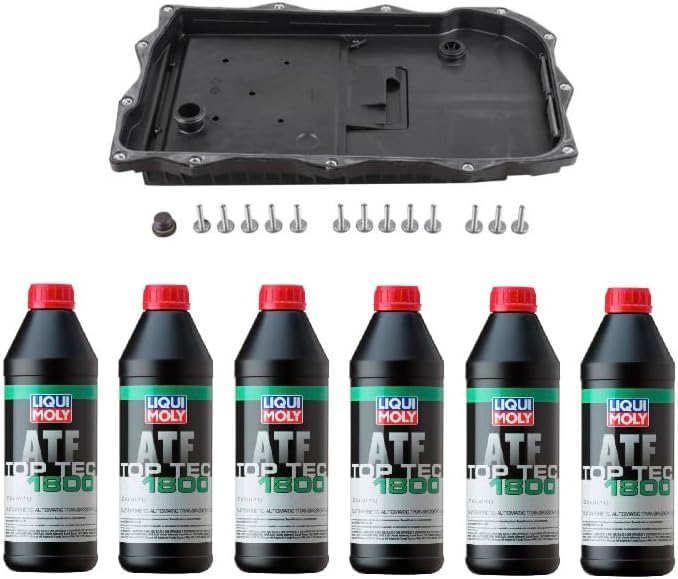
Step 1: Identify Which Pan and Filter You Actually Have
This is the step most DIY writeups skip, and it is the reason generic "ZF8HP pan torque" answers online are so inconsistent. ZF builds the 8HP with three different oil pan materials across its many OEM applications, and the torque spec and filter design both change depending on which one is on the transmission in front of you:
| Pan Material | Pan Bolt Torque | Filter Design |
|---|---|---|
| Aluminum | 4 N·m + 45° (torque-to-angle) | Separate part |
| Plastic | 10 N·m | Integrated into the pan |
| Steel sheet | 12 N·m | Separate part |
Those numbers come directly from ZF Aftermarket's Service Information bulletin 50130 DE for the 8HP oil change kit. Note the aluminum pan spec: it is a torque-to-angle fastener, not a straight Nm number. You snug it to 4 N·m, then rotate it an additional 45 degrees — treating it as a flat 4 N·m torque spec will leave the bolts loose and the pan will weep. On a plastic pan, the filter is molded into the pan assembly, so replacing the pan replaces the filter as one part; there is nothing extra to unclip. On aluminum and steel pans, the filter is a separate component that comes off the valve body on its own, independent of the pan.
Stellantis vehicles running the 850RE (the Chrysler-built version of the 8HP70, used in the Ram 1500, Jeep Grand Cherokee, Charger, Challenger, 300, Durango, Wrangler and Gladiator) use a steel pan with 13 retaining bolts. Stellantis's own technical service bulletin for this unit specifies those 13 bolts be torqued to 10 N·m (89 in-lb) — a factory number specific to that pan, separate from ZF's generic steel-pan figure. When you know you are working on a Stellantis-badged 8HP70/850RE, use the Stellantis number; it is the one the factory actually calls out for that pan.
Step 2: Drain and Pan Removal
Bring the vehicle to level ground and let the engine and transmission cool if the vehicle was just driven — the fluid will be hot. Remove the drain plug (if equipped) or go straight to the pan bolts if the application uses a sealed pan with no drain plug. Loosen the bolts starting from the corners inward, leaving two or three bolts snug on one side so the pan tilts down and drains in a controlled way rather than dropping fluid everywhere.
Once the pan is off, inspect the fluid and the pan floor. Fine metallic debris and some clutch material on the magnets is normal wear and, per Stellantis's own clutch-repair bulletin for this transmission family, is explicitly not on its own a reason to condemn the unit. What you are actually looking for is coarse metal, chunks, or a magnetic pickup that is heavily loaded — that points at a developing hard-part failure, not routine service wear.
Inspect the pan gasket. If it is intact, not cut, torn, or hardened, it can be reused on an aluminum or steel pan; if there is any doubt, replace it, since a gasket failure here means a slow transmission fluid leak that is easy to miss until the level drops enough to cause a shift complaint.
Step 3: Filter Replacement
On aluminum and steel pan applications, the filter element pulls or unbolts from the underside of the valve body once the pan is clear. Check for a rubber seal or O-ring on the filter neck where it seats into the valve body fluid passage — this seal comes with a quality replacement filter and should never be reused. On plastic-pan applications, the filter is already handled: it came off with the old pan and goes back on with the new one as a single assembly.
Wipe the pan magnet(s) clean before reinstalling — they are there to catch exactly the fine wear debris mentioned above, and a magnet packed with old material is less effective at catching new debris.
Step 4: Reinstall the Pan, In the Correct Pattern
This is where most comebacks on this job actually happen, and it is not from the torque number — it is from the sequence. ZF's service documentation is specific: thread every bolt in by hand first, then tighten them in a star pattern working from the center bolts outward, not in a simple circle. Tightening around the perimeter first can cock the pan slightly and crush the gasket unevenly, which shows up later as a slow weep at one corner that nobody can find because it only appears under heat and pressure.
| Fastener | Spec |
|---|---|
| Aluminum pan bolts | 4 N·m + 45° (torque-to-angle), star pattern |
| Plastic pan bolts | 10 N·m, star pattern |
| Steel pan bolts (ZF generic) | 12 N·m, star pattern |
| Steel pan bolts (Stellantis 850RE, 13-bolt) | 10 N·m (89 in-lb) |
| Drain plug, RWD (M18x1.0, 10mm hex) | 8.0 N·m ± 1.0 N·m |
| Fill/level plug, RWD (M18x1.5, 8mm hex) | 35 N·m ± 3.5 N·m |
The drain and fill plug numbers above are for rear-wheel-drive and X-drive 8HP housings. ZF's current "Oil Filling Specification 8HP | 8P" (document 1087.754.107c) lists different hardware for units with the all-wheel distributor transmission: the basic transmission fill/level plug is M22x1.5 with a 10 mm internal hex at 30 N·m ±3, the threaded pan drain plug is M10x1 with a 5 mm hex at 12 N·m ±1.2, and the bayonet-style drain plug is an 8 mm hex at 8 N·m +1. Fourth-generation 8HP units use an 8 mm hex fill plug at 35 N·m, with plastic-pan drain plugs at 5 or 8 N·m depending on hex size and an aluminum-pan drain plug (12 mm hex) at 17 N·m. Confirm which plug is in front of you before you torque it.
Step 5: The Correct Fluid — and Only the Correct Fluid
ZF is unusually direct about this in its own product documentation: only ZF LifeguardFluid 8 or ZF LifeguardFluid 9 may be used in the 8HP, with no additives of any kind, because the friction modifiers are precision-tuned to this transmission's clutch packs. ZF's language is blunt — using anything else "can lead to various adverse effects, ranging from significant deterioration in shifting characteristics to transmission failure."
The two fluids are visually different and not interchangeable by guesswork: LifeguardFluid 8 is green, LifeguardFluid 9 is blue, and which one a given transmission calls for depends on the specific 8HP variant and the OEM's own approval listing. If you are not certain which one the unit in front of you requires, match it to what came out, or confirm against the vehicle's own service data before refilling.
For Stellantis-badged units, the fluid is sold under Mopar part number 68218925AB, and Stellantis states this directly in its own technical bulletin: this fluid is not compatible with ATF+4 or any other current FCA/Stellantis transmission fluid. Grabbing a jug of ATF+4 off the shelf because it is what is normally stocked for Chrysler automatics is the single most common fluid mistake on this platform, and it is explicitly called out as a caution in the factory repair documentation, not just a forum warning.
Step 6: Fill and Check the Level at the Correct Temperature
The 8HP does not use a dipstick. Fluid level is set through a fill/level plug and is only accurate within a specific fluid temperature window, because ATF expands as it heats up. ZF's own service procedure for checking the level is:
- Start the engine with the transmission in Park and let it idle.
- Check transmission fluid temperature. If it reads below 30°C, let it warm up; if above 50°C (above 60°C on Maserati applications), let it cool. The target window is 30–50°C (50–60°C for Maserati).
- With the fluid in that window, cycle through P, R and D, holding manually selected D1 and D2 for roughly 10 seconds each, to fill the torque converter and circuits completely.
- Recheck the temperature is still in the correct window, then open the fill/level plug.
- If fluid runs out of the opening, wait until it slows to individual drops before closing the plug. If no fluid comes out, add the correct ZF LifeguardFluid until it just begins to drip from the opening, then close the plug.
- Check the transmission for leaks, particularly around the pan gasket and the plug you just closed.
Two refinements from ZF's current oil filling specification (1087.754.107c): before cycling the gears, run the engine at 2,000 rpm in Park for 30 seconds and let it return to idle, and wait at least 10 seconds in each position as you select P, R, D, 1 and 2. The vehicle should also be level on the lift within ±0.2° and not in limp-home mode. Fourth-generation 8HP units can only be checked or filled through the OEM scan tool routine.
If the cooler lines were opened during the service, account for them. Per Transmission Digest's ZF 8-speed replacement guide, the cooler and lines hold 0.8 to 1.0 liter, and the thermostatic bypass does not start opening until about 75°C (167°F), fully open at 90°C (194°F). Set the level cold-side only after the unit has been above 75°C once and cooled back into the 30–50°C window, or that liter leaves the pan the first time the thermostat opens.
Checking the level cold, or with the engine off, is the most common reason a freshly serviced ZF8HP comes back either overfilled (which causes foaming and shift flare once it heats up and the excess escapes past the overflow) or underfilled (which produces the exact harsh-shift and shudder complaints people assume mean a failing valve body). If the pan and filter service you just did does not resolve a shift complaint, check this step before you reach for a scan tool.
Common Mistakes on This Job
- Treating the aluminum pan's 4 N·m + 45° spec as a flat torque number. It is torque-to-angle; stopping at 4 N·m leaves the bolts under-torqued.
- Tightening pan bolts around the perimeter instead of the center-out star pattern. This is ZF's documented cause of an uneven gasket seal.
- Grabbing ATF+4 instead of the correct ZF LifeguardFluid. Stellantis's own bulletin states these fluids are not compatible.
- Checking the fluid level cold or with the engine off. The level is only accurate at 30–50°C with the engine running and the transmission cycled through gears first.
- Assuming fine metal on the pan magnet means a failed transmission. Per Stellantis's own documentation, that is expected wear debris, not a condemnation criterion on its own.
FAQ
What torque do ZF8HP transmission pan bolts actually take?
It depends on the pan material. ZF's own Service Information 50130 DE specifies 4 Nm plus an additional 45 degrees of rotation for an aluminum pan, 10 Nm for a plastic pan, and 12 Nm for a steel sheet pan, torqued in a star pattern from the center bolts outward after all bolts are started by hand. Stellantis's own TSB for the 850RE (the Chrysler-badged 8HP70) specifies 10 N-m, about 89 in-lb, for its 13 pan bolts, which is its own factory number for that specific steel pan and should be used over a generic spec whenever it applies.
Does the ZF8HP filter get changed separately from the pan?
Not always. Per ZF's service documentation, a plastic oil pan has the filter integrated into the pan itself, so replacing the pan replaces the filter in one part. Aluminum and steel sheet pans use a separate filter element that unclips or unbolts from the valve body and is replaced on its own, with the pan and gasket reused if undamaged.
What fluid does a ZF8HP pan and filter service require?
ZF LifeguardFluid 8 or ZF LifeguardFluid 9 only, per ZF's product data sheets for both fluids. Lifeguard 8 is green, Lifeguard 9 is blue, and they are not interchangeable with each other by vehicle application or compatible with any other ATF. Stellantis sells the correct fluid under Mopar part number 68218925AB and states explicitly in its own technical bulletin that it is not compatible with ATF+4 or any other FCA transmission fluid.
How do you check the fluid level correctly after a ZF8HP pan and filter service?
With the engine running, the transmission in Park, and the fluid temperature between 30 and 50 degrees Celsius (Maserati applications use 50 to 60 degrees Celsius), per ZF's own service procedure. The level plug is opened and fluid is added until it just drips rather than flows from the opening, then the plug is reinstalled and the transmission is checked for leaks. Checking at the wrong temperature is one of the most common reasons a freshly serviced ZF8HP comes back overfilled or underfilled.
Does a ZF8HP really need a lifetime fluid change, or is pan and filter service worthwhile at high mileage?
ZF calls its 8HP fill-for-life but qualifies that directly in its own fluid data sheet: it recommends a change at 150,000 km, roughly 93,000 miles, and sooner under high heat, heavy load, or when a vehicle's prior service history is unknown. A high-mileage trade-in or a transmission that has been towing regularly is exactly the case ZF describes, and a pan and filter service at that point is cheap insurance against the fluid being the actual cause of a shift complaint.
Related guides
- ZF8HP Fluid Type, Capacity and Service Interval
- ZF8HP Common Problems and Fixes
- ZF8HP Valve Body Wear: Symptoms and the Bench Fix
- ZF 8HP Transmission Guide: Fluid, Failures and Adaptation
- ZF6HP vs ZF8HP: Differences, Interchange and Which Is Stronger
Sources
- ZF Friedrichshafen AG / ZF Aftermarket — Service Information 50130 DE, "Ölwechselkit für ZF-Automatgetriebe 8HP" ("Oil Change Kit for ZF Automatic Transmission 8HP"), November 2024 revision. Backs the pan bolt torque specs by material (aluminum 4 N·m + 45°, plastic 10 N·m, steel sheet 12 N·m), the filter design differing by pan material (integrated on plastic pans, separate part on aluminum and steel pans), the center-out star bolt tightening pattern, the drain and fill plug sizes and torques by drivetrain configuration, and the temperature-gated (30–50°C, 50–60°C Maserati) fluid level check procedure. aftermarket.zf.com (PDF)
- ZF Friedrichshafen AG — Product Data Sheet, ZF LifeguardFluid 8, July 19, 2021. Backs the fluid's development specifically for 8HP transmissions, the requirement that only LifeguardFluid 8 or 9 be used with no additives, the warning that other oils can cause anything from deteriorated shift quality to transmission failure, the green color identification, and the 150,000 km (roughly 93,000 mile) factory-recommended change interval under normal use. aftermarket.zf.com (PDF)
- ZF Friedrichshafen AG — Product Data Sheet, ZF LifeguardFluid 9, July 19, 2021. Backs LifeguardFluid 9's application to both 8HP and 9HP transmissions, the blue color identification distinguishing it from LifeguardFluid 8, the same 150,000 km factory service interval guidance, and the requirement that only the approved fluid be used for any fluid change. aftermarket.zf.com (PDF)
- Stellantis / NHTSA — Technical Service Bulletin 21-039-24 REV. G, "D Clutch Repair," November 2, 2024. Backs the 850RE (8HP70) application across 2020–2023 Ram 1500, Jeep Grand Cherokee, Gladiator, Wrangler, Dodge Charger, Challenger, Durango, Chrysler 300 and Wagoneer/Grand Wagoneer; the 13-bolt steel pan torqued to 10 N-m (89 in-lb); the Mopar automatic transmission fluid part number 68218925AB; the caution that this fluid is not compatible with ATF+4 or any other current FCA/Stellantis transmission fluid; and the note that fine debris on the pan magnets is normal and not on its own grounds for condemning the transmission. static.nhtsa.gov (PDF)
- ZF Aftermarket Service Information — "Oil Filling Specification 8HP | 8P," document 1087.754.107c, February 2026. Backs the all-wheel distributor fill and drain plug sizes and torques, the 4th-generation plug torques and OEM tester requirement, the 2,000 rpm / 30 second pre-step, the 10 second wait in each selector position, and the ±0.2° vehicle level and no-limp-mode requirements. aftermarket.zf.com (PDF)
- Transmission Digest — "2009-2016 ZF 8-Speed Transmission Replacement." Backs the 0.8-1.0 liter cooler and line volume and the thermostatic bypass opening at 75°C and fully open at 90°C. transmissiondigest.com