A ZF8HP that leaves a spot on the floor sends most people straight to the pan. Sometimes that is right. Often it is not, because the pan is the lowest point on the transmission and every leak above it, at the cooler lines, the electrical plug, the case joint, ends up dripping off the pan rail. Replace a pan on a car that was really leaking at a cooler fitting and the customer comes back in a month with the same spot and a bill for a part they did not need.
This guide covers the leak points that actually show up on the 8HP family (8HP45, 8HP50, 8HP55, 8HP70, 8HP75, 8HP90, 8HP95, plus the Chrysler-built 845RE and 850RE), the factory bulletins behind each one, the exact plug and pan torques from ZF, and the order to check them so you fix the leak once.

Find the Real Source Before You Order Anything
Jaguar Land Rover published a dealer procedure for this exact problem. Their Service Support Message SSM74008, "8HP45/75 Automatic Transmission Oil Leak," was written because dealers were replacing transmission sumps and engineering could not yet confirm a root cause. Instead of letting technicians keep throwing pans at it, the SSM lays out a dye-and-road-test method that works on any 8HP:
- Put the car on a lift and degrease the suspect area all the way around, plus 25 to 50 mm (1 to 2 inches) above the suspected leak.
- Blow every trace of oil off the pan bolts and their threads with an air gun. Oil sitting in the bolt threads is the most common false positive on a pan.
- Coat the area with leak detector spray, let it sit a couple of minutes, and photograph it.
- Road test until the engine is at full operating temperature, then put it back on the lift and look for where the trace starts.
If the pan is not the source, the same SSM tells technicians to check the transmission output shaft seal, oil cooler pipes that are not secured correctly, and the transmission electrical plug. One more detail from that document is worth noting: before replacing a sump, JLR wanted the breakaway torque of every pan bolt recorded. That tells you how much of the pan-leak problem traces back to how the pan was installed.
Leak Spot 1: The Oil Pan and Pan Bolts
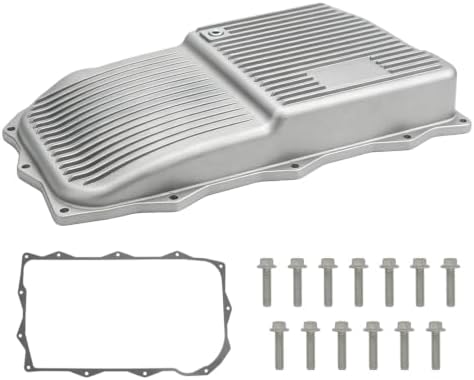
Most 8HP units use a plastic pan with the filter built into it, so the pan, filter and gasket are one service part. Some applications run an aluminum or steel pan with a separate filter, and that matters, because ZF specifies a different bolt torque for each. Per ZF Service Information 50130 EN (oil change kit for ZF 8HP, 11.2024):
| Pan material | Pan bolt torque | Filter |
|---|---|---|
| Aluminum | 4 Nm + 45° | Separate part |
| Plastic | 10 Nm | Integrated in pan |
| Steel plate | 12 Nm | Separate part |
Those numbers are small. 10 Nm is about 7.4 lb-ft, or roughly 89 lb-in. That is inch-pound wrench territory, and far less than anyone applies by feel with a 3/8 ratchet. Over-tightened plastic pans distort at the flange between bolts, and the gasket stops sealing at exactly the spots where the bolts were cranked hardest. The aluminum pan spec is torque-plus-angle, so a bolt that was just "snugged" is under-clamped.
ZF is also specific about sequence: run every bolt in by hand first, then tighten crosswise from the center outwards, and loosen in the same pattern. ZF's oil change kits ship with new pan screws for a reason. Use them, and chase the case threads clean before install so the torque you read is clamping the pan and not fighting old fluid and thread debris.
Leak Spot 2: Drain Plug and Fill Plug
The second-most common "pan leak" is a plug. The ZF Oil Filling Specification 8HP | 8P (document 1087.754.107c, 05.02.2026) lists the plug torques, and it tells you to install a new screw plug after the level check. The common rear-wheel-drive and X all-wheel-drive values are:
| Plug | Drive | Torque |
|---|---|---|
| Fill / level check plug | 8 mm internal hex | 35 Nm ± 3.5 Nm |
| Oil pan drain plug | 10 mm internal hex | 8 Nm +1 Nm |
| Fill plug, all-wheel distributor version (M22x1.5) | 10 mm internal hex | 30 Nm ± 3 Nm |
| Drain plug, threaded M10x1 (all-wheel distributor version) | 5 mm internal hex | 12 Nm ± 1.2 Nm |
| Drain plug, bayonet fitting | 8 mm internal hex | 8 Nm +1 Nm |
Fourth-generation 8HP units get their own table in the same document: plastic-pan drain plugs at 8 Nm +1 (8 mm hex) or just 5 Nm +1 (10 mm hex), and the aluminum-pan drain plug at 17 Nm ± 1.7 Nm (12 mm hex). Picture someone putting the 35 Nm fill-plug number on a 5 Nm plastic drain plug and you understand where a lot of cracked drain bosses come from. If the dye trace starts at a plug, replace the plug and seal. If the boss is cracked on a plastic pan, the pan is the repair.
Leak Spot 3: Overfill Pushing Out the Overflow
Some "leaks" are the transmission doing what it was designed to do. ZF SI 50130 EN warns that if the level is too high, the excess fluid leaks from the transmission through the overflow as it heats up, and that the escaping fluid can ignite on hot parts like the exhaust. So a car that weeps fluid only after a long drive, right after a fluid service, is a level problem until proven otherwise.
The cause is almost always a level set at the wrong temperature. ZF's filling specification sets the check window at 30 to 50 °C for most units, but lists exceptions: 40 to 50 °C for BMW and hybrid applications, 55 to 60 °C for Jaguar Land Rover AJ20 (P6/D6) engines, and 50 to 60 °C for Maserati. Check outside the window and the level is wrong in one direction or the other. On units with an additional oil cooler, the same document has you bring the transmission above 75 °C so the cooler circuit fills, then let it cool back into the check window before opening the fill plug.
Leak Spot 4: Cooler Line Connections
Cooler line fittings are the leak most often blamed on the pan, because the fluid runs down the case and drips off the pan rail. There are two well-documented versions.
BMW: worn O-rings at the transmission side
BMW Service Information bulletin SI B24 02 15 covers E84 X1, E89 Z4, and F22/F23/F30/F31/F32/F33/F34/F36 cars with the N20, N26 or N55 engine and the 8HP. The complaint is fluid leaking around the oil cooler lines on the transmission side. BMW's stated cause is damaged O-rings due to unfavorable cooling line connection tolerances. The repair is to replace the O-rings and the cooling lines, and the bulletin says plainly that replacing only the O-rings may result in a repeat failure. If you find wet O-rings on one of these cars, a $5 seal job is the wrong fix.
Ram: lines not fully seated at the cooler
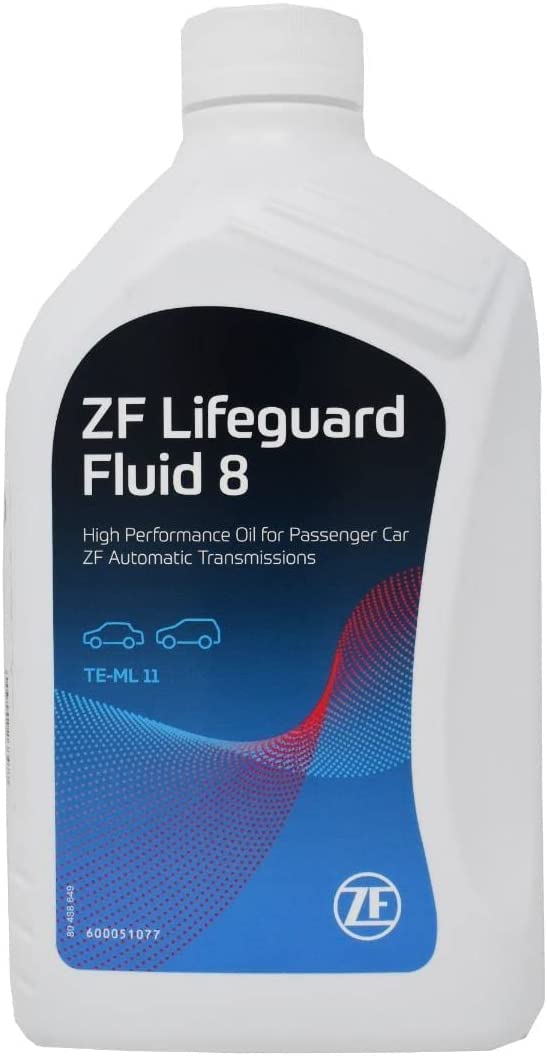
FCA Technical Service Bulletin 21-019-23 (July 11, 2023) covers 2023 DT Ram 1500 pickups built from December 1, 2022 through April 4, 2023 with the 3.6L V6 eTorque or the 6.2L supercharged SRT V8. The complaint is transmission fluid leaking toward the front of the truck, and the cause is cooler lines that were never fully seated into the transmission oil cooler at the factory. The repair is to fully seat the lines, make sure the caps are fully seated, clean up the residual fluid, and fill to spec. The bulletin calls for Mopar ZF 8&9 Speed ATF, part number 68218925AB.
The lesson for any 8HP truck, bulletin or not: a quick-connect cooler line can look connected and still be partially seated. Pull back on the line. If it moves, it was never locked.
Leak Spot 5: Electrical Plug and Output Shaft Seal
The mechatronic unit sits inside the pan, so the wiring has to pass through the case at a sealed connector. When the seal at that pass-through weeps, fluid wicks along the harness and then drips from wherever the harness hangs lowest, which can be inches away from the real source. Check the connector body itself for wetness and look for fluid inside the vehicle-side plug.
The output shaft seal at the rear of the case is the other spot JLR's SSM names. Rear-drive cars and trucks put a lot of driveshaft runout through that seal, so look at the driveshaft flange and the U-joint or flex disc before you install a new seal. On all-wheel-drive units the rear of the transmission bolts to a transfer case, which brings up the next spot.
Leak Spot 6: Case Porosity at the Transfer Case Joint
Jaguar Land Rover Technical Bulletin LTB01296NAS2 (section 307-01A, reissued August 29, 2019) covers 2015 to 2016 Discovery 4/LR4, Range Rover and Range Rover Sport models with the 8HP70 and all-wheel drive, in specific VIN ranges. The complaint is an oil leak from underneath the vehicle. The cause is internal porosity in the transmission case that lets fluid leak between the automatic transmission and the transfer case.
This is not a gasket job. The repair separates the transfer case and installs an automatic transmission insert (part LR133314) with Devcon putty (LR125418), plus a new transfer case O-ring and seals. JLR's warranty times for it run from roughly 8.9 to 10.8 hours depending on engine and transfer case. On any AWD 8HP with fluid at the transmission-to-transfer-case joint and a dry pan above it, think porosity before you think seal.
The Order to Check Them
- Check the level at the right temperature first. If it is overfilled, you may not have a leak at all, just overflow (Spot 3).
- Clean and dye it. Degrease, blow out the pan bolt threads, spray, and road test to full temperature, per JLR SSM74008.
- Work from the top down. Cooler fittings (Spot 4), electrical plug (Spot 5), case and transfer case joint (Spot 6), then plugs (Spot 2) and pan flange (Spot 1) last.
- Fix it with the right parts and torques. Lines and O-rings together on BMW, a fully seated line on Ram, new screws and ZF torques on a pan, a new plug on a plug leak.
- Refill by the ZF procedure.
One leak that never shows on the floor: on 845RE and 8HP70 Ram and Jeep applications, a failed transmission heater can push fluid into the engine coolant. If the fluid level keeps dropping with no external trace, check the coolant reservoir for a pink or milky tint. We cover that failure in the ZF8HP overheating guide.
ZF 8HP Oil Pan and Filter Kit (1087298247)
If the dye trace starts at the pan flange or a cracked drain boss, this is the repair: the plastic pan with the filter built in, plus the gasket, drain plug and new screws. Torque it to ZF's 10 Nm in a crosswise pattern.
View the ZF 8HP pan and filter kit →Shop ZF8HP pans, filter kits, ZF-spec fluid, coolers and seal kits, shipped fast from the USA.
Shop ZF8HP parts →FAQ
Where does a ZF8HP usually leak transmission fluid?
The most common spots are the oil pan flange and its bolts, the drain and fill plugs, and the cooler line connections. Less often it is the electrical connector, the output shaft seal, or on some AWD Land Rover 8HP70 units, porosity in the case where it meets the transfer case. Because the pan is the lowest point, fluid from any of these ends up dripping off the pan, so clean and dye-test before replacing anything.
What is the torque spec for ZF8HP pan bolts?
It depends on the pan material. ZF Service Information 50130 EN lists 10 Nm for a plastic pan, 4 Nm plus 45 degrees for an aluminum pan, and 12 Nm for a steel pan. Run all bolts in by hand, then tighten crosswise from the center outward.
What is the ZF8HP drain plug and fill plug torque?
On standard rear-wheel-drive and X all-wheel-drive units, ZF's Oil Filling Specification lists 35 Nm for the 8 mm hex fill plug and 8 Nm plus 1 Nm for the 10 mm hex pan drain plug. Fourth-generation plastic pans with a 10 mm drain plug take only 5 Nm, so check the generation before you torque anything.
Why is my ZF8HP leaking fluid after a fluid change?
The usual causes are an overfill or a plug or pan installed at the wrong torque. ZF warns that excess fluid is pushed out through the overflow as the transmission heats up, and that it can ignite on the exhaust. Recheck the level inside ZF's temperature window, usually 30 to 50 degrees C, and confirm the plug and pan torques.
Can I just replace the O-rings on a leaking BMW 8HP cooler line?
BMW says no. Bulletin SI B24 02 15 covers N20, N26 and N55 cars with the 8HP and traces the leak to O-rings damaged by unfavorable cooling line connection tolerances. The specified repair is new O-rings and new cooling lines, because O-rings alone may fail again.
Sources
- ZF Friedrichshafen AG — Service Information 50130 EN, “Oil change kit for ZF 8HP automatic transmission,” 11.2024. Backs the pan bolt torques by pan material (aluminum 4 Nm + 45°, plastic 10 Nm, steel 12 Nm), integrated versus separate filter, the crosswise center-outward bolting sequence, and the warning that overfilled fluid leaks through the overflow when hot and can ignite on the exhaust. aftermarket.zf.com (PDF)
- ZF Friedrichshafen AG — Service Information, “Oil Filling Specification 8HP | 8P,” document 1087.754.107c (05.02.2026). Backs the fill and drain plug torques for standard, all-wheel distributor and 4th-generation units, the new screw plug after the level check, the temperature check windows by application, and filling the additional oil cooler above 75 °C. aftermarket.zf.com (PDF)
- BMW of North America — SI B24 02 15, “8HP: Transmission Fluid Loss from Cooler Lines Connections,” November 2016 (hosted by NHTSA). Backs the affected models and engines, the cause (damaged O-rings from unfavorable cooling line connection tolerances), and the repair of replacing both the O-rings and the cooling lines because O-rings alone may fail again. static.nhtsa.gov
- FCA US LLC — TSB 21-019-23, “Transmission Oil Cooler Line(s) Not Fully Seated Causing Potential Oil Leak,” July 11, 2023 (hosted by NHTSA). Backs the 2023 Ram 1500 3.6L and 6.2L SRT build window, the leak toward the front of the vehicle, the not-fully-seated cooler line cause and repair, and Mopar ZF 8&9 Speed ATF part 68218925AB. static.nhtsa.gov
- Jaguar Land Rover North America — Technical Bulletin LTB01296NAS2 (307-01A), “8HP70 Automatic Transmission Casing Oil Leak,” August 29, 2019 (hosted by NHTSA). Backs the 2015-2016 LR4, Range Rover and Range Rover Sport 8HP70 AWD population, case porosity leaking between the transmission and transfer case, the insert LR133314 and Devcon putty LR125418 repair, and the roughly 8.9-10.8 hour labor times. static.nhtsa.gov
- Jaguar Land Rover — Service Support Message SSM74008, “8HP45/75 Automatic Transmission Oil Leak,” September 2018 (hosted by NHTSA). Backs the degrease, air-gun, leak-detector and road-test diagnosis procedure, the instruction to record pan bolt breakaway torques before sump replacement, and the alternate leak points: output shaft seal, unsecured cooler pipes and the transmission electrical plug. static.nhtsa.gov