Every week someone asks whether their ZF 8-speed should get a "flush" or a "drain-and-fill." The question assumes these are two competing products, and one of them is the dangerous one. On the 8HP, that is not really how it works. Both services can be done right or done badly. What separates them is how much old fluid comes out, whether the filter gets changed, what goes back in, and whether the level is set the way ZF publishes it. Here is how each service actually behaves on this transmission, what ZF's own service information says, and how we decide which one a given unit gets.


What Each Service Actually Is on an 8HP
Start with the hardware, because the 8HP is not a dipstick transmission. There is no tube and no stick. The level is set at a fill plug on the side of the case, and an overflow standpipe in the pan decides what "full" means. You fill until fluid runs back out of the hole at a controlled temperature, and that is the level.
Drain-and-fill on an 8HP means one of two things. On a quick service, you pull the drain plug, let the pan empty, and refill through the fill hole. On a proper service, you remove the pan. On most 8HP units the plastic pan is the filter. ZF's service information 50130 EN lists three pan types: plastic with the filter integrated into the pan, aluminum with a separate filter, and steel plate with a separate filter. So on a plastic-pan unit, "changing the filter" means replacing the whole pan. That is why ZF's own oil change kits for plastic-pan units ship as a complete pan with integrated filter, seal, bolts, magnets and screw plug.
A flush, more accurately called a fluid exchange, means connecting a machine at the cooler lines. Old fluid comes out of one line while new fluid goes in the other. Some machines let the transmission's own pump do the work. Others push fluid with their own pump. Either way, the goal is to replace fluid that a pan drain cannot reach: the fluid in the torque converter, cooler, cooler lines and clutch circuits.
How Much Fluid Each One Actually Replaces
This is the real difference between the two services. A drain-and-fill only replaces what drains out of the pan. The converter stays full. So do the cooler, the lines and the apply circuits in the valve body and clutch drums. Owners who measure the drain on Jeep and Ram 8HP70 units commonly report around 5 to 6 quarts coming out of a system that holds roughly 9. Treat that as a field number, not a spec, but the ratio is about right: one drain-and-fill replaces a bit more than half the fluid.
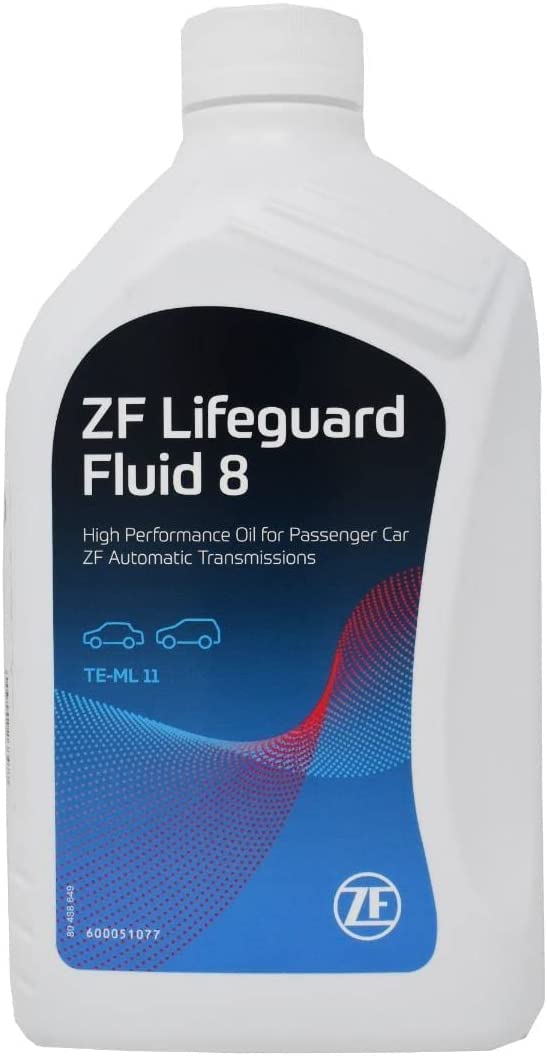
For what goes back in, use ZF's own number. ZF's oil change kits that include oil ship with 7 one-liter bottles of LifeguardFluid. That quantity is sized for filling through the fill hole after a pan service. ZF's Oil Filling Specification 8HP | 8P (document 1087.754.107c, February 2026) also states that when you use a flushing unit and fill through the oil cooler connections, a larger oil quantity than the one in the kit may be required. That one sentence settles two things. ZF does not treat cooler-line exchange as off-limits. And an exchange moves more fluid than a pan service.
Repeat drain-and-fills get you most of the way there. If each round replaces about 60 percent of what is in the unit, two rounds put you near 84 percent fresh fluid, and three put you near 94 percent. Drive it between rounds so the new fluid mixes. That is cheaper on fluid than an exchange. But it costs two or three trips through ZF's level-setting procedure, and you have to do that procedure right every single time.
What ZF Actually Says
ZF's documents do not use the word "flush" as a warning. What they lay down are rules that apply to any service, and those rules decide whether a given flush or drain is acceptable:
- Only approved fluid. The ZF LifeguardFluid 8 product data sheet says only LifeguardFluid 8 or 9 may be used in these transmissions, or the OEM-branded genuine equivalent. It warns that other oils can cause anything from significantly worse shift quality to transmission failure. Approvals for each application are listed in ZF's List of Lubricants TE-ML 11.
- No additives. Service information 50130 EN says not to use any further additives, because they alter the chemical composition of the oil. That rules out any exchange machine that runs a cleaning chemical through the unit before the new fluid goes in.
- Interval. The data sheet calls the factory fill lifetime oil, but ZF recommends an oil change after 150,000 km (about 93,000 miles). It also says a shorter interval can make sense with high temperatures, high loads, or an unknown history. Its service information lists the usual culprits: high-speed driving, towing and sporty driving, all of which age the semi-synthetic fluid faster.
- The level is the level. No matter how the fluid gets in, the level check and the temperature window are the same.
On 4th-generation 8HP units, ZF's filling specification says level checks, fills and oil changes are only possible with an OEM test device. On those transmissions, neither a drain-and-fill nor an exchange is a driveway job without the factory routine.
Setting the Level Is the Same Job Either Way
Most failures blamed on a "flush" or a "fluid change" are really a level set wrong. ZF's procedure from document 1087.754.107c, condensed:
- The vehicle must be level (ZF specifies within ±0.2°), with no active limp-home mode, and with a scan tool reading transmission temperature.
- Fill through the fill hole until fluid runs out. If the unit has an integrated electric oil pump, run it for at least 10 seconds. Then start the engine and fill again until fluid runs out.
- If the vehicle has an additional oil cooler, bring the transmission above 75 °C so the cooler circuit fills, then let it cool back into the check window.
- In Park, hold 2,000 rpm for 30 seconds to fill the converter, then return to idle. Select P, R, D, manual 1 and manual 2, holding each for at least 10 seconds, then go back to P.
- At 30 to 50 °C on most applications (BMW and the hybrids use 40 to 50 °C, Maserati 50 to 60 °C), open the fill plug. Top up until fluid runs out, or let excess drain until it stops.
Step 3 is the one an exchange machine cannot skip either. An exchange through the cooler lines still leaves you with the same level check at the end. If the cooler circuit has not filled, the level reads full when the unit is actually low. ZF's warning works in both directions: too low damages the transmission, and too high pushes fluid out of the overflow when it gets hot, where it can ignite on the exhaust.
| Fastener (per ZF SI 50130 EN / 1087.754.107c) | Torque |
|---|---|
| Fill / level plug, RWD and X-drive (8 mm hex) | 35 Nm ±3.5 |
| Fill / level plug, AWD basic transmission M22x1.5 (10 mm hex) | 30 Nm ±3 |
| Oil pan drain plug, RWD (10 mm hex) | 8 Nm +1 |
| Oil pan bolts, plastic pan | 10 Nm |
| Oil pan bolts, aluminum pan | 4 Nm + 45° |
| Oil pan bolts, steel pan | 12 Nm |
Tighten the pan bolts crosswise from the center out, starting them by hand first. Plastic pans crack if you hit them with an impact.
Where Machine Exchanges Go Wrong
The exchange itself is not the problem. The way it gets sold is. These are the failure patterns we see:
- Universal fluid. A quick-lube machine loaded with a "multi-vehicle" ATF puts 10-plus liters of non-approved fluid through the whole system, converter included. That is the exact case ZF's data sheet warns about, and an exchange makes it far more thorough than a drain ever could.
- Cleaner cycle first. A solvent or detergent pass through the cooler lines breaks ZF's no-additive rule, and some of it stays in the converter.
- No filter. An exchange alone never touches the pan. On a plastic-pan unit, that means the filter stays in service with whatever it has collected. An exchange without a pan is half a service.
- "Fluid in equals fluid out" instead of a level check. Exchange machines balance volume. They do not set the 8HP level. If nobody does ZF's temperature-controlled check afterward, the level depends on how full it was when the car came in.
The High-Mileage Question: Scan Before You Service
The old warning that fresh fluid kills a high-mileage transmission has a real story behind it. A worn unit with glazed frictions sometimes makes it on old fluid and complains on new fluid. Changing the fluid did not wear it out. It just showed what was already worn. On the 8HP, you do not have to guess. A Gears Magazine (ATRA) technical article on the ZF 8-speed fluid and filter change lays out a pre-service scan. Pull the adaptation data for all five shift elements: fast filling counter, filling counter, filling pressure in mBar, and filling time in ms.
- Filling counter above 14. A lower count means adaptations were reset too recently to trust the data.
- Filling pressure within −300 to +300 mBar (ATRA updated this from ±350 in 2019).
- Filling time within −120 to +120 ms. Pressure matters more than time.
The article's advice is direct. If the numbers are good, recommend the service. If they are bad, tell the customer the unit is too far gone for a fluid service to help, and quote the repair instead. Adaptation data will not show bearing or planetary wear, so road-test for gear whine and check the pan when it comes off. Sonnax's technical material on this unit points to wear in the converter circuit valves, which are under constant solenoid control. A unit with valve body wear will not be fixed by any fluid service. That is a valve body job.
Which One We Actually Do
| Situation | Service |
|---|---|
| Healthy adaptations, known history, at or near the interval | Pan and filter (kit) with LifeguardFluid, level set per ZF. Add a second drain-and-fill after a short drive if you want the percentage up. |
| Towing, heat, or unknown history; fluid dark but adaptations good | Pan and filter first, then a cooler-line exchange with approved LifeguardFluid only, no cleaner, then the full ZF level check. |
| Wrong fluid was installed | Pan and filter plus an exchange. You need the converter and cooler emptied of the wrong fluid, and a drain cannot do that. |
| After a valve body, solenoid or converter repair | Full fresh fill. ZF's data sheet says an oil change is necessary whenever repairs are carried out. |
| Adaptation values out of range, slipping, flare or shudder | Neither, as a fix. Diagnose first. See our ZF8HP slipping guide. |
One practical note on fluid: ZF's data sheet says to shake a container of up to 20 liters vigorously for at least 15 seconds before pouring. The additive package can settle on a shelf, so shake every bottle.
FAQ
Is it better to flush or drain and fill a ZF 8-speed?
Neither is automatically better. A drain-and-fill with a new pan and filter replaces a bit more than half the fluid and changes the filter. A cooler-line exchange replaces far more fluid but does not touch the filter. For a healthy unit at the interval, we do the pan and filter. We add an exchange with approved LifeguardFluid when the history is unknown or the wrong fluid was installed.
Does ZF allow flushing the 8HP transmission?
ZF's Oil Filling Specification 8HP | 8P addresses flushing units directly. It notes that filling through the oil cooler connections with a flushing unit may take more oil than the kit supplies. What ZF prohibits is non-approved fluid and any additives, so a machine exchange must use LifeguardFluid 8 or 9 (or an approved equivalent) with no cleaning chemicals.
How much fluid comes out of a ZF 8HP drain and fill?
Owners measuring Jeep and Ram 8HP70 units commonly report about 5 to 6 quarts draining from a system that holds roughly 9. The converter, cooler and clutch circuits keep the rest. ZF's oil change kits with oil include 7 one-liter bottles for a pan service filled through the fill hole.
How often should ZF 8HP fluid be changed?
ZF calls the factory fill lifetime oil but recommends a change after 150,000 km, about 93,000 miles. It advises shorter intervals for high temperatures, heavy loads, towing, or an unknown history. Fluid must also be changed after any repair.
Can changing fluid on a high-mileage 8HP cause it to fail?
Fresh fluid does not wear a transmission out, but it can show wear that old fluid was hiding. Scan the shift element adaptation data first. Gears Magazine (ATRA) uses a filling counter above 14, filling pressure within plus or minus 300 mBar, and filling time within plus or minus 120 ms. If the values are out of range, quote the repair, not a fluid service.
Related ZF8HP guides
Sources
- ZF Friedrichshafen AG — ZF Aftermarket Service Information, “Oil Filling Specification 8HP | 8P,” document 1087.754.107c (05.02.2026). Backs the statement that a flushing unit filled through the oil cooler connections may need more oil than the kit supplies, the ±0.2° level and no-limp-mode prerequisites, the temperature windows, the fill sequence including the integrated electric pump step and the above-75 °C cooler fill, the 4th-generation OEM test device requirement, and the fill plug torques. aftermarket.zf.com (PDF)
- ZF Friedrichshafen AG — Service Information 50130 EN, “Oil change kit for ZF 8HP automatic transmission,” 11.2024. Backs the no-additives instruction, the too-low and too-high level warnings (overflow and ignition risk), the high-temperature aging examples, the plastic/aluminum/steel pan and filter configurations, the pan bolt torques and crosswise sequence, and the drain plug torque. aftermarket.zf.com (PDF)
- ZF Friedrichshafen AG — Product Data Sheet, ZF LifeguardFluid 8. Backs the LifeguardFluid 8 or 9 only requirement, the warning that other oils can cause shift deterioration or failure, the lifetime-fill statement with a recommended change at 150,000 km and shorter for severe or unknown use, the oil change requirement after repairs, and the 15-second shake instruction. aftermarket.zf.com (PDF)
- ZF Friedrichshafen AG — List of Lubricants TE-ML 11. Backs the application-by-application fluid approvals for the 8HP family. aftermarket.zf.com (PDF)
- ZF Aftermarket — “In brief: ZF Oil change kits.” Backs the kit contents (complete pan with integrated filter, seal, screws, magnets, screw plug and 7 one-liter bottles of LifeguardFluid in kits with oil). aftermarket.zf.com
- Gears Magazine (ATRA) — “The ZF 8-Speed Transmission Fluid and Filter Change,” January/February 2020. Backs the pre-service adaptation scan (fast filling counter, filling counter, filling pressure, filling time), the thresholds (counter above 14, pressure ±300 mBar, time ±120 ms), and the advice to decline the service when the unit is too far gone. gearsmagazine.com
- Sonnax — “A New Path for ZF,” tech resource 263. Backs the statement that the converter circuit valves are under constant solenoid control and are common wear points. sonnax.com