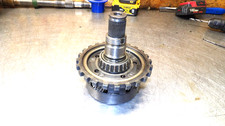
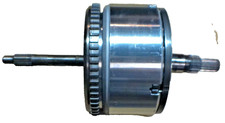
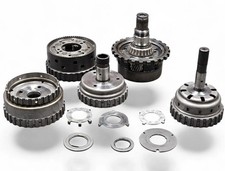
If your Jeep 42RLE whines more as road speed climbs, loses drive while the engine still revs, or dropped steel slivers into the pan, the rear planetary and the output shaft are among the first parts to look at. This listing is a used, pulled Jeep 42RLE rear planetary with its output shaft still attached. It was inspected on the bench: the five pinion gears turn smoothly, and the bushing looks close to new. The one flaw is spelled out below so there are no surprises. It suits the rear-drive 42RLE used in the Jeep Liberty and the Wrangler, along with other Chrysler rear-drive vehicles that used this four-speed.
What the rear planetary does in a 42RLE
The 42RLE is the rear-wheel-drive member of Chrysler's Ultradrive family, the same clutch-to-clutch design as the front-drive 41TE. It has no bands. The underdrive, overdrive and reverse clutches drive the gear train, and the 2-4 and low/reverse clutches hold parts of it. Two simple planetary sets are tied together. The rear carrier is the output member: its pinions are pinned to the carrier, and the carrier carries torque straight back to the output shaft in every forward gear and in Reverse. Transmission Digest describes how the two are joined. A stub shaft on the rear carrier splines into the output shaft, and a C-clip in a groove on the carrier snaps into a matching groove inside the shaft. Since all of the engine's torque passes through these pinions, their bearings and pins are where wear shows up first.
Symptoms of a worn rear planetary or output shaft
- Whine or growl that rises with road speed, not engine speed, and is often loudest in Drive at cruise
- Sudden loss of drive or a clunk as power comes on, from a broken pinion or stripped carrier-to-shaft splines
- Bronze or steel particles on the pan magnet
- Driveline clunk or wobble from a worn output shaft bushing
- Gear ratio or CVI codes after a pinion failure lets the unit slip, which can look like clutch wear
How to confirm before you buy
Start with the pan. Fine clutch material points to the clutch packs. Chunks of steel or bronze washer material point to the gear train. A slip that only shows up in certain gears, with the clutch volume index values out of range, is more often a clutch or hydraulic problem than a planetary one. Our guide to Ultradrive slipping under load explains how to tell them apart. If the scan tool shows solenoid or limp-mode codes but the fluid is clean, read the 41TE and 42RLE problems guide before you open the case. Once the unit is apart, check each pinion for end play and rough spots, look for blued pins, and check the carrier stub splines and the shaft splines for twisting.
Fitment and condition
This assembly came out of a Jeep 42RLE. The listing gives no model year, so match it to your old part rather than to a calendar. Output shafts differ in length and rear-end design depending on drivetrain. This shaft has a threaded end for the nut that retains the rear yoke, so lay it beside your original and compare the overall length, the spline count and the rear end before installing. One honest note on condition: the threads at the end of the shaft, where that yoke nut goes, were damaged when the nut was removed. They need to be cleaned up with the correct die before the nut is reinstalled. If you are unsure, send your year, VIN and drivetrain with the order. If you need a part with a stated year, look at the 42RLE planetary for 2003. The full range of parts is in the 41TE and 42RLE collection.
Install notes
- Chase the yoke nut threads with a die before assembly and test-fit the nut by hand. Never force it on damaged threads.
- Transmission Digest warns that the output shaft retaining C-clip is often ruined when the shaft is pulled from the carrier. It recommends a slide hammer threaded into the end of the shaft for removal. Have a new clip on hand. Its OE number is 52852916AA, or 0.135 inch thick by 1.095 inch OD.
- Clean any burrs off the splines and any debris out of the carrier's clip groove. Either one can keep the clip from collapsing and seating.
- Replace the thrust washers and bearings around the gear train and set end play to the factory spec.
- Planetary damage usually means debris went through the whole unit. Do the job with fresh frictions and seals, such as the 2006-up 42RLE banner rebuild kit, and flush the cooler and lines.
- Fill with ATF+4 only, check the level hot, and run the Quick Learn with a scan tool before the road test.