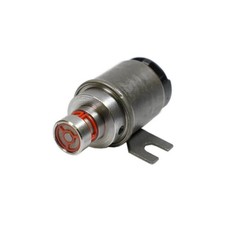
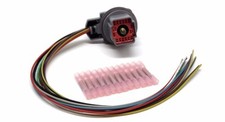
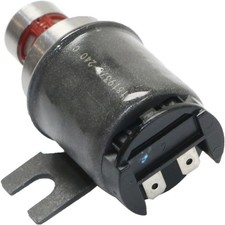
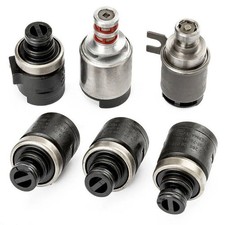
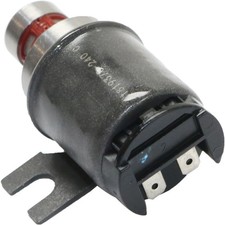
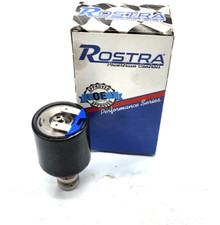
Ford Ranger, Explorer, Mountaineer and Mazda B-Series owners land on this page when the automatic starts shifting too soft, too hard, or sets a line pressure code and nobody can agree whether it is the solenoid or the transmission. This is a new electronic pressure control (EPC) solenoid built to the Bosch-style design Ford fitted to the small rear-drive automatics: the four-speed 4R44E and 4R55E and the five-speed 5R55E. The listing carries the Ford service numbers 9L2P-7G383-AA and XL2Z-7G383-AA, with F77Z-7G383-AA shown as an earlier reference.
How the EPC solenoid controls line pressure
In this transmission family the EPC solenoid is the only thing that tells the pump how much pressure to make. The PCM varies current to the solenoid, the solenoid turns that into a signal oil pressure, and the signal acts on the boost valve, which multiplies it into mainline pressure at the pressure regulator. Sonnax publishes the ratio for the factory boost valve: an EPC signal of about 30 psi produces roughly 107 psi of line pressure in Drive and 135 psi in Reverse, and a 120 psi signal produces about 250 psi in Drive and 313 psi in Reverse. That multiplication is why a small error at the solenoid turns into a large error at the clutches and bands. A few psi of drift at the EPC tip can mean dozens of psi too much or too little where the friction material actually does its job.
Symptoms this solenoid causes
- Soft, slow upshifts with engine flare, especially under load or towing
- Delayed or harsh engagement when shifting into Drive or Reverse
- Line pressure that will not rise on a gauge when EPC is commanded
- A pressure control electrical code such as P0748 stored with the check engine light
- On the four-speed units, flare on the 1-2 or 2-3 shift; on the 5R55E, flare on the 2-3 or 3-4
Rule out the other causes first
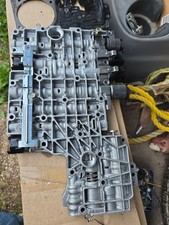
Several faults in this valve body look exactly like a bad EPC solenoid. A worn boost valve sleeve leaks the signal away, so pressure stays low even with a new solenoid. Worn servo bores in the case bleed off band apply oil and cause slipping with ratio codes. Test in this order: fluid level and condition, codes, connector and harness, solenoid resistance, then a live line pressure test while commanding EPC. If pressure follows the command, the solenoid is doing its job and the problem is further downstream. Our 5R55 diagnostic walkthrough lays out what normal and abnormal readings look like.
Fitment and the 1995-2012 range
The title covers the long run of this design from the mid-1990s four-speeds through the last 5R55E trucks. The application chart supplied with this part lists the 1997-2011 Ford Ranger with the 2.3L, 3.0L and 4.0L, the 1997-2001 Explorer and Mountaineer with the 4.0L V6, and Mazda B2300, B3000 and B4000 trucks from 1997 through 2010. For a 1995 or 1996 truck with the 4R44E or 4R55E, compare the bracket, the two-blade connector and the screened tip against your original before installing, or send us your year and VIN to confirm. It does not fit the 5R55W or 5R55S, which use an integrated solenoid body. The full list of parts for this family is on our 5R55 transmission page.
Install notes
- The solenoid is on the valve body, so the job starts with draining the fluid and dropping the pan.
- One bolt holds the bracket. Unplug the connector, remove the bolt, and ease the solenoid out of its bore.
- Check the old tip screen for clutch or band material. Heavy debris means a filter change alone is not enough.
- Lightly oil the O-ring, seat the new solenoid squarely, and tighten the bracket bolt to spec without overtightening into the aluminum casting.
- Fill with Mercon V, check the level hot, and confirm line pressure with a gauge before calling the job done.
The lockup side of the valve body uses its own solenoid, and if you are already under there with a converter slip code, the 5R55E TCC solenoid is worth fitting at the same time. For firmer, more consistent shifts after the repair, a 5R55E shift kit addresses the valve wear that new solenoids cannot.