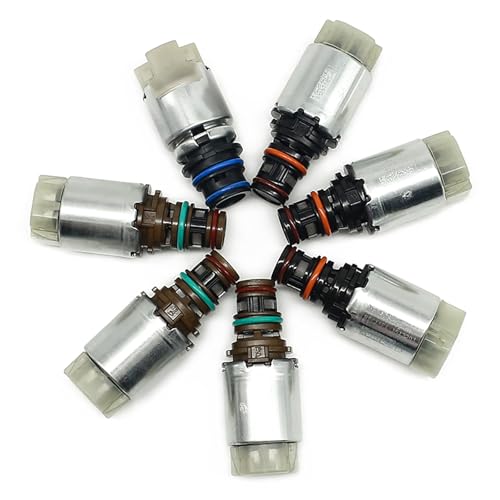
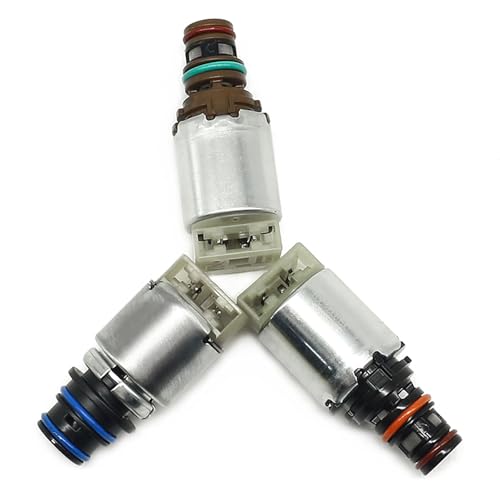
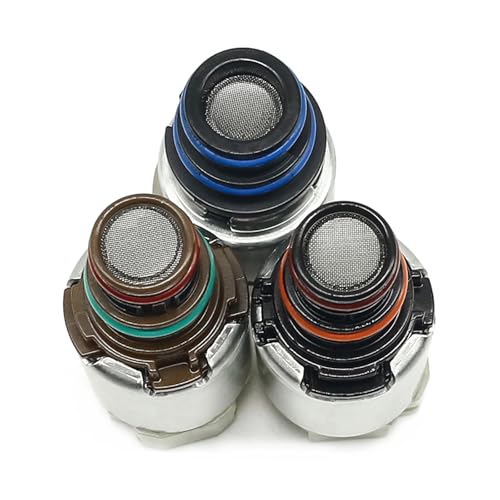
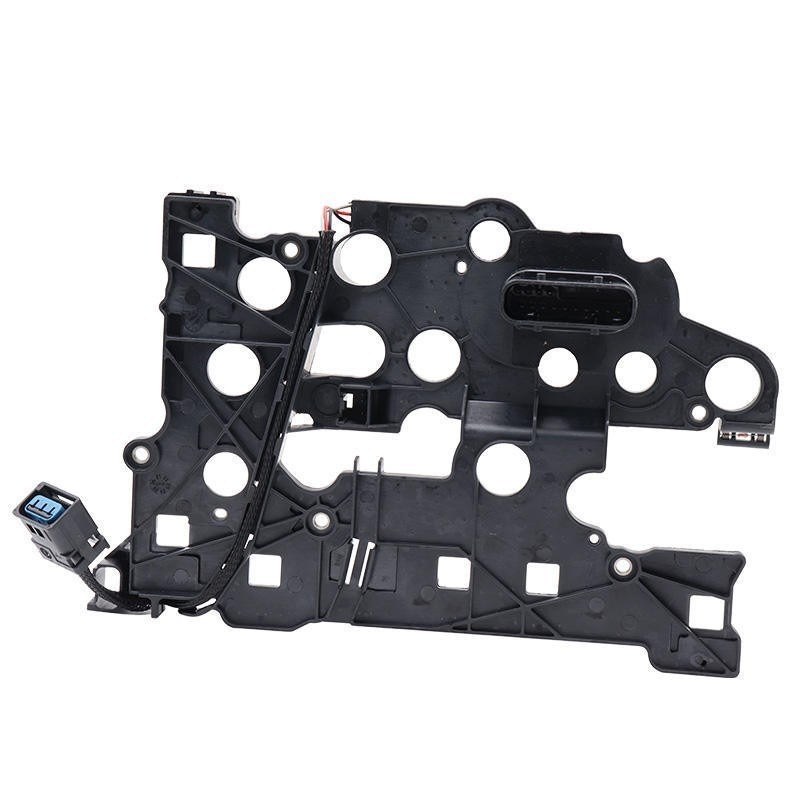
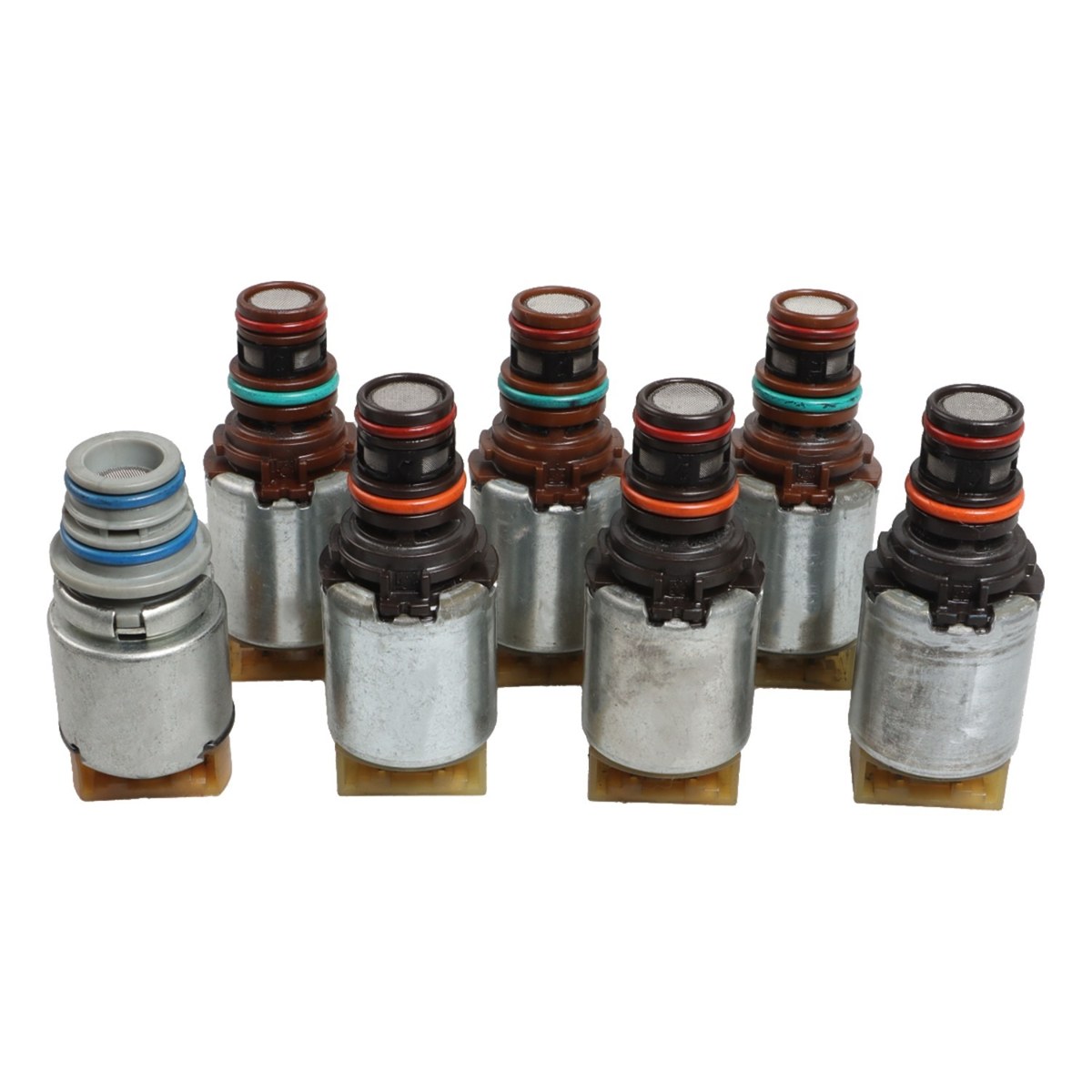
This is a complete set of seven new solenoids for the first-generation Ford 6F35 six-speed, the automatic behind the 2.3L, 2.5L and 3.0L V6 engines in the early Ford Escape, Mercury Mariner, Mazda Tribute and Ford Fusion. People land on this part with a familiar list: a hard 1-2 or 2-3 shift, a flare between 3rd and 4th or 4th and 5th, a car that drops into a fixed gear and lights the check engine lamp, or a shudder at highway speed that a fluid change did not cure. Every solenoid comes with its colored O-rings and inlet screen already fitted, so the set drops straight into the valve body.
What the solenoid kit does in an early 6F35
The 6F35 has no mechanical shift valves that respond to throttle or road speed. The transmission computer decides every shift and carries it out through seven solenoids sitting in the valve body: the shift solenoids that apply and release the clutches, the line pressure (EPC) solenoid that sets the pressure everything else works from, and the torque converter clutch solenoid. A shift is a hand-off between two clutches, so one sticking or weak solenoid usually spoils a pair of shifts rather than just one. Sonnax notes that the first-generation 6F35 solenoid body had no damper assemblies on its solenoid circuits, only a single rubber damper on the 1-2-3-4 (SSA) output, which makes the early unit sensitive to solenoid output that has gone erratic.
Symptoms that point to the solenoids
- Harsh or delayed 1-2 and 2-3 upshifts, often worse once the fluid is fully hot
- Flare or slip on the 3-4 or 4-5 shift
- Fail-safe operation with shift solenoid codes in the P0751-P0776 range
- Line pressure control circuit codes P0960-P0966 with soft or harsh engagements
- Converter clutch shudder or no lockup with P0741
- Harsh engagement into Drive or Reverse
How to confirm it before you buy
On these early cars, the external harness is a frequent impostor. A wire can fracture inside its insulation right at the transmission connector and set solenoid codes on a healthy unit, so wiggle-test the harness at the connector with a meter on the circuit that set the code. Next look at the fluid: dark, burnt Mercon LV causes slip and shudder on its own. Our 6F35 problems guide walks through that order, including the worn solenoid pressure regulator bore that will make even new solenoids misbehave. If the codes follow specific circuits, the harness tests good and the fluid is clean, the solenoids are the logical next step.
Fitment
The listing covers 2008-2011 Ford Escape and Mazda Tribute (2.3L, 2.5L, 3.0L V6), 2009-2011 Ford Fusion (2.5L, 3.0L V6) and 2009-2011 Mercury Mariner, and the same set fits the 6F15 version of the unit. One honest caveat: the 6F35 went into these models around the 2009 model year, so a 2008 that still has a four-speed automatic will not take this kit. Sonnax identifies first-generation 6F35 valve bodies by the casting numbers 9L8P or BL8P-7A100 on the main valve body, solenoid body and lead frame; check for one of those before ordering. Later units built from 2013 use different solenoids and the one-piece CV6Z-7G391-A solenoid pack, and the generations do not interchange. If you are unsure, send us your year and VIN and we will check it. Everything else for this unit is on our 6F35 parts page.
Install notes
- Drain the fluid, remove the side cover and the valve body, and note which colored seal came out of which bore.
- Pull the retainer on each solenoid and slide it out; lube every new O-ring with clean ATF and push each solenoid home by hand, never with a tool.
- Look at the inlet screens on the old solenoids. Heavy debris means the pan and filter need attention too; a 6F35 filter and pan gasket kit is cheap insurance while it is apart.
- Inspect the internal lead frame and connector for heat cracking; a brittle one should be replaced with the 6F35 internal wiring harness.
- Torque the valve body bolts to the factory spec, refill with Mercon LV (the only fluid Ford lists for the 6F35), clear codes and run a shift adapt with a scan tool before the road test.
Want a remanufactured original set instead of new? Compare it with the 2008 6F35 solenoid kit.