"Replace the cooler line" sounds like one job, but on a 10L80 it is actually two different repairs for two different GM-documented conditions, and they do not share a fix. One is a porous casting passage that lets fluid seep past a bolt. The other is a line that comes off the truck wound up wrong from the factory and never leaks a drop while it quietly messes with your shifts. Order the wrong fix and you either chase a leak that was never there or reseal a bolt that was never the problem.
This covers both documented conditions, how to tell which one you have before you pull anything apart, the actual replacement procedure, and the step almost everyone skips that causes the new line's replacement to fail early too.
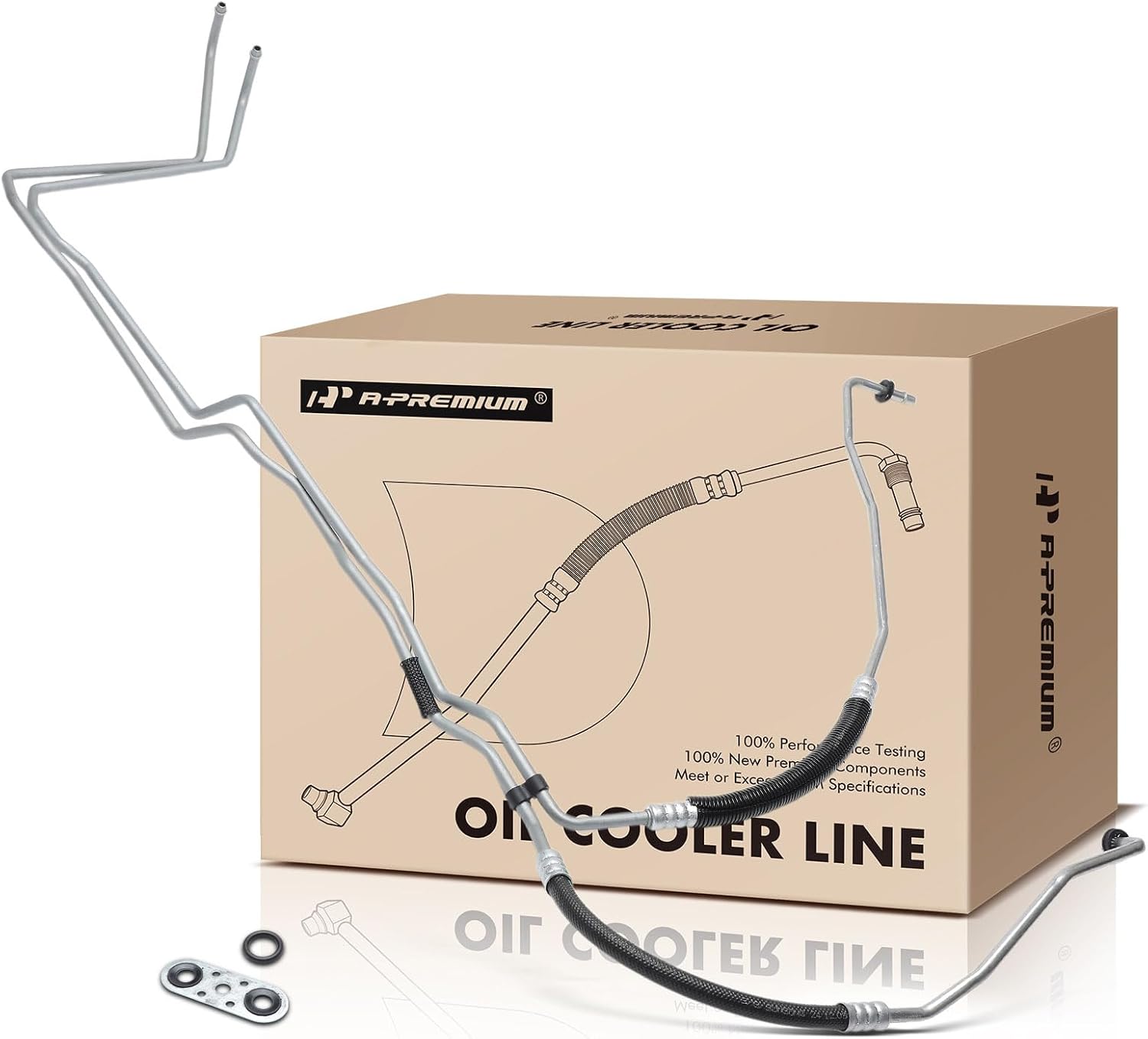

Two conditions, not one job
GM has written up two separate conditions on this platform that both get called "cooler line problems" by owners, and they point to opposite fixes:
| Condition | GM document | Symptom | Fix |
|---|---|---|---|
| Porous casting at the cooler line retaining bolt passage | Bulletin 18-NA-026 | Fluid at the bolt head, left side of case | New fitting seal + threadlocker on the bolt. No line replacement. |
| Cooler line twisted or misshapen from the factory | PIP5792A | Harsh shift, shudder, surge, stall, possible DTC P27EC — no leak | Untwist and reconnect, or replace the line if the rubber is misshapen. |
| Physical damage, corrosion-through, or collision damage | Not bulletin-covered — ordinary wear/damage | Visible crimp, crack, rust-through, or a line that will not seal no matter what | Full line replacement is the only real fix. |
The first two are GM's own documented conditions with specific causes and specific corrections. The third is not a design defect, it is just a line that got damaged, and it is the one that actually requires buying and installing a new line rather than resealing or untwisting the one that is already on the truck.
Condition 1: the seeping fitting (bulletin 18-NA-026)
This is a leak, not a flow problem. GM's bulletin covers 2018 Escalade, Tahoe and Yukon with the 10L80 (RPO MF6), 2019 Silverado 1500 and Sierra 1500 with the 10L80 (RPO MQB), and 2017-2018 Camaro with the shared 10L90 (RPO MGL). The stated cause is porosity in the case casting near the threaded bolt passage that holds the oil cooler line fitting on the left side of the transmission case, which lets fluid seep past the retaining bolt even when it is torqued correctly.
Confirm it by wiping the bolt head dry, running the truck, and rechecking that exact spot rather than the whole quadrant of the case. If it is wet there, the correction does not touch the line itself: install a new oil cooler line fitting seal, part number 23135703, onto the line, then clean the retaining bolt threaded passage and reseal the bolt with medium-strength (blue) threadlocker, part number 19333511 (Canada 10953489), before torquing it back down per Service Information. GM's bulletin specifically warns against using brake-clean solvent in that threaded passage — wash and dry it properly instead. The cooler line itself is not replaced for this condition.
Condition 2: the twisted line (bulletin PIP5792A)
This one does not leak at all, which is exactly why it gets missed. GM's bulletin PIP5792A covers 2021 model year Escalade, Silverado 1500, Silverado 2500HD/3500HD, Suburban, Tahoe, Sierra 1500, Sierra 2500HD/3500HD and Yukon across the 6L80, 6L90, 8L90, 10L80 and 10L000 transmission families (10L80 trucks on RPOs MQB, MQE and MYC). The complaint is harsh shifts, shudder, surge or a stall concern, and GM's stated root cause is a twisted cooler line on a low-mileage vehicle — a line that left the factory wound up wrong rather than one that failed in service. On ETRS-equipped trucks (RPO MQC) a twisted line can additionally set DTC P27EC in the TCM.
Finding it takes a visual inspection, and GM's own bulletin notes you may need to remove underbody panels to see the lines clearly. Look for a line that is visibly wound or corkscrewed along its length rather than running straight. GM's correction branches on what you find:
- If the line is twisted but the rubber itself is not misshapen, disconnect the cooler line from the transmission auxiliary cooler, untwist it, and reconnect it. No new parts needed.
- If the rubber is misshapen (not just twisted — actually deformed), replace the cooler line, then check the transmission fluid level per Service Information and add fluid if needed.
Either way the bulletin ends with the same instruction: recheck the fluid level once you are done, since disconnecting the line at the cooler lets fluid drain back and the level will read low until it is corrected.
Condition 3: physical damage — the one with no bulletin
The third reason a 10L80 cooler line gets replaced has nothing to do with either documented condition above. Road debris, corrosion from years of salt exposure, a collision, or a line that got crimped during some other repair under the truck all end the same way: a line that will not seal, no matter how many times you reseat the fitting. There is no bulletin for this because it is not a design issue, it is wear and damage, and the fix is a straight line-for-line replacement.
Replacing the line
Once you have confirmed you are actually dealing with condition 2 (misshapen) or condition 3 (damaged) rather than condition 1 (reseal only), the physical job is the same:
- Relieve any pressure in the system and have a drain pan ready — disconnecting either end empties fluid from both the line and the external cooler.
- Disconnect the line at the transmission auxiliary cooler fitting first, per the method GM describes in PIP5792A, then at the case end.
- Note the exact routing before you pull the old line free — these lines route around specific chassis points and through retaining clips, and running a new line the wrong way is how you end up with a second twisted-line condition on a brand new part.
- Inspect every routing clip and bracket along the path. A line that is correctly routed but pinched by a collapsed or missing clip will develop the same symptoms as a factory-twisted one.
- Install the new line using a fresh fitting seal at the case end rather than reusing the old one — a seal that already leaked once is not a part you want to put back in service.
- Route the new line exactly as the old one came out, seat it fully in every clip, and confirm there is no twist or kink anywhere along its length before you reconnect the fittings.
- Reconnect both ends, then move to the flush and refill steps below before you call the job done.
Flush before you fill — this is the step that gets skipped
If the line is being replaced because of contamination, corrosion debris, or after any internal transmission failure, do not just bolt the new line on and refill. Transmission Digest's technical writeup on cooler flushing (citing Lubegard's product-technical manager Pat Barrow) is blunt about this: contaminated cooling systems are a frequent cause of premature failure in replacement transmissions, specifically because the external cooler and lines are not properly purged of the old fluid and the dirt, sludge, clutch material and metal shavings it carries. That debris does not disappear when you swap one line — it sits in the cooler and the other line, waiting to work its way into whatever transmission is now hooked up to it.
The practical takeaway: flush both the external cooler and the remaining original line (not just the one you replaced) before the new line and the transmission see fluid, especially if the old line was damaged enough to let contamination in, or if this job followed any kind of internal failure. If a shop flush machine is not available, a portable aerosol line-and-cooler flush designed for this purpose is a legitimate substitute per the same source — catch the flush fluid in a clear container as you go, and if you see a heavy load of metal or debris come out, that is a sign the external cooler itself should be replaced rather than just flushed, not only the line.
When the cooler itself needs to go, not just the line
If the flush pulls metal or heavy contamination out of the external cooler, flushing alone will not fix it reliably. This is a direct-fit 10L80 auxiliary cooler to pair with the new lines.
Shop 10L80 Cooling System Parts →Refilling after the job
A cooler line job drains more fluid than a typical pan-and-filter service, since both the line you removed and the external cooler empty out along with it. GM's spec for the 10L80 is DEXRON ULV, part number 19352619 in the US (19352620 in Canada) — regular DEXRON VI is not a substitute in this unit. The published fluid change capacity is 7.7 liters (8.1 quarts) across the MQB, MQC, MHT, MI2 and MHS RPO codes, and that is the change figure, not what a cooler line job alone will take — expect to add more. There is no dipstick on this transmission; set the final level at the check plug per the Service Information procedure at the specified fluid temperature rather than pouring in a fixed quart count and calling it done.
FAQ
Do I need to replace the whole cooler line or just reseal the fitting?
It depends which condition you actually have. GM bulletin 18-NA-026 covers a porous casting passage at the cooler line retaining bolt on 2017-2019 10L80/10L90 trucks and SUVs — that one is a seal-and-threadlocker fix, no line replacement needed. GM bulletin PIP5792A covers a line that comes from the factory twisted on 2021 full-size trucks and SUVs — that one is untwist-and-reconnect if the rubber is not misshapen, or full line replacement if it is. Clean the area, identify which condition is present, then pick the matching fix instead of defaulting to a full line swap.
What does a twisted 10L80 cooler line actually do to the transmission?
Per GM bulletin PIP5792A, a twisted cooler line on a low-mileage 10L80 can cause harsh shifts, shudder, surge or a stall concern, and on ETRS-equipped trucks (RPO MQC) it can set DTC P27EC in the TCM. The twist restricts or alters flow through the cooler circuit rather than causing a leak, which is why the complaint shows up as a drivability problem instead of a wet spot on the driveway.
Do I need to flush the cooler and lines when I replace a 10L80 cooler line?
Yes, especially if the line is being replaced because of contamination or after any internal transmission failure. Transmission Digest's technical writeup on cooler flushing notes that contaminated cooling systems are a common cause of premature failure in replacement transmissions, because dirt, sludge, clutch material and metal shavings left in the cooler and lines migrate straight into the unit you just installed. If the old transmission failed catastrophically with metal in the fluid, flush the external cooler and both lines before the new line and transmission ever see fluid.
What fluid and how much does a 10L80 need after a cooler line job?
GM specifies DEXRON ULV, part number 19352619 in the US, and nothing else. The published fluid change capacity is 7.7 liters, or 8.1 quarts, across the MQB, MQC, MHT, MI2 and MHS RPO codes. A cooler line replacement drains more fluid than a pan-and-filter service since both lines and the external cooler empty out, so expect to add more than the change-capacity figure and set the final level at the check plug per Service Information rather than a fixed quart count.
Can I reuse the old cooler line fittings when I replace a 10L80 line?
Not at the transmission case end if that is where the original condition was. GM's fix for the porous fitting passage (bulletin 18-NA-026) calls for a new oil cooler line fitting seal, part number 23135703, installed fresh rather than reusing the old seal, plus the retaining bolt resealed with medium-strength (blue) threadlocker, part number 19333511. Reusing a seal that already failed once just restarts the same seep on the same timeline.
Need parts for this job?
OE-style cooler lines, a direct-fit auxiliary cooler, and the fill tools to refill it correctly are on our 10L80 transmission parts page, priced and in stock, with checkout on our own site. Match the part to the confirmed condition above before you buy — a reseal, an untwist and a full line replacement are three different jobs.
Sources
- General Motors — Service Bulletin 18-NA-026, "Transmission Fluid Leak from Transmission Oil Cooler Line Fitting Retaining Bolt," Version 4, revised January 2020. Backs the affected 2018 Cadillac Escalade, Chevrolet Tahoe and GMC Yukon (10L80, RPO MF6), 2019 Silverado 1500 (New Model) and Sierra 1500 (New Model) (10L80, RPO MQB), and 2017-2018 Chevrolet Camaro (10L90, RPO MGL); the stated cause of casting porosity near the oil cooler line retaining bolt threaded passage; and the correction of a new oil cooler line fitting seal (P/N 23135703) plus medium-strength (blue) threadlocker P/N 19333511 (Canada 10953489) on the retaining bolt. nhtsa.gov (PDF)
- General Motors — Preliminary Information Bulletin PIP5792A, "6L80 6L90 8L90 10L80 10L000 Equipped Vehicles With A Harsh Shift Shudder Surge or Stall Concern With Low Mileage," Version 2, revised May 2021. Backs the affected 2021 model year Cadillac Escalade (MQC), Chevrolet Silverado 1500/Sierra 1500 (MQB, MQE, MYC), Silverado/Sierra 2500HD-3500HD (MGM, MGU, MYD), Suburban/Tahoe/Yukon (MQC); the stated root cause of a twisted cooler line on low-mileage vehicles; the note that DTC P27EC may set in the TCM on ETRS transmissions (RPO MQC); and the branching correction of untwist-and-reconnect versus full line replacement if the rubber is misshapen. nhtsa.gov (PDF)
- General Motors — Preliminary Information Bulletin PIP5477E, "10L90 10L80 10 Speed Automatic Transmission Exchange Program," Version 5, revised April 2018. Backs the designation of the oil pan, oil pan gasket, output seal, output flange, output flange nut and oil cooler line seals as components that may be removed and serviced on the 10L80 (RPO MF6) and 10L90 (RPO MGL) without a full transmission exchange through GM's Product Quality Center. nhtsa.gov (PDF)
- Pat Barrow (product-technical manager, Lubegard) — "To Flush Or Not To Flush," Transmission Digest, published June 1, 2019. Backs the guidance that contaminated transmission coolers and lines are a frequent cause of premature failure in replacement transmissions, that debris including clutch material and metal shavings left in the cooling system migrates into newly installed units, and that heavy contamination recovered during a flush is a sign the external cooler itself should be replaced rather than reused. transmissiondigest.com
- General Motors — GM TechLink "2025 Transmission Capacities & Fluids" reference chart (U.S. and Canada). Backs the DEXRON ULV fluid specification for 10L80 applications and the 7.7 liter (8.1 quart) fluid change capacity across RPO codes MQB, MQC, MHT, MI2 and MHS. gm-techlink.com (PDF)