A 2021 Silverado comes in with a complaint the customer describes as driving over rumble strips. Steady 40 mph, light throttle, no shifting. The service writer already wrote "torque converter" on the ticket. Before anyone orders one, read what GM put in writing about this exact repair: warranty claim reviews show the vehicle often comes back for more engine or transmission work afterward, and in most cases the torque converter is not the cause of the shudder. That note lives in bulletin 22-NA-015.
GM did not simply say "do more diagnosis." The bulletin publishes five distinct scan-data signatures for a 10-speed shudder, and only one ends at the converter. Learn the graphs and this stops being a guessing game.


What the bulletin actually covers
Bulletin 22-NA-015 is titled for diagnostic tips on GDS graphing after a road test, for shake or shudder during steady and light throttle acceleration between 25 and 50 mph (40 and 80 km/h), and on deceleration at approximately 15 mph (24 km/h). Coverage runs 2020-2024 Chevrolet Silverado 1500 and GMC Sierra 1500 including the 2022 Limited and LTD splits, 2021 Suburban, Tahoe and Yukon, and 2021-2024 Escalade, with transmission RPOs MQB, MQC, MHS, MHO, MHT and MI2.
GM's stated cause is blunt: various transmission and engine concerns. Its first instruction is to resolve transmission and engine DTCs before evaluating anything else. A cam actuator code turns this whole job into a different job.
Kill Dynamic Fuel Management before you judge anything
This is the step most people skip, and it is why good 10L80s get torn down. GM states that some normal shudder, shake, vibration or growl is expected at low speed and light throttle as the engine cycles in and out of Dynamic Fuel Management, and that a vibration only felt while DFM is active is a normal design characteristic with no parts replaced.
Shift the transmission into manual range L9. That disables DFM and gives you a clean baseline. GM also suggests driving a like vehicle under the same conditions, which is the cheapest tool in the diagnostic kit and the one nobody uses. L9 is more than a filter, though: whether the shudder survives it is itself a diagnostic split that separates two different valve body faults from each other.
The five signatures, side by side
Set up a GDS2 session log from the TCM and graph four channels: engine torque, engine speed, transmission input shaft speed (ISS) and pedal or TPS, adding TCC pressure if you suspect solenoid drift. Collect steady-state data while the shudder is present, then match the picture.
| What the graph shows | Conditions | GM's call |
|---|---|---|
| Engine torque swinging more than ±25 Nm with no shift active and throttle relatively constant; engine speed and ISS track each other closely | Any range | Engine concern, not transmission. GM points to bulletin 22-NA-080, camshaft actuator |
| Engine RPM and torque oscillating at engine refuel points, 0% throttle during a coast | Only at 0% throttle, coasting at about 15 mph (24 km/h); 2021 Silverado and Sierra 5.3L (L84) with the 10-speed (MQB) only | Closed-throttle shudder, bulletin 21-NA-207 |
| ISS follows engine speed while engine torque stays relatively flat, inside ±25 Nm | Present in both Drive and manual L9; typically under 15,000 miles (24,000 km) | TCC solenoid in the valve body. Replace the valve body |
| TCC slip speed at or near 0 and the TCC pressure command sitting at 100 kPa | Present in Drive but not in manual L9; throttle typically under 10%, engine torque under 100 Nm | TCC solenoid drift. Replace the valve body |
| TCC pressure control steady, TCC slip elevated, engine RPM rises at the shudder point while ISS stays steady and engine torque and throttle angle stay steady | Data collected in manual 9th so DFM is disabled | TCC shudder. Replace the torque converter |
| Engine RPM erratic but not in a sinewave pattern, throttle fairly constant, small magnitude on both RPM and TPS | Any range | One or more fuel injectors |
Note what that table does to the odds: three of the six rows are engine faults wearing a transmission costume, two are the valve body, and the converter row is the only one that requires the unit to come out. The ±25 Nm engine torque threshold is the most useful number in the bulletin. Torque that swings wide while ISS and engine speed stay glued together means the driveline is faithfully reproducing a disturbance the engine is creating. Torque that stays flat while engine speed and ISS diverge means the coupling between them is the problem, and that is your transmission.
Putting a number on how bad it is
GM quantifies TCC shudder severity more explicitly in its 9-speed bulletin, 23-NA-072. That one covers the 9T65, not the 10L80, so the numbers are not a 10-speed spec, but the method is identical: log TCC slip at steady throttle and read peak-to-peak. GM's grading there runs below 20 rpm peak-to-peak is normal, near 60 rpm and repeating means fluid degradation and calls for a fluid condition check, and near 100 rpm and erratic means hardware damage has likely occurred. On the launch test it uses ISS peak-to-peak: under 50 rpm normal, 50 to 200 rpm degraded, over 200 rpm damaged. Treat those as calibration for your eye. Small and steady is fluid. Large and erratic is metal.
Check heat before you check anything else
Shudder, surge, harsh shift and overheating share a cause on these trucks that costs nothing to rule out. GM bulletin 22-NA-182 covers 10L80, 10L90 and 10L1000 units (along with the 6L and 8L) with exactly that symptom list, and the cause it names is a twisted cooler line on low mileage vehicles. On ETRS units with RPO MHS or MQC, a twisted line may set P27EC. You may have to drop underbody panels to see the lines.
If the lines are straight, the same bulletin sends you to the thermal bypass valve, and it publishes the open temperatures:
- 10-speed (10L80, 10L90, 10L1000): 143°F (61°C), and on every listed application except the 3.0L diesel the TBV lives inside the valve body.
- 3.0L diesel (LM2, LZ0): TBV is on the frame rail, external to the transmission, and opens at 194°F (90°C).
A 10-speed running hot because the TBV never opened cooks fluid, and cooked fluid is exactly what GM's slip-severity table calls degraded. Fix the heat path before condemning a converter that is only reacting to it.
Why the valve body is usually the answer
GM's bulletin tells you when to replace the valve body. Sonnax explains why it went bad, which matters if you would rather repair the bore than buy the assembly.
On the TCC regulator valve, bore wear reduces converter apply flow, converter release flow and cooler flow at the same time, and boost sleeve wear causes signal fluid loss that prevents the torque converter from locking up. Sonnax's oversized TCC regulator valve kit 105740-16K is built for Gen. 1 10L60, 10L80 and 10L90 units that show a ridge mark on the OE valve, and the complaints it lists are exactly the three you hear at the counter: TCC apply and release concerns, low TCC apply pressure in full lockup, and converter shudder with TCC slip. The Gen. 2 answer is the oversized TCC regulator and boost valve kit 105740-17K, and there is a TCC regulator valve spring, 105740-29, for release control. The 10L80-G1-10R80-ZIP Zip Kit bundles the TCC circuit repairs with the main line and clutch apply control fixes for the same valve body family.
That wear description lines up cleanly with the complaint: a worn regulator bore bleeds off the pressure that should be clamping the clutch, the clutch slips instead of holding, and slip that oscillates is shudder. It also explains GM's comeback warning. Put a new converter on a worn bore and it clamps against the same low, unstable apply pressure and shudders again in a few thousand miles.
The kit for the bore that causes the shudder
If your vacuum test shows wear in the TCC regulator bore, the Sonnax oversized TCC regulator and boost valve kit restores apply and release control without buying a complete valve body. It is the honest repair when the graph says valve body and the bore reads low.
See the Sonnax 105740-17K TCC regulator kit →When it really is the converter: check the part number
When the graph does land on the converter, make sure the replacement is the right kind. ATRA's Keith Clark explains in GEARS magazine that GM adds a Centrifugal Pendulum Accumulator (CPA) to the converter damper on diesel and Dynamic Fuel Management vehicles, which covers most 10L80 trucks and SUVs, and that if a non-CPA converter is installed in one of those vehicles, noticeable vibration comes through whenever the converter is operating. A truck that starts shuddering right after a converter job is a part-number check before it is a teardown. Clark also notes damper rivets coming loose at as few as 70,000 to 80,000 miles on DFM vehicles with the 10L90, which makes that converter non-rebuildable.
GM watched early 10-speed converters closely. Preliminary Information PIP5573A put 10L80 and 10L90 converters 24288828 and 24286575 on parts restriction through the Product Quality Center effective June 25, 2018, on the 2018–2019 Escalade, Tahoe and Yukon Denali and 2019 Suburban with RPO MF6, plus the Camaro. A restriction is not a recall; it meant the dealer had to open a PQC case before replacing that converter so engineering could study the failure.
Fluid: what goes in and what does not
The 10L80 takes DEXRON ULV. Not DEXRON VI, not a generic low-viscosity substitute, and there is no dipstick. GM's published fluid change capacity is 7.7 liters, or 8.1 quarts, across RPO codes MQB, MQC, MHT, MI2 and MHS. Level is set at the check plug at the specified fluid temperature, which is why a fill adapter is not optional on these.
Do not import the 8-speed repair. GM bulletin 18-NA-355 is the widely known TCC shudder fluid exchange, and it covers 8L45 and 8L90 units only. That procedure exchanges 20 quarts of blue-label Mobil 1 Synthetic LV ATF HP through a TransFlow machine, warns against pulling more than 3 quarts at a time to avoid pump cavitation, torques the level set plug to 9 N·m (80 lb in), and tells the customer full effect can take 200 miles (320 km) and two cold-to-operating-temperature drive cycles. GM is explicit that intermixing other fluid types or aftermarket additive packages dilutes the new fluid and will not give satisfactory results.
All of that is good procedure, and none of it is a 10-speed repair. The 8L fix was a fluid chemistry change; the 10L bulletin is a decision tree. Running an 8-speed flush at a 10L80 shudder is how a shop spends four hours and delivers a truck that still shudders. For the 10-speed fluid details, see our 10L80 fluid type and capacity guide.
The repair order that works
- Scan every module and resolve engine and transmission DTCs first. A cam actuator or injector code makes the rest of this meaningless.
- Inspect the cooler lines for a twist, and on MHS or MQC check for P27EC. Confirm fluid temperature behavior against the 143°F (61°C) TBV opening point.
- Duplicate the complaint on a road test, using the speed, throttle and road conditions the customer describes.
- Repeat it in manual L9. Gone in L9 and present in Drive is solenoid drift. Present in both is the TCC solenoid. Only felt with DFM cycling is normal.
- Record a GDS2 session log from the TCM with engine torque, engine speed, ISS, pedal and TCC pressure, at least 15 seconds of steady-state data at 30 to 50 mph.
- Match the graph to the table above before ordering a single part. If the call is the valve body, check fluid condition and cut the filter open while the pan is down.
- Reprogram the TCM to the latest calibration and set fluid level at the check plug at the specified temperature.
Need parts for this job?
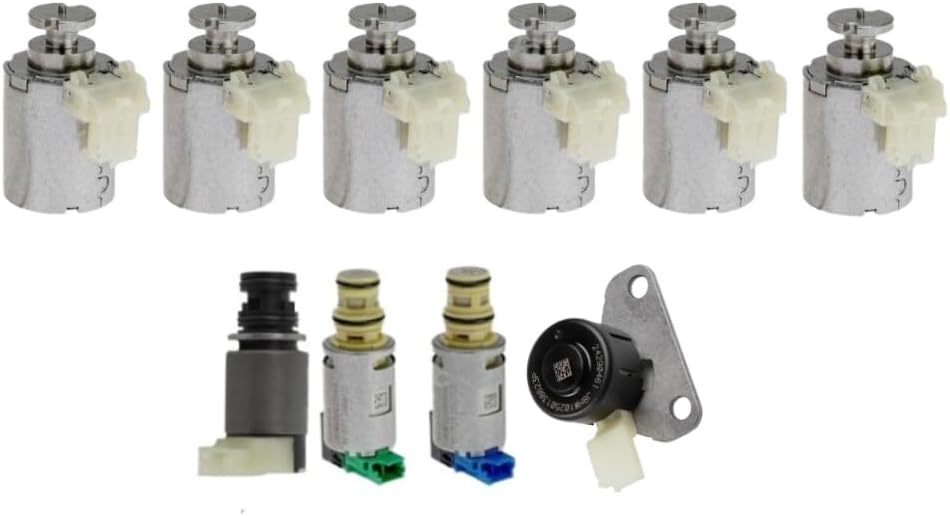
Valve body solenoid kits, filter and pan gasket kits and the fill adapter a no-dipstick 10-speed needs are on our 10L80 transmission parts page, priced and in stock, with checkout on our own site. If the graph pointed at the valve body, the solenoid kit and a fresh filter belong on the bench before the pan comes down.
FAQ
What speed does 10L80 torque converter shudder happen at?
GM bulletin 22-NA-015 defines the complaint as a shudder, shake or vibration from roughly 25 to 50 mph (40 to 80 km/h) under steady to lightly accelerating throttle, plus a closed-throttle version felt on deceleration near 15 mph (24 km/h). That window is where the converter clutch is slipping in controlled lockup rather than fully applied or fully released. A vibration that only appears above 60 mph or under hard throttle is almost never TCC shudder.
How do I know if it is the torque converter or the valve body on a 10L80?
Graph it. Per GM 22-NA-015, a valve body fault shows transmission input shaft speed following engine speed with engine torque staying relatively flat, inside plus or minus 25 Nm, and it is present in both Drive and manual L9. A converter fault shows steady TCC pressure control with elevated TCC slip, where engine RPM rises at the shudder point while input shaft speed stays steady. Two different pictures on the same four-channel graph, separable in one test drive.
Why should I drive a 10L80 in manual L9 to diagnose shudder?
Because manual range L9 disables Dynamic Fuel Management. GM states that some normal shudder, shake, vibration or growl can be expected at low speed and light throttle as the engine cycles in and out of DFM, and that a slight vibration only felt while DFM is active is a normal design characteristic with no parts replaced. L9 removes that variable, and it is a diagnostic split in its own right: present in Drive but gone in L9 points at TCC solenoid drift in the valve body.
Does a transmission fluid flush fix 10L80 shudder like it does on the 8-speed?
Not the same way. The well-known fluid-exchange repair is GM bulletin 18-NA-355, and it applies to 8L45 and 8L90 units, where dealers exchanged 20 quarts of blue-label Mobil 1 Synthetic LV ATF HP through a TransFlow machine. The 10-speed uses DEXRON ULV, and GM's 10-speed guidance in 22-NA-015 is a diagnostic decision tree, not a blanket flush. Fluid condition still matters on a 10L80, but do not assume the 8-speed fix transfers.
Will replacing the torque converter fix a 10L80 shudder?
Sometimes, but GM's own data says the odds are against it. Bulletin 22-NA-015 notes that warranty claim reviews show vehicles often come back for additional engine or transmission repairs after a converter is replaced for shudder, and states plainly that in most cases the converter is not the cause. Replace it when the graph shows elevated TCC slip with a steady TCC pressure command and rising engine RPM against a steady input shaft speed. Not before.
Sources
- General Motors — Service Bulletin 22-NA-015, "Diagnostic Tips on GDS Graphing after Road-Test, for Shake and/or Shudder During Steady and/or Light Throttle Acceleration Between 25 and 50 MPH (40 and 80 KM/H) at Steady Speed, and Deceleration at approximately 15 MPH (24 KM/H)," September 2023 version. Backs the 25-50 mph steady and light throttle plus 15 mph deceleration complaint definition; the 2020-2024 model coverage and transmission RPOs MQB, MQC, MHS, MHO, MHT and MI2; the instruction to resolve engine and transmission DTCs first; the Dynamic Fuel Management caveat and the manual L9 test-drive method; all five diagnostic signatures including the plus/minus 25 Nm engine torque threshold, the under-15,000-mile TCC solenoid pattern, the TCC slip near zero with a 100 kPa TCC pressure command for solenoid drift, the elevated-slip and steady-pressure converter pattern, and the erratic non-sinewave RPM fuel injector pattern; the pointers to bulletins 21-NA-207 and 22-NA-080; and the warranty-review note that in most cases the torque converter is not the cause of the shudder. nhtsa.gov (PDF)
- General Motors — Service Bulletin 22-NA-182, "Information on 6L80, 6L90, 8L90, 10L80, 10L90, 10L1000 Equipped Vehicles with A Harsh Shift, Shudder, Surge, Stall, Neutral/Flare, Transmission Overheating and/or High Transmission Fluid Temperature," June 2024 version. Backs the twisted cooler line cause on low mileage vehicles; DTC P27EC setting in the TCM on ETRS transmissions with RPO MHS or MQC; and the published thermal bypass valve opening temperatures of 143°F (61°C) for 10L80, 10L90 and 10L1000 with the TBV inside the valve body, and 194°F (90°C) on the frame rail for the LM2 and LZ0 3.0L diesel. nhtsa.gov (PDF)
- General Motors — Service Bulletin 23-NA-072, "Shudders or Shakes at Low Speeds," January 2024, replacing PIP5608J. Backs GM's quantified TCC shudder grading used here as a calibration reference: TCC slip peak-to-peak below 20 rpm normal, near 60 rpm repeating indicating ATF degradation and requiring a fluid condition check, and near 100 rpm erratic indicating likely hardware damage; plus the launch-test ISS peak-to-peak thresholds of under 50 rpm normal, 50 to 200 rpm degraded and over 200 rpm damaged. This bulletin covers the 9T65 (RPO M3W and M3V) in Traverse, Enclave, Acadia, Blazer, XT5 and XT6, not the 10L80. nhtsa.gov (PDF)
- General Motors — Service Bulletin 18-NA-355, "Shake and/or Shudder During Light Throttle Acceleration Between 25 and 80 MPH (40 and 128 KM/H) at Steady Speed," August 2019. Backs the restriction of the fluid exchange repair to 8L45 and 8L90 units; the 20 quart fill of blue-label Mobil 1 Synthetic LV ATF HP through the DT-45096 TransFlow machine; the caution against removing more than 3 quarts of fluid to avoid pump cavitation; the level set plug torque of 9 N·m (80 lb in); the statement that intermixing other transmission fluid types or aftermarket additive packages will not provide satisfactory results; and the note that full improvement can take up to 320 km (200 mi) and a minimum of two cold-to-operating-temperature drive cycles. nhtsa.gov (PDF)
- Sonnax — Oversized TCC Regulator Valve Kit 105740-16K product and technical page. Backs the wear mechanism: bore wear reduces converter apply flow, converter release flow and cooler flow, and boost sleeve wear results in signal fluid loss that prevents torque converter lockup. Also backs the fitment note for Gen. 1 10L60, 10L80 and 10L90 units with a ridge mark on the OE valve, and the listed complaints of TCC apply and release concerns, low TCC apply pressure in full lockup, and converter shudder and TCC slip. sonnax.com
- Sonnax — GM 10L80 (Gen. 1) transmission unit page, parts and complaint index. Backs the mapping of the converter shudder and TCC slip complaint category to oversized TCC regulator valve kit 105740-16K and TCC regulator valve spring 105740-29, the Gen. 2 oversized TCC regulator and boost valve kit 105740-17K, and the 10L80-G1-10R80-ZIP Zip Kit covering TCC apply and release concerns along with main line and clutch apply control circuits across GM Gen. 1 10L60/10L80/10L90 and Ford 10R60/10R80 valve bodies. sonnax.com
- General Motors — GM TechLink "2025 Transmission Capacities & Fluids" reference chart (U.S. and Canada). Backs the DEXRON ULV fluid specification for 10L80 applications and the 7.7 liter (8.1 quart) fluid change capacity across RPO codes MQB, MQC, MHT, MI2 and MHS. gm-techlink.com (PDF)
- ATRA / GEARS Magazine — Keith Clark, “Lock Up Madness! GM and Ford Torque Converter Clutch Control.” Backs the Centrifugal Pendulum Accumulator on GM diesel and DFM vehicles, the vibration from a non-CPA replacement converter, and the damper rivet failure at 70,000–80,000 miles on DFM vehicles with the 10L90. View source
- General Motors — Preliminary Information PIP5573A, “2017–2019 10L80 10L90 Automatic Transmission Torque Converter Restriction,” June 19, 2019 (NHTSA-hosted). Backs the PQC restriction of converters 24288828 and 24286575 effective June 25, 2018 on MF6 Escalade, Tahoe, Suburban and Yukon Denali and MGL Camaro applications. View source (PDF)