The 10R80 pan is a plastic flange holding an aluminum case closed against roughly 4 quarts of hot ATF, and the fasteners that hold it there are torqued in inch-pounds, not foot-pounds. Run those bolts in with an impact or guess at them with a foot-pound wrench set "low," and the next thing you see is a weep at the flange, or worse, a cracked ear around a bolt hole on a pan that is not cheap to replace. This is the number set I keep taped inside the toolbox for this job, where it came from, and why the low torque is not a typo.
For the step-by-step pan drop, filter swap and how to read the magnet, see our 10R80 filter and pan service guide. This page is the torque reference that goes with it.
The documented torque values
The table below comes from a published 10R80/10R60 heavy-duty pan installation manual that lists every fastener a pan swap touches, not just the pan bolts. It is a manufacturer install document, not Ford's own Workshop Manual, so treat it as the best public reference and confirm the exact OEM figure against Workshop Manual Section 307-01 for your specific model year before you sign off on a customer vehicle.
| Fastener | Torque | Notes |
|---|---|---|
| Pan bolts (12) | 89 lb-in | Standard bolts around the pan perimeter |
| Pan stud-bolts (6) | 106 lb-in | Carry brackets or harness clips at specific locations; note their holes before removal |
| Heat shield nuts (6) | 80 lb-in | 10mm, reinstalled after the pan is torqued |
| Filter bolts (2, if equipped) | 93 lb-in | Shorter bolt goes in the center hole |
| Fill/level indicator plug | 52 ft-lb | 19mm; this is foot-pounds, not inch-pounds. Matches Ford Workshop Manual 307-01: 52 lb-ft (70 Nm) |
| Temperature sensor port plug | 12 ft-lb | 7/16" Allen; apply thread sealant first |
| Drain plug (aftermarket pans only) | 20 ft-lb | Most factory pans have no drain plug |
| Transmission cooler bolts (2) | 22 ft-lb | 10mm |
| Sway bar bracket nuts (4) | 41 ft-lb | 15mm |
| Transmission mount nuts, 4WD | 76 ft-lb | 21mm, torqued after lowering the transmission back onto the mount |
These values are not just an aftermarket pan maker's numbers. Ford's Workshop Manual 307-01 "Transmission Fluid Pan, Gasket and Filter" removal and installation procedure for the 2019 Ranger 10R80 specifies the same three: pan studbolts tightened first in a crisscross pattern to 106 lb-in (12 Nm), then the pan bolts in a crisscross pattern to 89 lb-in (10 Nm), and the filter bolts at 93 lb-in (10.5 Nm). Ford also warns that installing the short and long filter bolts in the wrong holes "will" damage the transmission, and notes that the pan gasket and filter may be reused if undamaged and not excessively contaminated.
Notice the unit jump: everything that actually clamps the pan and gasket is specified in inch-pounds, while the surrounding structural fasteners (mount, sway bar, cooler, dipstick) are specified in foot-pounds. That is not an inconsistency in the source, it is the actual spread. 89 lb-in is 7.4 ft-lb. A pan bolt torqued to even half of a typical "low" foot-pound setting, say 15 ft-lb, is nearly double the documented spec and is exactly how a plastic ear splits at the bolt hole.
Why the number is this low
Two things make this different from torquing a steel pan on an older transmission. First, the 10R80's factory pan is injection-molded plastic, not stamped steel. Plastic does not have steel's yield margin, so over-torquing does not just stretch the bolt, it can crack the boss around the hole, and a cracked boss will not reseal no matter how carefully the gasket goes back in.
Second, the pan gasket is a reusable, molded design with metal limiters built into it, the kind of gasket Ford lists as an if-needed part rather than a mandatory replacement in its 10R80 service bulletins. The metal limiters are there specifically to stop the gasket from being crushed past its working thickness. Torque the bolts correctly and the limiters do their job for multiple pan services. Over-torque them and you can crush the gasket's sealing bead even though the limiters are present, because you are relying on the bolt stopping at the right clamp load, not on the limiter alone to save a tech who kept turning.
If you have seen a 10R80 pan with hairline cracks radiating from two or three bolt holes on a truck that "always weeps a little back there," over-torque at a prior service is the usual explanation, not a bad gasket.
Crisscross, not around the perimeter
The sequence matters almost as much as the number. Start every pan bolt and stud-bolt by hand so nothing is cross-threaded, then bring them to final torque working corner to corner in a star pattern, the same crisscross method used on a cylinder head or any flat gasketed cover. Do not walk around the pan tightening each bolt fully in order.
Going in sequence lets the gasket seat unevenly: the first few bolts you fully torque pull that corner of the pan down tight against the case rail while the far corner is still loose, and the gasket compresses more on one side than the other before you ever get there. On a steel pan with some flex, that mostly washes out. On a rigid plastic pan it does not, and you end up with a pan that is torqued to spec at every bolt but still not sealing evenly because the gasket set crooked under sequential tightening. Crisscross brings the whole flange down evenly in two or three passes.
What the Ford bulletins confirm
Ford's 10R80 technical service bulletins do not publish torque values in their public text (that level of detail lives in the Workshop Manual, which is not part of the bulletin), but they do confirm the parts you are torquing. TSB 24-2304, covering the Explorer, Transit, F-150, Mustang, Expedition and Navigator on 10R80 units built through mid-August 2022, lists the fluid pan gasket as part number HL3Z-7A191-B, the fluid filter as HL3Z-7A098-A for F-150/Expedition/Navigator/Mustang/Explorer and LK4Z-7A098-A for Transit, the filter seal as 7T4Z-7Z302-A, and specifies Motorcraft MERCON ULV (XT-12-QULV) as the fluid for the unit. All four are listed in the "only if necessary" parts tables, meaning Ford expects a tech to reuse an undamaged gasket rather than replace it as routine.
Motorcraft's own product documentation for MERCON ULV confirms it is the fluid "recommended by Ford Motor Company for use in the 8F Front Wheel Drive and 10R Rear Wheel Drive families," built on an ultra-low-viscosity base specifically because those units are calibrated for it, dyed red for leak detection, and explicitly not interchangeable with MERCON V, MERCON SP, or MERCON LV. Mixing in a higher-viscosity fluid because it is what was on the shelf is its own way to create a shift complaint that looks like a pan-service mistake months later.
The one value Ford's Workshop Manual does confirm
Ford's 10R80 Workshop Manual procedures, section 307-01, give the fill plug figure directly. Both the Transmission Fluid Drain and Refill procedure and the Transmission Fluid Level Check procedure end with "Install the transmission fluid fill plug. Torque: 52 lb.ft (70 Nm)." That matches the install manual's 52 ft-lb for the fill/level indicator plug, so that number is confirmed by two independent documents.
The same Ford procedures set the refill rules that go with a pan job. After the pan or filter has been removed, Ford calls for an initial fill of 4.8 L (5 qt) of MERCON ULV so the engine can be started, then a fill to between the first hatch mark and 6 on the level indicator before driving. The final level is set at a transmission fluid temperature of 96-101 C (206-215 F) on a scan tool, between 4 and 5 on the indicator, and Ford's note is blunt: do not overfill. A perfectly torqued pan does not save a unit that goes back on the road a quart high.
Tool notes that actually matter here
- Use an inch-pound torque wrench for the pan, not your foot-pound click wrench "turned down." A foot-pound wrench rated down to 10-20 ft-lb has poor resolution in the 7-9 ft-lb range these bolts actually need. An inch-pound (or dual-scale) wrench reading in the 20-150 lb-in range is the right tool, and it is worth owning one if you touch 10-speed Fords more than once.
- No impact driver on final torque, ever, on the pan bolts or stud-bolts. Snug by hand, torque with a calibrated wrench in the crisscross sequence.
- Mark stud-bolt locations before removal. Several holes carry OEM stud-bolts instead of plain bolts, for brackets or harness retention at that specific point. They are not interchangeable with the plain bolt positions.
- Thread sealant on the temperature port plug, not on the pan bolts or gasket. The pan gasket is designed to seal dry against clean mating surfaces; adding sealant there is more likely to create a high spot than help it.
While the pan is down, it is also worth checking fluid condition against the unit's normal running range. ATRA's own technical coverage of the 10R family puts the 10R80's normal operating temperature at 206-215°F (97-102°C); fluid that looks or smells cooked on a truck that has not been towing hard points to a cooling-circuit problem, not just a pan service, and is worth chasing down separately (see our 10R80 cooler line replacement guide).
If the flange is already cracked
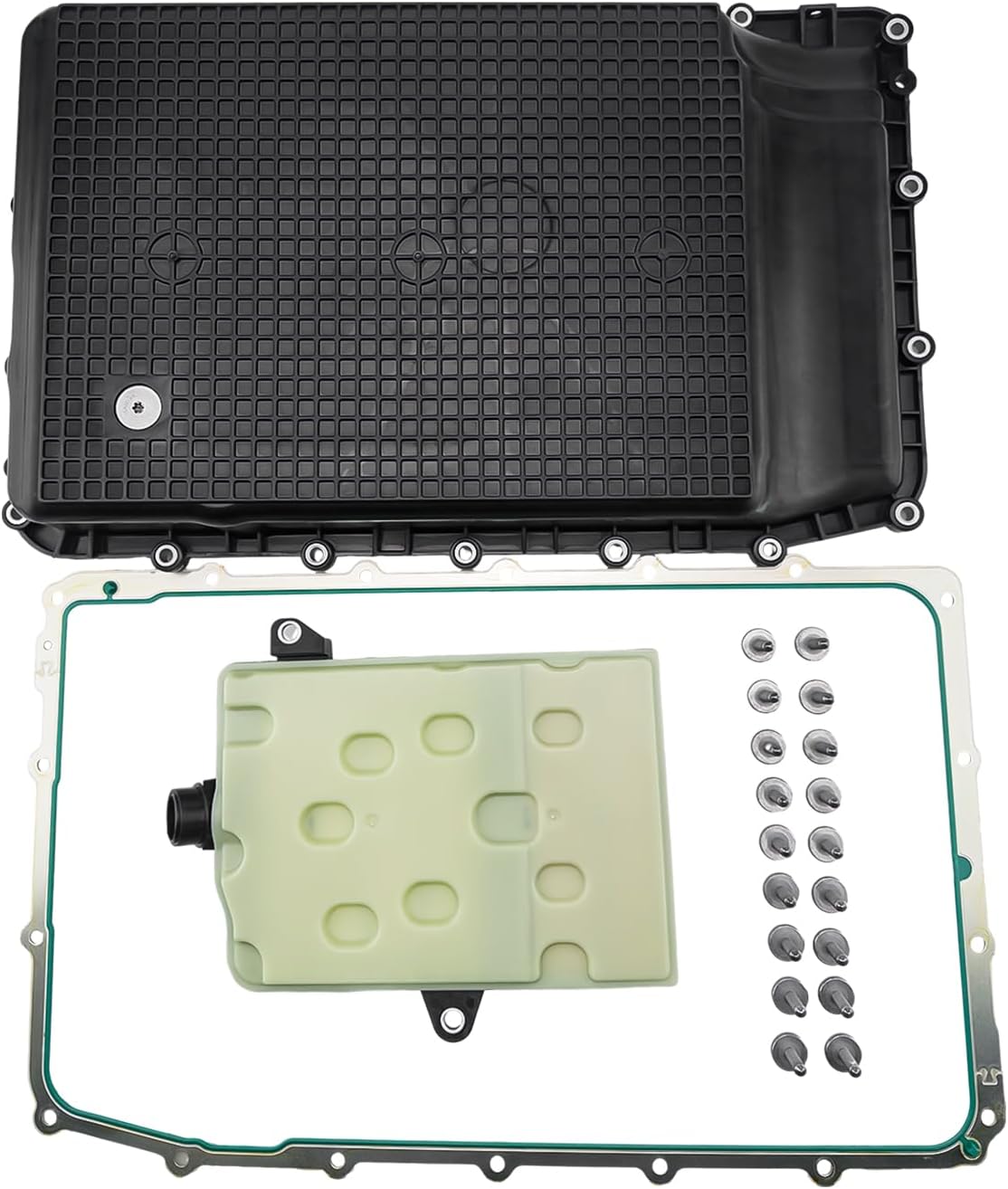
A cracked plastic pan boss does not get fixed by a new gasket and careful torque; the crack propagates under clamp load regardless of how gently you bring the bolt in. At that point the choice is a replacement OEM-style pan or an aftermarket cast-aluminum pan, which carries its own torque spec (commonly in the same inch-pound range for its bolts, since it is designed to mount on the same case) and, on most aftermarket versions, adds a drain plug the factory pan does not have. Check the specific pan's instructions rather than assuming the figures above carry over, since aftermarket flange thickness and bolt count are not always identical to stock.
Cracked flange? Replace the pan, not just the gasket
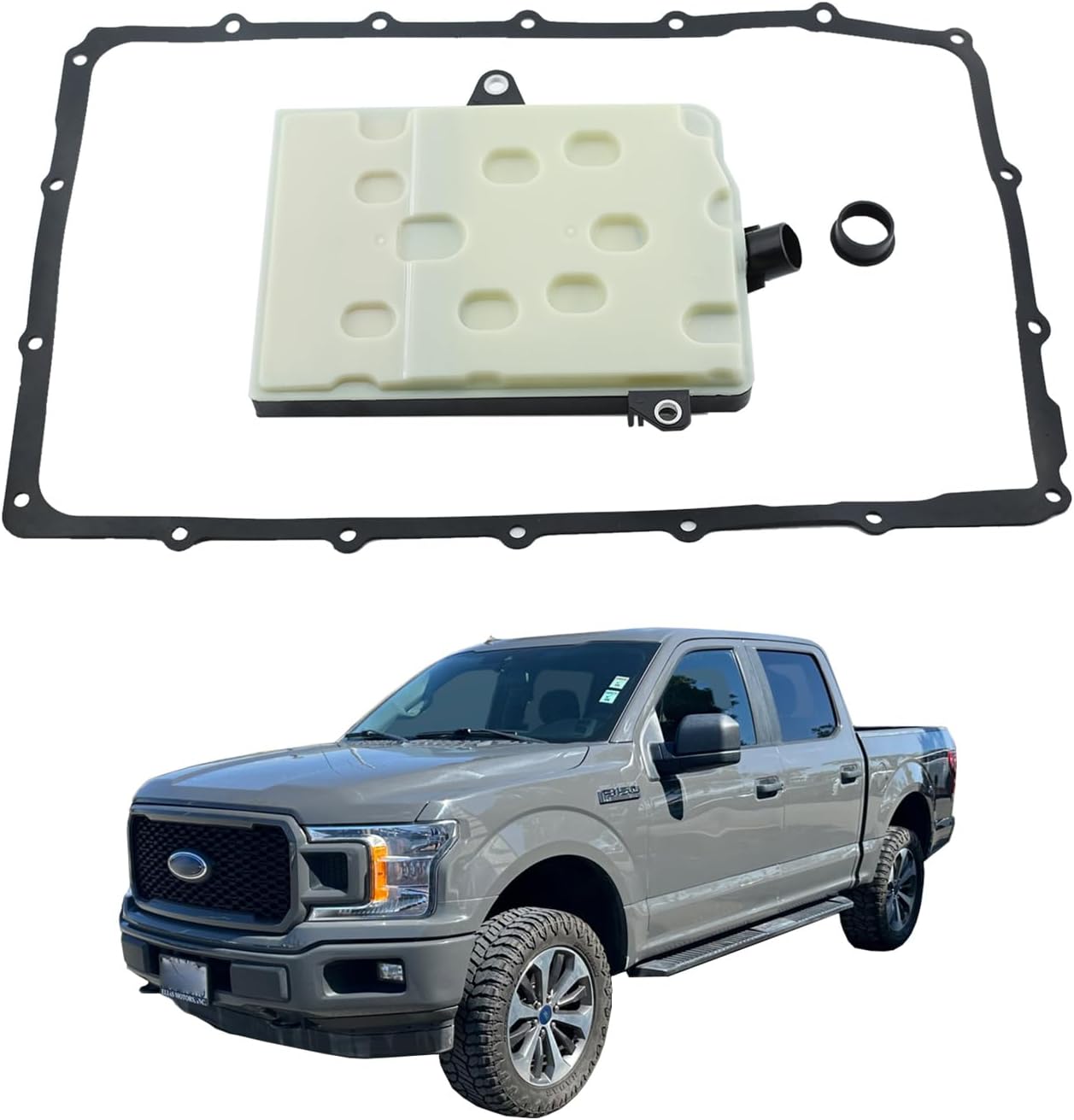
A 10R80 pan kit with filter, sized for a clean torque-to-spec reinstall. From our sister store CoreTransmissionParts.
Shop the part for this fix →Need more for the 10-speed? The 10-speed parts collection covers the Ford and GM 10-speed valve body kits, clutches and hard parts.
Need parts for this job?
The 10R80 filter and gasket kit, a complete pan-and-filter kit, and ULV-spec fluid are all on our 10R80 parts page, with checkout on site.
FAQ
What is the torque spec for 10R80 pan bolts?
The documented figure, from a published 10R80/10R60 pan installation manual, is 89 lb-in for the 12 standard pan bolts and 106 lb-in for the 6 stud-bolts. Ford's own Workshop Manual 307-01 pan, gasket and filter procedure for the 2019 Ranger 10R80 gives the same numbers: studbolts first to 106 lb-in (12 Nm) in a crisscross pattern, then the bolts to 89 lb-in (10 Nm), with filter bolts at 93 lb-in (10.5 Nm). Confirm the figure in Section 307-01 for your model and year before you torque a customer's truck.
Why is the 10R80 pan bolt torque so low?
Because the factory pan is plastic and the gasket is a reusable design with molded-in metal limiters. Both numbers are given in inch-pounds, not foot-pounds, because they sit well under 10 ft-lb. A standard foot-pound click wrench cannot resolve a value that small accurately, which is why an inch-pound wrench is required for this job.
What torque pattern should I use on a 10R80 pan?
Crisscross, the same star pattern used on any flat gasketed surface: snug every bolt and stud-bolt hand-tight first, then bring them to final torque working corner to corner rather than around the perimeter. This pulls the plastic flange down evenly instead of cocking it against the gasket on one side first.
What is the Ford part number for the 10R80 pan gasket?
HL3Z-7A191-B. It is listed as an if-needed part in Ford's 10R80 harsh-shift technical service bulletins, meaning it is reused when it is not damaged and replaced when it is. The same number appears in the 2024 bulletin covering the Explorer, Transit, F-150, Mustang, Expedition and Navigator.
What else gets torqued during a 10R80 pan service?
On a 4WD truck with the transmission supported for pan access, the transmission mount nuts, sway bar nuts, cooler line bolts, heat shield nuts, the fill/level plug and the temperature sensor port plug all get reinstalled. Each has its own torque value, and none of them share the pan bolt spec.
Related guides
- 10R80 F-150 Fluid Change: Type, Capacity and Cost
- 10R80 Filter and Pan Service Guide
- 10R80 Cooler Line Replacement Guide
- 10R80 Fluid Type and Capacity
- 10R80 Fluid Change Cost
- 10R80 Flush vs Drain and Fill
- 10R80 Common Problems and Fixes
Sources
- BD Diesel Performance, Installation Manual I-00542, "Ford 10R60/10R80 Heavy Duty Transmission Pan," 12 September 2024. Backs the documented torque values: pan bolts 89 lb-in, pan stud-bolts 106 lb-in, heat shield nuts 80 lb-in, filter bolts 93 lb-in, fill/level indicator plug 52 ft-lb, temperature sensor port plug 12 ft-lb, drain plug 20 ft-lb, cooler bolts 22 ft-lb, sway bar nuts 41 ft-lb, and transmission mount nuts 76 ft-lb (4WD), plus the crisscross tightening instruction and Ford pan gasket part number HL3Z-7A191-B. sdda.semadata.org (PDF)
- Ford Motor Company, Technical Service Bulletin 24-2304, "Various Vehicles Equipped With A 10R80 Automatic Transmission - Harsh/Delayed Engagement And/Or Harsh/Delayed Shift - Built On Or Before 15-Aug-2022," 24 September 2024, via NHTSA. Backs the fluid pan gasket (HL3Z-7A191-B), fluid filter numbers (HL3Z-7A098-A and LK4Z-7A098-A for Transit), filter seal (7T4Z-7Z302-A) and Motorcraft MERCON ULV (XT-12-QULV) fluid specification as listed in Ford's own parts tables, and that the pan gasket and filter are "only if necessary" service items. static.nhtsa.gov (PDF)
- Ford Motor Company / Motorcraft, FCSD Chemicals and Lubricants product catalog, "MERCON ULV Automatic Transmission Fluid." Backs that MERCON ULV is the fluid recommended by Ford for the 8F front-wheel-drive and 10R rear-wheel-drive transmission families, its ultra-low-viscosity formulation, red dye for leak detection, and that it must not be substituted with MERCON V, MERCON SP or MERCON LV. fcsdchemicalsandlubricants.com
- Transmission Digest, Wayne Colonna, "The root cause of 10R80 low roller clutch failure," published 11 April 2025. Backs that a clean pan service does not rule out internal clutch wear modes on this unit, and that the low one-way roller clutch is a distinct, parts-replacement-only failure separate from a pan or gasket issue. transmissiondigest.com
- Gears Magazine (ATRA), "Ford's 10R-Series Transmission: More Need-to-Know Information Inside the Unit," September 2024. Backs the 10R80's normal operating temperature range of 206-215°F (97-102°C), used here as the benchmark for judging fluid condition during a pan service. gearsmagazine.com
- Ford Motor Company, Workshop Manual 307-01, 10R80 Transmission Fluid Drain and Refill (procedure revision 12/11/2018). Backs the fill plug torque of 52 lb-ft (70 Nm), the 4.8 L (5 qt) initial fill after pan or filter removal, the 5.7 L (6 qt) initial fill after overhaul, the drive-able cold range between the first hatch mark and 6, and the 96-101 C (206-215 F) final check temperature. Ford 307-01 Drain and Refill (PDF)
- Ford Motor Company, Workshop Manual 307-01, 10R80 Transmission Fluid Level Check. Backs the hot level between 4 and 5 on the level indicator at 96-101 C (206-215 F), the do-not-overfill instruction, and the 52 lb-ft (70 Nm) fill plug torque. Ford 307-01 Level Check (PDF)
- Ford Motor Company — Workshop Manual 307-01, 10-Speed Automatic Transmission 10R80, 2019 Ranger, "Transmission Fluid Pan, Gasket and Filter," Removal and Installation (procedure revision 12/11/2018). Backs the OEM confirmation of pan studbolts at 106 lb-in (12 Nm) first, pan bolts at 89 lb-in (10 Nm), both in a crisscross pattern, filter bolts at 93 lb-in (10.5 Nm), the short/long filter bolt location warning, and the gasket and filter reuse notes. Ford 307-01 Pan, Gasket and Filter (PDF)