A 46RE that drives fine in D but will not back up, or backs up with the engine flaring, is common on the gas trucks this unit went into: the 5.2L and 5.9L Magnum V8s in Ram 1500s and other Dodge and Jeep trucks. Chrysler's manual treats no Reverse and a Reverse that slips as two separate complaints, with two separate cause lists. Most of the parts on those lists are ones you can check before pulling the transmission.
This guide covers both factory charts, the road test that splits them, the 46RE numbers that differ from the diesel 47RE (rear band back-off, servo piston size, front clutch pack) and the parts Sonnax and TransGo document as repeat failures. Specs are from Chrysler's 2001 Dodge Ram Truck (BR/BE) service manual. If you have the heavy-duty unit, see the 47RE no reverse guide instead. Sources are listed at the end.
Two Factory Charts: No Reverse vs. Slips in Reverse Only
The 46RE diagnosis section has an entry for No Reverse (D Ranges OK) on page 21-494. It lists seven causes and the factory correction for each:
- Gearshift linkage or cable misadjusted or damaged. Repair or replace the linkage.
- Park sprag sticking. The correction is to replace the overdrive annulus gear, not only the pawl.
- Rear band misadjusted or worn. Adjust it, or replace it.
- Valve body malfunction. Service it, and replace it if any valve or bore is worn.
- Rear servo malfunction. Pull the transmission and replace the worn servo parts.
- Overdrive direct clutch worn. Disassemble the overdrive unit and replace worn parts.
- Front clutch burnt. Pull and overhaul the transmission.
Two pages later (21-496) there is a separate entry for Slips in Reverse Only. The list overlaps but starts from the cheap end: low fluid, gearshift linkage, a misadjusted rear band, a worn rear band, a worn overdrive direct clutch, low hydraulic pressure, a leaking rear servo and band linkage binding. That last one is not on the no-Reverse list, and it is worth a look on a high-mileage truck: a rear band lever or strut that hangs up keeps the band from wrapping the drum fully.
Use the one that matches the truck. Slipping in Reverse means something is applying but not holding, and the problem is usually fluid, adjustment or a leak. No Reverse at all means a part has broken or is not applying at all.
If the truck will not move in D either, you are on the "No Drive or Reverse" chart (page 21-493). That one starts with low fluid, loose linkage, a broken U-joint, axle or transfer case, a plugged filter and a damaged pump. It also lists a park sprag that will not release and converter damage. Check the driveline before you blame the transmission.
If the driveline is good and the fluid level is right, do not assume a no-move in both directions means a dead pump. ATSG's Wayne Colonna documented a 4XRE that would not move in D or R even though it had cooler flow. Air-checking the rear (forward) clutch proved first gear, and air on the direct (front) clutch and the rear band proved Reverse was mechanically sound. The cause was a piece of debris holding the converter switch valve so that converter charge oil went to the cooler instead of the converter. His warning: cooler flow on a 4XRE does not prove the converter is charged.[10] Clean the switch valve and check it for full travel before you condemn hard parts.
Check the Fluid and the Linkage First
Reverse is the highest-pressure range in the 46RE. The manual says the hydraulic test pressures go as high as 300 psi at the rear servo port in Reverse. When the fluid is low, the pump draws air on the highest-demand range first, so a truck that is a quart or two low can lose Reverse before any forward gear slips. Check the level hot with the engine running in Park, and top up only with ATF+4, which ATSG lists as the required fluid for the 46RE, 47RE and 48RE. Smell the fluid. A burnt smell with a slipping Reverse points to band or clutch damage.
Next, put the shifter in R and look at the manual lever on the left side of the case. It should sit in its Reverse detent, not between detents. On a column-shift Ram a stretched cable or worn bushing can leave the manual valve partway, and the Reverse circuit never gets full line pressure. If the lever is right and the truck drags when you pull out of Park, think about the park sprag and the annulus gear the manual calls out.
Use the Application Chart to Find the Part
Chrysler's clutch and band application chart (page 21-487) shows three friction elements applied in Reverse: the front clutch, the rear band and the overdrive direct clutch. Each one also works in some forward range, so a road test tells you which one failed:
- Front clutch is also applied in third and fourth. The manual's own example: if the transmission slips in third and also in Reverse, the front clutch is slipping. If Reverse is fine, the rear clutch is the one slipping in third.
- Rear band is applied only in manual 1 and Reverse. If manual 1 freewheels on a closed-throttle downhill and Reverse is gone, look at the band, strut, servo and band linkage.
- Overdrive direct clutch is applied in every range except fourth. ATSG classes it as an input driving member of the rear overdrive section, alongside the front and rear clutches in the main case. The manual says that if the direct clutch fails, the transmission loses both Reverse and overrun braking in manual second.
So: third flares and no Reverse means the front clutch. No engine braking in manual 1 means the rear band side. No coast braking in manual 2 means the overdrive direct clutch. All forward gears solid with no Reverse usually means the band, servo or linkage, because those parts carry very little load going forward.
Rear Band Adjustment: The 46RE Number Is 2 Turns
This is where 47RE habits cause trouble. The 46RE rear band procedure (page 21-540):
- Raise the truck, remove the pan and drain the fluid.
- Loosen the adjusting screw locknut 5-6 turns and make sure the screw turns freely in the lever.
- Tighten the adjusting screw to 8 N·m (72 in-lb).
- Back the screw off 2 turns.
- Hold the screw and tighten the locknut to 34 N·m (25 ft-lb).
- Install the pan with a new gasket, pan bolts at 17 N·m (13 ft-lb), and refill with Mopar ATF+4.
The 46RE spec table on page 21-532 agrees: rear band back off 2 turns from 72 in-lb, front band back off 2-7/8 turns. The 1998 Ram service manual (pp. 21-308/309) gives the same 46RE values. The 47RE uses 3 turns, and an extra turn on a 46RE leaves the band loose enough to slip in Reverse. One thing to know about this manual: the torque table on page 21-533 lists 30 ft-lb for the rear band locknut and 25 ft-lb for the front, which is the reverse of the procedure pages (25 ft-lb rear here, 30 ft-lb front on page 21-539). The locknut only holds the adjustment, so the back-off count is what matters.
If the screw runs out of adjustment, or the band still slips after a correct adjustment, the band, drum or strut is worn. On a unit that has already been rebuilt, measure the drum. Sonnax warns that after the low/reverse drum is resurfaced and the band relined, the band may not hold, and you get a slip or no Reverse. Their strut guide by resurfaced drum OD applies to the 46RE as well as the 47RE and 48RE:
- 6.185-6.200 in.: the OE strut is fine.
- 6.170-6.185 in.: the extended strut 0.100 in. longer (22900-10).
- Under 6.170 in.: the 0.150 in. longer strut (22900-15).
The 46RE Rear Servo: 2.80 in. Piston, Flat-Tip Plug
The rear servo applies the low/reverse band and takes full Reverse pressure every time the truck backs up. Sonnax lists "No Reverse," burnt bands and rear servo piston sticking or breakage as the symptoms of a failed piston. The cause they give is the piston cocking in its bore, with pin bore wear, which keeps the band from applying fully. Their billet replacement (22912) has modified seal ridges so it does not stick in the case bore, and it will not crack like the cast OE piston.
Get the right size. Sonnax lists the 46RE, 46RH and A727 piston as OE 2801281 at 2.80 in. across. The 47RE and 48RE use a 2.46 in. piston (OE 4531229 for '94-96, 52118745 for '97-later). A 47RE servo part will not work in a 46RE case.
Check the plug inside the piston too. Sonnax says the 46RH/RE (A518) uses the flat-tip aluminum reverse servo plug, while the 47RH/RE and 48RE use an extended-tip plug. Either way, the OE aluminum plug wears and galls because the metal is soft, and it can break at the spring seat under Reverse loads. A broken plug means the servo cannot apply the band: no Reverse and a burnt Reverse band. Sonnax's hardened steel kit (22912-01K) fits both plug styles.
The Front Clutch: Only 3 Discs, and a Piston That Cracks
The 46RE front clutch is small. The spec table lists 3 discs, against 4 in the rear clutch, 4 in the overdrive clutch and 8 in the direct clutch. Front clutch pack clearance is 0.070-0.129 in. A 3-disc pack has little margin, and it is the part that burns when a truck tows more than it should or someone holds it in Reverse against the brakes.
A cracked piston is a less obvious cause. Sonnax reports that OE cast front (direct) clutch pistons in these units crack and break, which causes sudden clutch failure. Sonnax calls it the direct clutch; Chrysler calls it the front clutch. Their reinforced piston (22965A-01) adds webbing to the weak areas. It is a direct replacement for '98-later units and can be used in '97-earlier units with thicker steels, because the piston is 0.020 in. thinner. If you find burnt front clutch plates, look at the piston before you install new frictions behind it.
The Overdrive Direct Clutch Spring
The overdrive direct clutch is applied by a large spring, not by oil pressure. TransGo, which makes a high-temp replacement spring (TFOD-SP, OEM 4461027) for the A518 and 46RE, says faded direct clutch springs lose clamping force. The complaints they list are slip in Reverse, burnt overdrive direct clutch plates, and reduced or no coast braking in manual 2nd or 1st. That matches the manual's chart. Replace the spring any time you replace burnt direct clutch plates, and use a spring compressor. The spring is under heavy preload: the ATSG 46RE/47RE/48RE manual puts it at approximately 830 pounds and calls for compressor 6227-1 (or equivalent) in a shop press with at least 5 to 6 inches of travel, released slowly.
When you restack it, use the right count. ATSG gives the 46RE overdrive direct pack as 8 double-sided frictions and 7 steels, against 10 and 9 in the 47RE, so a 47RE pack will not drop into a 46RE overdrive.
While the overdrive unit is off, check the piston retainer. Sonnax says the overdrive piston support in the 46RE family does not seal well against the case, and excess clearance at the intermediate shaft cuts lube flow to the geartrain. That starves the rear of the unit and leads to reverse drum, retainer and planet failure. A scored reverse drum on teardown is usually a lube problem, not a band problem.
Pressure and Air Tests Before Teardown
The manual says the cause of a failure usually cannot be found until the hydraulic and air pressure tests are done. For Reverse, run Test Four (page 21-489): 300 psi gauge on the rear servo port, 100 psi gauge left on the accumulator port, engine at 1600 rpm, shift lever four detents back from full forward. Rear servo pressure should read 145-175 psi with the throttle lever forward and rise to 230-280 psi as the lever moves rearward. The spec table states it as 160 psi at idle, building to 270 psi at 1600 rpm. The 1998 Ram Truck service manual (pp. 21-217/218) lists the same 145-175 psi rising to 230-280 psi window for Reverse at 1600 rpm, so the spec has not moved across 46RE model years. Then read the results against the analysis chart (page 21-490):
- OK in 2, low in R and 1: leakage in the rear servo.
- OK in 1 and 2, low in D3 and R: leakage in the front clutch area.
- Low in all positions: clogged filter, stuck regulator valve, worn pump or low oil.
Good pressure and no Reverse means a mechanical failure: burnt front clutch, a slipping band or short strut, a broken servo plug or a burnt direct clutch. With the pan and valve body off, air test the circuits. Air on the front clutch apply passage should give a soft thump as the piston moves. Air on the rear servo apply passage should extend the servo rod and tighten the band on the drum, and spring pressure should release it when the air is removed. A hiss with no movement is a leaking seal or a cracked piston.
If Test Four reads low with clean fluid, look at the valve body before the clutches. Sonnax lists "Reverse slip," "Soft Reverse" and poor Forward and Reverse engagement as complaints its line pressure plug and sleeve kits (22229-01K and 22229-04K) cure on the 46RH/46RE/47RH/47RE. Its vacuum test guide for these units is a quick way to find a worn bore without guessing.[11]
The Fix, by What You Found
- Low fluid or linkage: top off and find the leak, or adjust the cable and replace the bushing. Confirm the lever sits in the Reverse detent.
- Rear band slipping: adjust to 72 in-lb and back off 2 turns. If it still slips, replace the band, measure the drum and fit the correct strut, and free up any binding band linkage.
- Rear servo: fit the 2.80 in. piston and a steel flat-tip plug, and check the bore for wear.
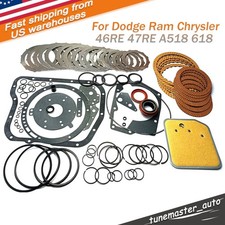
- Burnt front clutch or direct clutch, or friction material in the pan: overhaul. Use a master rebuild kit, inspect the front clutch piston for cracks, fit a new direct clutch spring and the piston retainer, flush the cooler and replace the converter if the unit made debris.
- Low Reverse pressure with good parts: service or replace the valve body. Our 46RE valve body testing guide covers the vacuum test.
Sonnax Extended Length Band Strut 22900-10 (46RE, 47RE, 48RE)
For a rebuilt 46RE that slips or will not hold Reverse on a resurfaced drum measuring 6.170-6.185 in. It is 0.100 in. longer than stock and takes up the extra band travel, from CoreTransmissionParts.
View the extended band strut →Or browse all RE-family transmission parts.
Shop the piston retainer kit →
Frequently Asked Questions
Why does my 46RE go forward but not in reverse?
Chrysler's 46RE chart for no Reverse with the D ranges OK lists seven causes: shift linkage, a sticking park sprag, the rear band, the valve body, the rear servo, a worn overdrive direct clutch and a burnt front clutch. The forward gears put almost no load on the rear band and servo, so a band, servo or linkage fault usually shows up as no Reverse first. A road test in manual 1 and in third tells you which part to chase.
How do you adjust the rear band on a 46RE?
Drop the pan, loosen the locknut 5-6 turns, torque the adjusting screw to 72 in-lb, then back it off 2 turns. Hold the screw and tighten the locknut to 25 ft-lb per the procedure page, install the pan with a new gasket at 13 ft-lb and refill with ATF+4. The 47RE backs off 3 turns, so do not use a 47RE number on a 46RE.
What rear servo piston does a 46RE use?
The 46RE uses the 2.80 in. rear servo piston, OE 2801281, shared with the A727. The 47RE and 48RE use a smaller 2.46 in. piston, so the parts do not interchange. Sonnax sells a billet version (22912) because the cast OE piston can cock in its bore, crack and stop applying the band.
How much pressure should a 46RE have in reverse?
Chrysler's Test Four puts a 300 psi gauge on the rear servo port at 1600 rpm in Reverse. It should read 145-175 psi with the throttle lever forward and climb to 230-280 psi as the lever is moved rearward. The spec table gives 160 psi at idle building to 270 psi at 1600 rpm. Good pressure with no Reverse means a mechanical failure.
Can low fluid cause no reverse in a 46RE?
Yes. Low fluid is the first cause on Chrysler's 46RE chart for slipping in Reverse only. Reverse is the highest-pressure range, so the pump can suck air when the level is low and Reverse fades before the forward gears do. Check the level hot with the engine running in Park before you pull anything apart.
Sources
- Chrysler — 2001 Dodge Ram Truck (BR/BE) Service Manual, 46RE Diagnosis Charts (pages 21-493, 21-494 and 21-496). Backs the "No Drive or Reverse" causes, the seven "No Reverse (D Ranges OK)" causes and corrections including the overdrive annulus gear for a sticking park sprag, and the eight "Slips in Reverse Only" causes including band linkage binding. The ManualsLib scan previously cited for this page no longer resolves (403, bot-blocked as of October 2026); cited here as the factory manual by page number pending a working public mirror.
- Chrysler — 2001 Dodge Ram Truck Service Manual, 46RE Clutch and Band Application Chart and Road Test Analysis (page 21-487). Backs the front clutch, rear band and overdrive direct clutch as the Reverse elements, the slip-isolation logic, the direct clutch failure causing loss of Reverse and manual-second overrun braking, and the 300 psi rear servo port pressure. The ManualsLib scan previously cited for this page no longer resolves (403, bot-blocked as of October 2026); cited here as the factory manual by page number pending a working public mirror.
- Chrysler — 2001 Dodge Ram Truck Service Manual, 46RE Test Four, Pressure Test Analysis Chart and Air Testing (pages 21-489 and 21-490). Backs the Test Four setup and 145-175 psi rising to 230-280 psi, the rear servo and front clutch leak indications, and the front clutch and rear servo air test results. The ManualsLib scan previously cited for this page no longer resolves (403, bot-blocked as of October 2026); cited here as the factory manual by page number pending a working public mirror.
- Chrysler — 2001 Dodge Ram Truck Service Manual, 46RE Specifications and Rear Band Adjustment (pages 21-532, 21-533 and 21-540). Backs the 3-disc front clutch, 4/4/8 disc counts, front clutch clearance 0.070-0.129 in., rear band back-off 2 turns and front band 2-7/8 turns, Reverse pressure 160 psi at idle to 270 psi at 1600 rpm, the torque table band locknut values, and the rear band procedure (72 in-lb, 25 ft-lb locknut, 13 ft-lb pan bolts, ATF+4). The ManualsLib scan previously cited for this page no longer resolves (403, bot-blocked as of October 2026); cited here as the factory manual by page number pending a working public mirror.
- Sonnax — Rear Servo Piston 22912 and Reverse Servo Piston Plug Kit 22912-01K. Backs the 46RE/46RH/A727 piston at 2.80 in. (OE 2801281) against 2.46 in. for the 47RE/48RE, piston cocking and pin bore wear inhibiting band apply, the cast piston cracking, the flat-tip plug in the 46RH/RE (A518) against the extended tip in the 47RE/48RE, and aluminum plug galling and breakage causing no Reverse. Rear servo piston and plug kit (sonnax.com)
- Sonnax — Extended Length Band Strut 22900-10. Backs 46RE fitment, the band failing to hold on a resurfaced low/reverse drum, and the strut guide by drum OD. sonnax.com
- Sonnax — Reinforced Front Clutch Piston 22965A-01 and Piston Retainer Kit 22754N-01K. Backs OE cast front (direct) clutch pistons cracking and causing sudden clutch failure, the '98-later direct replacement and 0.020 in. thinner piston for earlier units, and the poor overdrive support seal cutting geartrain lube and causing reverse drum, retainer and planet failure. Front clutch piston and piston retainer kit (sonnax.com)
- TransGo — TFOD-SP Overdrive Direct Clutch Spring. Backs A518/46RE fitment, the OEM 4461027 interchange, faded springs reducing clamping force, and the complaints of slip in Reverse, burnt direct clutch plates and lost coast braking in manual 2nd or 1st. transgo.com
- ATSG (Automatic Transmission Service Group) — 46RE, 47RE, 48RE Technical Service Manual (2011). Backs the overdrive direct clutch as an input driving member of the overdrive section, the approximately 830 lb direct clutch spring and compressor tool 6227-1 with a 5-6 in. travel press, the 46RE 8/7 and 47RE 10/9 overdrive direct stack-ups, and the ATF+4 requirement. Cited as the ATSG print manual. Introduction and application chart excerpt: atsg.biz (PDF)
- Transmission Digest — "Chrysler/Dodge/Jeep 4XRE Transmissions No Movement," Wayne Colonna (ATSG), January 2021. Backs the no-move-in-D-and-R case, the air checks of the forward clutch, direct (front) clutch and rear band, the debris-stuck switch valve sending converter charge oil to the cooler, and the warning that cooler flow does not prove the converter is charged. transmissiondigest.com
- Sonnax — Chrysler 46RE, 46RH, 47RE, 47RH Vacuum Test Guide (November 2016). Backs the vacuum test procedure for these units and the "Reverse slip," "Soft Reverse" and poor Forward/Reverse engagement complaints for line pressure plug and sleeve kits 22229-01K and 22229-04K. sonnax.com
- Chrysler — 1998 Dodge Ram Truck Service Manual, Group 21 (archive.org full scan). Backs the clutch and band application chart with Reverse on the front clutch, rear band and overdrive direct clutch (p. 21-216), Test Four Reverse pressure of 145-175 psi rising to 230-280 psi at 1600 rpm (pp. 21-217/218), and the 46RE rear band adjustment of 72 in-lb, back off 2 turns, locknut 25 ft-lb (pp. 21-308/309). archive.org
Shop 46RE master rebuild kits, clutch modules, valve bodies and hard parts — shipped fast from the USA.
Shop 46RE parts →