When a 48RE comes in with a 3-4 complaint — flare on the shift into overdrive, slip once it gets there, or a truck that just quits at 65 mph with a trailer on — people tend to say "the 3-4 clutch is gone" as if there were one clutch pack doing the job. On this transmission there isn't. The 3-4 shift happens entirely inside the overdrive unit bolted to the back of the case, and that unit has two clutch packs on one piston: an overdrive clutch that applies on the shift and an overdrive/direct clutch that releases on the shift. Either one can be the reason the truck came in, and they fail with very different symptoms.
This guide covers how the overdrive unit makes fourth, the two ways it fails, how to tell them apart before teardown, and the fix. It applies to the 48RE in 2003-2007 Ram 2500/3500 trucks with the 5.9L Cummins and the 8.0L V10, and most of the mechanical content carries over to the 46RE and 47RE.
How the 48RE Makes Fourth Gear
ATSG's 48RE technical service information lays out the split plainly: first through third come from the clutches, bands, low roller clutch and planetary sets in the main case, and fourth gear is provided by the overdrive unit at the rear, which contains an overdrive clutch, an OD/direct clutch, an overrun roller clutch and a planetary gearset. In the same document ATSG lists the OD/direct clutch as a driving component and the overdrive clutch as a holding component.
The mechanical logic is laid out in Chrysler's original patent for this add-on overdrive (US 4,798,103, filed by Chrysler Motors in 1987). The direct clutch pack is held engaged by a single large coil spring, so with no hydraulic pressure on the piston the unit locks up and passes power straight through at 1:1. Chrysler describes that as the fail-safe mode. When the overdrive circuit pressurizes the piston, the piston compresses that spring, releases the direct clutch, and applies the overdrive clutch, which grounds the sun gear to the case. The planetary then overdrives the output at a ratio the patent puts on the order of 0.69:1, and the overrun roller clutch freewheels because its outer race is now spinning faster than its inner race.
So one piston does two jobs on the 3-4 shift:
- Overdrive clutch — hydraulically applied, on only in fourth. Holds the sun gear. If it slips, you lose fourth.
- Overdrive/direct clutch — spring applied, on in first, second, third and reverse. Locks the overdrive planetary at 1:1. If it slips, you lose drive through the back of the box in every range except fourth, and you lose reverse and engine braking.
Why the 48RE leans harder on the overdrive clutch
Chrysler built the 48RE for its heavy-duty trucks starting in 2003, and Transmission Digest's write-up on the unit notes that the changes went beyond the converter and pump stator to the torque capacity of the clutch drums. ATSG's component illustration shows separate diesel and gasoline versions of the overdrive clutch for this reason. On the hydraulic side, Sonnax documents that 48RE overdrive apply pressure strokes the boost valve and exhausts two of the pressure regulator's reduction points (A and D) instead of one, raising line pressure roughly 22-28 psi in fourth versus about 10-15 psi on a 46RE/47RE. That extra pressure exists for one reason: clamping the overdrive clutch against diesel torque.
Failure Mode 1: The Overdrive Clutch Won't Hold
This is the classic towing failure. Symptoms, roughly in the order they show up:
- A flare on the 3-4 upshift that gets longer as the fluid gets hot.
- RPM creeping up in fourth on a grade or into a headwind, then dropping when the driver lifts.
- The truck pulls fine with overdrive locked out (tow/haul or OD off), because third gear never touches the overdrive clutch.
- Eventually, no fourth at all: the shift commands, the engine flares, and the unit falls back to 1:1 through the roller clutch.
The causes, from most to least common on the trucks we see:
- Burned overdrive frictions from sustained heavy towing in fourth, usually on a truck with added power and no transmission upgrades.
- Low apply pressure in fourth — a worn pump, a restricted or leaking overdrive feed, or a sticking boost valve that never delivers the 22-28 psi rise.
- Wrong valve body. Sonnax specifically reports 46/47RE valve bodies installed in 48REs that seem to work at first and then come back with a failed converter clutch or a failed overdrive clutch. The two look nearly identical on the bench. If the truck has a valve body swap in its history, confirm it is a 48RE unit before anything else.
- Overdrive piston seal leak. A cut or rolled piston seal bleeds off apply pressure, so the clutch applies soft and slips under load even with good line pressure.
Failure Mode 2: The Direct Clutch Spring Fades
This one confuses people because the complaint is not about the 3-4 shift at all. Since the direct clutch is applied by nothing but spring force, a tired spring means a direct clutch that slips in every range where it is supposed to be on. TransGo, who sells a high-temperature replacement for OEM spring 4461027, lists the symptoms as slipping or no reverse, reduced or no coast braking in manual 2nd or 1st, and burned overdrive direct clutch plates, and notes that 47RE and 48RE units commonly come in with faded springs and burned direct plates together.
In practice you see:
- Reverse that slips or takes a long time to bite, while Drive engages normally. Forward ranges at light throttle can still feel fine because the roller clutch carries the load in 1:1 on drive torque.
- No engine braking in manual 1 or 2 — on coast the roller clutch overruns, so only the direct clutch can carry reverse torque through the overdrive unit.
- Fourth gear that works perfectly, because in fourth the direct clutch is supposed to be released anyway.
That last point is your tell. A truck that slips in reverse and has no coast braking but pulls fine in overdrive is not an overdrive clutch problem — it is the direct clutch side of the same unit.
Diagnosing It Before Anything Comes Apart
1. Check fluid first
Pull the dipstick hot, in Neutral. Burned overdrive frictions leave dark, burnt-smelling fluid and fine black friction material on the dipstick and in the pan. The 48RE takes ATF+4 only; Chrysler's 2006 Ram capacity sheet lists a service fill of 3.8 liters (8 pints) and an overhaul fill of 14 to 16 liters (29 to 33 pints). If someone has been topping it off with a multi-vehicle fluid, note it. Our 48RE fluid type and capacity guide covers the hot check step by step.
2. Road test with a scan tool
Log engine RPM, vehicle speed or output shaft speed, the overdrive solenoid state, TCC state, and governor pressure actual versus desired. What you are looking for:
- Overdrive solenoid commanded on, RPM does not drop. At a steady speed with the converter locked, engine RPM in fourth should land near 69% of what it was in third. If the solenoid is commanded and RPM stays high or wanders, the overdrive clutch is not holding.
- Overdrive solenoid never commanded. Then the problem is upstream: the OD cancel or tow/haul switch, a throttle or speed input, or the solenoid circuit. Mechanical parts are innocent until the PCM actually asks for fourth. See our 48RE won't shift into overdrive guide for that path.
- Flare only when hot. Points at marginal clutch capacity or a seal that leaks once the fluid thins, not at a dead circuit.
3. Line pressure in fourth
Tee a gauge into the line pressure tap and watch it through the 3-4 shift. You want to see the jump when the overdrive circuit applies. If line pressure does not rise on the shift, the clutch is being asked to hold diesel torque with 46RE-level clamping force or less, and new frictions will burn again. Fix the pressure problem — pump, boost valve, or wrong valve body — before you rebuild the overdrive.
4. Split the two failure modes
- Slips in fourth only, reverse and coast braking normal: overdrive clutch side.
- Slips in reverse, no coast braking in manual 1/2, fourth normal: direct clutch / spring side.
- Both: the unit has been cooked. Plan on both packs, the spring, the piston seals, and a hard look at what caused the heat.
The Fix
The overdrive unit comes off the back of the transmission as an assembly, so on a truck where the main case is healthy you can repair it without a full overhaul. On a 4x4 that means pulling the transfer case and the overdrive extension housing. A few things matter on the bench:
- Use a spring compressor on the direct clutch spring. It is a very heavily loaded spring, and the retaining snap ring cannot be removed or installed safely without compressing it in a proper tool. Do not improvise this with a bench vise and a socket.
- Replace the direct clutch spring, don't reuse it, on any unit that came in with burned direct plates or a reverse slip. A faded spring will burn a fresh pack.
- Replace the overdrive piston seals and inspect the piston bore for scoring. A seal leak will undo new frictions in a few hundred miles of towing.
- Set clutch clearance to the service manual spec with the correct selective snap ring. Too loose on the overdrive clutch costs apply time and makes the 3-4 flare worse.
- Flush the cooler and lines and change the filter. Burned friction material from the overdrive goes everywhere, and a restricted cooler cuts lube to the back of the box, which is exactly where the overdrive unit lives.
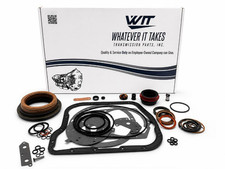
If the fluid shows debris from the main case too, or the truck has high mileage and a history of heat, stop and do the whole transmission. A master rebuild kit costs a fraction of a second teardown. Our 48RE rebuild cost breakdown lays out what that job actually runs.
Preventing a Repeat
- Lock out overdrive when towing heavy on grades or in headwinds. Third gear never loads the overdrive clutch.
- Keep the valve body correct for the unit. A 48RE needs the 48RE valve body and its 22-28 psi fourth-gear boost.
- Service the fluid on schedule with ATF+4, and drop the pan to look for friction material before it becomes a no-fourth complaint.
- If the engine has been turned up, the stock overdrive clutch and spring are now the weak link. Plan the upgrade instead of waiting for the failure.
48RE Friction Clutch Kit 2003-2016 (Raybestos)
Burned overdrive or direct clutch packs: this is the friction set for 2003-up 48RE units, including the overdrive unit packs.
View the 48RE friction clutch kit →Shop 48RE transmission parts →
Frequently Asked Questions
What clutch applies on the 48RE 3-4 shift?
The overdrive clutch. It sits in the overdrive unit at the back of the case and is applied by line pressure on the overdrive piston only in fourth gear. The same piston stroke compresses the big overdrive direct clutch spring, which releases the spring-applied direct clutch, so a 3-4 shift is really one clutch releasing while another applies.
Why does my 48RE slip only in overdrive?
If the truck holds fine in first through third and flares or slips only after the 3-4 shift, the overdrive clutch is not holding. The usual causes are burned overdrive frictions, a leaking overdrive piston seal, low line pressure in fourth, or a 46RE/47RE valve body installed in a 48RE, which cannot deliver the 22-28 psi line rise the 48RE needs in fourth.
Can a weak overdrive direct clutch spring cause no reverse on a 48RE?
Yes. The direct clutch in the overdrive unit is applied by spring force alone in first through third and in reverse. TransGo lists slipping or no reverse, weak or no coast braking in manual 2 or 1, and burned overdrive direct clutch plates as the symptoms of a faded spring, which is OEM part 4461027.
Can I fix 48RE overdrive clutch failure without a full rebuild?
The overdrive unit can be removed from the back of the transmission and serviced on its own, so a burned overdrive or direct clutch pack does not always mean a full overhaul. But burned overdrive frictions put debris through the whole hydraulic system, so at minimum change the filter and flush the cooler, and inspect the main case clutches before you decide.
How much fluid does a 48RE need after an overdrive repair?
Chrysler lists a 48RE service fill of 3.8 liters (8 pints) and an overhaul fill of 14 to 16 liters (29 to 33 pints), depending on cooler size and line length. Use ATF+4 only and set the final level hot in Neutral on the dipstick, not by the number.
Sources
- ATSG (Automatic Transmission Service Group) — 46RE, 47RE, 48RE Technical Service Information (2011). Backs the overdrive unit layout (overdrive clutch, OD/direct clutch, overrun roller clutch, planetary), the classification of the OD/direct clutch as a driving component and the overdrive clutch as a holding component, and the separate diesel and gasoline overdrive clutch versions. atsg.biz (PDF)
- Chrysler Motors Corp. — US Patent 4,798,103, "Automatic transmission with add-on overdrive." Backs the spring-applied direct clutch as the fail-safe 1:1 mode, the single piston that compresses the spring to release the direct clutch and apply the overdrive clutch, the sun gear being grounded in overdrive, the overrunning clutch freewheeling in overdrive, the direct clutch carrying reverse, and the approximately 0.69:1 overdrive ratio. patents.google.com
- Sonnax — "Dodge 48RE Hydraulic Features Revealed." Backs the boost valve exhausting reduction points A and D on overdrive apply, the 22-28 psi line rise on the 48RE versus 10-15 psi on the 46/47RE, and the field reports of 46/47RE valve bodies in 48REs returning with a failed TCC or overdrive clutch. sonnax.com
- Transmission Digest — "A Significant Departure: the 48RE Transmission." Backs the 2003 introduction of the 48RE for Dodge heavy-duty trucks and the changes to the pump stator, torque converter and clutch drum torque capacity. transmissiondigest.com
- TransGo — TFOD-SP overdrive direct clutch spring technical page. Backs the spring applying the overdrive direct clutch, OEM part 4461027, the 1988-2007 46/47/48RE applications, and the faded-spring symptoms (slipping or no reverse, reduced coast braking in manual 2/1, burned direct plates). transgo.com
- Chrysler / Ram Body Builder — 2006 Ram Fluid Capacities. Backs the 48RE service fill of 3.80 L (8 pints) and overhaul fill of 14.0-16.0 L (29-33 pints). rambodybuilder.com (PDF)