Every tech who has worked on a Dodge RE-series automatic knows the old rule: hot stall in Reverse, check the pump. That rule has been reliable since the 42RE. Then the 48RE showed up on 2003-and-later Cummins trucks and quietly broke it. On a 48RE, a bad TCC solenoid can stall the truck in Drive, at idle, with the pump perfectly healthy — and plenty of pumps have been swapped chasing a problem that was never there.
The cause is a real change Chrysler made to how the 48RE applies the torque converter clutch. It is not a software quirk and not a sensor glitch. It is a hydraulic circuit change that lets this transmission lock the converter clutch under conditions no other RE-series unit can reach. Once you understand that change, the stall-in-Drive-but-not-Reverse symptom stops being confusing and becomes a fast diagnosis. This guide covers how 48RE lockup actually works, how to tell a solenoid problem from a pump problem in under five minutes, and which codes and pressure checks back it up.
Why the 48RE Broke the Old Stall-in-Reverse Rule
According to Wayne Colonna's write-up for ATSG and Transmission Digest, the classic hot stall on any RE-series transmission — 42, 44, 46, 47 or 48 — traces back to a pump whose halves no longer mate flat. The surfaces can look pristine and still have lost flatness; Sonnax demonstrated this years ago using Pressurex pressure-indicating film cut and clamped between the pump halves, which changes color intensity with pressure and reveals a mating surface that looks perfect but isn't. A worn pump or a restricted cooler causes a hot stall in Reverse, and the same two causes, plus a bad converter or a stuck TCC switch valve, can stall in both Reverse and Drive.
What changed with the 48RE is the Drive side of that equation. When Chrysler designed the 48RE to replace the 46/47RE on heavy-duty trucks starting in 2003, it revised the pump stator, the torque converter, clutch-drum torque capacity, and — critically — the valve body hydraulics that control the converter clutch. Those changes eliminated the No. 2 checkball and altered the channel plate and spacer plates so the TCC solenoid is now fed forward-clutch pressure instead of second-gear oil off the 1-2 shift valve. That one change is the whole story.
How 48RE TCC Lockup Actually Works
Because the TCC solenoid now runs on forward-clutch pressure rather than second-gear oil, the PCM can command lockup under conditions a 46/47RE physically cannot reach. Per Sonnax's breakdown of the 48RE's hydraulic design, the solenoid feed on the 48RE comes from the manual valve in any Drive position, so the computer can apply the converter clutch in manual 2 and manual 1 for better pulling power at low engine speed when towing — something that would require external electronic control on a 46/47RE, which instead cancels lockup in those ranges through a passage to the spring side of the lockup valve.
Normal automatic-Drive lockup on the 48RE still happens where you'd expect it on an RE-series unit: third gear with TCC commanded on, and fourth gear. What's new is that first gear can also see TCC apply, but only under a specific computer strategy — the vehicle must be moving under load in manual 1 or manual 2. That strategy is also exactly why a stuck-closed TCC solenoid is so disruptive on this transmission: it can apply the clutch the instant Drive is selected, long before the truck would ever see lockup on a healthy unit.
The baseline schedule comes straight from Chrysler. Per the 1998 Ram Truck service manual, the PCM decides converter clutch engagement from coolant temperature, engine RPM, vehicle speed, throttle position and manifold vacuum. With overdrive on, the clutch engages after the shift to fourth and above about 45 mph; with the overdrive switch off, it engages after the shift to third at about 35 mph at light throttle. The PCM blocks converter clutch and overdrive engagement below about 50°F fluid temperature, and above about 260°F it forces a 4-3 downshift and applies the converter clutch on the third-gear schedule. The same manual notes the switch valve limits converter oil pressure to 130 psi. Those figures were published for the 46/47RE, and 48RE calibrations vary by year and engine, so confirm the commanded TCC state on the scan tool rather than trusting a speed alone.
The pressure side: why lockup clamps harder on a 48RE
Sonnax's hydraulic writeup also documents a line-pressure change that rides along with TCC apply. The 48RE's pressure regulator has four reduction points (labeled A through D) that oppose throttle pressure in 1st through 3rd with TCC off. When TCC or Overdrive apply pressure shows up — third with TCC on, or fourth — the boost valve exhausts reduction points A and D, leaving only B and C working, and line pressure climbs roughly 22-28 psi. Compare that to a 46/47RE, where the same boost event only exhausts point D and line pressure rises just 10-15 psi. That extra clamping force is there on purpose: it's what lets the 48RE hold lockup and the Overdrive clutch against the torque of a diesel engine. It's also 10 psi or more of extra force shoving a converter clutch closed if the solenoid controlling it is stuck.
The Diagnostic Split: Reverse vs. Drive
This is the test that actually separates a pump problem from a TCC solenoid problem on a 48RE, and it takes less time than pulling a code reader out of the truck:
- Stalls hot in Reverse, runs fine in Drive: classic pump wear, same as any RE-series transmission. Check pump-to-case mating flatness and cooler flow before you condemn anything else.
- Stalls hot in Drive, runs fine in Reverse: on a 48RE specifically, this points straight at a mechanically restricted TCC solenoid. The solenoid is dragging the converter clutch closed the moment Drive is selected. Colonna's write-up is explicit on this point — it is the key that eliminates the confusion his hotline fielded for years on this exact complaint.
- Stalls hot in both Reverse and Drive: back to the broader list — worn pump, restricted cooler, a defective torque converter, or a stuck TCC switch valve in the valve body.
There's a second symptom that travels with a dragging TCC solenoid and is worth knowing before a customer describes it badly: a sudden RPM flare right after the shifter is moved into Drive. The PCM reads the partially-applied converter clutch as an unexpected load on the engine and responds by raising idle speed to compensate. The driver feels the truck lurch or surge the instant it's put in gear. That combination — stall or near-stall in Drive, paired with an RPM flare instead of a clean stall — is close to a signature for this specific 48RE failure mode.
Codes and PID Checks That Back It Up
A mechanically restricted solenoid doesn't always set a code, because the circuit itself can still be electrically sound even while it's hydraulically stuck. Still, check these before you pull the valve body:
- P0743 — Chrysler's code table defines it as an open or shorted condition in the TCC solenoid/transmission relay circuits: typically an open or short in the solenoid winding or its wiring, not a hydraulic drag issue. If this sets, check resistance at the case connector before assuming the solenoid pack needs to come out.
- P0740 / P1740 — TCC performance code. Colonna's article notes this code recurring on RE-series units with a pump-flatness problem; it's a converter-clutch performance fault, not necessarily electrical, so it can also appear with a mechanically dragging solenoid that never delivers the commanded lockup state correctly. Chrysler's own definition of P0740 is no RPM drop at lockup, and the 1998 manual's Cummins table lists the same family as P1740, TCC or O/D solenoid performance. Sonnax's Ed Lee, writing in Transmission Digest, explains the logic: the controller compares engine and output speed, and if slip criteria are met while TCC apply is commanded, the 740 slip code sets. Full walkthrough in our 48RE P0740 diagnosis guide.
Beyond codes, a line-pressure gauge and a scan tool that can log governor and line pressure PIDs side by side are the most useful tools for this diagnosis. Gears Magazine, ATRA's trade publication, documented a 2003 Dodge 48RE with a cable-TV 5.9L Cummins that wouldn't complete a 2-3 upshift at wide-open throttle. The fix traced to the governor pressure solenoid: the technician installed pressure transducers on the line and governor taps, captured both on a scope, and found governor pressure never reached line pressure when the PCM commanded a near-zero duty cycle — even though the solenoid was brand new. Swapping the aftermarket solenoid for an OE unit resolved it. That same methodology — watching commanded duty cycle against actual pressure on a scope, and comparing a suspect solenoid against a known-good OE part — applies directly to chasing a TCC circuit that behaves oddly without setting a hard code. Keep in mind governor pressure and line pressure move together with TCC apply on the 48RE, since both ride the same boost valve event Sonnax describes above, so a pressure trace that looks wrong at lockup is telling you something real.
Fluid: Rule It Out Before You Chase the Solenoid
The 48RE's TCC circuit is calibrated around ATF+4 to Chrysler specification MS-9602, and nothing else is correct for it. Shell's technical data sheet for Pennzoil Platinum ATF+4 states the fluid is approved against Chrysler MS-9602 and replaces ATF+3, ATF+2 and ATF+ (MS-7176) in Chrysler automatics, and it warns the fluid is not for Chrysler 8-speed units, so ATF+4 is the RE-family fluid, not a universal Mopar answer. A generic multi-vehicle fluid or old, oxidized ATF+4 can make a converter clutch chatter, shudder, or release slowly even when the solenoid and hydraulics are completely correct, which can masquerade as a sticking solenoid. Check fluid condition on a white towel and confirm the spec before you spend an afternoon on electrical diagnosis.
Don't Swap In a 46/47RE Valve Body
Because the 48RE's TCC and pressure-boost hydraulics depend on the channel plate and spacer plate changes described above, a 46/47RE valve body is not a safe substitute, even though it bolts in. Sonnax states plainly that putting a 46/47RE valve body in a 48RE can seem fine at first and then come back later with a failed converter clutch or Overdrive clutch, because that valve body was never built to deliver the 22-28 psi boost or feed the TCC solenoid off the manual valve the way the 48RE requires. If a truck in your bay has a valve-body swap in its history, that's worth ruling out before you chase a solenoid or pump that was never the problem.
Diagnosis Order That Works
- Reproduce the stall hot and note whether it happens in Reverse, Drive, or both.
- Stall in Reverse only: check pump-to-case mating flatness and cooler flow.
- Stall in Drive only, with or without an RPM flare: suspect the TCC solenoid mechanically, even with no code set.
- Pull codes: P0743 points at the solenoid circuit; P0740/P1740 points at converter-clutch performance.
- Check fluid level, condition, and confirm MS-9602 ATF+4.
- Scope line and governor pressure against commanded duty cycle if the complaint is intermittent or doesn't match a clean stall-in-Drive pattern.
- Confirm valve-body history if nothing above adds up — rule out a 46/47RE valve body installed by mistake.
Two notes on step 2. First, measure cooler flow instead of guessing at it: GEARS Magazine (ATRA) sets the minimum at about one gallon per minute from the cooler return line, and puts the ideal maximum fluid temperature at 200°F, with transmission life roughly halving for every 20°F above that (GEARS, 48RE/68RFE/AS68RC Transmission Overheating). Low flow starves the converter as well as the cooler, and a hot, thin converter clutch is the one that slips and stalls. Second, look at converter feed in the valve body. Sonnax states that poor converter line feed pressure in Chrysler RWD units, the 48RE included, causes delayed engagement, pump bushing and lube failure, and its lube-regulated pressure regulator valve 22771A-02K is designed to improve converter feed and lube flow at low RPM under high load and to help charge the converter in Park (Sonnax 22771A-02K). If the TCC complaint comes with slow engagements or a converter that seems to drain back overnight, that circuit belongs on the list.
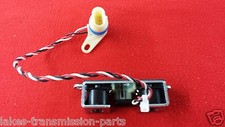
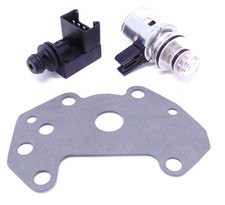
48RE TCC Lock-Up Solenoid
If the stall only happens in Drive, or the TCC circuit fails a resistance check, this is the replacement lock-up solenoid for the 48RE valve body.
View the 48RE TCC lock-up solenoid →Shop 48RE transmission parts →
Frequently Asked Questions
Why does my 48RE stall when I put it in Drive but not Reverse?
On every other RE-series transmission a hot stall points at the pump. The 48RE is different because its TCC solenoid is fed forward-clutch pressure instead of second-gear oil, so a partially restricted TCC solenoid can fully apply the converter clutch the instant Drive is selected. If it stalls in Drive but not Reverse, the pump is almost certainly fine and the TCC solenoid is the mechanical cause.
What is different about TCC lockup on a 48RE compared to a 46RE or 47RE?
The 48RE feeds the TCC solenoid from the manual valve in any Drive position instead of the 1-2 shift valve, and it exhausts two line pressure reduction points instead of one, raising line pressure roughly 22-28 psi at lockup versus 10-15 psi on a 46/47RE. That lets the 48RE apply the converter clutch as early as manual 1st and 2nd, which a 46/47RE cannot do.
What code sets when the 48RE TCC solenoid circuit fails?
An open or shorted TCC solenoid circuit typically sets P0743. A converter clutch that will not hold the commanded lockup state sets a performance code, logged on these trucks as P0740 or P1740. A mechanically restricted solenoid that drags the clutch often sets no code at all because the circuit itself is electrically fine; that is why the stall-in-Drive-only test matters more than the scan tool here.
Can I put a 46RE or 47RE valve body in a 48RE?
No. Sonnax specifically warns against it. A 46/47RE valve body does not have the channel and spacer plate changes that feed the TCC solenoid from the manual valve, and it will not deliver the 22-28 psi line rise the 48RE's clutch and Overdrive drum need. It may shift fine for a while and then come back with a failed converter clutch or Overdrive clutch.
What fluid does the 48RE TCC circuit need?
ATF+4 to Chrysler specification MS-9602, and nothing else. Shell's technical data sheet for Pennzoil Platinum ATF+4 lists approval against Chrysler MS-9602 and states it replaces ATF+3, ATF+2 and ATF+ in Chrysler automatics. The wrong fluid type can make a mechanically good TCC clutch shudder or chatter even when the solenoid and hydraulics are correct.
Sources
- Wayne Colonna (ATSG) for Transmission Digest — "A Significant Departure: the 48RE Transmission." Backs the classic pump-related hot-stall-in-Reverse diagnosis across RE-series units, the Pressurex film method for checking pump mating flatness, the P0740/P1740 and pump-related code pattern, the 48RE's TCC solenoid being fed forward-clutch pressure instead of second-gear oil, the elimination of the No. 2 checkball, the manual 1/2 lockup strategy, and the specific stall-in-Drive-not-Reverse diagnostic logic for this transmission. transmissiondigest.com
- Sonnax — "Dodge 48RE Hydraulic Features Revealed." Backs the pressure regulator's four reduction points (A-D), the boost valve exhausting points A and D at TCC/Overdrive apply, the resulting 22-28 psi line rise on the 48RE versus 10-15 psi on the 46/47RE, the TCC solenoid feed from the manual valve versus the 1-2 shift valve, and the warning against installing a 46/47RE valve body in a 48RE. sonnax.com
- Gears Magazine (ATRA) — "It Can't Be the Solenoid, I Replaced It!" Backs the governor-pressure/line-pressure scope diagnostic method on a 2003 Dodge 48RE, including the pressure-transducer setup, the duty-cycle-versus-actual-pressure comparison, and the OE-versus-aftermarket solenoid result on this transmission family. gearsmagazine.com
- Shell / Pennzoil — Pennzoil Platinum ATF+4 Technical Data Sheet. Backs the approval against Chrysler MS-9602, its use where ATF+3, ATF+2 or ATF+ (MS-7176) is specified, and the warning that it is not for Chrysler 8-speed transmissions. shell-livedocs.com (PDF)
- Chrysler — 1998 Dodge Ram Truck Service Manual (Group 21 and Group 25 DTC tables), archive.org full text. Backs the TCC engagement inputs, the roughly 45 mph fourth-gear and 35 mph third-gear lockup schedules, the 50°F and 260°F temperature rules, the 130 psi switch valve limit, and the P0740, P1740 and P0743 code definitions. archive.org
- Transmission Digest — Ed Lee (Sonnax), “740/1740 Codes and Chrysler Converter Flow,” September 2005. Backs 740/1740 indicating excessive TCC slip and the controller logic that sets a slip code only when TCC apply is commanded. transmissiondigest.com
- GEARS Magazine (ATRA) — "48RE, 68RFE, AS68RC Transmission Overheating." Backs the minimum cooler flow of about one gallon per minute, the 200°F ideal maximum temperature, and transmission life halving for every 20°F above it. gearsmagazine.com
- Sonnax — Lube Regulated Pressure Regulator Valve 22771A-02K. Backs poor converter line feed pressure causing delayed engagement, pump bushing and lube failure in Chrysler RWD units including the 48RE, and the valve improving converter feed and lube flow at low RPM and high load and helping charge the converter in Park. sonnax.com