When somebody says "shift solenoid" about a 48RE, they usually mean one of two different parts, and mixing them up is how people buy the wrong one. The 48RE does not have a stack of on/off shift solenoids like a 4L60E. Its 1-2 and 2-3 shifts are made hydraulically, using governor pressure that a single duty-cycle solenoid controls. The only electrical "shift" solenoid in the unit is the overdrive solenoid, which makes the 3-4 shift, and it lives in one assembly with the torque converter clutch (TCC) solenoid.
This guide covers that overdrive/TCC solenoid pair: what each solenoid does, the symptoms each one produces when it fails, the codes that go with them, how to test the pack from the case connector with a meter, and what to watch for when you replace it. The governor pressure solenoid has its own failure pattern, and we cover it separately in our 48RE governor pressure solenoid guide. Every spec here comes from ATSG, the Chrysler 48RE service manual, Sonnax or Transmission Digest. The sources are listed at the bottom.
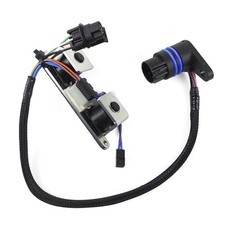
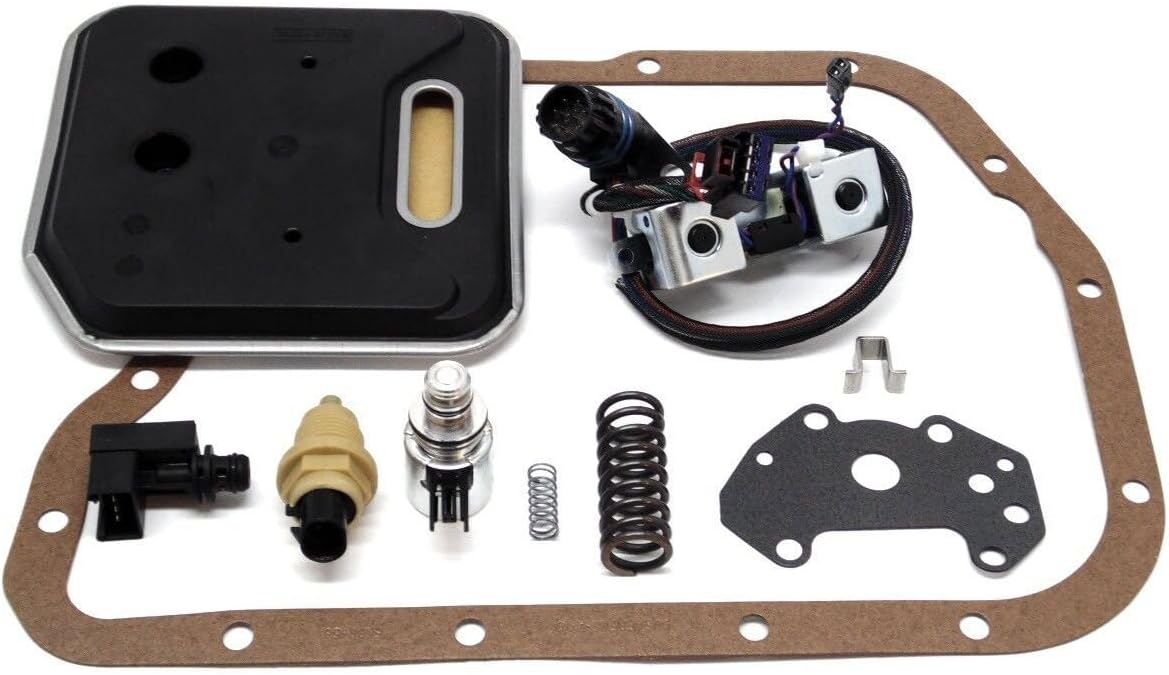
Which Solenoid Does What on a 48RE
ATSG's 46RE/47RE/48RE technical manual lays out the split plainly. First, second and third gear are controlled by the electronic governor solenoid on the valve body. The shift into fourth and the converter clutch are each controlled by their own separate solenoid, also mounted on the valve body. ATSG also notes that the 3-4 upshift is not directly influenced by governor pressure at all. It is controlled strictly by the overdrive solenoid.
That gives you a quick way to sort a complaint before you pick up a tool:
- Bad 1-2 or 2-3 shifts, early or late shifts, or no upshift out of first: that is the governor side, meaning the governor pressure solenoid, the governor pressure sensor, or the governor body and screen.
- No fourth gear, or a 3-4 that comes and goes: overdrive solenoid, the overdrive switch, or the wiring feeding them.
- No lockup at cruise, lockup that cycles, or an engine that stalls when you pull it into Drive: TCC solenoid side.
One warning on the governor side before you buy a sensor. Per Transmission Digest's TECH/TALK on RE-series P1763 (governor pressure sensor volts too high), the code sets at 4.89 volts or more for eight seconds and drops the transmission into third-gear failsafe, and the most common cause is not the sensor at all: the governor pressure sensor shares a ground path with the battery temperature sensor and the heated oxygen sensors, and a bad O2 sensor corrupts it. Their quick check is to clear the code, unplug both O2 sensors and road test. The same article lists line pressure above spec (often from a modified valve body) and a spiking alternator as the other two causes.
On the 48RE, the overdrive and TCC solenoids are not separate replaceable parts. ATSG describes the overdrive/TCC solenoid as an integral part of the internal wiring harness and case connector assembly. You buy it as one piece: two solenoids on a bracket, the harness, the 8-pin case connector, and the pigtail that runs back to the governor pressure sensor. ATSG notes the harness is model sensitive, mainly because there were four different design levels of the governor pressure and fluid temperature sensor over the years, each with its own connector. Match the new assembly to the sensor in your truck.
How the Circuit Works
Per ATSG, the pin functions at the 8-pin transmission case connector stayed the same for the whole RE run, even though the controllers changed several times. The pins that matter here:
| Case connector pin | Function |
|---|---|
| 1 | 12V feed to all three valve body solenoids (governor, overdrive, TCC) |
| 6 | Ground from the PCM/ECM to turn on the overdrive solenoid |
| 7 | Ground from the PCM/ECM to turn on the TCC solenoid |
So the solenoids are fed power all the time the system is healthy, and the computer switches the ground side. On 1996-up trucks, pin 1 is not fed straight from the computer. It comes through a transmission control relay. When the PCM/ECM decides there is a system fault, it drops that relay and cuts power to pin 1. With no power, none of the three solenoids can work, and the unit falls back to the third-gear-only default, which is what most owners call limp mode. That is why one electrical fault can take out overdrive, lockup and governor control at the same time.
The overdrive switch is part of this chain too. The Chrysler 48RE service manual says the tow/haul overdrive switch must be in the overdrive-on position to energize the solenoid and allow a 3-4 upshift. Pressing it once enters tow/haul overdrive OFF mode and lights the lamp, and the mode resets to on every time the key is cycled.
What changed on the 48RE
This is where the 48RE is different from the 46RE and 47RE, and it changes how a bad TCC solenoid acts. Wayne Colonna of ATSG, writing in Transmission Digest, explains that on the 48RE the TCC solenoid is fed with forward clutch pressure instead of second-gear oil from the 1-2 shift valve, a change made by eliminating the No. 2 checkball. Sonnax's Jim Dial describes the same change: the 48RE TCC solenoid feed comes from the manual valve in any Drive position, which makes it possible to apply the converter clutch in manual 2nd and even manual 1st for better pulling at low engine speed.
Sonnax also found a pressure change tied to these solenoids. On the 48RE, when the TC apply or overdrive apply circuit is charged, the boost valve moves and line pressure goes up roughly 22-28 psi, compared to about 10-15 psi on the 46/47RE. That extra clamping force for the converter clutch and overdrive clutch is what the heavy Cummins and V10 trucks need when towing.
Overdrive Solenoid Symptoms
- No 3-4 upshift. The truck shifts 1-2-3 fine and just stays in third. RPM at highway speed is high and fuel mileage drops. Check the overdrive switch and lamp first; a truck left in tow/haul OD-off mode looks exactly like this.
- Intermittent fourth gear. The 3-4 happens sometimes and not others, often worse when hot. That usually points to a weak coil, a chafed wire in the internal harness, or a corroded pin at the case connector.
- Stuck in third in every forward range, with codes. If the PCM has dropped the transmission control relay, you lose everything, not just overdrive. That is a circuit problem to diagnose, not proof that the solenoid is bad.
- Codes. In ATSG's 46RE/47RE/48RE code list: P0753 (3-4 solenoid circuit/transmission control relay circuit), P0783 (3-4 shift solenoid, no RPM drop at 3-4 shift), and P1740 (TCC, overdrive solenoid performance).
A P0783 with no circuit code is worth slowing down on. It means the PCM commanded fourth and did not see the RPM drop. The solenoid may be fine and the overdrive clutch may be burnt. Do the electrical checks below before you condemn either one.
TCC Solenoid Symptoms
- No lockup. Cruise RPM stays a couple hundred higher than it should, the fluid runs hotter, and the P0740 code (TCC, no RPM drop at lockup) sets. Heat is the bigger problem on a tow rig, since an unlocked converter makes a lot of it.
- Lockup that cycles or shudders. Often a sticking solenoid or weak coil, but on these trucks fluid condition and converter clutch wear cause the same complaint. Check the fluid before blaming the solenoid; our 48RE fluid guide covers the ATF+4 requirement.
- Engine stalls when you shift into Drive, but not into Reverse. This one is specific to the 48RE. Per Colonna in Transmission Digest, if the TCC solenoid becomes restricted, the converter clutch can fully apply as soon as Drive is selected and stall the engine, because the solenoid is now fed forward clutch oil. Reverse does not use that circuit, so it does not stall there. His rule: if it does not stall in Reverse but stalls in Drive, the TCC solenoid is mechanically bad. A partial apply shows up differently: the engine picks up speed soon after Drive is selected as the computer compensates for the extra load.
- Codes. P0740 (no RPM drop at lockup), P0743 (TCC solenoid circuit/transmission control relay circuit) and P1740 (TCC, overdrive solenoid performance), per ATSG.
That stall-in-Drive rule saves real money, because on an older 46/47RE the same complaint usually sends people after the pump or the cooler. On a 48RE, check the TCC solenoid first.
How to Test the Overdrive and TCC Solenoids
The Chrysler 48RE service manual says the overdrive switch, valve body solenoid, case connector and wiring can all be tested with a 12-volt test lamp or a volt/ohmmeter, and that switch and solenoid continuity should be checked any time the transmission fails to shift into fourth. Here is the order we use.
- Scan first. Pull codes and note whether you have a circuit code (P0743, P0753) or a performance code (P0740, P0783). A circuit code means electrical; a performance code with no circuit code means the solenoid was commanded and the result did not happen.
- Check the overdrive switch and lamp. Confirm the truck is not sitting in tow/haul OD-off mode.
- Check power at pin 1. Unplug the harness at the transmission case connector. With the key on, engine off, you should have battery voltage on the vehicle-harness side at pin 1. No voltage key-on is not the end of the test, though. Jon Glatstein of ATSG documented in Transmission Digest that on 46RE/47RE-era controllers the relay coil is powered from the PCM's generator source circuit (PCM connector 3, pin 25), which is only live with the engine running; the PCM grounds the other side of the coil at connector 2, pin 30. If pin 1 is dead key-on, start the engine and check again before you condemn anything. Still no voltage with the engine running means the transmission control relay, its fuse, or the wiring, not the solenoids. And if the truck also shows a charging fault or an EVAP leak detection pump code, that shared feed is the common thread. ATSG's test: check continuity from the relay to pin 1 of the vehicle harness connector with the harness unplugged at the transmission. You want 5 ohms or less. An open means a broken wire; more than 5 ohms means corrosion somewhere in the wiring.
- Ohm the solenoids at the case connector. On the transmission side of the connector, measure pin 1 to pin 6 (overdrive solenoid) and pin 1 to pin 7 (TCC solenoid). ATSG gives 25 to 40 ohms for each. An open or a reading far outside that range means the assembly is bad or the internal harness is damaged. Also check each pin to the transmission case; any continuity to ground is a shorted winding or a pinched wire.
- Check the ground side. With the connector plugged in, the PCM should pull pin 6 to ground when it commands fourth and pin 7 to ground when it commands lockup. A test lamp from battery positive to each pin, back-probed, will light when the computer grounds it. If the solenoids ohm good and the PCM grounds the pins, but the result still does not happen, you have a mechanical solenoid problem or a hydraulic or clutch problem.
- Transmission Digest — TECH/TALK, March 2006 issue: RE-series P1763 "governor pressure sensor volts too high." Backs the 4.89 V / eight-second set condition, the third-gear failsafe, the governor sensor ground shared with the battery temperature and heated oxygen sensors, the O2 unplug test, and high line pressure and alternator spikes as the other causes. transmissiondigest.com
- Chrysler / Ram Body Builder Guide 2006 — Fluid Capacities. Backs the 48RE ATF+4 3.8 L (8 pint) service fill. rambodybuilder.com (PDF)
For reference, the governor pressure solenoid on the same circuit reads about 3 to 5 ohms, per ATSG. If you are ohming through the connector and get a 3-5 ohm reading on what you think is the TCC pin, you are on the wrong pin.
Replacing the Overdrive/TCC Solenoid Assembly
The pack is on the valve body, so this is a pan-down job. Drain the fluid, drop the pan and filter, unplug the governor sensor pigtail, and release the case connector from the case. The solenoid bracket comes off the valve body and the whole harness assembly comes out as one unit. A few things we see go wrong:
- Case connector O-rings. ATSG's assembly steps call for new O-ring seals on the case connector. Reusing hard old ones is a common source of a slow leak at the connector.
- Locating tab. ATSG notes the case connector has a small locating tab that has to line up. Forcing it in crooked can push a pin back.
- Wire routing. Keep the harness clear of the manual valve lever and anything that moves. A pinched wire on this harness gives you the exact intermittent symptoms you were trying to fix.
- Refill correctly. Chrysler's 2006 Ram Body Builder fluid chart lists the 48RE service fill as 3.8 liters (8 pints) of ATF+4, and the level is checked hot in Neutral. The fluid guide has the full procedure plus the pan torque and band adjustment you should do while it is apart.
Part quality matters here
Jesse Zacarias wrote up a case in GEARS Magazine where a 48RE would not make the 2-3 at wide open throttle even after the governor solenoid was replaced. Pressure transducers on the governor and accumulator taps showed the aftermarket solenoid never reached line pressure when commanded, and an OEM solenoid fixed it. That case was the governor solenoid, not the overdrive/TCC pack, but the lesson carries over: if a new solenoid does not fix the problem, test it instead of assuming it is good because it is new.
Do not swap in a 46/47RE valve body
Because the solenoid feed and boost circuits changed, Sonnax warns that putting a 46/47RE valve body in a 48RE can seem to work at first and then fail the converter clutch or overdrive clutch after some road time. If a truck has a history of lockup or overdrive clutch failures, confirm the valve body is actually a 48RE unit before you blame the new solenoid pack.
48RE Overdrive and Lock-Up Solenoid Assembly, 8-Pin (2003-2007)
The one-piece overdrive/TCC solenoid pack with harness and 8-pin case connector for the 2003-2007 48RE. It is the part to replace when the tests above show an open, shorted or sticking solenoid.
View the 48RE OD/TCC solenoid →Shop 48RE transmission parts →
Frequently Asked Questions
Does a 48RE have shift solenoids?
Not in the usual sense. The 1-2 and 2-3 shifts are made hydraulically using governor pressure controlled by the governor pressure solenoid. The only electrical shift solenoid is the overdrive solenoid, which makes the 3-4 shift, and it shares one assembly with the torque converter clutch solenoid.
What are the symptoms of a bad 48RE overdrive solenoid?
The most common symptom is no 3-4 upshift, so the truck stays in third with high highway RPM. It can also cause fourth gear that comes and goes, especially when hot, and codes such as P0753 or P0783. Check that the overdrive switch is not in the OD-off mode before blaming the solenoid.
Why does my 48RE stall when I put it in Drive?
On the 48RE the TCC solenoid is fed forward clutch pressure, so a restricted TCC solenoid can fully apply the converter clutch as soon as Drive is selected and stall the engine. Reverse does not use that circuit. If it stalls in Drive but not in Reverse, the TCC solenoid is the first thing to replace.
How many ohms should a 48RE overdrive and TCC solenoid read?
ATSG gives 25 to 40 ohms for each solenoid, measured at the transmission side of the 8-pin case connector: pin 1 to pin 6 for overdrive and pin 1 to pin 7 for TCC. The governor pressure solenoid on the same circuit reads about 3 to 5 ohms.
Why is my 48RE stuck in third gear?
If it is stuck in third in every forward range and has codes, the PCM has most likely cut the transmission control relay, which removes 12 volts from pin 1 and disables all three valve body solenoids. That is the third-gear default mode. Find the circuit fault that set the code before replacing parts.
Sources
- ATSG (Automatic Transmission Service Group) — 46RE, 47RE, 48RE Technical Service Information (2011). Backs governor control of 1st-3rd, the separate overdrive and TCC solenoids on the valve body, the OD/TCC solenoid being integral with the internal harness and case connector, the model-sensitive sensor design levels, case connector pins 1, 6 and 7, the transmission control relay and 3rd-gear default, the 25-40 ohm overdrive/TCC spec, the 3-5 ohm governor solenoid spec, the 5-ohm relay-to-pin-1 wiring test, the P0740/P0743/P0753/P0783/P1740 code descriptions, the case connector O-ring and locating tab steps, the overdrive switch having to be in the overdrive-on position to energize the solenoid for the 3-4 upshift, OD-off mode resetting at key cycle, and testing the switch, solenoid, case connector and wiring with a 12V test lamp or volt/ohmmeter whenever the unit will not shift into fourth. atsg.biz (manual preview PDF)
- Transmission Digest — Wayne Colonna (ATSG), "A Significant Departure: the 48RE Transmission." Backs the 48RE TCC solenoid being fed forward clutch pressure instead of 2nd-gear oil, elimination of the No. 2 checkball, TCC apply in manual 2 and manual 1, and the stall-in-Drive-but-not-Reverse diagnosis for a restricted TCC solenoid. transmissiondigest.com
- Sonnax — Jim Dial, "Dodge 48RE Hydraulic Features Revealed." Backs the TCC feed from the manual valve in any Drive position, the 22-28 psi line pressure rise with TC or overdrive apply (versus 10-15 psi on the 46/47RE), and the warning that a 46/47RE valve body in a 48RE leads to converter clutch or overdrive clutch failure. sonnax.com
- GEARS Magazine (ATRA) — Jesse Zacarias, "It Can't Be the Solenoid... I Replaced It!" Backs the 48RE case where an aftermarket governor solenoid failed to reach line pressure on transducer testing and an OEM solenoid corrected the no 2-3 at wide open throttle. gearsmagazine.com
- Transmission Digest — Jon Glatstein (ATSG), "46RE/47RE Power Circuit for Transmission Control Relay Coil." Backs the transmission control relay coil being fed from the PCM generator source circuit (connector 3, pin 25) only with the engine running, the PCM grounding the coil at connector 2, pin 30, and the shared feed with the EVAP leak detection pump. transmissiondigest.com