Half the phone calls about a 48RE start with somebody reading a number off a forum post that was copied from another forum post. This page is the other way around. Every figure here comes from the Chrysler 48RE service manual, Chrysler's own Ram body builder capacity sheet, ATSG, or Sonnax, and each one is tied to its source at the bottom. It is the sheet we want taped to the bench when a 48RE is apart: gear ratios, what applies in each gear, clutch counts, clearances, end play, band settings, pressure specs and fluid capacity.
It also covers the part people skip: what the ratios actually do to engine rpm behind a 5.9 Cummins, and why the 0.69 overdrive is the gear that decides whether the transmission lives.
The short version: 1st 2.45, 2nd 1.45, 3rd 1.00, 4th 0.69, reverse 2.20 (often quoted as 2.21). Front clutch 5 discs, rear clutch 4, overdrive clutch 5 (6 on the diesel HO), direct clutch 23 single-sided discs. Bands: 72 in-lb, then back off 1-3/4 turns front and 3 turns rear. ATF+4 only; about 4 quarts for a pan service, 14.5–16.5 quarts dry.
48RE Gear Ratios
The specifications table in the Chrysler 48RE service manual (page 21-189 in the DR truck manual) lists the ratios like this:
| Gear | Ratio | How it is made |
|---|---|---|
| 1st | 2.45:1 | Rear clutch drives the front annulus; overrunning clutch holds the rear carrier (rear band holds it in manual 1) |
| 2nd | 1.45:1 | Rear clutch applied; front (kickdown) band holds the sun gear |
| 3rd | 1.00:1 | Front and rear clutches both applied; the gearset turns as one unit |
| 4th | 0.69:1 | Third-gear elements plus the overdrive clutch in the rear overdrive unit |
| Reverse | 2.20:1 | Front clutch drives the sun gear; rear (low/reverse) band holds the rear carrier |
You will see reverse listed as 2.21 in plenty of places, including our own 47RE vs 48RE comparison. It is the same gearset; the factory table rounds it to 2.20. Neither number changes anything you do on the bench.
The ratios are identical across the 46RE, 47RE and 48RE. You can check that against a public factory document: the 1998 Dodge Ram Truck service manual (Group 21, p. 21-211) lists the 46RE/47RE set as 2.45, 1.45, 1.00 and 0.69, with reverse printed as 2.21. That matters when someone wants to put a 48RE behind a truck that had a 47RE: the speedometer, the axle ratio choice and the shift feel at cruise do not change because of the ratios. What changes is hardware and calibration, which Sonnax sums up as changes to the clutch packs and gear train plus a valve body that produces a different pressure curve and TCC clamping. We cover the hardware split in the 47RE vs 48RE guide.
What applies in each gear
The service manual's powerflow section and its clutch and band application chart are the most useful diagnostic tools in the whole book, because they let you name a slipping unit from a road test. The same analysis appears word for word in the 46RE/47RE section of the 1998 Ram service manual (pp. 21-215 and 21-216), which is the easiest copy to pull up on a shop computer. The manual's own rules:
- The rear clutch is applied in all forward ranges (D, 2 and 1). Slipping in any two forward gears points at the rear clutch.
- The transmission overrunning clutch holds in first gear only (D, 2 and 1 ranges). Slip in first in D and 2, but not in manual 1, is the overrunning clutch, because manual 1 adds the rear band.
- The rear band applies only in 1 and R.
- Front and rear clutches apply together only in third and fourth. If it slips in third, check reverse: slip in reverse too means the front clutch; no slip in reverse means the rear clutch.
- The overdrive clutch applies only in fourth, while the overdrive direct clutch and overdrive overrunning clutch are applied in every range except fourth. Slip only on the 3-4 or only in fourth is the overdrive clutch.
- A failed direct clutch costs you both reverse and engine braking in manual 2.
The manual is also clear on how 4th gets commanded. The overdrive solenoid on the valve body is not energized in first, second, third or reverse; its vent port stays open and bleeds line pressure away from the 3-4 shift valve. The PCM energizes it for the 3-4 upshift, the check ball closes the vent, and line pressure strokes the 3-4 shift valve to feed the 3-4 timing valve, quick fill valve, 3-4 accumulator and overdrive piston. The direct clutch releases before the overdrive clutch applies. No 4th with no slip is usually electrical: the Tow/Haul (overdrive cancel) switch, the overdrive solenoid or its wiring. Our 48RE won't shift into overdrive post walks that circuit.
What the Ratios Mean on the Road
A gear ratio by itself does not tell you much. Multiply it by the axle ratio and you have the overall ratio the engine actually sees. As a worked example, here are two axle ratios common on 5.9 Cummins Rams:
| Gear | Trans ratio | Overall with 3.73 | Overall with 4.10 |
|---|---|---|---|
| 1st | 2.45 | 9.14 | 10.05 |
| 2nd | 1.45 | 5.41 | 5.95 |
| 3rd | 1.00 | 3.73 | 4.10 |
| 4th | 0.69 | 2.57 | 2.83 |
| Reverse | 2.20 | 8.21 | 9.02 |
On a roughly 31.6-inch tire, the wheels turn about 690 rpm at 65 mph. With the converter locked, that works out to about 1,780 engine rpm in 4th with 3.73s and about 1,960 rpm with 4.10s. Drop to 3rd at the same speed and the 3.73 truck is near 2,580 rpm. Those are our calculations from the factory ratios, not a factory table; your tire size moves them a few percent.
Two practical points come out of that arithmetic:
- The 1-2 shift is the big step. Going from 2.45 to 1.45 drops engine speed by about 41 percent. The 2-3 and 3-4 steps are each about 31 percent. That big first step is why a tired front band or a worn 2nd-gear servo shows up as a flare on the 1-2 before anything else.
- Fourth is a 0.69 overdrive, and that is where heavy towing hurts. In 4th the overdrive clutch alone is holding the load through a gear that multiplies output speed by about 1.45 over input. Pulling a heavy trailer up a grade in 4th with the converter hunting in and out of lockup is how overdrive clutches get cooked. The service manual's thermal logic backs that up: the PCM forces a 4-3 downshift and applies the converter clutch if fluid temperature exceeds 126 C (260 F). Our 48RE towing upgrades post covers keeping it out of that zone.
Clutch Packs, Clearances and End Play
These are the build numbers from the general specifications table in the 48RE service manual:
| Spec | Metric | Inch |
|---|---|---|
| Front clutch | 5 discs | |
| Rear clutch | 4 discs | |
| Overdrive clutch | 5 discs (standard) or 6 discs (diesel HO) | |
| Direct clutch | 23 single-sided discs | |
| Front clutch pack clearance | 2.5–4.09 mm | 0.098–0.161 in. |
| Rear clutch pack clearance | 0.635–0.914 mm | 0.025–0.036 in. |
| Input shaft end play | 0.86–2.13 mm | 0.034–0.084 in. |
| Planetary end play | 0.150–1.22 mm | 0.006–0.048 in. |
A few notes from the bench:
- Count the overdrive discs before you order. A diesel high-output unit carries six overdrive frictions, the standard unit five. Build a HO unit with a five-plate kit and you have given away holding capacity in the one gear that already works hardest.
- The direct clutch is 23 single-sided discs, not a normal alternating pack. Stack them the way they came out and use the proper spring compressor; that pack is under a lot of spring load.
- Rear clutch clearance is tight on purpose. 0.025–0.036 in. is a narrow window. Too loose and the rear clutch, which is applied in every forward gear, takes a long time to apply and slips under load. Set it with the selective snap ring, not by guessing.
- End play is selective. The manual notes the intermediate shaft thrust plate and spacer are select fit and points to the overdrive unit sizing charts. Measure input shaft end play before teardown and again on assembly. A reading outside 0.034–0.084 in. on the way in tells you a thrust washer or bearing is worn before you ever open it up.
On the input side, Sonnax notes that stock and heavy-duty input shafts come in 23- and 29-spline versions, and that the answer for serious horsepower is a 35-spline shaft (their 22121B-08K kit, listed for the 47RH, 47RE and 48RE) paired with a converter that has a matching 35-spline turbine hub. Spline count is a spec you confirm on the converter and the shaft together, never one without the other.
Bands
Both bands are adjusted the same way: torque the adjusting screw to 72 in-lb, then back it off. The 48RE manual calls for 1-3/4 turns on the front (kickdown) band and 3 turns on the rear (low/reverse) band. Note that the front band number is 1-3/4 here, while older RE manuals and a lot of tech articles publish 1-7/8 or more; use the figure for the unit on the bench. Hold the adjusting screw while you snug the locknut, or you will move the setting you just made.
Hydraulic Pressure Test Specs
The service manual's pressure test runs from about 1 psi of governor pressure up to 300 psi at the rear servo port in reverse, so it specifies two gauges: a 100 psi gauge (C-3292) for the accumulator, governor and front servo ports, and a 300 psi gauge (C-3293-SP) for the rear servo and overdrive ports. Line pressure is read at the accumulator port on the right side of the case; the front servo port is on the right side just behind the fill tube.
| Test port / condition | Spec |
|---|---|
| Overdrive clutch, 4th gear only | 76–82 psi at closed throttle, rising to about 140 psi at 1/2 to 3/4 throttle |
| Line pressure (accumulator port), closed throttle | 54–60 psi |
| Front servo, 3rd or 4th only | No more than 3 psi below line pressure |
| Rear servo, 1 range | No more than 3 psi below line pressure |
| Rear servo, R range | About 160 psi at idle, building to about 270 psi at 1,600 rpm |
| Governor, D range closed throttle | Smooth rise with road speed; back to 0–1.5 psi at a stop |
The governor line is the one to take seriously. The manual states that governor pressure above 1.5 psi at a standstill will prevent the transmission from downshifting. That is a common "starts in second or third" complaint, and it is a governor circuit or transducer problem, not a clutch problem.
One more thing: the 48RE valve body raises line pressure more than a 47RE once the converter clutch applies or it goes into 4th. Sonnax measured the 46/47RE boost at roughly 10–15 psi in those conditions and the 48RE at roughly 22–28 psi, because two of the pressure regulator's four reduction points are exhausted instead of one. That extra clamping is part of why the 48RE handles more torque, and it is also why a 47RE valve body on a 48RE is a mistake.
Fluid and Capacity
The service manual specifies Mopar ATF+4, built to Chrysler Material Standard MS-9602, the same specification independent fluid makers test their own ATF+4-licensed products against. Chrysler's 2007 Ram fluid capacity sheet gives two numbers for the 48RE:
| Fill | Liters | Pints |
|---|---|---|
| Service fill (pan and filter) | 3.80 | 8.00 |
| Overhaul fill | 14.00–16.00 | 29.00–33.00 |
The overhaul figure is a range because cooler size and line length vary. Finish by the dipstick, hot, in Neutral. The full procedure and why a single pan drop only replaces about a quarter of the fluid are in our 48RE fluid type and capacity guide.
Applications and Year Changes
ATSG's application chart puts the 48RE in 2003–2007 Dodge Ram pickups with the 5.9L Cummins diesel and the 8.0L V10. Two year changes affect parts:
- 2002: a push-in transmission range sensor replaced the screw-in park/neutral switch across the RE family.
- 2005: 48RE trucks with the 5.9L diesel got the electronically controlled Transmission Throttle Valve Actuator (TTVA), which replaced the throttle valve cable and all its linkage. A 2003–2004 48RE still has the cable.
If the unit's history is unknown, confirm what you have before you trust any of the numbers above. Our 48RE identification guide covers the case stamping, valve body and separator plate checks.
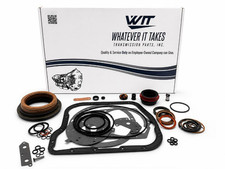
Master rebuild kits, planetaries, pumps, valve bodies, bands, end play gauges and the overdrive tools to build a 48RE to spec — shipped fast from the USA.
Shop 48RE parts →48RE heavy-duty overdrive planet (2003-2007 Ram 2500/3500 5.9L)
The 0.69 overdrive gear takes the worst of a towing life. If the OD planet shows pinion wear or end play on teardown, this is the heavy-duty replacement. Or browse the full 48RE parts collection.
View the overdrive planet → All 48RE parts →FAQ
What are the 48RE gear ratios?
Per the Chrysler 48RE service manual: 1st 2.45:1, 2nd 1.45:1, 3rd 1.00:1 (direct), 4th 0.69:1 (overdrive) and reverse 2.20:1. You will often see reverse quoted as 2.21:1; that is the same gearset rounded differently.
Does the 48RE have the same gear ratios as the 47RE?
Yes. The 46RE, 47RE and 48RE all share the 2.45 / 1.45 / 1.00 / 0.69 spread, so swapping a 47RE for a 48RE does not change your final drive or speedometer calibration. The differences are in the clutch packs, pump, input shaft and valve body calibration, not the ratios.
How much fluid does a 48RE hold?
Chrysler lists a service fill of 3.8 liters (8 pints, about 4 quarts) for a pan and filter change, and an overhaul fill of 14.0 to 16.0 liters (29 to 33 pints, roughly 14.5 to 16.5 quarts) depending on cooler size and lines. The fluid is ATF+4 (MS-9602). Always finish by the dipstick, hot, in Neutral.
What are the 48RE band adjustment specs?
Both bands are adjusted by tightening the adjusting screw to 72 in-lb, then backing it off. The factory spec for the 48RE is 1-3/4 turns on the front (kickdown) band and 3 turns on the rear (low/reverse) band. Hold the screw while you snug the locknut so the setting does not move.
Sources
- Chrysler 48RE Automatic Transmission Service Manual (DR), Specifications section, "Transmission General" and "Gear Ratios" (print/scan reference, no stable public link available). Backs the 2.45 / 1.45 / 1.0 / 0.69 / 2.20 ratios, the front (5), rear (4), overdrive (5 standard, 6 diesel HO) and direct (23 single-sided) disc counts, the front and rear clutch pack clearances, input shaft and planetary end play, the select-fit thrust plate and spacer, the band adjustment from 72 in-lb (1-3/4 turns front, 3 turns rear), and Mopar ATF+4.
- Chrysler 48RE Automatic Transmission Service Manual, Specifications section, "Pressure Test" (print/scan reference, no stable public link available). Backs the overdrive clutch 76–82 psi / 140 psi figures, 54–60 psi closed-throttle line pressure, the 3 psi servo limits, 160–270 psi reverse rear servo pressure, and the 0–1.5 psi governor-at-standstill rule.
- Chrysler 48RE Automatic Transmission Service Manual, Direct Drive and Fourth Gear Powerflow, Road Testing, Clutch and Band Application Chart, Hydraulic Pressure Test (print/scan reference, no stable public link available). Backs the elements applied in each gear, the slipping-unit elimination rules, overdrive solenoid operation on the 3-4 upshift, the C-3292 (100 psi) and C-3293-SP (300 psi) gauges, the pressure port locations, and the PCM forcing a 4-3 downshift with converter clutch apply above 126 C (260 F) fluid temperature.
- Chrysler / Ram Body Builder — 2007 DR Fluid Capacities. Backs the 48RE service fill of 3.80 L (8.00 pints) and overhaul fill of 14.00–16.00 L (29.00–33.00 pints). rambodybuilder.com (PDF)
- ATSG (Automatic Transmission Service Group) — 46RE, 47RE, 48RE Technical Service Information, 2011. Backs the 2003–07 5.9L diesel and 8.0L V10 application, the 2005 introduction of the TTVA replacing the throttle valve cable, the 2002 push-in range sensor, and the front/rear clutch, OD/direct clutch, band and overrunning clutch layout. atsg.biz (PDF)
- Sonnax — "Dodge 48RE Hydraulic Features Revealed." Backs the 2003 introduction, and the line pressure increase in 3rd with TCC on and in 4th of about 10–15 psi on the 46/47RE versus about 22–28 psi on the 48RE. sonnax.com
- Sonnax — "Smart-Tech Big Input Shaft Kit: The End of 48RE Input Shaft Failure." Backs the 23- and 29-spline stock/heavy-duty input shafts, the 35-spline 22121B-08K kit for the 47RH, 47RE and 48RE, and the matching 35-spline turbine hub requirement. sonnax.com
- AMALIE Oil Company — Chrysler ATF+4 Full Synthetic Sell Sheet. Backs Chrysler Material Standard MS-9602 (and the superseded MS-7176E/D) as the specification an ATF+4-licensed fluid must meet, confirming the fluid identity behind the service manual's "Mopar ATF+4" call-out. amalie.com (PDF)
- Chrysler Corporation — 1998 Dodge Ram Truck Service Manual, Group 21 (46RE/47RE), archived full text at the Internet Archive. Backs the shared 2.45 / 1.45 / 1.00 / 0.69 ratios with reverse listed as 2.21 (p. 21-211), the road-test slip analysis (rear clutch in all forward ranges, overrunning clutch in first only, rear band in 1 and R, overdrive clutch in fourth only, "also slips in Reverse = front clutch") on p. 21-215, the clutch and band application chart on p. 21-216, the 100 psi C-3292 and 300 psi C-3293-SP test gauges, and the forced 4-3 downshift above 126 C (260 F) fluid temperature. archive.org (1998 Ram Truck service manual)