An S10 with a 4L60E that "shifts funny" is usually a 20-plus-year-old truck with a 20-plus-year-old computer, harness and valve body. That changes how you diagnose it. On a newer half-ton you can lean on the scan tool. On a 1993-2004 S10, Blazer, Sonoma or Jimmy, the scan data can look perfect while the shift is wrong, because the part that failed is the solenoid driver in the PCM, a corroded connector pin, or a servo somebody swapped during a previous rebuild.
Sort the complaint into one of three buckets before anything comes apart: electrical command, line pressure, or mechanical shift feel.
The short version: Check the fluid hot on DEXRON-III first. Stuck in 3rd in Drive with manual 2nd still working means the shift solenoids have lost power. Wrong-gear starts point at one specific solenoid. A harsh 1-2 with P1870 or P0894 on a 1998-2004 truck is the pattern GM describes in PIP5340A. A 2-3 flare or a missing 2nd with clean codes and good pressure on an S10 this age can be the computer itself, so put a meter on the solenoid circuits before you buy a valve body.


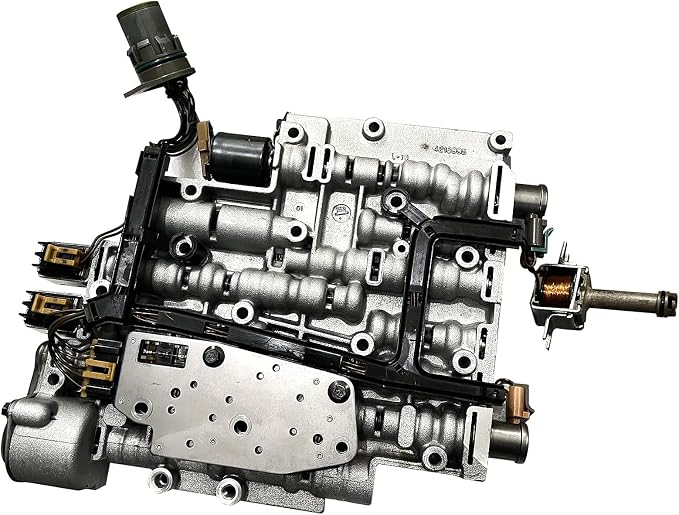
Confirm the Truck, Then the Fluid
Colonna puts the 4L60E platform in service from 1993 to 2015, and the S10, Blazer, Sonoma and Jimmy ran it (RPO M30) right up to the end of the compact trucks. GM's own bulletins group these trucks together. PIP5340A, for example, is written for 1998-2004 Chevrolet Astro, Blazer and S-10 and GMC Jimmy, Safari and Sonoma with the 4L60E (M30) or 4L65E (M32). Read the RPO sticker before ordering parts, and note whether the truck has the 2.2L four-cylinder or the 4.3L V6. That matters later when we get to the servo.
Then check the fluid the way GM wrote it. The 2000 S10 owner manual calls for fluid labeled DEXRON-III, says to read the level hot, and notes it generally takes less than one pint (0.5 L) to bring a low reading up to the HOT area. The manual lists the 4L60E drain-and-refill at about 5.0 quarts (4.7 L), the filter kit as GM 24200796, and a fluid-and-filter interval of 15,000 miles for severe service (heavy city traffic in 90°F heat, hills, towing) or 50,000 miles otherwise. Burnt fluid with friction material in the pan means the complaint is already a rebuild.
Know the Solenoid Chart Before You Touch Anything
Barry Bartlett, writing in Transmission Digest, calls the application chart his go-to tool for shift complaints, using the 4L60E as his example. Two on/off solenoids set the gear, and Sonnax's test procedure uses the same states.
| Gear (Drive) | Shift Solenoid A (1-2) | Shift Solenoid B (2-3) | Holding members |
|---|---|---|---|
| 1st | On | On | Forward clutch, forward sprag, low roller |
| 2nd | Off | On | Forward clutch, sprag, 2-4 band |
| 3rd | Off | Off | Forward clutch, sprag, 3-4 clutch |
| 4th | On | Off | 3-4 clutch, 2-4 band |
With that chart in your head, most S10 wrong-gear complaints sort themselves out:
- Stuck in 3rd in Drive, manual 2nd works. No power to either solenoid leaves both off, and off/off is 3rd. Bartlett notes manual 2nd still functions because it is hydraulically shifted, and that a no-power condition generally sets multiple solenoid codes. Check fuses first. In the 2000 S10 owner manual fuse chart, fuse 15 feeds the 4WD switch and engine control (VCM, PCM, transmission), so a blown fuse there can take out more than the shifts. Then check power at the case connector.
- 2nd-gear starts, shifts to 3rd, never gets 4th. Solenoid A is not turning on. A is on in both 1st and 4th, so losing it leaves only 2nd and 3rd.
- 4th-gear starts. Solenoid B is not turning on. Bartlett notes manual 2nd and 3rd still work at about 30 mph in that case.
- Long 1st, then a shift, but never overdrive. If 1st and 3rd are fine, both solenoids are switching. The element common to 2nd and 4th is the 2-4 band, so the truck is skipping 2nd and actually sitting in 3rd. A sun gear broken loose from the sun shell, Bartlett notes, takes out 2nd, 4th and reverse together.
On the scan tool, watch commanded gear, both solenoid states, vehicle speed, throttle position and fluid temperature on a drive. Commanded gear and actual ratio disagreeing means hydraulic or mechanical; a wrong command means inputs and codes. Our P0753/P0758 guide covers resistance and wiring checks for the solenoid circuits.
When the Computer Is the Shift Problem
This is where a lot of good S10 transmissions get pulled for no reason. The PCM's solenoid outputs are solid-state drivers, and when they age they do not always fail dead. They fail slow.
Sonnax's TASC Force documented a 1998 GM truck with a 2-3 flare before and after an overhaul. No codes, a second valve body with new solenoids changed nothing, and line pressure was normal even during the flare. A new computer fixed it. The tell was in amp draw: with the DVOM wired in place of the trans fuse, solenoid A's current dropped to zero in a fraction of a second when it was turned off, but solenoid B took about 2 seconds. A slow-releasing B solenoid exhausts its oil slowly, the 2-3 shift valve drifts instead of snapping over, and the 2-4 band lets go before the 3-4 clutch applies. That is your flare.
ATRA's Gears magazine ran the mirror image: a freshly rebuilt 4L60E that skipped 2nd, though holding about 20 mph would get it into 2nd. The scan tool showed every command on time, and new solenoids changed nothing. A meter on the command wires showed solenoid A's signal rising very slowly. Powers and grounds were good, a replacement computer fixed it.
The test that catches both of these takes about ten minutes:
- Pull the transmission fuse and bridge it with your DVOM leads on the amp scale, so the solenoid circuit's current runs through the meter.
- Key on, engine off. With a bi-directional scan tool, command 3rd (both solenoids off) and zero the meter.
- Command 4th (A only), then back to 3rd. Command 2nd (B only), then back to 3rd. Graph or watch the current each time.
- Both solenoids should pull similar current and drop to zero almost instantly when turned off. A circuit that bleeds down slowly, as Sonnax recorded, points at the driver, not the solenoid.
Line pressure gets the same treatment. Wayne Colonna, in Transmission Digest, says a failed EPC solenoid driver in the computer is a known line pressure problem, especially on 1993-1997 units, which covers a big slice of the S10 population. He warns not to rely on the scan tool's EPC commanded amperage PID: it can display the correct value when the actual current is wrong. Put a pressure gauge on the case tap and a DVOM in series with the EPC circuit. The 4L60E EPC works in reverse, so more current means less line pressure. A dead driver or open circuit gives you maximum pressure and hard shifts everywhere. A matching PID with a wrong meter reading is a computer problem.
Harsh 1-2 With a Code: Read the TCC Codes First
If the S10 bangs into 2nd and the MIL is on, look for P1870 or P0894 before touching the valve body. Colonna calls line pressure boost control the Achilles heel of the 4L60E and says many harsh 1-2 complaints are TCC slippage codes P1870/P0894 putting the unit into high line pressure mode. The harsh shift is the computer protecting a slipping converter clutch.
GM spells out the same pattern for these exact trucks in PIP5340A (Feb 2016): MIL on, harsh 1-2 upshift, and P0894 or P1870 setting after a torque converter or service replacement transmission is installed, on 1998-2004 S-10, Blazer, Sonoma and Jimmy with the M30 or M32. If the hard shifts started right after a unit or converter swap, that bulletin is your first read. Our P1870 guide covers the converter clutch side. After TCC slip, Colonna's suspects are the EPC driver, lean misfire, the MAF sensor and the EPC solenoid.
Harsh or Soft 1-2 With No Codes: The 554 Servo Trap
If pressure checks out on the gauge and there are no codes, the shift feel is coming from the parts that cushion the band apply. This is where the S10's engine choice matters. Colonna lists four OE servo piston sizes. The 093 is mostly Corvette and high-performance Camaro. The 554 is intended for 4-cylinder and 2.8 V6 applications only. Most everything else should have the 553 or 159. The wrong apply area gives either a soft slide-bang 1-2 or a harsh one.
That makes the S10 a trap. A 2.2L truck with a used unit built for a V6, a 4.3L truck with a four-cylinder unit, or a stock truck where someone dropped in a Corvette servo to "firm it up" all have the wrong apply area. Pull the servo cover and identify the piston first. Our servo pin selection guide covers measuring the band apply pin.
After the servo, work Colonna's list in order:
- Accumulator valve. Inspect it for sticking and make sure the spring is not cocked in the bore.
- 1-2 accumulator piston and spring. Early and late units stack the piston and spring in opposite order, so assembling it backward inverts the shift feel. Check the pin bore for wear.
- The #8 checkball. It forces band apply oil through the .067-.086 inch separator plate orifice on the 1-2. Leave it out or misplace it and you get a harsh 1-2.
- Servo cushion spring and band pin. Pull the pin from the servo and confirm it does not bind, or the cushion spring does nothing.
- 4-3 sequence valve. Stuck inboard, it sends 2-4 band apply oil to the 4th gear servo piston (6.108 sq in apply area) at full flow, with no cushion spring and no orifice metering. Harsh 1-2 plus rough 2-3 and 3-2 shifts points here.
The 3-4 Clutch Check
A 2-3 flare that is not electrical is usually the 3-4 clutch. Bartlett's road test: select manual 2nd, accelerate to about 40 mph, shift to Overdrive and lift off the throttle. If you still have a 2nd-gear ratio when 4th is commanded, the 3-4 clutch is not holding, because the forward clutch and the band keep the unit in 2nd. If the 3-4 clutch fails this test, the truck needs a rebuild, and our S10 slipping guide takes it from there.
Fixing It Right on an S10
- Electrical command: Fix fuse, connector or harness faults first. A slow driver on the amp-draw test means the PCM. An open or shorted solenoid means replacing A and B together.
- Line pressure: Fix TCC slip first if P1870/P0894 are present. Replace the EPC solenoid only after the driver and wiring test good on a meter.
- Mechanical shift feel: Correct the servo, accumulator, checkball or valve. With several worn bores in a 25-year-old valve body, a remanufactured unit is often less labor.
After any repair, clear codes and let the adapts relearn. For prevention, keep fluid at the HOT mark, use GM's severe-service interval if the truck tows or sits in summer traffic, and treat a new harsh 1-2 with a TCC code as heat building every mile.
Shop the part for this fix
If your tests point at a shift solenoid, the CTP 1-2 and 2-3 (A and B) set for 1993-up 4L60E units replaces both at once.
See the A and B shift solenoid set →Need something else? Browse every 4L60E part at CoreTransmissionParts.
FAQ
Why is my S10 stuck in 3rd gear with the check engine light on?
Third is what a 4L60E gives you when neither shift solenoid is powered, because both off equals 3rd. Manual 2nd still works since it is hydraulic. Check the fuse that feeds the engine and transmission controls, the case connector and internal harness, and only then the solenoids and the PCM.
What causes a harsh 1-2 shift on an S10 4L60E?
If P1870 or P0894 is set, the computer is usually raising line pressure to protect a slipping converter clutch, which GM documents for 1998-2004 S-10, Blazer and Sonoma in PIP5340A. With no codes, check line pressure with a gauge, then the servo piston size, the 1-2 accumulator, the #8 checkball and the 4-3 sequence valve.
Can a bad computer cause S10 transmission shift problems?
Yes. Sonnax documented a 1998 GM truck whose 2-3 flare was cured only by a new computer because the B solenoid driver was slow to shut off, and an ATRA Gears case traced a no-2nd complaint to a slow solenoid A command signal. On trucks this old, test the solenoid circuits with a meter before buying hard parts.
What transmission fluid does a Chevy S10 4L60E take and how much?
The 2000 S10 owner manual calls for fluid labeled DEXRON-III and lists about 5.0 quarts (4.7 L) for a 4L60E drain and refill. GM says to check the level hot and that it generally takes less than a pint to bring a low reading back to the HOT mark.
Keep the numbers at the bench. Our free transmission fluid spec chart lists the correct ATF type for the 4L60E and dozens of other units, so you never top off with the wrong fluid.
Sources
- General Motors Preliminary Information PIP5340A, Feb 2016 (via NHTSA). Backs: 1998-2004 S-10, Blazer, Sonoma and Jimmy with the 4L60E (M30)/4L65E (M32), harsh 1-2 upshift with MIL and P0894 or P1870 after a torque converter or transmission replacement. static.nhtsa.gov/odi/tsbs/2016/SB-10096073-2280.pdf
- General Motors — 2000 Chevrolet S10 Owner's Manual. Backs: DEXRON-III, the hot level check and less-than-a-pint top-off, the 5.0 qt (4.7 L) 4L60E drain-and-refill capacity, filter kit 24200796, the 15,000/50,000-mile fluid intervals, and the fuse 15 engine control/transmission circuit. GM: 2000 Chevrolet S10 owner's manual (PDF)
- Transmission Digest, Wayne Colonna — 4L60E Harsh 1-2 Shift. Backs: line pressure boost as the 4L60E weak point, P1870/P0894 high line pressure mode, the EPC driver failure on 1993-1997 units, the gauge-plus-DVOM test and the warning about the EPC amperage PID, the four servo piston sizes including the 554 for 4-cylinder and 2.8 V6, accumulator spring orientation, the #8 checkball and .067-.086 orifice, and the 4-3 sequence valve. transmissiondigest.com: 4L60E Harsh 1-2 Shift
- Transmission Digest, Barry Bartlett — Diagnosing Shifting Issues. Backs: the 4L60E solenoid application chart, 3rd-gear default with manual 2nd working hydraulically, SSA and SSB failure patterns, the manual-2nd-to-OD 3-4 clutch test, and the sun shell failure. transmissiondigest.com: Diagnosing Shifting Issues
- Sonnax TASC Force, Gregg Nader — 4L60E Flares on 2-3 Shift? Could Be a Bad Computer. Backs: the 1998 GM truck 2-3 flare case, the fuse-bridge amp-draw test, solenoid states by commanded gear, and B solenoid current taking about 2 seconds to fall to zero. sonnax.com/tech_resources/106
- GEARS Magazine (ATRA), Rob Faucett — 4L60E No 2nd, March 2021. Backs: the no-2nd case traced to a slow-rising solenoid A command signal and fixed with a replacement computer. gearsmagazine.com: 4L60E No 2nd