An S-10 with a slipping 4L60E usually comes in with one of three stories. It is a 4.3L Vortec truck that pulled a boat or a utility trailer in Drive for years. It is a high-mileage pickup that "flares" on the 2-3 shift and then settles down. Or the transmission was swapped at some point with a used unit from a full-size truck, and nobody is quite sure what is in it now. Each story points somewhere different.
The short version: Check the fluid exactly the way GM's S-10 manual describes it, hot at 180-200°F after about 15 miles of driving. Then figure out which gear slips, because on a 4L60E that names the part: 3rd and 4th is the 3-4 clutch, 2nd and 4th is the 2-4 band and servo, everything in Drive but not Reverse is the forward clutch or sprag. Rule out the computer before you pull the transmission; Sonnax and GEARS have both documented 4L60E slips and missed gears that were a bad module, not a bad clutch.


Which S-10s Have a 4L60E
From 1993 through 2004, the automatic in an S-10 pickup is the 4L60E four-speed, RPO M30 on the Service Parts Identification label in the glovebox. GM's 2000 S-10 owner manual lists one automatic for both the Vortec 2200 four-cylinder and the Vortec 4300 V6: 4L60E, 5.0 quarts (4.7 L) for a drain and refill. The same unit sits behind the S-10 Blazer, Sonoma, and Jimmy of those years, so everything below applies to them too.
The ratios are 3.06, 1.63, 1.00, and 0.70. Keep those handy. With a scan tool that shows input (turbine) speed and output speed, you can divide one by the other and see whether the truck is actually holding the gear the computer says it is in.
Step 1: Check the Fluid the Way GM Wrote It
A 4L60E a quart low will slip in turns, on hills, and right after a cold start, because the pump pulls air at the filter. Before anything else, check it properly. The S-10 has no TRANS TEMP display, so GM's manual has you get there by driving:
- Drive about 15 miles (24 km) when it is above 50°F outside. Below 50°F, drive in THIRD (3) until the engine temperature gauge moves and stays steady for 10 minutes. The target is normal operating temperature, 180-200°F (82-93°C).
- Park on level ground, set the parking brake, and leave the engine idling.
- With your foot on the brake, move the shifter through every range, pausing about three seconds in each, then back to PARK.
- Pull the dipstick, wipe it, push it all the way in, pull it again, and read it. The fluid should be in the HOT area.
GM says a low unit generally needs less than one pint (0.5 L) to come up to the HOT mark. If it takes a quart or more, there is a leak to find before you go any further. The manual calls for fluid labeled DEXRON-III; that spec is long superseded, so use a current GM-licensed fluid that is backward-compatible with it.
Then read what is on the stick. Red and clean with a slip points at pressure, a leak inside a circuit, or the electronics. Brown, burnt-smelling fluid with black friction material on the stick or the pan magnet means the clutch or band is already damaged. A fluid change will not bring it back,.
Make sure the dipstick is telling the truth
This one catches a lot of S-10s, because so many of them have had a used 4L60E dropped in. Sonnax's product support team documented what happens when the dipstick, tube, pan, and the stop bracket on the valve body do not match. GM introduced deep pans and a longer dipstick on C/K trucks and vans in 1998, revised the bracket for the standard pan, and added a chamfer to 1998-and-later valve bodies so the new brackets fit. Mix the parts and the stick lies. Per Sonnax, a regular pan with no bracket can underfill by up to 0.5 qt, a deep dipstick with no bracket by up to 0.75 qt, and a deep dipstick and tube on a regular pan will read normal while the unit is significantly low.
If the truck slips and the stick says full, and you know or suspect the transmission came out of something else, drain it and measure what comes out.
Step 2: Match the Slip to the Gear
Drive it and note exactly where the engine flares. The 4L60E apply chart does most of the work from there:
| What the S-10 does | Element | Where to look |
|---|---|---|
| Flare on the 2-3 shift, slips in 3rd and 4th, 1st and 2nd are fine | 3-4 clutch | 3-4 pack, input housing and checkball, 3rd accumulator checkball, pump and stator |
| Flare on the 1-2 shift, slips in 2nd and 4th, 3rd is fine | 2-4 band and servo | Servo seals and bore, band and drum, 4-3 sequence valve bore |
| No 4th or slips in 4th only, burnt band smell | Servo apply oil in 4th | 4-3 sequence and 3-4 relay valve bore |
| Slips or neutral in every Drive gear, Reverse is fine | Forward clutch | Forward piston seals, input housing sealing rings, line pressure |
| Slips in Drive 1st, holds in manual 1 | Forward sprag or low roller clutch | One-way clutches (manual 1 bypasses both with the overrun and low/reverse clutches) |
| RPM creeps up at steady cruise, no shift involved | Converter clutch | TCC circuit (see our P0894 guide) |
The manual 1 test is worth doing on every no-pull-from-a-stop complaint. In D1 the truck drives through the forward clutch, the forward sprag, and the low roller clutch. In manual 1 the overrun clutch and the low/reverse clutch apply as well and carry the load around both one-way clutches. If it slips in D1 and pulls hard in manual 1, the friction elements are fine and a one-way clutch is freewheeling.
Step 3: The Common Mechanical Causes
3-4 clutch burned by a pressure leak
This is the slip you will see most, and it is almost never "just worn clutches." Sonnax's 4L60E 3-4 clutch article puts it plainly: low line pressure and leaks of 3rd gear oil are the root cause of most 3-4 slipping. The 3-4 circuit ties into the D4, forward, 2nd, and 3rd accumulator circuits, so a handful of small leaks add up. The checks Sonnax lists that matter on a 200,000-mile S-10:
- Input housing checkball: vacuum test it. Sonnax treats anything below 25 in-Hg as an unacceptable leak.
- 3rd accumulator checkball (#7): it leaks 3-4 apply and band release oil, which can burn the 3-4 clutch and the 2-4 band at the same time. Do not cup-plug it.
- Pump and stator: worn stator sleeve where the input shaft rings ride, a rotated sleeve partly blocking a feed, a sticking pump slide, and worn boost valve bores.
- 3-4 backing plate: the OE plate flexes under load. A heavy-duty plate stops it, which matters on a 4.3 that tows.
- Engine sensors: TP, MAP, and MAF faults change the line pressure the computer commands. Clear the engine codes first.
2-4 band, servo, and the 4-3 sequence valve
If the slip is in 2nd and 4th, the band is not holding the reverse input drum. Worn servo seals and a worn servo bore lose apply pressure, and a band that has slipped long enough glazes and heats the drum surface. But do not stop at the servo. Sonnax's oversized 4-3 sequence valve kit page lists the symptoms of a worn sequence and relay valve bore in the valve body: burned 2-4 band, low 4th gear pressure, no 4th, and poor 2nd. Continuous oscillation of the 3-4 relay and 4-3 sequence valves wears the bore, and wear at the inboard spools and the end plug leaks 4th servo feed, 3-4 accumulator oil, and 2nd clutch oil. Put a new band and servo in a truck with that bore and the band burns again. Vacuum test the bore; if it fails, it gets reamed for an oversized valve (Sonnax 77964-14K) or the valve body gets replaced.
Forward clutch and forward sprag
A truck that will back up but slips or sits in neutral in Drive points at the forward clutch or the forward sprag. The manual 1 test above separates them. If the forward clutch is gone, look for the reason: a cut forward piston seal, worn input housing sealing rings, or low line pressure. If the sprag is freewheeling, inspect the input sun gear and sprag race while it is apart.
Step 4: Rule Out the Computer
Two well-documented cases show why you should check the electronics before you pull a transmission that "slips" between gears. Sonnax's Gregg Nader wrote up a 1998 GM truck with a 4L60E that flared on the 2-3 shift before and after an overhaul, with no codes. A second valve body and new solenoids did not help, and line pressure was normal during the flare. The fault was the computer: the "B" (2-3) solenoid driver did not switch off cleanly, so the 2-3 shift valve moved slowly and the 2-4 band released before the 3-4 clutch applied. An amperage draw test through the TRANS fuse showed the good "A" solenoid dropping to zero almost instantly while the bad "B" circuit took about two seconds. A new computer fixed it.
GEARS magazine (the ATRA publication) ran a similar 4L60E case: a freshly rebuilt unit with no 2nd gear, where the scan tool showed the shift commands on time. Back-probing the solenoid command wires on a road test showed the "A" solenoid signal rising very slowly. Swapping both solenoids changed nothing; a remanufactured computer did.
On an S-10, the practical takeaway is simple. If the slip is really a flare between gears, the fluid is clean, and line pressure is normal, put a meter on the shift solenoid circuits before you condemn the clutches. In 1st both solenoids are on, in 2nd only B is on, in 3rd both are off, and in 4th only A is on.
Step 5: Pressure Gauge and Scan Data
- Ratio math: in 3rd, input speed should equal output speed (1.00). Input running ahead of output in 3rd or 4th is a slipping 3-4 clutch. In 2nd, input should run 1.63 times output.
- Line pressure: put a gauge on the line tap and compare idle and stall readings in each range to the factory spec. Low in every range points at the pump, the pressure regulator, or the pressure control solenoid. Normal pressure with a gear-specific slip points at a leak inside that gear's circuit.
The Fix, and Keeping It Fixed
If the slip went away when the fluid level was corrected and the fluid was clean, find the leak and you are done. If a clutch or band is burnt, the transmission needs a rebuild, and the rebuild has to fix whatever burned it:
- Replace the burnt pack or band and the parts it damaged (a glazed drum gets replaced, not reused).
- Vacuum test the input housing checkball, the 3rd accumulator checkball, the servo, and the valve body bores Sonnax lists, including the 4-3 sequence valve bore.
- Upgrade the 3-4 pack and backing plate on a truck that tows.
- Match the dipstick, tube, pan, and bracket to the valve body year.
- Flush the cooler and lines so the old debris does not end up in the new parts.
- Fill and check hot at 180-200°F.
For prevention, follow GM's own S-10 instruction: DRIVE should not be used when towing, carrying a heavy load, climbing steep hills, or off-road. Use THIRD (3) for those. A 4.3 S-10 that tows in overdrive cycles between 3rd and 4th on every grade, and each cycle is a 3-4 clutch apply under load.
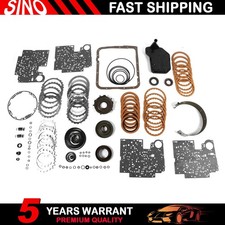
4L60E Master Rebuild Kit for the 4.3L (1993-2003)
Frictions, seals, and gaskets for the 4.3L-era 4L60E behind the S-10, Blazer, and Sonoma. For later trucks or single parts, the full 4L60E lineup is here.
See the 4.3L rebuild kit →FAQ
Why is my S-10 transmission slipping?
Start with the fluid: GM's S-10 manual wants it checked hot, at 180-200 degrees F after about 15 miles of driving, and a low unit should need less than a pint. If the level is right, note which gear slips. Slip in 3rd and 4th is the 3-4 clutch, slip in 2nd and 4th is the 2-4 band and servo, and slip in every Drive gear with good Reverse is the forward clutch or sprag.
How much transmission fluid does an S-10 4L60E take?
GM's 2000 S-10 owner manual lists 5.0 quarts (4.7 L) for a drain and refill on the 4L60E, for both the 2.2L four and the 4.3L V6. Always finish by checking the level hot. If the transmission or pan has been swapped, make sure the dipstick, tube, and pan match, because Sonnax documents mismatches that read full while the unit is up to 0.75 qt low.
Can a bad computer make a 4L60E slip?
Yes, between gears. Sonnax documented a 1998 GM truck whose 2-3 flare came from a computer that switched the 2-3 solenoid off too slowly, and GEARS magazine documented a 4L60E with no 2nd caused by a computer fault. In both cases line pressure and scan data looked normal, and a replacement computer fixed it.
Should I tow with my S-10 in Drive?
No. GM's S-10 owner manual says DRIVE should not be used when towing a trailer, carrying a heavy load, driving on steep hills, or off-road, and says to select THIRD instead. Towing in overdrive makes the transmission cycle between 3rd and 4th, which loads the 3-4 clutch on every shift.
Keep the numbers at the bench. Our free transmission fluid spec chart lists the correct ATF type for the 4L60E and dozens of other units, so you never top off with the wrong fluid.
Sources
- General Motors — 2000 Chevrolet S-10 Owner Manual. Backs: 4L60E as the automatic for the Vortec 2200 and 4300, 5.0 qt (4.7 L) drain and refill, DEXRON-III, the 15-mile warm-up and 180-200°F hot check, driving in THIRD below 50°F, the less-than-one-pint note, and the instruction not to use DRIVE when towing or hauling. GM: 2000 S-10 owner manual (PDF)
- Sonnax — All Over the Map: Attacking 4L60/E Burnt 3-4 Clutches with Confidence. Backs: low line pressure and 3rd gear oil leaks as the root cause of most 3-4 slipping, the 25 in-Hg input housing checkball threshold, the #7 checkball, pump and stator checks, backing plate flex, and engine sensor effects on line pressure. sonnax.com/tech_resources/659
- Sonnax — Oversized 4-3 Sequence Valve Kit 77964-14K. Backs: burned 2-4 band, low 4th pressure, no 4th, and poor 2nd from relay and sequence valve bore wear, and the 4th servo feed, 3-4 accumulator, and 2nd clutch oil leak paths. sonnax.com/parts/4637
- Sonnax — 4L60E Flares on 2-3 Shift? Could Be a Bad Computer (Gregg Nader). Backs: the 1998 GM truck 2-3 flare with no codes, normal line pressure, the slow-switching "B" solenoid driver, the amperage draw test, and the computer replacement fix. sonnax.com/tech_resources/106
- GEARS Magazine (ATRA) — 4L60E No 2nd (Rob Faucett, March 2021). Backs: the rebuilt 4L60E with no 2nd, on-time scan commands, the slow "A" solenoid signal found by back-probing, and the remanufactured computer fix. gearsmagazine.com: 4L60E No 2nd
- Sonnax — How to Avoid a Dipstick Move in 4L60-E Series Transmissions (Jason Larochelle). Backs: the 1998 deep pan, dipstick, and bracket changes, the valve body chamfer, and the 0.5 qt and 0.75 qt underfill figures from mismatched parts. sonnax.com/tech_resources/941