A Silverado 1500 with a 4L60E that "shifts weird" covers a lot of ground. One truck bangs into 2nd hard enough to chirp the tires. Another holds 1st forever and then drops straight into 3rd. A third flares on the 2-3 and never finds overdrive, or it suddenly takes off in 3rd with the check engine light on. Those are different failures, and the half-ton Chevy (and its GMC Sierra twin) is where you will see every one of them, because it is the most common home this transmission ever had.
This guide is about sorting the complaint into the right bucket before anything comes apart: electrical command, line pressure, or a mechanical shift-feel component. Every specific claim below is tied to a GM bulletin or a recognized transmission technical source listed at the end.
The short version: Check DEXRON-VI hot (160-200°F) first. Then read codes and pull up commanded gear against actual ratio. If the truck is stuck in 3rd in Drive with manual 2nd still working, you have lost power to the shift solenoids. Wrong-gear patterns (2nd-gear starts with no 4th, or 4th-gear starts) point at one specific solenoid. A harsh 1-2 with P1870 or P0894 is usually the TCM raising line pressure to protect a slipping converter clutch, which GM documents in PIP5340A. A harsh 1-2 with no codes is mechanical: accumulator valve, 1-2 accumulator, servo, the #8 checkball, or a stuck 4-3 sequence valve.


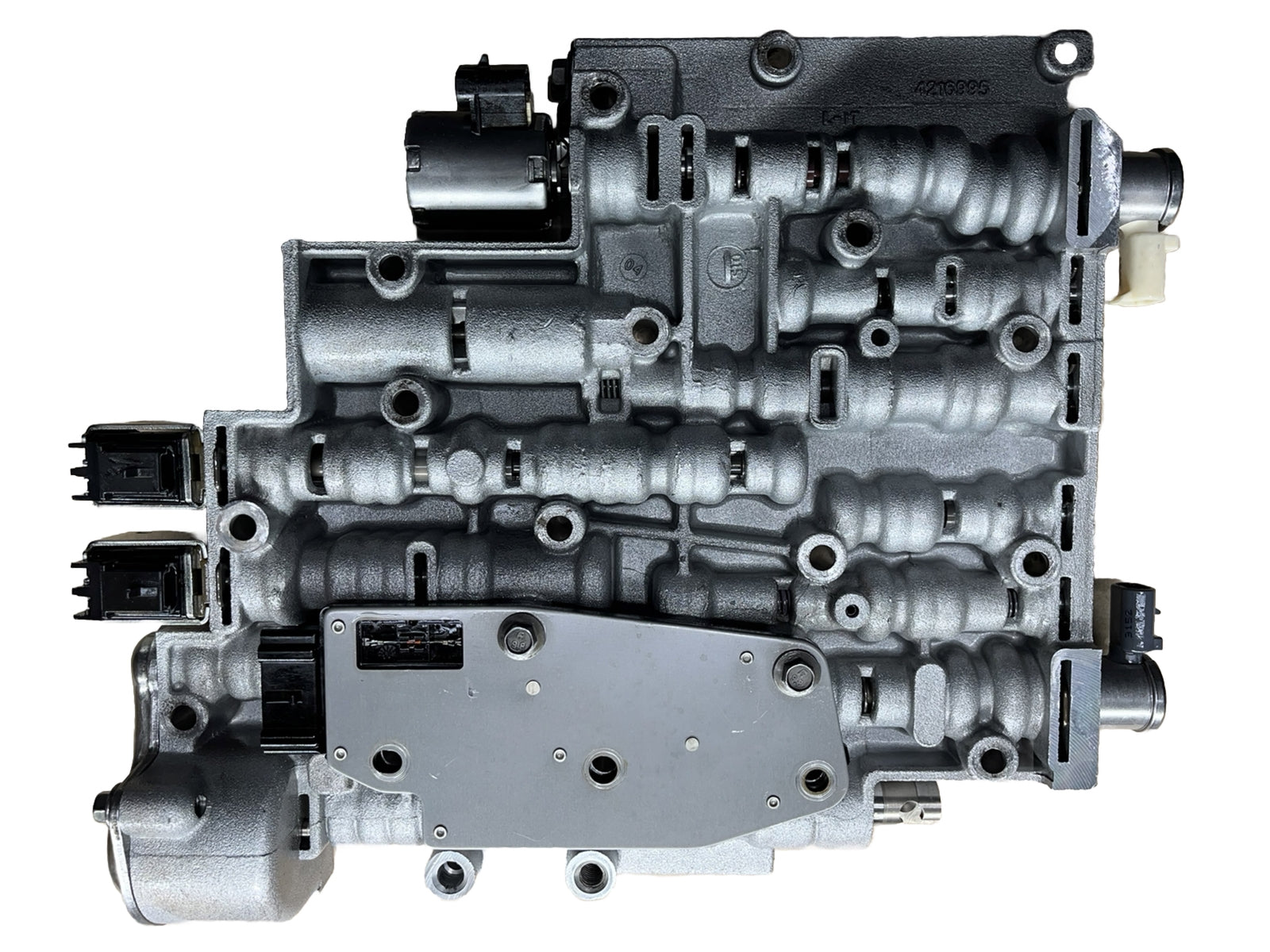
Confirm the Truck and the Fluid First
GMT800 (1999-2006) and GMT900 (2007-2013) half-tons were offered with more than one automatic, so read the RPO sticker in the glovebox before ordering anything. M30 is the 4L60E and M32 is the heavier 4L65E; GM writes its 4L60E bulletins to cover both, as PIP5340A does. If you see the six-speed listed instead, you are on the wrong page.
Then check the fluid the way GM wrote it. The 2012 Silverado owner manual specifies DEXRON-VI and has you check the level hot, with the TRANS TEMP reading on the cluster between 71 and 93°C (160-200°F). A pan and filter service on the 4L60-E takes about 4.7 L (5.0 qt). Low fluid causes delayed and soft shifts that look exactly like pressure problems, and burnt fluid with friction material in the pan tells you the shift complaint is now a rebuild, whatever started it.
Know the Solenoid Chart Cold
The single most useful tool for a 4L60E shift complaint is the application chart, a point Barry Bartlett, an ASE L1 diagnostician, makes in his Transmission Digest article on diagnosing shift issues. The 4L60E uses two on/off shift solenoids, A and B, and the gear is set by the combination:
| Gear (Drive) | Shift Solenoid A | Shift Solenoid B | Holding members |
|---|---|---|---|
| 1st | On | On | Forward clutch, forward sprag, low roller |
| 2nd | Off | On | Forward clutch, sprag, 2-4 band |
| 3rd | Off | Off | Forward clutch, sprag, 3-4 clutch |
| 4th | On | Off | 3-4 clutch, 2-4 band |
Once that chart is in your head, the wrong-gear complaints sort themselves out:
- Stuck in 3rd in Drive, manual 2nd still works. With no power to either solenoid, both are off, and off/off is 3rd. Bartlett notes manual 2nd still functions because it is hydraulically shifted without the solenoids. This is the classic "limp mode" truck, and it is a fuse, connector, harness, or command problem far more often than a hard-parts failure. Check the 20-way case connector for fluid wicking and the internal harness before condemning anything.
- 2nd-gear starts, shifts to 3rd, never gets 4th. Solenoid A is not turning on. A is on in both 1st and 4th, so losing it leaves only 2nd and 3rd.
- 4th-gear starts. Solenoid B is not turning on, so the unit sees A-on/B-off and launches in 4th. Bartlett notes manual 2nd and 3rd still work at about 30 mph in this case.
- Long 1st, then what feels like 2nd, but no overdrive. If 1st and 3rd are fine, both solenoids are switching. The common element in 2nd and 4th is the 2-4 band, so the truck is skipping 2nd and actually sitting in 3rd. Bartlett adds that the sun gear can break away from the sun shell on 4L60E units, which takes out 2nd, 4th, and reverse together.
On the scan tool, put Commanded Gear, the input and output speed values, and TFT on one screen and drive it. If commanded gear and the actual ratio disagree, you have a hydraulic or mechanical failure. If the command itself is wrong or frozen, look at inputs and codes. For the electrical codes, P0753 and P0758 are the A and B circuit codes, and our shift solenoid circuit guide covers the resistance and wiring checks.
The 3-4 Clutch Check Every Silverado Needs
A flare on the 2-3 shift, or a truck that seems to fall back to 2nd when 4th is commanded, needs one road test before you decide anything. Bartlett's procedure: select manual 2nd, accelerate to about 40 mph, shift to Overdrive, and lift off the throttle. If you are still in a 2nd-gear ratio when 4th is commanded, the 3-4 clutch is not holding. In 4th the band is applied, so if the 3-4 clutch slips, the forward clutch and band keep the unit in 2nd.
On a working half-ton, a weak 3-4 clutch is the most common reason a "shift problem" turns into a rebuild. Our Silverado 1500 slipping guide walks through the Silverado-specific causes, including the 2012 input housing issue GM documented.
Harsh 1-2 With a Code: Read the TCC Codes First
When a Silverado bangs into 2nd and the MIL is on, look for P1870 or P0894 before you touch the valve body. In his Transmission Digest article on 4L60E harsh 1-2 shifts, Wayne Colonna calls line pressure boost control the Achilles heel of this unit, and says many harsh 1-2 complaints come from TCC slippage codes P1870/P0894 putting the transmission into high line pressure mode. The harsh shift is the computer protecting a slipping converter clutch, not the cause.
GM documents the same pattern in PIP5340A (Feb 2016), which covers 1998-2000 Silverado and Sierra (plus several vans and S-trucks) with the 4L60E (M30) or 4L65E (M32): MIL on, harsh 1-2 upshift, and P0894 or P1870 setting after a torque converter or replacement transmission is installed. If you just put a unit or a converter in a truck and the shifts went hard, that is the first bulletin to read. Our P1870 guide covers the TCC side.
Once TCC slip is ruled out, Colonna lists the remaining line pressure suspects: a failed ECM EPC solenoid driver (most common on 1993-1997 units), lean misfire, MAF sensor problems, and the EPC solenoid itself. The 4L60E EPC is an inverse control: more current commanded means less line pressure. That is why a dead driver or open circuit gives you maximum pressure and harsh shifts everywhere.
Here is the catch Colonna warns about: do not rely on the EPC commanded amperage PID on the scan tool. The PID can show the correct commanded amperage when the actual current is wrong, especially when the ECM driver has failed. Put a line pressure gauge on the case tap and a DVOM in series with the EPC circuit, and compare actual current and actual pressure to what is commanded. A matching PID and a wrong meter reading is a computer problem, not a transmission problem.
Harsh Shift With P0716 or P0717 on 2013 Trucks
A harsh shift with an input speed sensor code has its own GM bulletin. PIP5084A (Jan 2013) covers 2013 Silverado, Sierra, Express, and Savana with the 4L60E (M30) that come in with a harsh shift or MIL and P0716 and/or P0717 current or in history in the TCM. GM's added checks:
- Check circuit 1984 from the input speed sensor at terminal V to TCM terminal 45.
- Install the J 44152 20-pin harness at the engine side of the inline 20-way connector and use a test light from terminal E to terminal V to check the TCM ground. No light means the TCM's internal ground is suspect.
- Unplug the TCM and check continuity across pins 45 and 49. No continuity: replace both the TCM (GM 24252114) and the ISS (GM 24244544). Continuity: replace the ISS only.
The TCM uses input speed to manage shift timing and pressure, so a dropping ISS signal can produce harsh shifts with nothing wrong inside the case. Our P0716 guide has more on that sensor.
Harsh 1-2 With No Codes: The Mechanical List
If line pressure checks out on the gauge and there are no codes, the shift feel is coming from the parts that cushion the band apply. Sonnax explains that during the 1-2 shift the accumulator valve regulates D4 pressure into the 1-2 accumulator circuit, creating throttle-sensitive back pressure on the accumulator piston, and that the servo's 2nd apply piston adds its own accumulation for the 2-4 band. Sonnax lists wear at the accumulator valve, the 1-2 accumulator piston, the servo assembly, and the pin-to-case interface as causes of 1-2 and 2-1 shift complaints, along with the wrong accumulator valve or servo ratio for the application. Work through it in this order:
- Accumulator valve. Colonna says to inspect it carefully for sticking and make sure the spring is not cocked in the bore. A worn bore lets regulated pressure leak and the shift feel wanders with temperature.
- Servo apply area. There are four OE servo sizes. Colonna notes the 093 piston is mostly Corvette and high-performance Camaro, the 554 is for 4-cylinder and 2.8 V6 applications, and most other work should have the 553 or 159 piston. The wrong piston gives either a slide-bang or a harsh 1-2. A previous rebuilder who dropped a Corvette servo into a stock half-ton changed the shift feel on purpose, whether the owner knew it or not.
- 1-2 accumulator piston and spring. Early units put the piston in first with the spring on top, where more spring meant a firmer shift. Later units reversed it, springs first and piston on top, where more spring means a softer shift. Assemble it the wrong way for the case and the shift feel inverts. Check the piston pin bore for wear and pin interference.
- The #8 checkball. It forces band apply oil through the .067-.086 inch orifice in the separator plate on the 1-2 upshift. Colonna's point is blunt: leave it out or misplace it and the result is a harsh 1-2. Also check that nobody drilled that orifice oversize.
- Servo cushion spring and band pin. The heavy spring between the servo piston and the steel retainer is part of 1-2 accumulation and the 2-3 system. Pull the band pin out of the servo and confirm it is not binding, because a binding pin makes the cushion spring do nothing.
- 4-3 sequence valve. It has no role in normal 1-2 feel, but stuck inboard it sends 2-4 band apply oil to the 4th gear servo piston (6.108 sq in apply area, close to the Corvette piston's 6.356). The band then applies at full flow with no cushion spring and no orifice metering. Colonna says this also causes 2-3 and 3-2 problems, so a truck that is harsh 1-2 and rough on the 2-3 and 3-2 points at this valve.
Fixing It Right on a Half-Ton
Match the repair to the bucket you landed in:
- Electrical command (stuck in 3rd, wrong-gear starts): Repair the case connector or internal harness, then replace the failed solenoid. On a high-mileage truck, replace A and B together; they have the same hours on them and the valve body is already apart.
- Line pressure: Fix the TCC slip first if P1870/P0894 are present, then prove EPC current with a meter. Replace the EPC solenoid only after the driver and wiring test good.
- Mechanical shift feel: Correct the servo, accumulator, checkball, or valve problem at the valve body. Where several bores are worn, a remanufactured valve body is often less labor than chasing each one.
After any solenoid, valve body, TCM, or transmission work, clear codes and let the shift adapts relearn with normal driving, or run the relearn with a capable scan tool. Shift feel right after a repair is not the final shift feel.
For prevention on a truck that tows: use Tow/Haul with a trailer behind it, keep fluid at the right level on DEXRON-VI, and treat a new harsh 1-2 as a warning. If it comes with a TCC code, the converter clutch is slipping and heat is building in the fluid every mile.
Shop the part for this fix
The CTP 4L60E master solenoid kit covers EPC, both shift solenoids, TCC, 3-2, and PWM in one box for 1996-up units, so the whole electrical side gets done in one valve body job.
See the master solenoid kit →Need something else? Browse every 4L60E part at CoreTransmissionParts.
FAQ
Why is my Silverado 4L60E stuck in 3rd gear?
With no power to the shift solenoids, both are off, and the off/off combination is 3rd gear. Manual 2nd still works because it is hydraulically shifted. That points at a fuse, the 20-way case connector, the internal harness, or the command from the computer before any hard part.
What causes a harsh 1-2 shift on a 4L60E Silverado?
If P1870 or P0894 is set, the TCM is usually raising line pressure because the converter clutch is slipping, a pattern GM documents in PIP5340A. With no codes, check line pressure with a gauge, then the accumulator valve, 1-2 accumulator piston and spring, servo piston size, the #8 checkball, and the 4-3 sequence valve.
Can I trust the EPC amperage reading on my scan tool?
Not by itself. Transmission Digest warns that the EPC commanded amperage PID can show the correct value when the actual current is wrong, especially when the ECM solenoid driver has failed. Measure actual current with a DVOM and actual line pressure with a gauge.
What fluid does a Silverado 1500 4L60E use?
GM specifies DEXRON-VI. Check it hot with TRANS TEMP between 160 and 200 degrees F, and expect about 4.7 L (5.0 qt) for a pan and filter service per the 2012 Silverado owner manual.
Keep the numbers at the bench. Our free transmission fluid spec chart lists the correct ATF type for the 4L60E and dozens of other units, so you never top off with the wrong fluid.
Sources
- Transmission Digest, Wayne Colonna — 4L60E Harsh 1-2 Shift (April 2021). Backs: line pressure boost as the 4L60E weak point, P1870/P0894 high line pressure mode, EPC driver/misfire/MAF causes, the gauge-plus-DVOM test and the warning about the EPC amperage PID, servo piston sizes, 1-2 accumulator spring orientation, the #8 checkball and .067-.086 orifice, servo cushion spring, and the 4-3 sequence valve. transmissiondigest.com: 4L60E Harsh 1-2 Shift
- Transmission Digest, Barry Bartlett — Diagnosing Shifting Issues (February 2016). Backs: the 4L60E solenoid application chart, 3rd-gear failsafe with manual 2nd working hydraulically, SSA and SSB failure patterns, the manual-2nd-to-OD 3-4 clutch test, the 2-4 band diagnosis, and the sun shell failure. transmissiondigest.com: Diagnosing Shifting Issues
- General Motors Preliminary Information PIP5340A (via NHTSA). Backs: 1998-2000 Silverado/Sierra 4L60E (M30)/4L65E (M32) harsh 1-2 upshift with MIL and P0894 or P1870 after torque converter or transmission replacement. static.nhtsa.gov/odi/tsbs/2016/SB-10096073-2280.pdf
- General Motors Preliminary Information PIP5084A (via NHTSA). Backs: 2013 Silverado/Sierra 4L60E harsh shift with P0716/P0717, circuit 1984, ISS terminal V to TCM terminal 45, J 44152 test harness, TCM ground test, pins 45/49 continuity, and parts 24244544 (ISS) and 24252114 (TCM). static.nhtsa.gov/odi/tsbs/2013/MC-10112742-9999.pdf
- Sonnax — Hydraulics Fundamentals Part II: Accumulators and Shift Feel. Backs: the EPC solenoid replacing the 4L60 throttle valve system, the accumulator valve regulating D4 into the 1-2 accumulator, servo 2nd apply piston accumulation, and the wear points behind 1-2 and 2-1 shift complaints. sonnax.com/tech_resources/675
- General Motors — 2012 Chevrolet Silverado Owner Manual. Backs: DEXRON-VI, the TRANS TEMP hot check at 71-93°C (160-200°F), the 4.7 L (5.0 qt) pan and filter capacity, and Tow/Haul. GM Owner Center: 2012 Silverado owner manual (PDF)