Somebody drops a core on your bench, tells you it is "a 4L60E out of a Chevy," and walks off. That sentence narrows it down to roughly two decades and several million units. Sonnax puts the run at 1993 through 2014 and more than 11 million vehicles across better than 60 models [2], and the unit was redesigned continuously the whole way through. Valve bodies, solenoid counts, pans, dipstick brackets, input shafts, stator supports and output shafts all changed. A lot of them will physically bolt together and then not work.
So the real question is never "is this a 4L60E." It is "which 4L60E is this, and what will interchange." Here is the order I work through it, from the paperwork down to the parts in your hands.
The short version: The RPO code tells you the family, not the year. On a GM Service Parts Identification label, M30 is the 4L60E — GM's own certification paperwork spells it out as "M30 (4L60E)" [5]. After that, stop reading labels and start counting parts. Solenoid count splits 1993–94 from 1995-later. The manual valve and casting ports split 1995 from 1996–2000 and again at 2000 and 2003 [1]. Pan depth and dipstick bracket split pre-1998 from 1998-later [3]. Then verify the input shaft, stator and pump cover as a matched set before you order anything [4].
Step 1: The RPO Code Gets You in the Door
GM has put a Service Parts Identification label on its vehicles for decades. On most trucks and SUVs it lives on the back of the glovebox door; on cars it may be in the trunk, on the spare tire cover, or inside the console lid. It lists every Regular Production Option the vehicle was built with, in alphanumeric order. The transmission is one of them.
For the 4L60E that code is M30. This is not folklore. GM's own 2007 Engine & Transmission Certification File Matrix, published on GM's service information server, lists the transmission RPO column entry directly as "M30 (4L60E)" and pairs it with engine RPOs across the lineup: 4.2L LL8 in the TrailBlazer and Envoy, 4.3L LU3 and 5.3L LH6, LMG, LC9 and LY5 in the Silverado, Sierra, Tahoe and Suburban, 2.9L LLV and 3.7L LLR in the Colorado and Canyon [5]. That same document shows the codes you will see sitting next to it on heavier trucks — MT1 for the 4L80E family, plus M32, MN8 and M70 on the bigger and later units — which is why reading the label matters when a Silverado could have left the plant with either.
What M30 will not tell you is the model year of the transmission, whether it has been swapped, or which of its several internal generations you are holding. A 1994 M30 and a 2007 M30 share a name and very little else. If the vehicle has any history at all, treat the RPO as a starting hypothesis and confirm it on the unit.
Step 2: Count the Solenoids
This is the fastest, highest-value check on the bench, and it needs nothing but the pan off. The Sonnax 4L60-E valve body identification guide breaks the production run into clean generations by solenoid count and hardware, and it is the chart I keep taped inside a cabinet door [1]:
| Years | Solenoids | 3-2 control solenoid | TCC solenoid | Manual valve |
|---|---|---|---|---|
| 1993–1994 | 4 | PWM, metal, white, 10–15 ohms | None | Non-vented |
| 1995 | 5 | PWM, metal, white, 10–15 ohms | PWM, metal, white, 10–15 ohms | Non-vented |
| 1996–2000 | 5 | On/off, plastic, white, 20–31 ohms | PWM, plastic, gray, 10–15 ohms | Vented |
| 2000–2002 (annular lockup) | 5 | On/off, plastic, white, 20–31 ohms | PWM, plastic, gray, 10–15 ohms | Vented |
| 2003–2008 | 5 | On/off, plastic, white, 20–31 ohms (late style) | PWM, plastic, gray, 10–15 ohms | Vented |
Four solenoids means 1993 or 1994, full stop. That generation has no dedicated PWM TCC solenoid at all — converter clutch apply was simple on/off through the valve. Five solenoids means 1995 or later. Sonnax describes the 1995-and-later units as the ones with PWM/EC3 (electronically controlled capacity clutch) control [2], and the second solenoid is what makes that possible.
The distinction is not academic. Under PWM the module ramps a variable duty cycle to the regulator solenoid instead of snapping the clutch on. Under the later EC3 strategy the module deliberately holds roughly 20 to 40 RPM of converter slip most of the time, stepping duty cycle up to around 50% to begin apply and to 98% for full lock under high load. Friction material designed for on/off systems burns up under that controlled slip, and PWM-era lining wears out early in an EC3 unit [6]. Ordering a converter without knowing which control scheme you have is how you buy the same converter twice.
The ohm readings in the table are worth using. A digital meter across the solenoid terminals separates a 20–31 ohm on/off 3-2 control solenoid from a 10–15 ohm PWM unit in about four seconds, and it catches the very common case where somebody already put the wrong solenoid in [1].
Step 3: Read the Valve Body Casting and Manual Valve
Once the solenoid count has you in the right decade, the casting narrows it further. The Sonnax identification guide calls out specific features on the valve body itself [1]:
- Manual valve non-vented, no vent at the manual valve on the bottom of the casting, and an open port over the 3-2 valve: 1993 through 1995.
- Manual valve vented, a vent at the manual valve, and the 3-2 port cast shut: 1996 and later. That cast-shut port is the visual signature of the switch to the on/off 3-2 control solenoid.
- TCC annular exhaust port on both the top and bottom of the casting: 2000 and later, the annular lockup design.
Sonnax assigns remanufactured valve body part numbers along those same breaks: GM047 for 1995, GM048 for 1996–2000, GM049 for the 2000–2002 annular lockup units, and GM051 for 2003–2008 [1]. If you can match your casting to one of those numbers, you have effectively dated the valve body. The 2003-and-later split is the late-style 3-2 control solenoid; the Colorado and Hummer H3 casting is its own animal again, with an angled port by the EPC and accumulator valve.
Step 4: The Pan, the Dipstick and the 1998 Line
You can date a 4L60E from underneath without pulling anything, if you know what changed in 1998. Per Sonnax, that model year brought a deeper transmission oil pan on the C/K/G trucks and vans to raise fluid capacity in the larger vehicles, and the deep pan came with a longer dipstick, a longer tube and a taller dipstick stop bracket. Standard-pan models got a revised stop bracket at the same height as before but shorter than the deep-pan version. Before 1998 the bracket was not used on every vehicle; after 1998 every model except the Corvette had one [3].
The part that bites people is the valve body. GM added a small chamfer to the 1998-and-later valve body casting specifically to clear the new-design stop brackets. Because pre-1998 castings do not have that chamfer, a new-design stop bracket will not install on a pre-1998 valve body. The old bracket will physically go onto a 1998-later standard pan, but you give up the larger contact area GM added for a reason [3]. Mix an early valve body with a late bracket and dipstick and you can hand a customer a transmission that reads full while sitting a quart off.
So: three brackets, two pan depths, one chamfer. Check the bracket against the casting, not against the calendar.
Step 5: Case Features Worth Checking
Cases changed too, and one specific trap is documented rather than rumored. Sonnax sells a shift cable mount bracket (34913-01) precisely because early cases without shifter bracket bosses cannot be used in 1996–1997 vehicles [2]. If you are dropping a junkyard early case into a 1996 or 1997 truck, look for those bosses before you bolt anything up. Damaged bosses on an otherwise good case are the same problem arriving from the other direction.
Two other case-adjacent items are easy to confirm and worth noting on the tag before the unit goes back together. Sonnax lists its heavy duty output shafts by application: 74678S-HD fits 4WD and AWD only, while 74678L-HD fits 2WD and Corvette applications only [2]. That tells you the tailshaft is not a universal part, and that Corvette units live in their own category. It also lines up with the Corvette being the one 1998-later model GM left without a dipstick stop bracket [3].
Step 6: Input Shaft, Stator and Pump Cover Must Match Each Other
This is where identification stops being trivia and starts saving transmissions. Sonnax is blunt about the consequences: a misaligned or incorrect stator can cause no movement, converter charge problems, input shaft failure, and converter damage [4].
Start with the shaft. Sonnax fitment notes put 27-spline input shafts on 1982–1984 units, 30-spline shafts on 1985-and-later units with the 298mm converter, and separate non-reluctor and reluctor-style shafts on the units built for the 300mm converter [2]. The reluctor is the tell for an input speed sensor unit.
Then run the three checks [4]:
- Identify the shaft type by sealing ring location. There are several 300mm shaft variations and the ring positions are what separate them. Watch for the anomaly Sonnax flags: a pump cover with no ISS hole drilled, paired with a reluctor-style stator and a shaft with no reluctor. That combination needs an ISS stator.
- Early or late pump. Lay a straightedge through the centers of the pump bolt holes. On earlier pumps the converter feed hole sits slightly to the right of that line; on later and current GM pumps it sits slightly to the left.
- Early or late stator. Look at the converter feed and lube holes. On the early stator they are directly in line with one another. On the late stator the converter feed hole is offset to the right of the lube hole.
Early pump plus early stator, late pump plus late stator. Cross them and you have built a fluid-routing problem that will not show up until the converter is charging.
Step 7: Confirm an ISS Unit with a Scan Tool
If the unit is still in the vehicle, the input speed sensor is easy to confirm without touching a wrench. Pull codes and look at the ISS parameter. Transmission Digest reports that P0716 (ISS performance) and P0717 (ISS circuit low voltage) are the recurring troublemakers on ISS-equipped 4L60E, 4L65E and 4L70E units, and that the GM diagnostic flow chart calls for a J38522 variable signal generator connected to the AT ISS signal circuit at the 20-way connector on the engine harness side [7]. Few shops have that tool, so the practical move is to verify continuity on the three ISS circuits and the connector to the transmission.
The same article points at a failure most people chase in the wrong place: when the circuits check good, the fault often sits in the ground circuit of the Hall Effect speed sensor — circuit 1984 or 1231, pin V of the transmission case connector [7]. A live ISS PID that reads plausibly against engine RPM at cruise also confirms, in about ten seconds, that you are looking at a later unit with the sensor in the pump.
Write It Down Before You Order
Every rebuild I quote gets this short list written on the tag first. It takes two minutes and it has stopped more wrong-part shipments than anything else I do:
- RPO from the SPID label, if the vehicle is available
- Solenoid count: four or five
- 3-2 control solenoid resistance: 10–15 or 20–31 ohms
- Manual valve vented or non-vented; 3-2 port open or cast shut; annular exhaust ports present or not
- Pan depth and which of the three dipstick stop brackets is fitted
- Shifter bracket bosses present on the case, yes or no
- Converter size and input shaft: 27 or 30 spline, reluctor or non-reluctor
- Pump and stator: early or late per the straightedge check
- 2WD, 4WD/AWD, or Corvette tailshaft
Do that and "which 4L60E is this" stops being a guess. The unit tells you, as long as you ask it the right nine questions.
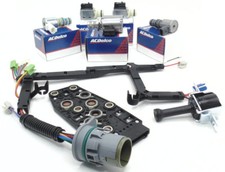
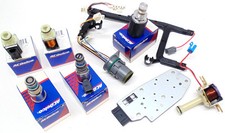
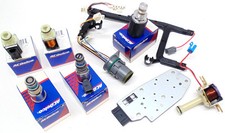
4L60E Master Solenoid Kit (EPC, Shift, TCC, 3-2, PWM) 1996-Up
Once you have counted five solenoids and found a vented manual valve with the 3-2 port cast shut, this is the kit that matches: EPC, both shift solenoids, PWM TCC and the on/off 3-2 control solenoid for 1996-up units. Running a four-solenoid 1993–94 unit instead? Order the 1993–2002 shift solenoid kit, or browse the full 4L60E parts collection.
Shop the 1996-Up Master Solenoid Kit →Year-correct 4L60E solenoid kits, valve body parts, stator support shafts, input shafts, pans, filters and rebuild kits — shipped fast from the USA.
Shop 4L60E parts →Related reading on the bench work this identification feeds into: our separator plate and check ball guide, the P0753 and P0758 shift solenoid walkthrough, and 4L60E fluid type and capacity.
Sources
- Sonnax — GM 4L60-E Valve Body Identification Guide. Backs the solenoid counts by year, the 10–15 and 20–31 ohm solenoid resistance ranges, vented vs. non-vented manual valve, the cast-shut 3-2 port and TCC annular exhaust port casting features, and the GM047 / GM048 / GM049 / GM051 year splits. sonnax.com/tech_resources/614
- Sonnax — GM 4L60-E Transmission unit reference. Backs the 1993–2014 production run and 11 million-plus vehicles, the 1995-later PWM/EC3 description, the 27-spline vs. 30-spline and 298mm vs. 300mm input shaft fitments, the note that early cases without shifter bracket bosses cannot be used in 1996–1997 vehicles, and the 4WD/AWD vs. 2WD/Corvette output shaft split. sonnax.com/units/455-4l60-e
- Sonnax — How to Avoid a Dipstick Move in 4L60-E Series Transmissions (Jason Larochelle). Backs the 1998 deep-pan change on C/K/G trucks and vans, the three dipstick stop brackets, the Corvette exception, and the 1998 valve body chamfer that prevents new-design brackets from fitting pre-1998 castings. sonnax.com/tech_resources/941
- Sonnax — 4L60-E Series Input Shaft, Stator & Pump Cover Compatibility: Three Easy Checks (Caleb Perham). Backs the three-check procedure, the sealing-ring shaft identification, the pump bolt-hole straightedge test, the stator converter feed vs. lube hole alignment, the no-ISS-hole / reluctor-stator anomaly, and the failure modes of a mismatched stator. sonnax.com/tech_resources/1419
- General Motors — 2007 Engine & Transmission Certification File Matrix (GM Service Information, gsi.ext.gm.com). Backs the RPO M30 to 4L60E mapping, listed in GM's own transmission RPO column as "M30 (4L60E)", along with the engine RPO pairings and the neighboring MT1, M32, MN8 and M70 transmission codes. gsi.ext.gm.com — 2007 OBD Groupings (PDF)
- Sonnax — 20 Years Later: What's New with 4L60-E PWM Modifications. Backs the on/off vs. PWM vs. EC3 control strategies, the 20 to 40 RPM commanded converter slip, the roughly 50% and 98% duty cycle figures, and why on/off, PWM and EC3 friction linings are not interchangeable. sonnax.com/tech_resources/214
- Transmission Digest — Recent Diagnostic Trends (Jim Stokes, May 2015). Backs codes P0716 and P0717 on ISS-equipped 4L60E / 4L65E / 4L70E units, the J38522 variable signal generator and 20-way connector called out in the GM flow chart, and the Hall Effect sensor ground on circuit 1984 or 1231 at pin V of the transmission case connector. transmissiondigest.com/recent-diagnostic-trends