The Suburban is the one GM utility where you cannot assume which transmission is under it. A half-ton Suburban and a three-quarter-ton Suburban look the same from the curb, wear the same badges, and share an owner manual, but they do not share a transmission. The 1500 got the 4L60-E. The 2500 got the much bigger 4L80-E. Different pan, different filter, different capacity. Buy parts for the wrong one and you find out with the pan already on the floor.
This guide sticks to what GM printed in the Suburban owner manuals: the fluid each year calls for, how much each transmission takes on a pan service, how the GVWR on your door label changes the interval, the transfer case that does not take ATF, and the hot check that settles the level.
The short version: Confirm your transmission first: RPO M30 on the glovebox label is a 4L60-E, MT1 is a 4L80-E. The 2007 Suburban owner manual lists a pan service at 5.0 qt (4.7 L) for the 4L60-E and 4L70-E, and 7.7 qt (7.3 L) for the 4L80-E. Service every year with a licensed DEXRON-VI. The 2005 manual puts any Suburban with a GVWR over 8,600 lb on the 50,000-mile fluid and filter schedule no matter how it is driven; everyone else gets 50,000 under severe service or 100,000 otherwise. Check hot, 180-200°F. The automatic 4WD transfer case takes AUTO-TRAK II (GM 12378508), 2.0 qt, not ATF.


First, Find Out Which Transmission Your Suburban Has
Open the glovebox and find the Service Parts Identification label, the sticker covered in three-character RPO codes. M30 is the 4L60-E. MT1 is the 4L80-E. Thirty seconds here saves a wasted parts order.
As a rule of thumb, a Suburban 1500 with the 5.3 is a 4L60-E truck, and a Suburban 2500 with the 6.0 or the 8.1 is a 4L80-E truck. You can see the split in GM's own capacity table. The 2007 Suburban manual covers both series in one book, and under Transmission Fluid it lists two separate lines: "4L70-E Super Duty Transmission and 4L60-E Electronic Transmission" at 5.0 qt, and "4L80-E Transmission" at 7.7 qt. The 2005 manual shows the same 1500/2500 divide elsewhere, listing a separate fuel tank size for each series (31.0 gal for the 1500, 37.5 gal for the 2500).
The rule of thumb is not a substitute for the label. A used transmission could be anything. If the RPO says M30, everything below for the 4L60-E applies. If it says MT1, use the 4L80-E numbers and read our 4L80E filter and pan service guide before you start, since that unit's service has its own details. For a full side-by-side, see 4L60E vs 4L80E.
Fluid Type: DEXRON-VI for Every Year
| Suburban | What the manual says | What to put in it |
|---|---|---|
| 2005 and earlier | DEXRON-III, "Approved for the H-Specification" (2005 manual) | Licensed DEXRON-VI |
| 2006-up four-speed | DEXRON-VI (2007 manual, Recommended Fluids and Lubricants) | Licensed DEXRON-VI |
The 2005 manual is blunt about it: "Always use automatic transmission fluid labeled DEXRON-III, Approved for the H-Specification," and it warns that other fluids "may damage your vehicle" and may not be covered by warranty. You cannot buy that fluid with a valid license today. GM introduced DEXRON-VI in April 2005 as the factory fill for 2006 model-year Hydra-Matic vehicles. Per GM's licensing program as reported by Counterman, DEXRON-III H licenses expired at the end of 2006, and DEXRON-VI is back-serviceable for older vehicles that called for DEXRON, DEXRON-II, or DEXRON-III. The 2007 manual simply lists "DEXRON-VI Automatic Transmission Fluid."
The same fluid goes in the 4L60-E and the 4L80-E. Look for the actual DEXRON-VI license on the back of the jug, not "suitable for use where DEXRON-VI is recommended." Multi-vehicle fluids have not necessarily passed GM friction testing.
Capacity: 1500 vs 2500
| Item | Spec | Source |
|---|---|---|
| 4L60-E / 4L70-E pan service | 5.0 qt (4.7 L) | 2007 Suburban owner manual, Capacities |
| 4L80-E pan service | 7.7 qt (7.3 L) | 2007 Suburban owner manual, Capacities |
| Top-off when low on the hot check | Generally less than 1 pint (0.5 L) | 2005 Suburban owner manual, How to Add Fluid |
| Transfer case fluid | 2.0 qt (1.9 L) | 2007 Suburban owner manual, Capacities |
| Automatic 4WD transfer case fluid | AUTO-TRAK II, GM 12378508 | 2007 Suburban owner manual, Recommended Fluids |
Those transmission numbers are what a pan drop and filter change takes. They are not the full fill. The torque converter, the cooler, and the lines hold a big share of the fluid and none of it comes out when you drop the pan. Sonnax's oil-flow anatomy shows why: converter charge oil leaves the converter and goes to the cooler, and cooler return feeds the lube circuit, so that fluid is always in circulation and is never sitting in the pan waiting to drain.
Practical shopping list: six quarts for a 4L60-E Suburban, nine quarts for a 4L80-E Suburban.
4L60-E: check that the pan, dipstick, and filter match
On the 4L60-E, Sonnax documents a fluid-level trap that shows up on trucks with mixed parts. In 1998 GM put a deeper pan on its C/K trucks along with a longer dipstick, longer tube, and a taller stop bracket. Without the correct stop bracket, the dipstick sits too low and reads full when the unit is short: Sonnax puts it at up to 0.5 qt low with a regular pan and no bracket, and up to 0.75 qt low with a deep dipstick and no bracket. Some combinations go the other way and overfill by about 0.75 qt. If your Suburban has had a pan swapped, or the level never seems to make sense, look at the bracket before you blame the transmission.
Interval: Your Door Label Decides Part of It
The 2005 Suburban manual has a rule most people skip past. It says to change both the fluid and filter every 50,000 miles (83,000 km) "if the vehicle's GVWR is over 8,600" lb, or if it is mainly driven in any of these:
- Heavy city traffic where the outside temperature regularly reaches 90°F (32°C) or higher.
- Hilly or mountainous terrain.
- Frequent trailer towing.
- Taxi, police, or delivery service.
Only when the GVWR is 8,600 lb or less and none of those conditions apply does the interval stretch to 100,000 miles (166,000 km). That GVWR clause matters on a Suburban more than on almost anything else GM sold, because the heavy-duty series is built to carry and tow more. Read the GVWR off the label on the driver's door pillar instead of guessing. If it is over 8,600 lb, you are on the 50,000-mile schedule even if the truck never pulls a trailer.
The 2007 manual moves the interval into its Additional Required Services table, with one line for severe service (footnote h, the same four conditions) and one for normal service. It drops the GVWR wording, but the logic is the same.
Be honest about your driving. Pat Burrow points out in GEARS Magazine (ATRA) that most everyday use meets the severe-service definitions, and that the severe schedule cuts the interval in half. A Suburban pulling a camper, hauling eight people through summer traffic, or living somewhere hot is a severe-service truck. For a 4L60-E you want to keep, 30,000 to 50,000 miles is far cheaper than a 3-4 clutch job.
Don't Forget the Transfer Case
On a 4x4 Suburban with the automatic transfer case (the one with an AUTO 4WD position), GM's fluid table lists AUTO-TRAK II Fluid (GM Part No. U.S. 12378508). That appears in both the 2005 and 2007 Suburban manuals. It is not ATF. The 2007 manual gives transfer case capacity as 2.0 qt (1.9 L), and the maintenance footnotes say to check the transfer case vent hose for kinks and correct routing.
This is a separate unit with its own fill and drain plugs. Changing transmission fluid does nothing for it, and the classic mistake on a "do all the fluids" service is filling it from the ATF jug. The wrong fluid shows up as binding, chatter in tight turns, or noise.
Read the Old Fluid First
Before draining anything, wipe a drop from the dipstick on a white paper towel.
- Red or pink, little smell: normal. Service it.
- Brown, faint burnt smell: overdue. Service it and recheck in a few thousand miles.
- Dark, sharp burnt smell, or gritty: the friction material is already hurt. Fresh fluid will not fix that.
Burrow also covers the "the fluid change killed it" complaint. Fresh fluid with a full detergent package can loosen deposits in a high-mileage unit that was never serviced, and one that was already worn can fail soon after. For unknown-history units he favors a pan drop and filter over a full flush. That replaces roughly half the fluid and is easier on the unit. Test drive it first, and confirm reverse works before you pull it into the bay. If it already slips or flares on the shifts, fluid is not the repair; start with our Suburban 4L60E slipping guide.
The Pan and Filter Service
- Warm it, then let it cool enough to touch. Warm fluid drains faster and takes more debris with it.
- Drain. Use the drain plug if the pan has one. If not, loosen the rear and side bolts, leave the front ones finger tight, and let the pan tip into a wide catch pan. A 4L80-E pan holds more, so use a bigger pan.
- Pull the pan and filter. Check that the filter neck seal came out with the filter. A new filter pushed in on top of an old seal left in the bore pulls air, and you get a whine and slipping. Pry the old seal out without scratching the bore.
- Read the pan. Clean the magnet and look at what was on it. Fine gray paste is normal wear. Brass or bronze flakes point at bushings or thrust washers. Black fiber or chunks of friction material mean clutches are coming apart.
- Reinstall. Clean the pan and the case rail, install the new filter and seal, and put the pan back with a new gasket. Tighten in a crisscross pattern to the inch-pound spec in the service manual. Overtightening crushes the gasket and bows the pan rail, which is where most leaks after a pan service start.
- Refill. Add 5 qt (4L60-E) or 7.7 qt (4L80-E) of licensed DEXRON-VI down the dipstick tube, then set the level hot.
If the fluid was burnt or the pan had friction material in it, flush the cooler and lines before refilling, including the auxiliary cooler on tow-package trucks. See our 4L60E cooler flush guide.
The Hot Check, Straight From the Manual
This is the procedure from the 2005 Suburban manual; the 2007 manual uses the same temperature window. GM wants the fluid at 180-200°F (82-93°C).
- Drive about 15 miles when it is above 50°F outside. Below 50°F, drive in THIRD (3) until the engine temperature gage moves and then stays steady for 10 minutes.
- If you have been towing, driving at high speed for a while, sitting in heavy traffic, or driving in heat above 90°F, wait at least 30 minutes before checking.
- Park level, engine running, parking brake set, shifter in PARK (P).
- Foot on the brake, move the shifter through every range, pausing about three seconds in each, and return to PARK.
- Idle at least three minutes and leave it running.
- The dipstick is at the rear of the engine compartment on the passenger side. Flip the handle up, pull it, wipe it, push it all the way back in, wait three seconds, and pull it again.
- Check both sides and read the lower level, tip pointed down. Hot, it must be in the HOT or cross-hatched area.
- Do it twice. If the readings will not repeat, GM says to check that the transmission breather hose is clean and not plugged.
A cold check after the truck has sat for eight hours is a reference only. GM says to add fluid only after a hot check, and that it "does not take much fluid, generally less than one pint." Overfilling is not harmless: the manual warns excess fluid can come out onto hot engine and exhaust parts and start a fire.
What It Costs
DIY on a 1500, the parts are a filter and gasket kit and six quarts of licensed DEXRON-VI. On a 2500 it is a 4L80-E filter kit and about nine quarts. If your pan has no drain plug, this is the time to put on a pan that has one; every future service gets cleaner and faster.
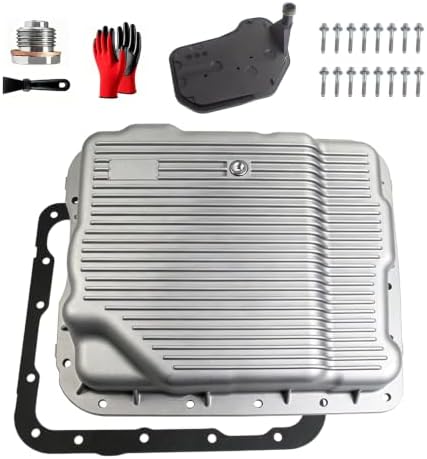
4L60E Deep Pan Filter Kit, 1998-2013 (OEM 24208576)
Filter, neck seal, and gasket for the deep pan GM used on its C/K trucks and utilities from 1998, which covers the 4L60-E Suburban 1500 from that year on. 2500 owners with the 4L80-E can find filters and pans in the 4L80E lineup, and the rest of the 4L60E parts are in the 4L60E lineup.
See the deep pan filter kit →FAQ
What transmission fluid does a Suburban take?
Every 4L60-E and 4L80-E Suburban is serviced with a licensed DEXRON-VI fluid. The 2005 manual called for DEXRON-III with the H-Specification, but those licenses expired at the end of 2006 and GM made DEXRON-VI back-serviceable to older vehicles. The 2007 manual lists DEXRON-VI directly.
How many quarts does a Suburban transmission take for a pan and filter change?
The 2007 Suburban owner manual lists 5.0 qt (4.7 L) for the 4L60-E and 4L70-E, and 7.7 qt (7.3 L) for the 4L80-E used in 2500 series trucks. That is the pan-service amount, not the total fill, because the converter, cooler, and lines keep their fluid. Buy six quarts for a 4L60-E or nine for a 4L80-E and set the level hot.
Does a Suburban 2500 have a 4L60E?
Generally no. The 2500 series Suburban used the heavier 4L80-E, while the 1500 used the 4L60-E. Confirm it on the glovebox Service Parts Identification label: RPO M30 is a 4L60-E and MT1 is a 4L80-E.
How often should Suburban transmission fluid be changed?
The 2005 Suburban manual calls for a fluid and filter change every 50,000 miles if the GVWR is over 8,600 lb or if the truck is mainly driven in hot city traffic, hills, frequent towing, or taxi, police, or delivery service. Otherwise it is every 100,000 miles. Check the GVWR on the driver's door label.
What fluid goes in the Suburban transfer case?
On 4x4 Suburbans with the automatic transfer case, both the 2005 and 2007 manuals list AUTO-TRAK II Fluid, GM Part No. 12378508, not ATF. The 2007 manual gives the transfer case capacity as 2.0 qt (1.9 L). It is a separate unit with its own fill and drain plugs.
Keep the numbers at the bench. Our free transmission fluid spec chart lists the correct ATF type for the 4L60E, 4L80E, and dozens of other units, so you never top off with the wrong fluid.
Sources
- General Motors — 2007 Chevrolet Suburban Owner Manual. Backs: the 5.0 qt (4L60-E/4L70-E) and 7.7 qt (4L80-E) pan-service capacities, 2.0 qt transfer case capacity, DEXRON-VI and AUTO-TRAK II (GM 12378508) in Recommended Fluids, and the severe/normal service intervals with footnote (h). assets.gm.com: 2007 Suburban owner manual (PDF)
- General Motors — 2005 Chevrolet Suburban Owner Manual. Backs: DEXRON-III "Approved for the H-Specification," the 50,000-mile interval for GVWR over 8,600 lb or severe service and 100,000 miles otherwise, the 180-200°F hot check procedure, the less-than-one-pint top-off, and the 1500/2500 fuel tank figures. assets.gm.com: 2005 Suburban owner manual (PDF)
- Sonnax — How to Avoid a Dipstick Mix-Up in 4L60-E Series Transmissions. Backs: the 1998 deep pan, dipstick, and stop bracket change, and the 0.5-0.75 qt underfill or overfill from mismatched parts. sonnax.com/tech_resources/941
- Sonnax — Anatomy of a Transmission: Oil Flow in the Pump, PR, Converter, Cooler and Lube Circuits. Backs: converter and cooler oil stays in circulation, which is why a pan drop does not drain the whole unit. sonnax.com/tech_resources/131
- Pat Burrow, GEARS Magazine (ATRA) — Is It Safe to Change Transmission Fluid in High-Mileage Vehicles? Backs: most driving meets severe-service conditions, a pan drop replaces roughly half the fluid, full-flush detergent risk on neglected units, and test-driving before service. gearsmagazine.com
- Counterman — FAQs on GM's DEXRON-VI Specs. Backs: DEXRON-VI introduced April 2005 for 2006 Hydra-Matic vehicles, DEXRON-III H licenses expired end of 2006, and DEXRON-VI back-serviceability. counterman.com