"It shifts funny" on a Suburban usually means one of six things: hunting between 3rd and 4th with a trailer, late firm shifts on a cold morning, banging into gear after a rebuild, a big flare on a part-throttle 3-2, a clunk on the 2-3, or a real 2-3 flare that is cooking the 3-4 clutch. Those are different problems with different fixes, and two of them are the truck doing what GM built it to do.
The short version: Hunting under load and odd cold-morning shifts are designed behavior, spelled out in the Suburban owner manual. Use Tow/Haul or THIRD. A harsh shift right after a repair is usually leftover adapt values (TAP cells) that never got reset. A 1000-2000 RPM flare on a part-throttle 3-2 at 19-31 mph on a 1996 truck is GM bulletin 67-71-47: replace the 3-2 control solenoid. A 2-3 clunk with a clean ratio change is GM bulletin 01-07-30-042, and GM says leave it alone. A real 2-3 flare means 3rd-gear oil is leaking somewhere, and that is the one that burns up 3-4 clutches.

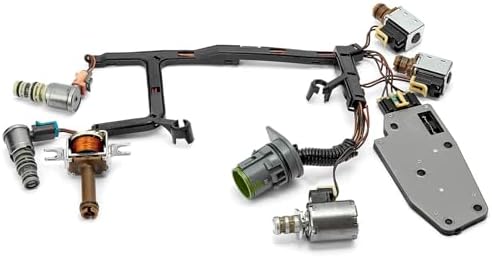

Confirm the Transmission Before You Diagnose Anything
The half-ton Suburban 1500 runs the 4L60E (RPO M30), and some later trucks got the 4L65E (M32) or 4L70E (M70), which share the same hydraulics and the same shift complaints. The three-quarter-ton Suburban 2500 uses the much larger 4L80E, and everything below does not apply to it. Read the RPO codes on the glovebox label first; our Suburban common problems guide covers the split.
Then drive it with a scan tool and record these PIDs while the complaint happens:
- Commanded gear and Shift Solenoid A / B commanded state.
- Trans input and output speed. Input divided by output should land on 3.06, 1.63, 1.00 or 0.70. A ratio that runs high during or after a shift is slip or flare.
- Trans fluid temperature (TFT), engine coolant temperature, and throttle position.
- TAP cell values for each upshift, if your scan tool shows them.
- Stored codes. A TP, MAP or MAF fault changes commanded line pressure, so fix engine codes first.
| What the Suburban does | Most likely cause | First move |
|---|---|---|
| Hunts 3-4-3 on grades or towing | Normal shift schedule under heavy load | Tow/Haul or THIRD, per the owner manual |
| Late, firm shifts below about 32°F | Designed cold-weather strategy | Recheck after the engine is fully warm |
| Harsh shifts right after a repair | Old TAP adapt values still stored | Reset adapts, then 10-15 upshift cycles |
| RPM flare on part-throttle 3-2 at 19-31 mph | 3-2 control solenoid exhaust seat (1996 trucks) | GM bulletin 67-71-47; replace the solenoid |
| Clunk on 2-3 or 3-2, ratio change is clean | Normal torque reversal | GM bulletin 01-07-30-042: no repair |
| RPM flare between 2nd and 3rd | 3rd-gear oil leak, low line pressure | Line pressure gauge, then vacuum tests |
Hunting Between Gears Under Load Is in the Owner Manual
A loaded Suburban on rolling highway drops out of 4th on every grade and goes back to 4th when the load comes off. Do that every half mile and the owner thinks the transmission is failing. Usually it is not.
GM's 2005 Suburban owner manual addresses it directly. It says you can tow in DRIVE, but you may want to shift to THIRD, or a lower gear if needed, if the transmission shifts too often under heavy loads or in hilly conditions. On trucks with the button on the end of the column shifter, it describes Tow/Haul as a mode meant to reduce how often the transmission shifts and make those shifts more predictable with a heavy trailer or load, and to give the same solid shift feel loaded as unloaded.
Three details from that section save diagnostic time:
- Tow/Haul works best when the truck and trailer together are at least 75 percent of GCWR.
- Using it empty will not hurt anything, but GM warns it can cause unpleasant engine and transmission driving characteristics and lower fuel economy. A customer who leaves it on all the time will complain about late, firm shifts that are perfectly normal.
- The truck turns Tow/Haul off every time it is started. An owner who thinks it is on may be towing in plain DRIVE.
Cold mornings
The same manual says that at about 32°F (0°C) or colder, the transmission is designed to shift differently until the engine reaches normal operating temperature, to improve heater performance. Late, firm upshifts for the first few miles of a winter morning, gone once the coolant is up to temperature, are not a fault. If the shift quality is still off with the engine fully warm and TFT in the normal range, keep going.
Harsh Shifts Right After a Repair: Reset the Adapts
This one sends good rebuilds back to the shop. The truck comes in slipping, gets a new 3-4 pack or valve body, and leaves banging into 2nd. The parts are fine. The computer is still running the pressure it learned while the old unit was slipping.
Dan Tucker explains the mechanism in his Sonnax article on transmission adaptive pressure systems (TAPS). For each upshift the PCM keeps a table of TAP cells, from light-load easy takeoffs at the low cells up to near-wide-open-throttle launches at the high ones. After every shift it measures how long the shift took, and if the result was not acceptable it changes the pressure control solenoid current it will use the next time that shift happens in that cell. Tucker gives the normal range as about -29.75 to +29.75 psi from base. His example is a 4T65-E, but the 4L60-E adapts the same way.
The useful numbers from that article:
- On a healthy unit, most cells sit within about 3 psi of base pressure, and neighboring cells look alike.
- Big, erratic swings between neighboring cells (his example had one cell at +12.50 psi beside one at -19.50) point to a pressure control problem even with no codes stored.
- If the PCM learned to compensate for a burned clutch, burned band or internal leak, it added pressure. Tucker's warning: if you do not reset the TAP after the repair, expect a harsh shift. After a good repair the adapt values should settle much closer to zero.
- Relearning on its own takes many drive cycles. Reset with a scan tool, or disconnect the battery for usually more than 30 minutes, then allow 10-15 upshift cycles before you judge the shift.
Reset first, drive every shift at light and moderate throttle, then judge. Our 4L60E adaptive relearn guide covers the drive cycle.
The Part-Throttle 3-2 Flare on 1996 Trucks
If the complaint is a big engine flare on a part-throttle downshift coming off 3rd, roughly between 19 and 31 mph, and the truck is a 1996, check GM Dealer Service Bulletin 67-71-47 before you touch the valve body. It covers 1996 Chevrolet and GMC C/K models (the Suburban is a C/K truck) and several cars with the Hydra-Matic 4L60-E (RPO M30) built before May 24, 1996 (Julian date 6145).
- Condition: an engine speed flare of 1000-2000 RPM during a part-throttle downshift at 19-31 mph. It sets no DTCs.
- Cause: the exhaust seat on the 3-2 control solenoid backing out.
- Correction: replace the 3-2 control solenoid with one dated Julian 6134 (May 13, 1996) or later. The bulletin lists P/N 24209121.
- Check which solenoid you have first: per Sonnax's 4L60-E valve body identification guide, 1993-95 valve bodies use a metal PWM 3-2 solenoid that reads 10-15 ohms, while 1996-and-later units use a plastic ON/OFF solenoid at 20-31 ohms. Order the one that matches the valve body in the truck.
A sticking or worn 3-2 solenoid or 3-2 control valve can do the same thing on any year. If the ratio jumps above 1.63 before 2nd catches, the band is coming on late. Our 3-2 downshift solenoid guide covers the P0785 side and the resistance check.
One more 1996-specific item: Sonnax's 4L60E 3-4 clutch guide tells rebuilders to verify that 1996 trucks have the ground wire update from GM bulletin 00-07-30-026. That is a VCM ground repair, and an erratic ground means erratic commanded line pressure, which shows up as flares and soft shifts that no amount of hard parts will cure.
The 2-3 or 3-2 Clunk: GM Says It Is Normal
A dull clunk on the 2-3 upshift or 3-2 coast-down, with a crisp shift and clean fluid, sounds broken. GM addresses it in bulletin 01-07-30-042. As ATSG president Wayne Colonna summarizes it in Motor Age, revision G (September 22, 2011) covers 2012 and earlier 4L60-E, 4L65-E and 4L70-E units in cars and light-duty trucks.
The 2-3 shift releases the 2-4 band while the 3-4 clutch applies, and the 3-2 does the reverse. The timing of that handoff can cause a momentary torque reversal at the output shaft, and the driveline answers with a clunk. GM notes it can be worse on 4WD vehicles because of the extra tolerances in the transfer case, which is why four-wheel-drive Suburbans get this complaint more than 2WD pickups. GM calls it a normal condition and says no repairs should be attempted.
Prove it first: the ratio should step cleanly from 1.63 to 1.00 with no RPM flare, and the U-joints, slip yoke and mounts should be tight. Our Tahoe shift problems guide covers the same bulletin.
A Real 2-3 Flare: Find the 3rd-Gear Oil Leak
A flare is the engine running up a few hundred RPM between 2nd and 3rd before the 3-4 clutch catches. On a Suburban that tows, this is the complaint that ends transmissions. Brian Wing of Sonnax puts the cause in one line in his burnt 3-4 clutch article: low line pressure and/or leaks of 3rd-gear oil cause most 3-4 slipping. The job is finding where the oil goes.
1. Line pressure first
Put a gauge on the line tap and compare idle and stall readings in each range to factory spec. Low everywhere sends you to the pump, the pressure regulator and boost valve, and the EPC solenoid. Wing notes boost valves leak, especially at high line pressure, and lists the pressure regulator valve, pump slide, pivot pin and relief ball as items to vacuum test.
2. The 3rd accumulator checkball (#7)
On the 4L60E the 2-4 servo doubles as the 3rd accumulator, and a hidden checkball capsule in the case controls that circuit. Sonnax documents that a leak there lowers 3-4 clutch apply pressure and band release pressure at the same time, so you get a burned 3-4 pack and a dragging band from one small leak. Vacuum it with a soft rubber tip and expect a near-perfect seal, or drip solvent into it with the case pan-side up and watch for leakage inside the case. If it leaks, reseat the ball with a light tap on a punch and retest. Replace the assembly if it still leaks.
Wing adds two warnings. New OE capsules are known to leak right out of the box, so test the new one too. And do not cup-plug the capsule. The plug blocks venting and can cause soft 2-3 shifts and 3-2 flares, which is the exact complaint you were trying to fix.
3. The input housing and the valve body
The input housing checkball should hold 25 in-Hg on a vacuum test. Wing calls anything less an unacceptable leak. Check the shaft-to-housing press fit and the forward housing O-ring. In the valve body, he lists the 2-3 shift valve (a common sticker), the 3-4 shift valve, the 3-2 control valve, and the reverse abuse bore plug behind the 3-2 control valve, which leaks 3rd-gear oil. If the flare showed up after a valve body swap, start there.
4. Clean hydraulics and still flaring? Check the B solenoid circuit
Gregg Nader of Sonnax documents a 1998 GM truck that flared on the 2-3 before and after an overhaul, with no codes, normal line pressure in every range, and a second complete valve body that changed nothing. A new computer fixed it. The scan tool sometimes showed the "B" shift solenoid as "short" right when the flare happened. The cause: the B solenoid driver was not switching off cleanly, so the 2-3 shift valve moved gradually and the 2-4 band released before the 3-4 clutch applied.
His test is worth copying. Pull the Trans fuse and put an ammeter across the fuse terminals, key on. Use bi-directional controls to command 3rd (both solenoids off) and zero the meter, then command 4th (A on only) and 2nd (B on only). Per the Sonnax article, the A circuit drops to zero in a fraction of a second when turned off; the faulty B circuit took about 2 seconds. A slow drop on B with a known-good solenoid points at the PCM, not the transmission.
5. Build it for the weight
Wing notes the OE 3-4 backing plate flexes and that new load release springs belong in every 3-4 job. On a Suburban that tows, a higher-capacity 3-4 pack and heavy-duty backing plate are cheap next to doing the job twice. Then reset the adapts, because the PCM learned around the leak.
FAQ
Why does my Suburban 4L60E keep shifting between 3rd and 4th when towing?
Under heavy load on grades it drops to 3rd to climb and returns to 4th when the load comes off. GM's owner manual says to use THIRD or Tow/Haul when it shifts too often. Tow/Haul works best at 75 percent of GCWR or more and turns off at every start.
Why does my Suburban shift hard after a transmission rebuild?
The PCM's adapt values (TAP cells) added pressure to cover the old slipping unit. If they are not reset, the new transmission gets that extra pressure and shifts harsh. Reset them with a scan tool or a 30-plus minute battery disconnect, then drive 10-15 upshift cycles.
What causes a flare on a 3-2 downshift in a 4L60E?
On 1996 units built before May 24, 1996, GM bulletin 67-71-47 traces a 1000-2000 RPM part-throttle 3-2 flare at 19-31 mph to the 3-2 control solenoid exhaust seat backing out; the fix is a new solenoid. On any year, a sticking 3-2 control valve or a cup-plugged 3rd accumulator capsule can do it too.
Is a clunk on the 2-3 shift normal on a 4WD Suburban?
Often, yes. GM bulletin 01-07-30-042 describes a 2-3 or 3-2 clunk from a momentary torque reversal during the band-to-clutch handoff, worse on 4WD because of transfer case tolerances. GM calls it normal and says no repairs should be attempted, as long as there is no RPM flare and the driveline is tight.
Keep the right fluid on the shelf: our transmission fluid spec chart lists the correct ATF for the 4L60E and dozens of other units.
Sources
- General Motors — 2005 Chevrolet Suburban Owner Manual, Automatic Transmission Operation and Towing a Trailer sections. Backs: DRIVE/THIRD towing guidance, Tow/Haul purpose, the 75 percent of GCWR note, the warning about unloaded use, Tow/Haul turning off at every start, the Autoride interaction, and the cold-weather (32°F) shift strategy. GM: 2005 Suburban owner manual (PDF)
- GM Dealer Service Bulletin 67-71-47, "3-2 Part Throttle Downshift Flare (Replace 3-2 Solenoid)," 1996 (GM dealer print bulletin; no OEM-hosted copy is online, so it is cited by number). Backs: 1996 C/K trucks and cars with 4L60-E (RPO M30) built before May 24, 1996 (Julian 6145); 1000-2000 RPM flare at 19-31 mph with no DTCs; cause is the 3-2 control solenoid exhaust seat backing out; replace with a Julian 6134 or later solenoid, P/N 24209121.
- Sonnax — GM 4L60-E Valve Body Identification Guide (April 12, 2017). Backs: the 3-2 control solenoid types by year, metal PWM at 10-15 ohms on 1993-95 valve bodies and plastic ON/OFF at 20-31 ohms on 1996-and-later valve bodies. sonnax.com: 4L60-E valve body ID guide
- Sonnax, Dan Tucker — Playing TAPS on Pressure Systems (May 2005). Backs: How TAP cells work, the roughly -29.75 to +29.75 psi adjustment range, healthy cells within about 3 psi of base, erratic cell swings as a pressure control symptom, the harsh shift if adapts are not reset after a repair, battery disconnect longer than 30 minutes, and 10-15 upshift cycles to relearn. sonnax.com: Playing TAPS on Pressure Systems
- Sonnax, Brian Wing — All Over the Map: Attacking 4L60/E Burnt 3-4 Clutches with Confidence (June 2018). Backs: Low line pressure and 3rd-oil leaks as the root cause of 3-4 slip, the 25 in-Hg input housing checkball standard, new 3rd accumulator capsules leaking out of the box, the cup-plug warning, the reverse abuse bore plug and 2-3 shift valve, backing plate flex, and the 1996 truck ground wire update per GM bulletin 00-07-30-026. sonnax.com: Burnt 3-4 clutches
- Sonnax — Guard Against 4L60-E Band and 3-4 Clutch Failure: Test the 3rd Accumulator Checkball Assembly for Leakage. Backs: The hidden #7 checkball's effect on 3-4 apply and band release pressure, the vacuum and solvent tests, and the reseat-then-replace repair. sonnax.com: 3rd accumulator checkball test
- Motor Age (VehicleServicePros), Wayne Colonna, ATSG — A Problem That Isn't a Problem (January 2020). Backs: GM bulletin 01-07-30-042G (September 22, 2011): 2-3 and 3-2 clunk from output shaft torque reversal on 2012 and earlier 4L60/65/70-E units, worse on 4WD, no repairs to be attempted. vehicleservicepros.com: A Problem That Isn't a Problem
- Sonnax, Gregg Nader — 4L60E Flares on 2-3 Shift? Could Be a Bad Computer (TASC Force tip, November 2006). Backs: the no-code 2-3 flare cured by a new computer, the intermittent "short" B solenoid status, the gradual 2-3 shift valve stroke, and the fuse-terminal amperage test with A dropping to zero in a fraction of a second versus about 2 seconds on the faulty B circuit. sonnax.com