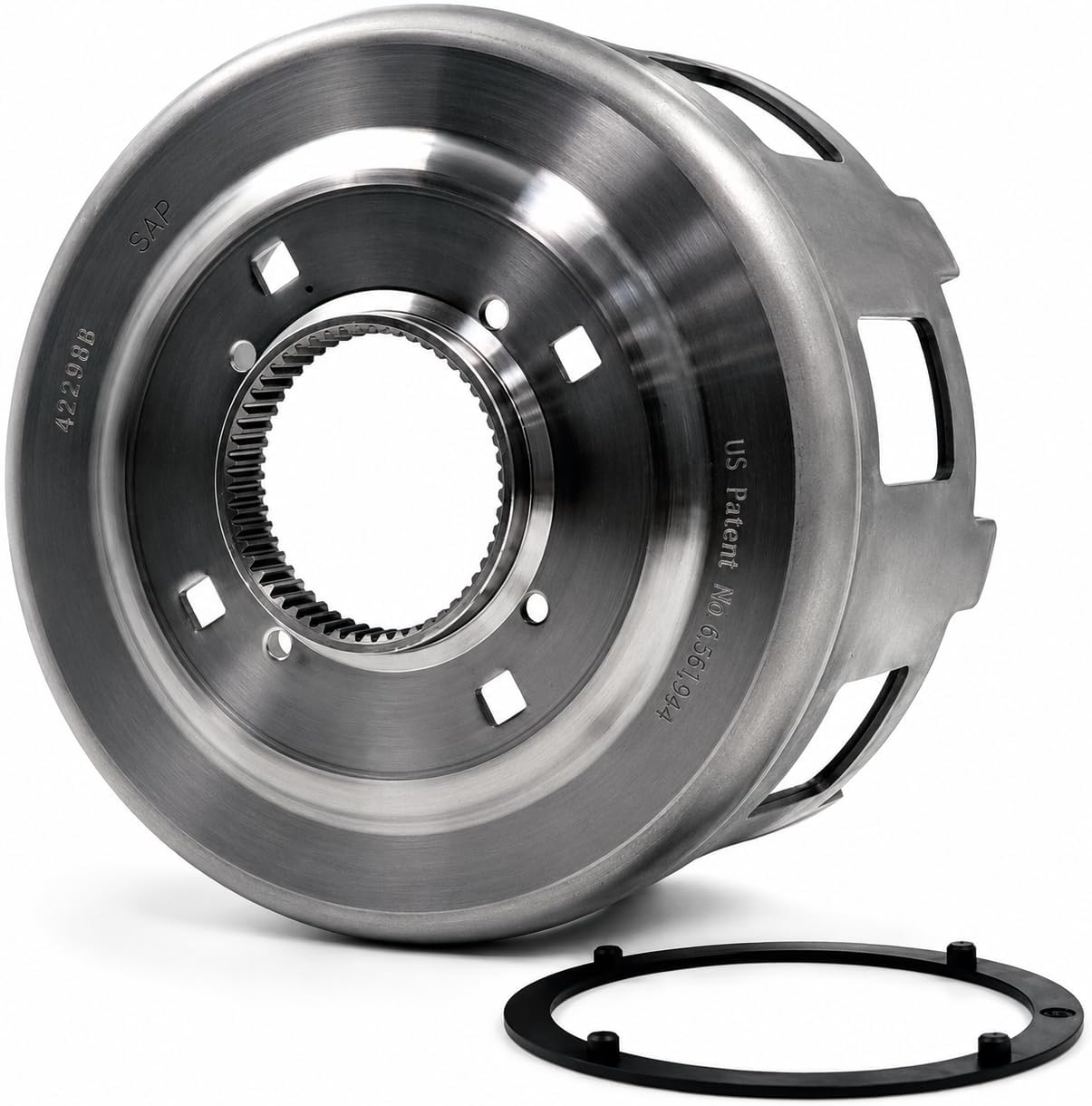
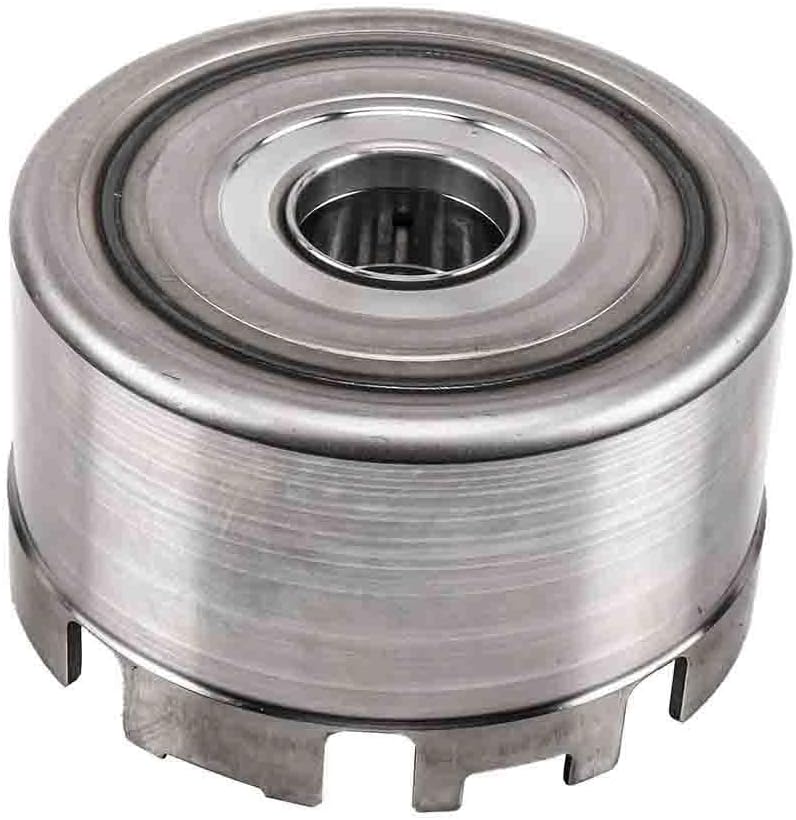

No reverse on a 4L65-E is one of the few complaints on this transmission that tells you something useful before you touch it. Reverse is not solenoid controlled on this unit. It is fed through the manual valve, which is why a truck sitting in electrical failsafe still backs up fine. So when reverse is the thing that quit, the computer is almost never the answer, and the diagnostic path is short: two clutches, two valve body bores, one sheet-metal shell.
The 4L65-E ran from 2001 to 2013 behind 6.0-liter trucks and SUVs, the Hummer H2, the SSR and the TrailBlazer SS. It is a 4L60-E with a five-pinion gear set and a stronger input drum, so every 4L60-E procedure below transfers unchanged. What follows is the order to work it in, and what each test actually rules out.
What has to apply for reverse
Two friction elements, and only two. Per the apply chart Transmission Digest walks through for this family, the reverse input clutch and the low/reverse clutch both have to engage to get reverse. The reverse input clutch drives the reaction sun gear through the sun shell. The low/reverse clutch holds the reaction carrier so the gear set has something to push against.
That gives you three distinct symptom patterns, and they do not overlap:
| What the driver has | What it points at | Where to look first |
|---|---|---|
| All four forward gears, no reverse | Reverse input clutch or low/reverse clutch | Road test, then pressure gauge |
| No reverse, no 2nd, no 4th, but 1st and 3rd are fine | Reaction sun shell | Teardown, the shell is stripped or cracked |
| No reverse plus slipping in the forward ranges | Line pressure, not a single clutch | Pressure regulator and low overrun valve bores |
Write down which one you have before you order anything. The second pattern in particular gets misdiagnosed as a burnt reverse clutch constantly, and a new drum will not fix a stripped shell.
The 20 mph manual-low test
If you have all forward gears and no reverse, this test decides which of the two clutches failed, and it costs nothing. Transmission Digest lays it out plainly: get the vehicle to about 20 mph, pull it into manual low, and let off the gas.
- You get engine braking. The low/reverse clutch is holding the sprag from overrunning, so it is doing its job. The reverse input clutch is your failure.
- You get no engine braking. The low/reverse clutch is not holding, which is both why you have no engine braking and why you have no reverse.
That one distinction is the difference between a reverse input drum and a rear clutch pack on the parts order. It is also worth doing on a unit you are about to rebuild anyway, because sprag integrity is hard to judge with the part in your hand on the bench.
Gauge the pressure before you condemn a clutch
Reverse asks for the highest line pressure of any range in this transmission. A clutch that is physically fine will still slip if the pump cannot hold pressure behind it, and two bores in this unit are known for exactly that.
The pressure regulator valve bore
Sonnax is direct about how to catch this one: a worn pressure regulator valve shows up as 50 to 100 psi less than specified in reverse. The bore wear allows leakage and contributes to erratic pump slide movement, and the symptom list that comes with it is erratic line pressure, low line rise, reverse chatter, excess pump noise and 3-4 clutch failure. If a customer reports reverse that works cold and fades once the unit is hot, this belongs at the top of your list, not the bottom. Sonnax oversized pressure regulator valve 77917-07 is the repair for 4L60-E, 4L65-E and 4L70-E pumps.
Note what else is on that symptom list. Reverse chatter and 3-4 clutch failure sharing a root cause is why a unit that lost reverse often has a fried 3-4 pack waiting inside it.
The low overrun valve bore
This is the one that gets missed, and it is the most direct hydraulic cause of no reverse on this family. The low overrun valve directs line pressure to the reverse input and low and reverse clutches. When the bore wears, line pressure cross-leaks into the low/overrun circuit and to exhaust at both the inboard and outer spool locations, and clutch apply pressure drops right where you need it most.
Sonnax lists the symptoms for that bore as no reverse or manual first gear, burnt reverse or low/reverse clutch, slips in forward and reverse, and low line pressure in reverse. That is a no-reverse complaint described four different ways. The fix is oversized low overrun valve kit 77754-62K, which ships as a hardcoat anodized aluminum valve, plug and spring, and it needs reaming tool kit F-77754-TL62 to install.
Here is the part that saves you a comeback: this bore burns the clutch. If you rebuild the unit, install a fresh low/reverse pack, and bolt the same worn valve body back on, the new clutch goes away the same way the old one did. Vacuum test the bore as a matter of course on any unit that came in with a burnt rear clutch.
The sun shell, and why it takes three gears with it
If the complaint is no reverse plus no second and no fourth, stop testing and plan a teardown. The mechanism is worth understanding because it explains the symptom set exactly.
The 2-4 band holds the sun shell. The sun shell is splined to the reaction sun gear. In second and fourth, the band holds the shell and the shell holds the sun gear stationary. In reverse, the reverse input clutch drives that sun gear through the same shell. So one piece of stamped steel is the load path for three of the six ranges. Transmission Digest puts the failure plainly: the sun gear can break away from the sun shell on these units and you lose second, fourth and reverse, requiring replacement of the sun shell. First and third never touch it, which is exactly why the truck still drives itself into the shop.
Sonnax breaks the shell failure into three modes: spline stripping, hub breakage, and rear planetary bearing failure from excessive thrust loads. Their SmartShell kit 77749-02K addresses all three, and the detail that matters is how. Rather than simply making the shell thicker, the kit reroutes thrust load through the carrier to bypass the delicate bearing entirely. Sonnax points out that bulky aftermarket shells keep stripping splines and breaking under stress because thickness alone does not solve the load path. The kit is a heavy duty shell, an enclosed thrust bearing and a custom roller clutch race, and it covers 4L60, 4L60-E, 4L65-E and 4L70-E.
If you are staying with a conventional replacement, a hardened shell is the minimum. The stock stamped shell is the weak link in this gear train and it does not get stronger with age.
Bench work: what to check while it is apart
A unit that lost reverse is open anyway, so these are the measurements that decide whether it stays fixed.
- Reverse input drum. Inspect the clutch surface, the piston, the sealing rings and the drum lugs. Heat checking on the steels means the clutch was slipping before it quit, and a slipping reverse clutch usually means pressure, not friction material.
- Low/reverse clutch pack and sprag. If the road test said no engine braking, this is the pack. Replace frictions and steels together, and inspect the sprag rather than assuming it.
- Endplay. Sonnax specifies input shaft endplay of .005 in. to .035 in. Assemble the planetary components on the output shaft before installation and check bench endplay with a dial indicator or feeler gauge; .020 in. to .030 in. indicates a correct stack-up.
- Watch the 2007 parts split. In 2007 the reaction carrier bearing was upgraded to a thicker design, and the reaction carrier and shaft were changed to accommodate it. Mix old and new designs and you get incorrect endplay and an output shaft snap ring that will not install properly. Sonnax front planet to reaction shaft thrust bearing 74238-01 is the OE replacement for 2007 and later units.
- Valve body. Vacuum test the pressure regulator, boost and low overrun bores before the pan goes back on. Every one of them feeds the circuits you just repaired.
Fluid and refill
Use DEXRON-VI. It is the current GM-licensed service fluid for this family and it supersedes the earlier grades this transmission was originally filled with. For reference, a licensed DEXRON-VI such as the Mobil product runs a kinematic viscosity of 5.83 mm2/s at 100 C and 29.5 mm2/s at 40 C, with a Brookfield viscosity of 11,500 mPa.s at -40 C. That cold-temperature number is the reason the newer fluid behaves better on a cold reverse engagement than the fluid this unit shipped with.
Set the level hot and in gear, not cold on a lift. An overfull 4L65-E aerates, and aerated fluid will not hold reverse apply pressure any better than a leaking bore will.
Keeping reverse alive after the repair
Reverse fails on this unit for two reasons: pressure that fell off slowly, and a shell that was always marginal. Address both while it is open. Ream or replace the worn bores, fit a hardened or SmartShell reaction shell on anything that tows or carries weight, keep the cooler flowing, and set endplay with an indicator instead of by feel. A unit built that way does not come back with the same complaint.
FAQ
Can a bad solenoid cause no reverse on a 4L65E?
Almost never. Reverse on this unit is fed through the manual valve, not through a shift solenoid, which is why a truck sitting in electrical failsafe still backs up normally. If reverse is gone but the forward gears are all there, the fault is hydraulic or mechanical. Scan it anyway to catch a ratio or pressure code, then put the scan tool down and pick up a pressure gauge.
How do I tell the low/reverse clutch from the reverse input clutch without pulling the transmission?
Get the vehicle to about 20 mph and pull it into manual low, then let off the throttle. If you get engine braking, the low/reverse clutch is holding the sprag from overrunning, so the low/reverse clutch is good and the reverse input clutch is the failure. If there is no engine braking, the low/reverse clutch is the one that is gone. It is a two-minute road test that decides which drum you are buying.
What does it mean if I lost reverse, second and fourth at the same time?
That combination is the reaction sun shell. The 2-4 band holds the sun shell, and the sun shell is splined to the reaction sun gear, so when the sun gear breaks away from the shell you lose every gear that depends on that connection: second, fourth and reverse. First and third survive because they do not use it. The shell has to come out, and a hardened replacement is the only repair worth doing.
Can low fluid or a worn pump cause no reverse by itself?
It can, because reverse asks for the highest line pressure of any range. A worn pressure regulator valve bore leaks under boost, and Sonnax puts the resulting shortfall at 50 to 100 psi below spec in reverse. Check the level hot and in gear first, then gauge the line pressure in reverse before you decide anything is burnt. Reverse that engages cold and disappears hot is a pressure story, not a clutch story.
Is a 4L65E worth fixing when reverse is gone?
It depends on what the fluid tells you. Clean fluid with a stripped sun shell is a targeted repair, since the shell, the drum and the clutch pack come out through the back of the case in a bench teardown. Black fluid with clutch material in the pan means the low/reverse pack already cooked and debris is in the valve body, and at that point a full rebuild with new frictions, steels and pistons is the cheaper path.
Sources
- Transmission Digest, "Diagnosing Shifting Issues" (Barry Bartlett, February 2016) — the 4L60E apply chart logic that reverse requires the reverse input clutch and the low/reverse clutch, the 20 mph manual-low engine-braking test that separates the two, the 2-4 band holding the sun shell, and the sun gear breaking away from the sun shell causing loss of second, fourth and reverse. www.transmissiondigest.com
- Sonnax, Oversized Low Overrun Valve Kit 77754-62K — the low overrun valve directing line pressure to the reverse input and low and reverse clutches, bore wear cross-leaking line pressure into the low/overrun circuit and to exhaust, and the symptom list of no reverse or manual first, burnt reverse or low/reverse clutch, slips in forward and reverse, and low line pressure in reverse, plus reaming tool kit F-77754-TL62. www.sonnax.com
- Sonnax, Oversized Pressure Regulator Valve 77917-07 — pressure regulator valve bore wear allowing leakage and contributing to erratic pump slide movement, the 50 to 100 psi below specification in reverse detection threshold, and the symptom list including reverse chatter, low line rise, 3-4 clutch failure and excess pump noise. www.sonnax.com
- Sonnax, SmartShell Heavy Duty Reaction Shell Kit 77749-02K — spline stripping, hub breakage and rear planetary bearing failure as the three reaction shell failure modes, the kit contents of heavy duty shell, enclosed thrust bearing and custom roller clutch race, the rerouting of thrust load through the carrier to bypass the bearing, and fitment across 4L60, 4L60-E, 4L65-E and 4L70-E. www.sonnax.com
- Sonnax, "Too Close For Comfort: Pinpointing 4L60-E Gear Train Assembly Problems" — the 2007 change to a thicker reaction carrier bearing with a revised carrier and shaft, the input shaft endplay specification of .005 in. to .035 in., the .020 in. to .030 in. bench endplay that confirms a correct stack-up, and the output shaft snap ring that will not install when designs are mixed. www.sonnax.com
- Transmission Digest, "GM 4L60/65/70-E Front Planet to Reaction Shaft Thrust Bearing" (October 2020) — Sonnax bearing 74238-01 as the OE replacement front planet to reaction shaft thrust bearing for GM 2007 and later 4L60-E, 4L65-E and 4L70-E units. www.transmissiondigest.com
- Mobil DEXRON-VI ATF product data sheet — the GM DEXRON-VI licensed specification, kinematic viscosity of 5.83 mm2/s at 100 C and 29.5 mm2/s at 40 C, Brookfield viscosity of 11,500 mPa.s at -40 C, and its use wherever DEXRON is specified in older GM vehicles. www.mobil.com
Need parts for this job?
Reaction sun shells, reverse input clutch drums, low/reverse clutch packs, sprags, valve bodies and master rebuild kits for the 4L65E, all in one place with secure on-site checkout.
Shop 4L65E parts →