A 4R70W Mustang that "slips" can be one of five different problems, and they do not share a fix. A flare on the 1-2 shift, a tach that climbs in overdrive at 70 mph, a car that bogs and flares under a hard launch, and a car that feels loose only when the fluid is hot all get the same word from the customer. In a 1996-2004 Mustang, the 4R70W behind the V6 or the 4.6L, the right fix starts with one question: which gear is it slipping in, and does reverse slip too? Answer that and you have usually narrowed it to one clutch, one band or one hydraulic circuit before the pan comes off.
This guide is the slipping-specific workflow I use on these cars. It covers how the slip maps to the apply chart, how to prove it with a tach and a calculator, what the pressure gauge should read, and the four failures that cause most Mustang 4R70W slips. For the wider list of Mustang faults, including speed sensor dropouts that only feel like slipping, see our 4R70W Mustang common problems guide.
Step 1: Map the slip to the part that holds that gear
The 4R70W uses a Ravigneaux gearset with four clutch packs, two bands and two one-way clutches. ATSG's AODE/4R70W update handbook lists the 4R70W ratios as 2.84 first, 1.55 second, 1.00 third, 0.70 fourth and 2.32 reverse. Those are not the AODE ratios (2.40, 1.47, 1.00, 0.67, 2.00), and ATSG notes the gear train parts and the computer calibrations do not interchange between the two. That matters on a Mustang that has had a swap, because the PCM is doing its math with the ratios it was built for.
Here is what is holding each range, and what a slip in that range points at:
| Range | Applied elements | If it slips only here, suspect |
|---|---|---|
| 1st (OD or D) | Forward clutch, low one-way clutch | Forward clutch or forward drum (or low one-way if it freewheels) |
| 2nd | Forward clutch, intermediate clutch, intermediate one-way | Intermediate clutch or intermediate one-way clutch |
| 3rd | Forward clutch, direct clutch | Direct clutch, direct drum, stub shaft |
| 4th | Direct clutch, overdrive band (forward released) | Overdrive band, servo, servo regulator |
| Reverse | Reverse clutch, low/reverse band | Reverse clutch or band |
| Every range, worse hot and at throttle | Line pressure feeds all of them | Pressure regulator bore, EPC circuit, pump |
Two patterns cover most Mustangs I see. If it slips in 1st, 2nd and 3rd but reverse is solid, the forward clutch is the common element, and on these cars a cracked forward drum is high on the list. If it slips in 3rd and 4th but 1st and 2nd are fine, the direct clutch is the common element, and on a 2001-2004 car that usually means the cross leak covered below.
Step 2: Prove it is slipping with a tach and a calculator
Before you trust a feeling, do the math. With the converter locked, engine rpm is tied directly to road speed:
RPM = MPH x axle ratio x gear ratio x 336 / tire diameter (inches)
Take a Mustang with 3.55 gears and a 26-inch-tall tire. At 60 mph in 3rd (1.00) that works out to about 2,750 rpm. In 4th (0.70) it is about 1,930 rpm. If the scan tool shows the converter clutch commanded on, 4th gear commanded, and the engine is sitting at 2,300 rpm at a steady 60, something between the crank and the tires is slipping. Unlock the converter (light brake tap or a scan tool command if you have it) and see whether the gap stays. A gap that only exists while the converter is locked points at the converter clutch. A gap that stays with the converter released, in one gear, points at the element holding that gear.
Use the real axle ratio and the real tire. Mustangs get gear swaps and tall drag radials constantly, and a calculation done with the factory numbers will tell you a healthy transmission is slipping. The same goes for the PCM. If the axle ratio and tire size in the calibration were never updated after a gear swap, the PCM's own vehicle speed and shift points are wrong too, which is a programming job, not a rebuild.
On the scan tool, watch commanded gear, engine rpm, output shaft speed, commanded EPC pressure, TCC duty cycle and fluid temperature together. ATSG's handbook lists the inputs the PCM uses for shift timing and line pressure: MAF, engine coolant temperature, throttle position, the manual lever position sensor, output shaft speed and transmission oil temperature. On a modified Mustang, a bad TPS signal or a MAF that does not match the tune can command low line pressure and make a perfectly good transmission slide its shifts. Check those PIDs before blaming hard parts.
Step 3: Put a gauge on it
A line pressure test is the step most people skip, and on a 4R70W it is the one that separates a hydraulic problem from a worn-out clutch pack. ATSG's tap chart for this family gives these idle values with the gauge on the line tap:
- Park, Neutral and forward ranges at idle: 50-75 psi
- Reverse at idle: 80-120 psi
- EPC (TV) tap at idle: 0-9 psi
- Clutch taps: about 50-75 psi on whichever forward, intermediate or direct circuit is applied in that gear, 0-5 psi on the ones that are not
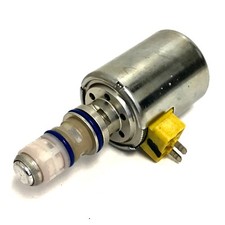
ATSG notes that pressures should rise as throttle increases. Teckpak's EPC solenoid instruction sheet for the AODE/4R70W puts that wide-open-throttle line pressure at 160-210 psi in Park, Drive and Neutral and 220-280 psi in Reverse, and lists the solenoid at 2.48-5.66 ohms. Ohm the EPC solenoid at the case connector first. Then load the engine and watch the gauge rise against the commanded EPC on the scan tool. If EPC commands a rise and line pressure stays flat, stop. New clutches will not fix it.
Cause 1: Pressure regulator bore wear (slips everywhere, worst hot)
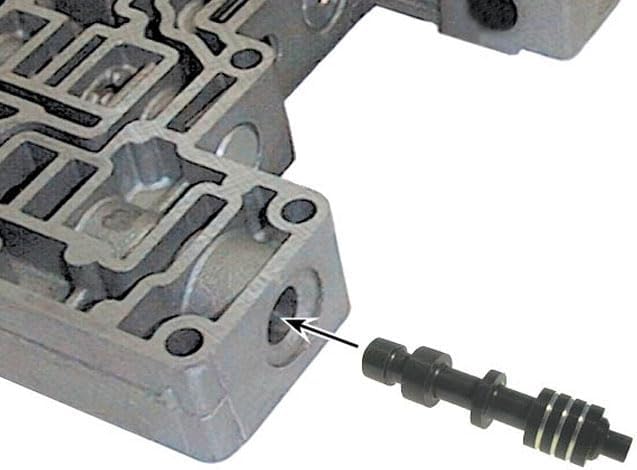
This is the failure behind most "it slips when it gets hot and I floor it" Mustangs. Wayne Colonna of Transmission Digest described it in "I Lost My EPC!": EPC pressure is routed to the pressure regulator valve right next to a circuit Ford calls boost, which actually returns to the inlet side of the pump. When the bore wears between those two lands, the pump sucks EPC pressure away. The result is little or no line rise with throttle, which he describes as medium- to full-throttle slipping in gear and sliding shifts. The usual misstep is to replace the EPC solenoid. The pressure stays low because the leak is in the casting.
His quick test: pull the pan and filter and blow compressed air into the TV pressure port. Air and fluid coming out around the EPC solenoid is normal. Air and fluid coming out of the filter opening means the regulator bore is worn. He also points out that mild wear can go unnoticed while it slowly wears out the forward clutch, which is why a Mustang with "just a burned forward clutch" needs this checked before the new pack goes in.
Sonnax's Brian Wing adds that the valve typically scores on the EPC end, and that a valve this badly worn usually means the bore is gone too. A new valve alone will not seal in a worn casting. The bore gets vacuum tested, then reamed for an oversize valve. Sonnax lists its main pressure regulator valve 76948-09 for '96-later units and its boost valve kit 76948-02K for this circuit. If you do not have the reamer and fixture, a replacement valve body is the practical fix.
Cause 2: Cracked forward drum (slips in 1st through 3rd, reverse OK)
A Mustang launches harder than the trucks and vans this unit also went into, and the forward drum takes it. Sonnax describes chronic forward clutch drum breakage across the AOD, AODE and 4R70W family and lists the symptoms its Smart-Tech drum 76654-01K cures: no forward, slipping gears, a broken drum and ratio codes. The drum cracks, the piston loses its seal, and forward clutch apply pressure bleeds off. It starts as a slip under load and ends as no forward at all.
The tell is the pattern from Step 1: slips in 1st, 2nd and 3rd, reverse is fine, line pressure is good at the main tap but the forward clutch tap reads low or drops under load. It is a teardown repair. On a stock-power car a good used or new OE drum works. On a car with gears, a stall converter or a power adder, Sonnax also makes a high-capacity version, 76655-01K, with about 20% more clutch capacity. That is the drum I would put in a car that already broke one.
Cause 3: The 2001-2004 cross leak (slips or binds in 3rd and 4th)
If the Mustang is a 2001 or later and the direct clutch is burned, look here first. Sonnax's Gregg Nader documented that up through 2000, a two-bolt stiffener plate under the 2-3 accumulator clamped the separator plate and lower gasket against the valve body. Starting with 2001 models it was deleted, and the 2-3 accumulator retainer sits directly on the separator plate. The forward and direct clutch circuits are kept apart everywhere except in that unclamped area.
Without the clamp, forward clutch oil pushes the separator plate up and leaks into the direct circuit. The direct clutch drags in 1st and 2nd, cooks itself, and then slips in 3rd and 4th where it actually has to hold. Cracked separator plates near the 2-3 accumulator are the bench evidence, but Nader is clear that the cracks are a symptom, not the cause. The fix is to clamp the plate again with a retainer plate kit, such as Sonnax 76507F-01K, and replace the direct clutch. Putting a new direct pack in a 2001-2004 valve body without clamping that area just burns the new pack.
Cause 4: Overdrive band and servo (slips or neutrals in 4th only)
When everything is fine through 3rd and the rpm climbs or the car drops to neutral on the 3-4 shift, the overdrive band is not holding. In 4th the forward clutch releases and the band applies, so a band that does not come on in time gives a neutral flare. Hitting the overdrive cancel button and getting a solid 3rd confirms it. Common causes are a worn overdrive servo regulator sleeve that leaks servo apply oil, a worn servo pin bore, a broken servo snap ring, and a band that has already burned. We cover the 4th-gear side in detail in our 4R70W no-overdrive guide. If the slip in 4th only happens with the converter locked, read the converter shudder guide instead.
Fluid: what to put in it, and what not to
Ford's Motorcraft automatic transmission fluid chart lists MERCON V for the 4R70W, 4R70E, 4R75W and 4R75E, sold as XT-5-QMC in quarts. The same chart carries a caution worth reading if your Mustang has a bottle of slip treatment in it: Ford says not to use supplemental transmission fluid additives, treatments or cleaning agents because they may affect transmission operation and damage internal components. A slipping 4R70W that gets better for a week after an additive is still slipping. The additive just changed the friction for a while.
Check the level hot, in Park on level ground, and smell and look at what comes out. Dark fluid with a burned smell and friction material on the pan magnet means a clutch or band has already been cooked. A fluid change will not bring it back, and on a 4R70W with a worn regulator bore a fresh fill sometimes makes the slip feel worse for a while.
Rebuild or repair?
If the gauge shows low line rise and the clutches are not burned yet, a valve body repair, either a reamed regulator bore or a replacement body, can save the unit. If the forward drum is cracked, the direct clutch is burned, or the band is glazed, the transmission is coming out anyway, and at that point a full rebuild with the fixes for the cause is the only repair that lasts. On a 2001-2004 car that means the retainer plate. On any car that sees hard launches it means a better forward drum. On every one of them it means checking the regulator bore before the valve body goes back on.
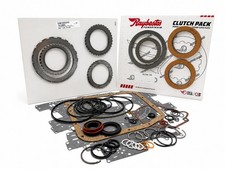
4R70W Stage-1 Deluxe Level 2 rebuild kit, 1996-2003 (Raybestos)
For a Mustang that already burned its forward or direct clutch, this kit uses Raybestos Stage-1 frictions, which hold up better than stock material in a car that gets launched hard. Do the regulator bore and retainer plate fixes above with it. Sold by our sister store, CoreTransmissionParts.
Shop the part for this fix →Need the Sonnax high-capacity forward drum, a 2004 kit or valve body parts? The 4R70W parts collection has the full range.
Need parts for this job?
Master rebuild kits for 1996-2003 Mustangs, Sonnax boost valve kits, EPC solenoids, valve bodies and band sets are on our 4R70W parts page, with checkout on site.
FAQ
Why does my 4R70W Mustang slip when it gets hot?
The most common cause is wear in the pressure regulator valve bore, which lets the pump pull EPC pressure away so line pressure does not rise with throttle. It shows up as slipping and sliding shifts at medium to full throttle, worse when the fluid is hot. A line pressure gauge and a compressed air test at the TV port will confirm it, and replacing the EPC solenoid will not fix it.
How do I know which clutch is slipping in a 4R70W?
Note which gears slip and whether reverse slips too. Slipping in 1st, 2nd and 3rd with good reverse points at the forward clutch or drum. Slipping in 3rd and 4th only points at the direct clutch, and slipping or neutral in 4th only points at the overdrive band and servo. If every range slips, start with line pressure.
What should 4R70W line pressure be?
ATSG's chart lists 50-75 psi at idle in Park, Neutral and the forward ranges and 80-120 psi in Reverse at idle. Teckpak's EPC solenoid instructions list 160-210 psi in the forward ranges and 220-280 psi in Reverse at wide open throttle. Pressure should climb as throttle increases.
Will a transmission additive fix a slipping 4R70W?
No. Ford's Motorcraft fluid chart says not to use supplemental transmission fluid additives, treatments or cleaning agents because they may affect operation and damage internal components. Use MERCON V and find the actual cause, whether that is low line pressure, a cracked drum or a burned clutch.
Can a rear gear swap make a Mustang feel like it is slipping?
Yes. If the axle ratio and tire size in the PCM were never updated, the PCM's vehicle speed and shift points are off, and an rpm check done with the factory numbers will look like slip. Recalculate with the real ratio and tire diameter before condemning the transmission.
Related guides
- 4R70W Mustang Common Problems and Fixes
- 4R70W Slipping: Causes and Fix
- 4R70W 3-4 Clutch Failure
- 4R70W Pressure Control Solenoid Symptoms
- 4R70W Fluid Type and Capacity
Sources
- ATSG (Automatic Transmission Service Group) — AODE, 4R70W, 4R70E, 4R75E Update Handbook. Backs the PCM inputs for shift and line pressure control, the component application chart, the line pressure and tap chart (50-75 psi idle, 80-120 psi reverse, EPC 0-9 psi), and the 4R70W vs AODE ratio and non-interchange information. ATSG update handbook (PDF)
- Transmission Digest — Wayne Colonna, "I Lost My EPC!" (April 2004). Backs the pressure regulator bore wear that bleeds EPC pressure to the pump inlet, the medium- to full-throttle slip and sliding shifts, the compressed air test at the TV port, and the link to premature forward clutch wear. transmissiondigest.com
- Sonnax — Brian Wing, "Watch Out for 4R70W Pressure Regulator Valve & Casting Wear"; Gregg Nader, "4R70W, 4R75W 2001-Later Forward & Direct Clutch Problems: The Easy Valve Body Fix"; "Stop 4R70W Forward Drum Failure with a Sonnax Smart-Tech Drum." Back the EPC-end valve scoring, vacuum testing and valve 76948-09, the 2001 stiffener plate deletion and forward-to-direct cross leak, and the forward drum breakage symptoms with drums 76654-01K and 76655-01K. PR valve wear · cross leak · forward drum
- Ford Customer Service Division (Motorcraft) — Automatic Transmission Fluid Chart, Version 21, US. Backs MERCON V (XT-5-QMC) for the 4R70W/4R70E/4R75W/E and Ford's caution against supplemental fluid additives, treatments and cleaning agents. Motorcraft ATF chart (PDF)
- Teckpak (Fitzall) — EPC Solenoid for AODE/4R70W, part 76923, installation instructions. Backs the 2.48-5.66 ohm EPC solenoid resistance and the closed- and open-throttle line pressure ranges (160-210 psi forward and 220-280 psi reverse at wide open throttle). teckpak-fitzall.com (PDF)