"It slips" is the most common complaint on a 2002-2005 Explorer or Mountaineer with the 5R55W, and it means different things to different owners. One person means the engine flares between 2nd and 3rd. Another means the truck feels like it is in neutral for a second when it shifts into 5th on the highway. A third means the tach climbs in every gear and the fluid smells burnt. Those are three different failures, and the 5R55W happens to make it easy to tell them apart, because each gear uses a different combination of bands and clutches. If you know which gear slips, you know which component to look at.
This is how I work a slipping Explorer 5R55W: fluid first, then match the slip to the apply chart, then prove it with a gauge before anything comes apart.
The short version: Slip in 2nd and 5th points at the overdrive band and servo, slip in 3rd at the intermediate band and servo, slip in 4th at the direct clutch, and slip in every forward gear at the forward clutch or low line pressure, per Ford's clutch and band application chart [1]. On this unit the most common root cause behind band slip is a worn servo apply pin bore in the case, which leaks apply oil and lets the band burn [4][5]. Rule out a wrong fluid level first: Ford specifies MERCON V, 12.6 qt total, set at the check plug with TFT at 81-120°F [2].
Step 1: Check the Fluid the Right Way
The 5R55W in the Explorer has no dipstick, and a lot of "slipping" trucks are simply low because someone checked it wrong or never checked it at all. Ford's procedure uses the level plug in the pan: monitor TFT on a scan tool, run the engine until TFT is between 81 and 120°F (27-49°C), and with the engine running in Park, remove the small level plug in the center of the drain plug with a 3/16 in. Allen key while holding the larger drain plug with a wrench [2]. Fluid goes in through Ford's fill adapter, tool 307-437, and the correct fluid is MERCON V [2]. Total capacity is 12.6 quarts (12.0 L) [2].
TransGo's instructions for this unit put it more bluntly: wrong fluid level is a big problem, and when you fill it the fluid must run a full stream out of the level hole; if it is just burping out, it is not full [3]. TransGo also warns that an overfull unit will burp fluid into the bell housing [3], which owners mistake for a rear main seal or converter leak.
While the plug is out, look at what comes out. Bright red with no smell is fine. Brown, burnt-smelling fluid with black flakes in it means a band lining is already coming apart, and topping it off will not fix anything. Fluid foaming or pushing out of the vent with no external leak is its own clue: Sonnax lists foaming, fluid out the vent and false readings at the fill plug as symptoms of worn servo pin bores [4].
Step 2: Match the Slip to the Apply Chart
This is the part most people skip. Ford's clutch and band application chart for the 5R55W/S lists exactly what holds in each gear in the OD range [1]. The forward clutch is on in all five forward gears. The other elements change gear to gear:
| Gear (OD range) | Elements applied (Ford chart) | If it slips here, suspect |
|---|---|---|
| 1st | Forward clutch, direct one-way clutch, low one-way clutch | Forward clutch, one-way clutches |
| 2nd | Forward clutch, overdrive band | Overdrive band and servo |
| 3rd | Forward clutch, intermediate band | Intermediate band and servo |
| 4th | Forward clutch, direct clutch | Direct clutch, center support |
| 5th | Forward clutch, overdrive band, direct clutch | Overdrive band and servo (again) |
| Reverse | Reverse band, coast clutch, direct clutch | Reverse band and servo, direct clutch |
Look at 2nd and 5th. Both use the overdrive band. When an Explorer slips in 2nd and in 5th but feels fine in 3rd and 4th, you have already narrowed it to one band and one servo. That pattern is common enough that Mike Brown called out slipping in 2nd and 5th gears as a frequent W/S complaint in GEARS, and his first instruction is to check the servo pin bore for wear [5].
Ford's own symptom charts agree with the apply chart. For a soft or slipping 1-2 or 4-5 shift, Ford lists line pressure, sticking valves, valve body bolt torque (cross-leaks), and the overdrive band and servo. For a soft or slipping 2-3 shift, Ford lists the intermediate band and servo and the direct one-way clutch. For a soft or slipping 3-4 shift, it is the center support, intermediate servo and direct clutch [1]. Slips and chatter in manual 2nd add the overdrive planetary to the list [1].
Step 3: The Usual Root Cause, Worn Servo Pin Bores
On most slipping 5R55Ws I tear down, the band did not just wear out on its own. The overdrive and intermediate servo apply pins ride directly in bores machined into the aluminum case, and Sonnax describes severe wear of the case at the servo apply pin bore caused by continuous oscillation of the pin [4]. Once the bore goes oval, apply oil leaks into the case barrel, which hurts shift timing and band apply pressure, and release oil can cross-leak into the apply circuit [4].
The band then never gets full holding force. It slips under load, the lining glazes and burns, and you are now chasing a ratio code. Sonnax ties this wear to 1-2, 2-3 and 4-5 flares, gear loss and codes 732, 733 and 735 [4]. TransGo's kit instructions list the same set: P0732 and P0735, a 1-2 slide bump, a 2-3 flare, a 4-5 slide bump, or a burned OD band, with a note to inspect for a worn OD band servo pin bore [3].
The GEARS article adds one more trap: both servo pistons use release oil to stay off, and a servo that air checks fine can still leak on the release side [5]. So a passing air test on the servo does not clear it.
The repair that lasts is reaming the case and installing a sleeve, not a new piston and seal by themselves. Sonnax's 56361J-01K kit sleeves both the overdrive and intermediate pin bores, and its tooling aligns from the pin bore centerline instead of the servo piston bore [4]. A new servo piston in a worn bore will feel good for a while and then the slip comes back.
5R55W Overdrive/Intermediate Band (Raybestos)
If the OD or intermediate band is burned from slipping, it has to be replaced along with the bore repair. This is the Raybestos band that fits both positions on the 5R55W.
View the 5R55W OD/intermediate band →Need something else? Browse all 5R55W parts at Core Transmission Parts.
Step 4: Band Adjustment
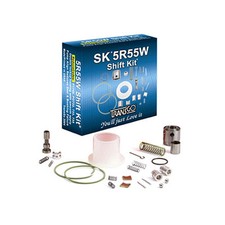
The OD and intermediate bands on the 5R55W have external adjusting screws, and a misadjusted band will both slip and bind. TransGo's procedure is to tighten the adjusting screws snug with a short wrench, back them off two turns, and tighten the locknuts [3]. When the servo is apart, TransGo notes the intermediate and overdrive servo struts install with the short side toward the valve body [3]; a strut installed backwards changes the effective adjustment.
Do not try to "adjust out" a slip. If the band is already burned or the pin bore is worn, tightening the screw buys a few hundred miles and can drag the band in gears where it should be off. Brown's article makes the point that in Drive both bands should be off in the gears that do not use them, and a band adjusted too tight is its own problem [5].
Step 5: Prove It With a Gauge
Line pressure
Before you condemn hard parts, put a gauge on the line pressure tap. Ford's specs for the 4.0L Explorer and Mountaineer are 75-120 psi in Park and Neutral at idle, 145-190 psi in Reverse at idle, and 80-110 psi in the forward ranges at idle, rising to 228-263 psi forward and 282-350 psi Reverse at WOT stall [1]. The 4.6L V8 runs higher at idle: 175-215 psi Reverse and 100-135 psi forward [1].
Ford's results chart reads like a slip map [1]:
- Low at idle in all ranges: low fluid, a bad filter or filter seal, loose valve body bolts, pump or pump gasket leakage, case leakage, or a bad valve body or separator plate.
- Low in all forward ranges: forward clutch, valve body, overdrive servo or intermediate servo.
- Low in manual 2 or manual 3: intermediate servo, overdrive servo or forward clutch.
- Low in Reverse only: separator plate, rear servo cover or piston leakage, reverse clutch, overdrive or intermediate servo, valve body or forward clutch.
Notice how often the servos show up. A servo leak drops line pressure in the ranges where that circuit is charged, which is one more way to catch a worn pin bore before teardown.
Stall test
Run line pressure first. Ford warns that stalling a unit with low pressure will cause more damage, and says not to hold WOT for more than 5 seconds [1]. Stall spec is 2557-3036 rpm on the 4.0L and 2687-3150 rpm on the 4.6L [1]. If the engine passes the spec, Ford says release immediately, because that indicates clutch or band slippage [1]. High stall in OD only points at the forward clutch or direct one-way clutch; high in Reverse only, the reverse clutch or reverse band or servo; high in all ranges, the forward clutch or direct one-way clutch [1]. Ford also notes an extended stall test can set P0712 or P1783, so clear codes afterward [1].
Codes and scan data
Ford's ratio codes P0731 through P0735 (no 1st through no 5th) are set when RPM is higher or lower than expected for the commanded gear [1]. A P0732 plus P0735 together is the overdrive band pattern again. Watch turbine speed against output speed: in a slip, turbine speed climbs while output holds flat.
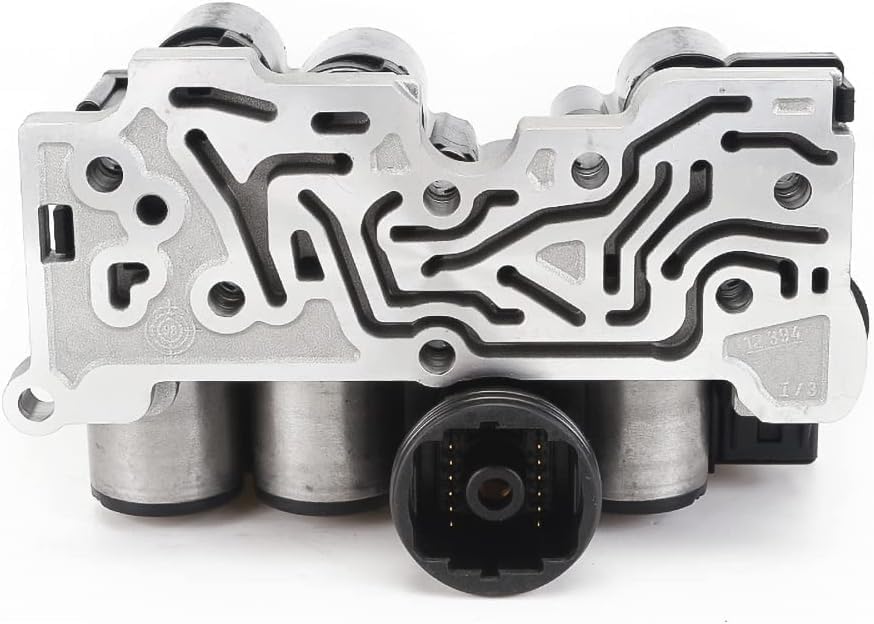
Do not skip the electrical side. Ford's DTC chart shows that a PC-A solenoid circuit shorted to ground (P1747) causes low PC pressure, limited engine torque and slipping in gear [1], and an open PC-A circuit (P0745/P1746) also lists slips in gear [1]. A slip that comes with a PC solenoid code is a solenoid body or wiring job first, not a rebuild. And if the slip is a highway RPM flutter at cruise with no gear change, look at P0741, which Ford describes as a TCC engagement error with no TCC operation or TCC slip [1].
When the Slip Is Everywhere: Lube, Heat and the Pump
A unit that slips in every gear, especially after it gets hot, is past the single-band stage. Wayne Colonna's Motor Age write-up on 5R55N/S/W overdrive planetary failures describes lube loss from the internal cooler bypass/thermal valve and erratic shifts after overhaul from a sticking pump flow control valve and solenoid regulating valve [6]. TransGo says the original flow control assembly sticks, causing won't-move complaints, and wears out, causing burned friction and noise [3]. TransGo also recommends cleaning the lube orifice cup plug and passage on the edge of the stator to prevent repeated OD planet meltdown [3].
If you rebuild one of these, Ford requires a new cooler or a cleaned and backflushed cooler and lines, and a flow test that should put about 8 oz (237 ml) in a container in 15 seconds [1]. Band material left in the cooler goes straight back into the new clutches.
The Fix, in Order
- 1. Level and condition — check-plug method, MERCON V, TFT 81-120°F [2].
- 2. Codes — PC solenoid or wiring codes get fixed before anything mechanical [1].
- 3. Which gear slips — match it to the apply chart [1].
- 4. Line pressure, then stall — against Ford's tables [1].
- 5. Band adjustment — snug, back off two turns, lock [3], only if the band is not burned.
- 6. Repair — sleeve the worn servo pin bores [4], replace burned bands, service the pump flow control valve [3][6], and flush the cooler [1].
Prevention on a truck this age is cheap: keep the level right with the plug method and change the fluid and filter on Ford's severe schedule. Ford's normal interval is 150,000 miles, but it drops to 30,000 miles for towing, sustained temperatures above 90°F, heavy loads, hilly terrain or dusty use [2], and most Explorers live in that category.
Rebuild kits, shift kits, solenoid packs and filter kits for the 2002-2005 Explorer and Mountaineer 5R55W, with checkout on our site.
Shop 5R55W parts →FAQ
Why is my Ford Explorer transmission slipping?
On the 2002-2005 Explorer 5R55W, slipping usually comes from a band that is not getting full apply pressure, most often because the servo apply pin has worn its bore in the aluminum case and leaks apply oil. Low fluid from an incorrect check, a PC-A solenoid fault, or a worn forward or direct clutch can also cause it. Which gear slips tells you which part to look at.
Why does my 5R55W slip in 2nd and 5th gear?
Ford's apply chart shows the overdrive band is applied in both 2nd and 5th. When a 5R55W slips in those two gears but feels normal in 3rd and 4th, the overdrive band and its servo are the prime suspects. Check the overdrive servo pin bore for wear, since a worn bore leaks apply oil and lets the band burn.
What transmission fluid does a 5R55W Explorer take and how do I check it?
Ford specifies MERCON V, with 12.6 quarts (12.0 L) total capacity. There is no dipstick. With the engine running in Park and TFT between 81 and 120 degrees F, remove the small level plug in the pan and fill through Ford's adapter until fluid runs out in a steady stream.
Can a band adjustment fix a slipping 5R55W?
Only if the band is misadjusted and not yet burned. TransGo's procedure is to tighten the adjusting screw snug with a short wrench, back it off two turns and lock it. If the band lining is burned or the servo pin bore is worn, adjustment will not last and the bore needs a sleeve repair plus a new band.
Can a solenoid cause a 5R55W to slip?
Yes. Ford's DTC chart shows a PC-A solenoid circuit shorted to ground (P1747) causes low pressure control pressure, limited engine torque and slipping in gear, and an open PC-A circuit also lists slips in gear. If a slip comes with a PC solenoid code, fix the solenoid body or wiring before considering a rebuild.
Sources
- Ford Motor Co. service information (Mitchell reprint) — 2002 Ford Explorer, "5R55W/S Diagnosis," on the clutch and band application chart, soft/slipping shift symptom charts, line pressure specifications and results, stall speed specifications and results, ratio codes P0731-P0735, PC-A codes P0745/P1746/P1747, P0741, and the cooler flow test. 5R55W/S Diagnosis (PDF)
- Ford Motor Co. service information (Mitchell reprint) — 2002 Ford Explorer, "Servicing - Explorer & Mountaineer," on MERCON V, 12.6 qt (12.0 L) capacity, the 81-120°F TFT check-plug procedure, fill tool 307-437, and the 150,000/30,000-mile service intervals. 5R55W/S Servicing (PDF)
- TransGo — SK 5R55W shift kit instructions (2013), on fluid level checking, OD and intermediate band adjustment, servo strut orientation, P0732/P0735 with 2-3 flare and burned OD band, the pump flow control assembly, and the stator lube orifice. TransGo SK5R55W (PDF)
- Sonnax — Overdrive & Intermediate Servo Pin Bore Sleeve Kit 56361J-01K, on case pin bore wear, apply and release oil leakage, flares, 732/733/735 codes, foaming and fluid out the vent, and the sleeve repair. sonnax.com/parts/2207
- GEARS Magazine (ATRA) — Mike Brown, "Street Smart," March 2017, on 2nd and 5th gear slip in the W/S, checking the servo pin bore, band adjustment and release-side servo leaks that pass an air check. gearsmagazine.com
- Motor Age / VehicleServicePros — Wayne Colonna, "Ford 5R55N/S/W's Overdrive Planetary Failure," on lube loss from the internal cooler bypass/thermal valve and erratic shifts from the pump flow control and solenoid regulating valves. vehicleservicepros.com