Most shift complaints on a Mercury Mountaineer 5R55W are not slips. They are a bang into 2nd, a 2-3 that hunts back and forth on a grade, a truck that starts off in the wrong gear, or one that will not go into 4th and 5th at all. Each of those has its own short list of causes, and on this unit more of them live in the electronics and the valve body than in the clutch packs.
The Mountaineer wrinkle: many have the 4.6L V8, and Ford publishes a separate shift schedule and pressure spec for it. A V8 truck that shifts 1-2 at 10 mph is normal; judged by the V6 table it looks early. Here is the order I work it in.
The short version: Ford's own harsh-shift diagnosis on the 5R55W/S starts with codes, then the shift solenoids, TFT sensor, range sensor, the three pressure control solenoids and the speed sensors before any hard part [1]. Solenoid circuits should read 16-45 ohms for SSA through SSD and 9-16 ohms for the TCC solenoid [1]. On a 4.6L Mountaineer with the W, light-throttle upshifts happen at about 9-11, 16-20, 21-25 and 37-42 mph [1]. Worn VFS modulator bores, a mismatched spacer plate and a leaking servo piston cause shift complaints that look electrical but are not [3][5][6].
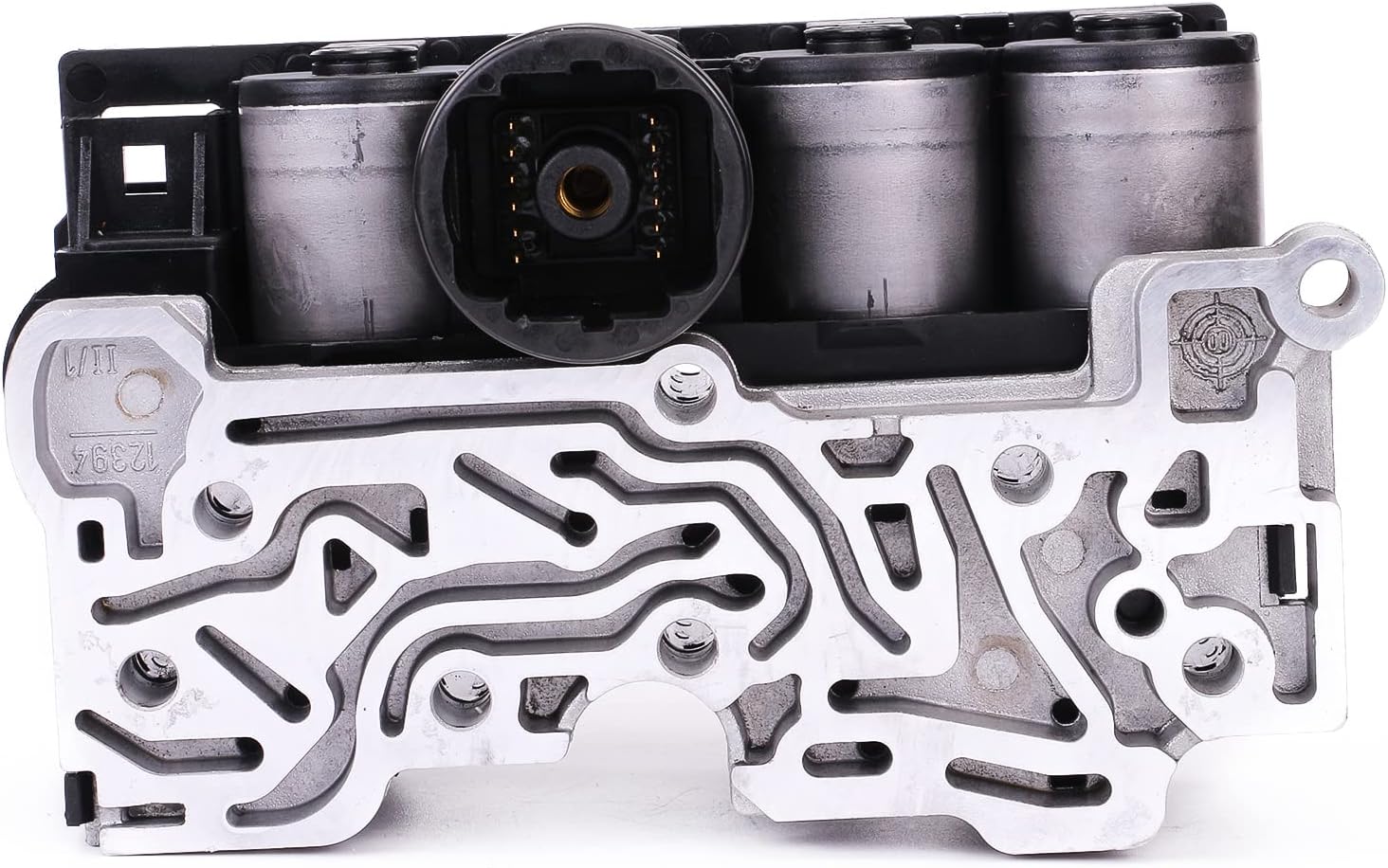
Which Transmission Is in Your Mountaineer
Sonnax's Bob Warnke puts the W in 2002-2003 Explorers and Mountaineers, with the S taking over on 2004-2005 models; the W runs a 24-tooth overdrive sun gear and the S a 38-tooth one [3]. Ford's service information covers both units in one 5R55W/S diagnosis procedure for the Explorer and Mountaineer with either the 4.0L or the 4.6L [1]. The diagnostic steps below apply to both. The shift speed numbers do not, because Ford gives each engine and unit combination its own table.
What a Normal 4.6L Mountaineer Shift Schedule Looks Like
Before you call a shift early, late or missing, road test it against the right numbers. Ford's road test is done at normal operating temperature in Drive with overdrive on, at minimum throttle, watching where each upshift and the converter clutch apply happen [1]. The light-throttle numbers are taken at a TP voltage of 1.25 volts. Here are Ford's figures for the two 5R55W combinations a 2002-2003 Mountaineer could have:
| Shift (approximate mph) | 4.0L V6, 5R55W | 4.6L V8, 5R55W |
|---|---|---|
| 1-2, minimum throttle | 12-14 | 9-11 |
| 2-3, minimum throttle | 17-19 | 16-20 |
| 3-4, minimum throttle | 24-28 | 21-25 |
| 4-5, minimum throttle | 36-40 | 37-42 |
| 1-2 / 2-3 / 3-4, WOT | 33-37 / 49-54 / 77-83 | 33-37 / 49-54 / 77-83 |
| 5-4 / 4-3 / 3-1, coasting | 30-34 / 20-22 / 7-9 | 25-29 / 15-18 / 6-8 |
Ford's road test has three more checks worth doing before you guess [1]:
- O/D cancel: press the Transmission Control Switch on the shifter. The O/D OFF light comes on, the transmission should make every upshift except 4-5, and the TCC should apply above 29 mph.
- Kickdown: floor it and it should drop 3-2 or 3-1 depending on speed, with the TCC releasing.
- Manual low: at about 30 mph, move the lever to 1 and lift. It should go to 3rd, then drop to 1st once you fall below 20 mph.
One thing to know about that O/D OFF light: Ford wires it to flash if a PC solenoid is open or shorted, or if the PCM sees a fault in a sensor it uses for transmission control [1]. A flashing O/D OFF light on a Mountaineer is a code, not a switch problem. Scan it.
Step 1: Pull Codes, and Read What Each One Does to the Shift
Ford's symptom chart for "Harsh Shifts (Some or All)" sends you through the quick test and then Test A (shift and TCC solenoids), Test B (TFT sensor), Test D (PC-A, PC-B and PC-C solenoids) and Test E (ISS, OSS and TSS speed sensors). "Erratic or Hunting Shifts" and "Early or Late Shifts" both go straight to Test E [1]. In other words, Ford expects a hunting or mistimed shift to be a speed signal problem until proven otherwise.
The DTC table in the same manual spells out what each fault does to the drive. The ones that show up as shift complaints [1]:
| Code | Fault | What the driver feels |
|---|---|---|
| P0750 / P1714 | SSA circuit or mechanical | Shorted: no 4th or 5th. Open: no 1st. |
| P0755 / P1715 | SSB circuit or mechanical | Shorted: no 1st. Open: no 3rd. |
| P0760, P1716 / P1717 | SSC, SSD | Wrong gear selection depending on mode and lever position |
| P1746 | PC-A circuit open | Maximum PC-A pressure, harsh engagements and shifts |
| P0775 / P1789 | PC-B circuit | Shorted: low PC-B pressure, torque limited, no 2nd and 5th |
| P0795 / P0797 | PC-C circuit | Incorrect gear ratio in 4th and 5th; open circuit gives maximum pressure and harsh shifts |
| P0715-P0722 | TSS or OSS signal | Harsh shifts, abnormal shift schedule |
| P0791 / P0794 | ISS signal | Harsh 2-3 shift |
| P0705 | Digital TR sensor | Raised control pressure, harsh shifts |
| P0712 / P0713 | TFT reads 315°F or -40°F | Firm shift feel |
| P1783 | Overheat, 270°F (127°C) | Raised PC pressure |
Do not overlook the engine side. Ford lists TP sensor codes P0121-P0123 as causing harsh shifts and abnormal shift patterns, because a TP failure puts the PCM in fail-safe and it raises line pressure to protect the transmission [1]. The PCM also uses MAF for control pressure and shift scheduling, and the A/C clutch signal to bump pressure under load [1]. A Mountaineer that bangs every shift with a lazy TP sensor needs a $40 sensor, not a valve body.
Ford also warns not to clear codes by disconnecting the battery, since that wipes Keep Alive Memory and the truck drives oddly until it relearns [1]. Plenty of "it shifted fine until I changed the battery" complaints are a relearn in progress.
Step 2: Test the Solenoid Body Electrically
All seven solenoids, three variable-force PC solenoids, four on/off shift solenoids (SSA, SSB, SSC, SSD) and the TCC solenoid, live on one solenoid body, along with the TFT sensor [1]. Ford's Test A, at the 16-pin transmission connector [1]:
- Key on, connector unplugged: terminal 3 (solenoid power) to chassis ground should read more than 10 volts.
- Command each solenoid on and off with a scan tool in output state control and listen for a click. The control terminals are SSA 16, SSB 15, SSC 6, SSD 5 and TCC 14.
- Resistance from terminal 3 to each solenoid terminal: 16-45 ohms for SSA-SSD, 9-16 ohms for TCC. Out of range means a solenoid body.
- Terminals 3, 5, 6, 14, 15 and 16 to chassis ground: anything under 5 ohms is a short, and Ford calls for a solenoid body.
For the TFT sensor, watch PIDs TFT and TFTV while the transmission warms; they should climb smoothly. Terminal 2 should show a 4.5-5.5 volt reference with the key on [1]. A TFT that is stuck cold keeps the PCM in its cold-fluid strategy, which is where a lot of firm-shift complaints come from.
If you put a new solenoid body in, there are two traps. Warnke notes the early factory fill used a MERCON V that degraded solenoid performance; Ford answered with additive 4L2Z-19B546-AB under bulletin FSA 04B22, then a revised XT-5-QM [3]. He also notes the VFS solenoids can lose their prime in handling, so fill them with fresh MERCON V and pull fluid through before installing, and run a relearn afterward along with a check of the battery and PCM grounds and a cleaned MAF [3]. Ford's fill spec for the Mountaineer is MERCON V, 12.6 qt total, checked at the pan plug at 81-120°F TFT [2].
Step 3: Put a Gauge on It
If the electrical checks pass, the shift is being told the right thing and the hydraulics are not delivering it. Ford's chart lists the hard causes for a harsh shift as wrong line pressure (high or low), the PC solenoids, sticking valves, and valve body bolts torqued wrong so they cross-leak, before it gets to servos, bands and clutches [1]. On a 4.6L Mountaineer, Ford's idle line pressure spec is 75-120 psi in P and N, 175-215 psi in R and 100-135 psi in the forward ranges, with 55-65 psi in P and N and 40-50 psi in R and forward at the pressure control tap [1]. Check line pressure before any stall test, and never hold WOT more than 5 seconds.
High line pressure with good electrical readings points at the PC solenoids or a stuck regulator valve. Ford's description of the PC solenoids is plain: a pressure that is always high or always low can be the PCM, the wiring, or a solenoid stuck open or closed mechanically [1].
Step 4: The Valve Body Problems That Look Electrical
Worn VFS modulator bores
Warnke's teardown notes are the best map of this valve body. The TCC modulator bore and the main regulator bore wear first because they move the most. Wear in the VFS 1, 2 and 3 modulator bores cuts clutch and servo pressure, the adaptive strategy hides it for a while, and then you get gear ratio codes or slippage, with the solenoid or the servo pin bore taking the blame [3]. He also lists solenoid-related symptoms as a 1-2 or 2-3 flare, delayed forward or loss of reverse, and warns that a new solenoid body may not fix the root cause [3]. Wet air test the bores at 40-60 psi with ATF; bubbling at the exhaust slots means wear.
Base plate and filter that do not match
Warnke also warns that the solenoid base plate and the filter must be the W/S versions. Mixing them up gives loss of reverse, TCC apply and solenoid oil pressure [3]. On a used valve body, check the plate before you bolt it in.
The 2009-up spacer plate on an early valve body
This one catches shops buying used parts. Transmission Digest, publishing ATSG's bulletin, explains that 2009 and later 5R55S units got a redesigned valve body casting with changed VFS 1, VFS 2 and line pressure passages, plus a revised bonded spacer plate, and that none of the 2009 parts retrofit to earlier units [6]. ATSG had already seen shops install the 2009 bonded plate (9L2Z-7Z490-B) on an earlier valve body. The extra hole in it connects a line pressure passage to the VFS 2 circuit, and the result is a harsh 1-2 upshift and a flared 2-3 [6]. If your Mountaineer started banging into 2nd right after a valve body or plate swap, check the plate first.
Step 5: Servos That Cause Wrong-Gear Starts and Binds
A shift that binds, or a truck that pulls away in the wrong gear, can be a servo even when the solenoids are good. In GEARS, Mike Brown explains that both servo pistons on these units are held off by release oil, not just their springs. If the release side of a piston is hard, torn or delaminated, release oil leaks across and acts as apply oil, so the band applies when it should be off [5]. A large leak gives a bind in Reverse and manual low plus wrong-gear starts; a small one gives wrong-gear starts or a band and clutch failure with gear ratio codes. Those servos usually pass an air check, because the apply side is fine [5].
His test: confirm the computer is commanding the right gear, then with the engine running, the truck on a lift and the lever in Drive, have a helper try to turn each band adjusting screw in. Both bands should be off and both screws should turn; a tight screw means that band is applied [5]. In his example, a valve body and a solenoid block went in before anyone found the servo.
The other servo failure is the case itself. Sonnax documents the servo apply pins wearing their bores in the aluminum case, with 1-2, 2-3 and 4-5 flares, gear loss and codes 732, 733 and 735 [4]. With those codes, check the pin bores before condemning the electronics; the fix is a ream and sleeve such as Sonnax kit 56361J-01K [4].
The Fix, in Order
- Road test to the right table: 4.6L 5R55W light-throttle shifts at about 9-11, 16-20, 21-25 and 37-42 mph [1].
- Scan for codes, including engine codes. TP, MAF, TR and speed sensor faults all cause harsh or erratic shifts [1].
- Test A at the 16-pin connector: over 10 V on terminal 3, 16-45 ohms SSA-SSD, 9-16 ohms TCC, nothing under 5 ohms to ground [1].
- Watch TFT and TFTV warm up; check the 4.5-5.5 V reference [1].
- Gauge line and control pressure to the 4.6L spec [1].
- Valve body: wet air test the VFS modulator and regulator bores, confirm the W/S base plate and filter, and make sure no 2009 spacer plate is on an early body [3][6].
- Wrong-gear starts or binds: band screw test in Drive, then the servo pistons and pin bores [4][5].
- After any solenoid or valve body work: prime the VFS solenoids, fill with MERCON V to the plug, and run a relearn [2][3].
Solenoid block packs, valve bodies, shift kits and filter kits for the 2002-2005 Mountaineer and Explorer 5R55W/S, with checkout on our site.
Shop 5R55W parts →FAQ
Why does my Mercury Mountaineer transmission shift hard?
On a 2002-2005 Mountaineer with the 5R55W/S, harsh shifts usually come from high pressure control output: a PC solenoid fault, a TP sensor failure that puts the PCM in fail-safe and raises line pressure, a TFT sensor reading cold, or a speed sensor signal problem. Worn valve body bores and a wrong spacer plate after a valve body swap can also cause it. Scan for codes, including engine codes, before replacing parts.
At what speed should a 4.6L Mountaineer 5R55W shift?
Ford lists approximate light-throttle upshifts of 9-11 mph for 1-2, 16-20 mph for 2-3, 21-25 mph for 3-4 and 37-42 mph for 4-5 on the 4.6L V8 with the 5R55W. The 4.0L V6 schedule is different, with the 1-2 at 12-14 mph, so check the table for your engine before calling a shift early or late.
What should 5R55W shift solenoids measure?
Ford's spec, measured at the 16-pin transmission connector from terminal 3 to each solenoid terminal, is 16-45 ohms for shift solenoids SSA, SSB, SSC and SSD and 9-16 ohms for the TCC solenoid. Any of those terminals reading under 5 ohms to chassis ground is a short, and Ford calls for a new solenoid body.
Why is my Mountaineer stuck without 4th and 5th gear?
Ford's code table lists a shorted SSA solenoid (P0750 or P1714) as causing no 4th or 5th gear, and a PC-B fault as causing no 2nd and 5th. A PC-C fault gives incorrect ratios in 4th and 5th. Read the codes, then run Ford's solenoid tests at the transmission connector.
Will a new solenoid pack fix 5R55W shift problems?
Only if the solenoid body is the actual fault. Sonnax notes that worn VFS modulator bores in the valve body cut clutch and servo pressure and often get blamed on the solenoid, and GEARS documents servo pistons leaking release oil after both a valve body and a solenoid block were replaced. Prime a new pack with fresh MERCON V and run a relearn after installing it.
Sources
- Ford Motor Co. service information (Mitchell reprint), 2002 Explorer/Mountaineer, "5R55W/S Diagnosis." Backs the 4.0L/4.6L coverage, the road test procedure and shift speed tables for each engine and unit, the O/D OFF light flash behavior, the harsh, erratic and early/late shift symptom routings and hard-part checklists, the DTC effects table, the input sensor descriptions (TP fail-safe, MAF, A/C clutch, TFT, ISS/OSS/TSS), the KAM caution, Test A terminal, voltage and resistance values, Test B TFT checks, PC solenoid description, and the 4.6L line and control pressure specs. 5R55W/S Diagnosis (PDF)
- Ford Motor Co. service information (Mitchell reprint), "Servicing - Explorer & Mountaineer." Backs MERCON V, 12.6 qt total capacity, and the check-plug level procedure at 81-120°F TFT. 5R55W/S Servicing (PDF)
- Sonnax, Bob Warnke, "Figuring Out the 5R55 Alphabet." Backs the W/S model years and sun gear tooth counts, valve body bore wear order and VFS modulator wear symptoms, the wet air test, W/S base plate and filter matching, solenoid symptoms, the early MERCON V solenoid issue with additive 4L2Z-19B546-AB and FSA 04B22, and VFS priming, relearn, ground and MAF advice. sonnax.com/tech_resources/195
- Sonnax, Overdrive & Intermediate Servo Pin Bore Sleeve Kit 56361J-01K. Backs servo pin bore wear, apply and release oil leakage, the 1-2/2-3/4-5 flare and 732/733/735 symptom list, and the sleeve repair. sonnax.com/parts/2207
- ATRA / GEARS Magazine, Mike Brown, "5R55N with Wrong Gear Starts and Bindups? Look for a Faulty Servo." Backs the release-oil servo failure on the W/S family, leak size versus symptom, why the servos pass an air check, and the band screw test in Drive. gearsmagazine.com
- Transmission Digest (ATSG), December 2018, "Ford 5R55S: Avoid 1-2 harsh shifts and 2-3 flared shifts." Backs the 2009-up valve body and bonded spacer plate changes, no retrofit to earlier units, spacer plate 9L2Z-7Z490-B, and the harsh 1-2 and flared 2-3 caused by the wrong plate. transmissiondigest.com