The 2002-2005 Mercury Mountaineer is an Explorer underneath, and Ford's service data treats them as one platform: Explorer and Mountaineer, 4.0L and 4.6L, all backed by the 5R55W/S five-speed [2]. So the core transmission failures are the same ones we see on the Ford. What is different on a Mountaineer is the mix of trucks that come through the door. More of them have the 4.6L V8, more of them are all-wheel drive, and Ford lists a different transfer case for the Mercury than for the Explorer: a Borg-Warner 44-03 on the Mountaineer versus a 44-05 on the Explorer [2]. That changes your pressure specs, your service procedure, and what you rule out before you condemn the transmission.
This is how I work a Mountaineer with a transmission complaint, from the cheap checks to the teardown, with the factory numbers to back each step.
The short version: On a Mountaineer 5R55W, the problems that matter are worn servo apply pin bores in the case (flares, loss of 2nd/3rd/5th, ratio codes) [4]; overdrive planetary failure from lube loss through the internal thermal bypass valve [6]; the 2002-2004 front planet bearing [5]; DTR sensor and shift cable faults that cause harsh engagement and no-crank [1]; and a park and brake-shift interlock problem NHTSA studied across 1.5 million Explorer, Mountaineer and Aviator trucks [3]. Ford calls for MERCON V and gives separate 4.6L line pressure specs [1][2].

Know Which Mountaineer You Have
Write down three things before you touch a wrench: engine, driveline and build date. The engine matters because Ford publishes separate line pressure and stall numbers for the 4.0L and the 4.6L [1]. A V8 Mountaineer judged against V6 numbers will look like it has a pressure problem when it doesn't. The driveline matters because the AWD and 4WD trucks have a transfer case that shares the same fluid service headaches, and Ford's servicing article warns that transfer case failure can result if the correct fill procedure is not followed [2]. Build date matters because the 5R55W gave way to the 5R55S during this generation, and hard parts are not all interchangeable. The sun gear tooth count and the tag on the case settle it; the model year alone does not.
Problem 1: Servo Apply Pin Bore Wear
This is the most common hard failure on any 5R55W, and the Mountaineer is no exception. The overdrive and intermediate band servos push their apply pins through bores machined straight into the aluminum case. The pins move every time a band applies and releases, and over a couple hundred thousand cycles they wear those bores oval. Sonnax describes severe case wear at the servo apply pin bore caused by that constant oscillation [4].
Once the bore is oval, apply oil leaks past the pin and release oil cross-leaks into the apply side. The bands don't get full apply pressure. Sonnax lists the symptoms: 1-2, 2-3 and 4-5 flares, gear loss with 732, 733 and 735 ratio codes, delayed Reverse, band lining failure, and fluid foaming out of the vent with false readings at the check plug [4]. Ford addressed the same condition in TSB 09-12-12, which covers 5R55N/S/W units with loss of 2nd, 3rd and 5th and incorrect-ratio codes caused by band failure from servo pin case bore wear. The problem is generally worse when the unit is hot, which is why the Mountaineer that drives fine around town flares on the highway.
A new servo piston and seal is not the fix. The bore is still oval. The repair is to ream the case and press in a sleeve; the Sonnax 56361J-01K kit includes both an overdrive and an intermediate sleeve, and its tooling locates off the pin bore centerline [4]. If you are rebuilding a Mountaineer 5R55W and you skip the bores, you will see it again.
Problem 2: Overdrive Planetary Failure
The second big one is a burned-up overdrive planet. Wayne Colonna's Motor Age write-up traces it to lube loss: on the 5R55N/S/W the thermal bypass valve is inside the transmission, and a malfunctioning cooler bypass/thermal valve line-up reduces lube to the coast clutch drum and the center lube for the overdrive planetary, while rear lube stays normal [6]. He also notes the valve can stay closed too long before cooler flow begins [6].
A V8 Mountaineer pulling a camper up a grade is exactly the duty cycle that exposes this. If you find a welded or shedding planet, don't stop at the planet. Colonna documents rebuilt units that come back with flares, slide-bump shifts and harsh shifts that change cycle to cycle, caused by a sticking pump flow control valve and solenoid regulating valve [6]. Those two valves feed the pressure control, shift and TCC solenoids, so a sticky one makes the whole shift schedule erratic. Service them and the thermal bypass circuit during the overhaul.
Problem 3: The 2002-2004 Front Planet Bearing
Sonnax calls the 5R55W front planet bearing in 2002-2004 Explorers and Mountaineers "especially prone to failure" [5]. The center of the bearing cage on the sun gear side gets stamped out, and if nobody catches it the planet fails outright [5]. On a Mountaineer, the early warning is usually a growl or whine that changes with load in the lower gears, followed by bronze-colored debris in the pan.
The bearing isn't serviced separately, so the factory answer is a new planet, Ford 2L2Z-7A398-AA [5]. If the race on the planet side is still good, Sonnax describes substituting the RE4F02A stator support bearing, which is 0.020 in. thinner, and making up the difference with a 0.010 in. (77406-10) or 0.015 in. (77409-15) shim [5]. Recheck endplay after assembly.
Problem 4: DTR Sensor and Shift Cable Faults
Before you blame hard parts for a harsh engagement, check what tells the PCM which gear the driver picked. The Digital Transmission Range (DTR) sensor sits on the outside of the case at the manual lever and opens or closes four switches the PCM monitors [1]. Ford says a bad DTR sensor can cause harsh engagements and firm shift feel, improper shifting, no back-up lights and no crank [1].
The codes point the way. Ford's chart lists P0705 (DTR circuit short to ground or open) with increased control pressure and harsh shifts, and P0708 (TR3A open) where the transmission defaults to the OD position in all ranges with no 1st, 3rd or 4th in automatic mode [1]. P1702 is an intermittent DTR signal [1]. With the sensor on the scan tool, move the lever through each position, then wiggle the harness and tap the sensor while watching the TR PID; a value that jumps is your answer [1].
Misalignment is as common as a dead sensor. Ford's procedure aligns the sensor with gauge 307-351 and tightens the bolts to 89 in-lb, with the manual control lever nut at 35 ft-lb [2]. The shift cable is set with the lever in OD and a 3 lb weight hanging on the column shifter, then confirmed by checking park engagement, start-in-Park-and-Neutral only, and back-up lights [2]. A cable that is off by a detent will make a good transmission act broken.
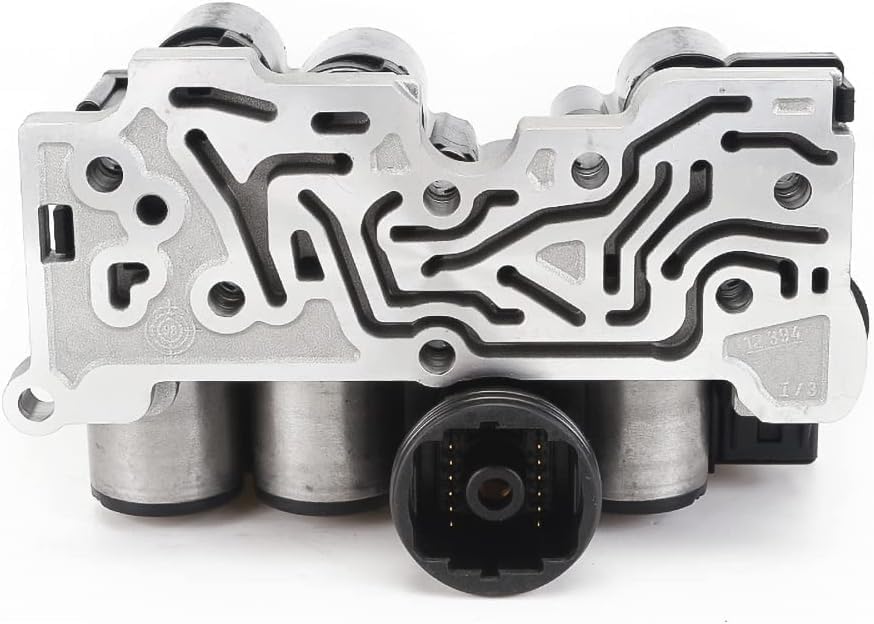
5R55W Transmission Range Sensor 2002-Up (OEM 5L2Z-7F293-AA)
The DTR sensor for the 2002-2005 Mountaineer and Explorer 5R55W. Replace it when P0705/P0708 or a jumping TR PID confirms the sensor, then align it with the gauge.
View the 5R55W range sensor →Need something else? Browse all 5R55W parts at Core Transmission Parts.
Problem 5: Hard to Shift Into Park, or Rolls in Park
This is the one that worries owners most, and it is well documented. NHTSA's Office of Defects Investigation opened PE09-020 and then Engineering Analysis EA09-013 on 2002-2005 Explorer and Mountaineer trucks (later adding the 2003-2005 Aviator), an estimated population of 1.5 million, over allegations of rollaway after shifting to Park and difficulty getting the column lever into Park [3]. The preliminary evaluation turned up 883 reports of drivers having trouble shifting into Park [3].
NHTSA found two main mechanisms. The first is the brake-shift interlock (BSI) in the steering column. The BSI solenoid pin was designed with a retraction delay of up to 0.4 second after the brake is applied. Drivers who shift to Park quickly hit the pin against the swing arm ramp, and over time that deforms the swing arm until it takes more effort to reach Park, or the lever won't go into Park at all [3]. In that state the PRNDL shows not-in-Park, the pawl isn't engaged, and the key won't come out [3]. Ford changed the solenoid on June 14, 2004 to retract in 0.03 second and released TSB 04-22-12 in November 2004 for 2002-2005 Explorer 4-door and Mountaineer trucks with high shift effort into Park [3].
The second mechanism is inside the transmission: park pawl and park apply rod damage. NHTSA reports these parts can be damaged by impulse loading during rail or car-hauler shipping when the parking brake isn't applied, and the truck can then move with the PRNDL showing Park [3]. That failure ran at 4.4 per 100,000 vehicles, the highest of any mechanism NHTSA identified; the BSI was next at 3.4 per 100,000 [3]. NHTSA closed the investigation in February 2013 without a recall and noted that closing it is not a finding that no defect exists [3].
Ford's own diagnostic chart for "Transmission Will Not Go Into Park" lists a misadjusted shift cable, a misaligned DTR sensor, and damage to the parking pawl, gear or guide [1]. On the bench, the pawl, return spring and pawl shaft sit under the extension housing, and Ford warns they can fall out when it comes off [2]. On reassembly, seat the parking lever actuating rod in the case guide cup and torque the extension housing bolts to 29 ft-lb [2]. If the lever won't go to Park, check the column before you pull the transmission. If it reaches Park but the truck still rolls, the problem is under the extension housing.
Diagnose the V8 With the Right Numbers
Line pressure
Tee a gauge into the line pressure tap, watch RPM on the scan tool, and set both brakes [1]. Ford's 4.6L Explorer/Mountaineer specs [1]:
| Range (4.6L) | Line pressure at idle | Line pressure at WOT stall |
|---|---|---|
| P and N | 75-120 psi | N/A |
| R | 175-215 psi | 282-350 psi |
| D, 3, 2, 1 | 100-135 psi | 228-263 psi |
The V8 runs higher idle pressure in Reverse and Drive than the 4.0L, which Ford lists at 145-190 psi in Reverse and 80-110 psi forward [1]. If line pressure is out, Ford has you move the gauge to the pressure control tap; the 4.6L spec is 55-65 psi in Reverse and 40-50 psi forward at idle, and 112-134 psi at stall [1]. Low pressure in all forward ranges points at the forward clutch, valve body, or the overdrive or intermediate servo, which ties right back to Problem 1 [1].
Stall speed
Ford's 4.6L stall spec is 2687-3150 rpm, versus 2557-3036 rpm for the 4.0L [1]. Do the line pressure test first, never hold WOT more than 5 seconds, and clear codes afterward; Ford notes a long stall test can set P0712 or P1783 [1].
Service: Transmission and Transfer Case
Ford specifies MERCON V for the 5R55W/S, 12.6 qt (12.0 L) total, with the level set by the check plug at 81-120°F TFT and the engine running [2]. The pan has 16 bolts at 97 in-lb, the drain plug is 19 ft-lb, and the converter has its own drain plug at 89 in-lb behind an access plug in the housing [2]. Pulling that converter plug gets you a lot more old fluid than a pan drop alone. Ford's interval is 150,000 miles normal and 30,000 miles severe [2], and a towing Mountaineer is severe.
On AWD trucks, service the transfer case at the same visit. Ford calls for transfer case fluid every 150,000 miles normal and 60,000 miles severe, filled to just below the fill plug hole, and gives 17 ft-lb for the AWD drain and fill plugs [2]. Being able to touch the fluid with a finger doesn't mean it's full, according to Ford [2]. Use the fluid Ford lists for that case, not leftover MERCON V by default.
After any rebuild, Ford requires a new cooler or a cleaned and backflushed one, using only clean ATF and no solvents or additives [2]. A planet failure loads that cooler with metal.
Repair Order That Saves Money
- 1. Codes, level and cable — DTR codes, shift cable adjustment, check-plug level at TFT [1][2].
- 2. Park complaint? — column BSI first, park pawl second [3].
- 3. Line pressure on the correct engine row [1].
- 4. Pan inspection — band lining, bronze bearing debris, steel from a planet.
- 5. Rebuild — sleeve the servo bores [4], inspect the front planet bearing [5], service the pump flow control and bypass valves [6], and flush the cooler.
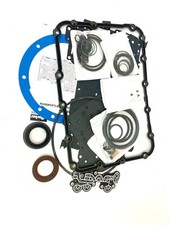
Rebuild kits, solenoid packs and filter kits for the 2002-2005 Mountaineer and Explorer 5R55W, with checkout on our site.
Shop 5R55W parts →FAQ
What are the most common 5R55W problems on a Mercury Mountaineer?
Worn servo apply pin bores in the case are the most common hard failure, causing flares, loss of 2nd, 3rd and 5th, and ratio codes. After that come overdrive planetary failures from lube loss through the internal thermal bypass valve, the 2002-2004 front planet bearing, and DTR sensor or shift cable faults. Read codes and check line pressure on the correct engine row before buying parts.
Why is my Mountaineer hard to shift into Park?
NHTSA's EA09-013 investigation found the brake-shift interlock solenoid pin on 2002-2005 Explorers and Mountaineers had a retraction delay of up to 0.4 second. Shifting quickly makes the pin strike the column swing arm, which deforms over time and raises shift effort into Park. Ford released a faster solenoid in June 2004 and TSB 04-22-12 in November 2004 to replace it.
What line pressure should a 4.6L Mountaineer 5R55W have?
Ford lists 75-120 psi at idle in Park and Neutral, 175-215 psi at idle in Reverse and 100-135 psi at idle in the forward ranges for the 4.6L. At WOT stall it should read 282-350 psi in Reverse and 228-263 psi forward. Do not judge a V8 truck against the 4.0L numbers, which are lower at idle.
What transmission fluid does a 2002-2005 Mountaineer take?
Ford specifies MERCON V for the 5R55W/S with a total capacity of 12.6 quarts (12.0 L). The level is set at the check plug in the pan with the engine running and transmission fluid temperature between 81 and 120 degrees F. AWD trucks also need their transfer case serviced, every 60,000 miles under severe use.
Sources
- Ford Motor Co. service information (Mitchell reprint) — 2002 Explorer/Mountaineer "5R55W/S Diagnosis," on the DTR sensor description and P0705/P0708/P1702 codes, the TR PID wiggle test, the "will not go into park" checklist, 4.0L and 4.6L line pressure and pressure control specs, and stall speed specs. 5R55W/S Diagnosis (PDF)
- Ford Motor Co. service information (Mitchell reprint) — "Servicing - Explorer & Mountaineer," on the 5R55W/S application, the Borg-Warner 44-03 (Mountaineer) and 44-05 (Explorer) transfer cases, MERCON V and 12.6 qt capacity, check-plug procedure, transfer case intervals and fill, shift cable and TR sensor adjustment, extension housing and park pawl notes, cooler backflush, and the torque table. 5R55W/S Servicing (PDF)
- NHTSA Office of Defects Investigation — EA09-013 closing resume and report (from PE09-020), Vehicle Rollaway, MY 2002-2005 Explorer/Mountaineer and 2003-2005 Aviator: BSI 0.4-second pin delay, swing arm deformation, the June 14, 2004 solenoid change, TSB 04-22-12, park pawl damage from shipping loads, and the 4.4 and 3.4 per 100K failure rates. static.nhtsa.gov EA09-013 (PDF)
- Sonnax — Overdrive & Intermediate Servo Pin Bore Sleeve Kit 56361J-01K, on case pin bore wear, flares, 732/733/735 codes, delayed Reverse, fluid out the vent, and the sleeve repair. sonnax.com/parts/2207
- Sonnax — Ed Lee, "A Fix for 5R55W Front Planet Bearing Failure," on the 2002-2004 Explorer/Mountaineer bearing, Ford planet 2L2Z-7A398-AA, the RE4F02A bearing substitution and the 77406-10 / 77409-15 shims. sonnax.com/tech_resources/182
- Motor Age / VehicleServicePros — Wayne Colonna, "Ford 5R55N/S/W's Overdrive Planetary Failure," on lube loss through the internal cooler bypass/thermal valve and erratic shifts after overhaul from the pump flow control and solenoid regulating valves. vehicleservicepros.com