Shift complaints on a 2011-2014 Chrysler 200 come in a handful of flavors: a bang on the 2-3, a double bump on the same shift, a clunk coasting down to a stop, a lazy 1-2 that flares, or a car that suddenly will not leave third. Some of those are calibration and get fixed with a flash. Some are worn valve body bores. A few are the compounder eating itself. The 62TE gives you the tools to tell them apart, as long as you understand how it makes its six ratios and what the TCM is watching.
This is how I work a 200 with a shift quality complaint, from the cheapest checks to the teardown. The numbered references point to the Sources list at the bottom.

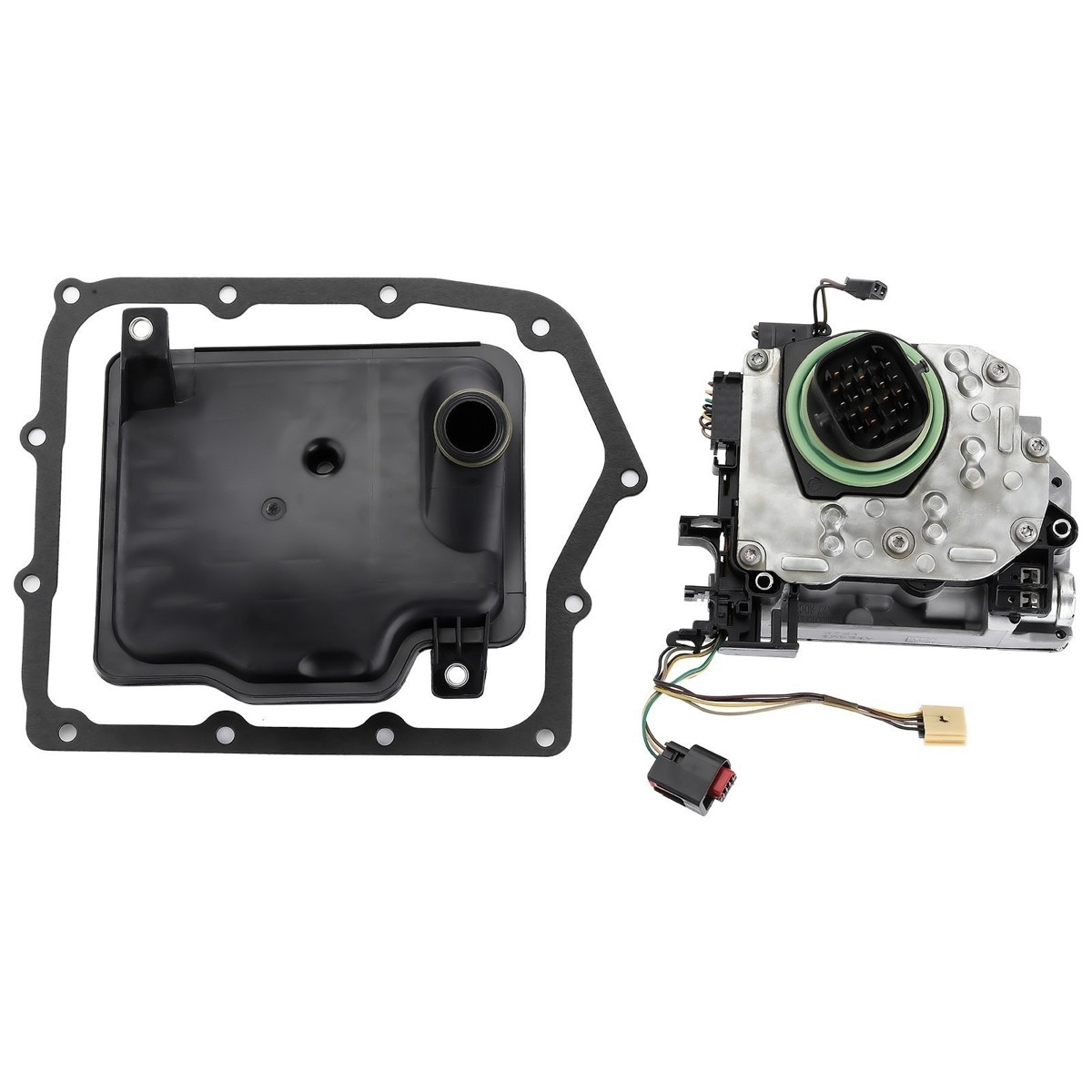
Confirm the car actually has a 62TE
Only the first-generation (JS) 200, 2011 through 2014, can have the 62TE. The 2015 and later 200 uses the 948TE nine-speed, which has its own bulletins and nothing here applies to it [1]. Within the JS cars, the 3.6L V6 (engine sales code ERB) got the six-speed, and so did some 2.4L cars (ED3 or EOG). The transmission sales code is DG2, per Chrysler bulletin 21-013-12 [1]. Other 2.4L cars got the old four-speed.
You can tell from the driver's seat. The six-speed has an AutoStick position below Drive and no dipstick; the fill tube is capped and the dealer checks level with a special service dipstick. The four-speed has a dipstick and a 3 range on the shifter [6]. If you are about to quote a 62TE repair on a four-speed car, stop here.
What is normal, so you do not chase it
The owner's manual is blunt about two behaviors that generate shift complaints on perfectly good units [6]:
- Self-calibration. The transmission electronics adapt, so the first few shifts after a battery disconnect, a module flash or a rebuild can be abrupt. Chrysler says precise shifts develop within a few hundred miles.
- Cold operation. Converter clutch engagement is inhibited until the fluid warms, and at -16 F (-27 C) or below the transmission may briefly be held in third gear only.
Limp home is different. When the TCM sees a condition that could damage the unit it holds third gear in every forward range, Park, Reverse and Neutral still work, and the MIL may come on. The manual's reset is: stop, shift to Park, key off, wait about 10 seconds, restart [6]. That gets a customer home. It does not fix anything, and if third comes back there is a code waiting for you.
How the 62TE makes six speeds, and why that matters for shift feel
The 62TE is a 41TE main box with an underdrive compounder bolted onto the transfer shaft. The compounder has its own low clutch, direct clutch, overrunning (sprag) clutch and planetary set, and it runs in either reduction or direct [3]. Every forward ratio is a main-box gear multiplied by a compounder state, which is how Chrysler got six speeds plus a seventh, 4th prime, out of a four-speed core.
| Gear | Ratio | Note |
|---|---|---|
| 1st | 4.127 | Sprag holding |
| 2nd | 2.842 | |
| 3rd | 2.284 | Limp-home gear, sprag holding |
| 4th prime | 1.573 | Used only on a 6-4 kickdown |
| 4th | 1.452 | Sprag holding |
| 5th | 1.000 | |
| 6th | 0.689 | |
| Reverse | 3.215 |
Ratios per the TransGo SK 62TE-A clutch application chart [4]; limp gear and 4th prime per ATRA [3].
Here is the part that explains most "it bangs into third" complaints. The 2-3, 3-2 and 4-2 shifts are double swaps: two elements release while two others apply, one pair in the main box and one pair in the compounder. ATRA's 62TE update puts the synchronization window at 40 to 70 milliseconds [3]. If the compounder shifts too early relative to the main box, the driver feels a shudder or a harsh shift. If it shifts too late, they feel a double bump [3]. So a harsh 2-3 and a double-bump 2-3 are the same timing problem from opposite sides, and both can come from calibration, from a clutch that takes too much or too little volume to apply, or from a leak that slows one apply.
Chrysler designed around the worst case. To avoid a double swap on a 6-4 kickdown the TCM goes to 4th prime, dropping the OD clutch and applying the UD clutch, and the sprag provides the nonsynchronous handoff. The sprag also holds in first, third and fourth, which is what smooths the 1-2, 2-1, 4-5 and 5-4 shifts [3]. A sprag that slips, or was installed backwards, shows up on exactly those shifts. ATRA and TransGo both note the outer race must turn counterclockwise with the drum held [3][4].
Step 1: Check level before anything else
The capped fill tube means nobody has looked at this fluid in years, and a slow leak shows up as shift quality before it shows up as a slip. The manual warns that running with an improper level can cause severe transmission damage and that any fluid other than ATF+4 can cause poor shift quality and converter shudder [6]. Check it hot with the service dipstick, top up with ATF+4 only, and do not add additives, sealers or flushes. Chrysler allows only leak-detection dye [6].
Step 2: Read codes and data, using all three speed sensors
The 62TE has three speed sensors, and they are your best diagnostic tool [3]:
- ISS (input), on top of the case, reads turbine speed from the input clutch hub.
- TSS (transfer), at the rear, reads the front annulus/rear carrier. It is the old 41TE output sensor, moved and renamed.
- OSS (output), also at the rear, reads the compounder output carrier and is unique to the 62TE.
Log input, transfer and output speed, commanded gear, line pressure desired versus actual and TCC slip through the complaint shift. ISS against TSS tells you what the main box is doing; TSS against OSS tells you what the compounder is doing. If a harsh or late shift lines up with the TSS-to-OSS ratio changing early or late while the main box is on time, you are looking at the compounder side. On the electrical side, the 23-way case connector uses gold pins for the pressure switches and tin pins for solenoids [3]. Green or corroded pins there cause intermittent pressure switch codes that feel like random harsh shifts.
Codes that matter for shift complaints:
- P0792 or P0735 with a slipping 1-2 and no line rise points at the compounder low clutch drum ring lands. ATRA calls it the most common failure, with about .005 in. of ring clearance on a badly worn drum and a "100% failure rate" on the original part; aftermarket drums have a steel insert [3].
- P2764 (TCC stuck on) was the top 62TE call on ATRA's hotline, and the fix was the TCC solenoid, 5169313AA [3]. TransGo adds that if the unit chugs or kills the engine at a stop, the TCC solenoid is bad, and the OEM retainer often breaks and lets the solenoid back out [4].
- TCC slip or pressure switch rationality codes can be a worn solenoid switch valve bore. TransGo sells .420 in. and .453 in. replacement valves (RFE-SV420 and RFE-SV453) depending on which size you measure [4].
Step 3: Rule out calibration
For 2012-2013 200s and Avengers with the 62TE built before October 9, 2012 (MOH 1009XX), bulletin 21-013-12 reprograms the PCM to improve upshift torque management. Its diagnosis line is simply: if the customer indicates shift quality issues, perform the repair. It requires wiTECH 13.01 or later, a battery charger holding 13.2 to 13.5 volts during the flash, and an authorized modification label, 04275086AD. Labor is 0.2 hours [1].
The minivans, which use the same 62TE (DG2), got a parallel bulletin, 21-012-12 Rev A, and it lists the classic calibration complaints: harsh 1-3 upshift in ECO mode, harsh 2-3 upshift in normal mode, and a 1-2 upshift clunk after a throttle back-out. It also revised the 1-2, 3-4, 4-5 and 5-6 upshift schedules, the 6-4P, 6-5 and 5-4 downshifts, and fifth gear converter lockup [2]. That bulletin does not cover the 200, but its after-flash steps are the procedure every 62TE needs: clear the Variable Line Pressure (VLP) counters, then run Quick Learn, both in the PCM's Misc Function menu [2]. TransGo says the same thing about every repair, not just flashes: clear codes and reset the VLP counter [4].
If the car is current on software and the complaint survives a VLP reset, Quick Learn and a couple hundred miles of adaptation, it is mechanical. Keep going.
Step 4: Match the complaint to the hard part
Clunk coasting down: 6-5 or 3-2
TransGo lists a coasting 6-5 UD apply clunk and a 3-2 L/R apply clunk among the complaints its 62TE kit corrects, along with drainback and delayed or no engagement [4]. The kit puts new seals and expanders on the six aluminum accumulator pistons (plastic pistons reuse their seals) and replaces the pressure regulator valve and torque converter regulator valve. TransGo's own note is that the valve body work stabilizes the main pressure system to reduce shift complaints and fixes the TC regulator so it stops starving lube and cooling [4]. Do not change accumulator springs [4].
Rough 4-3 coast, then limp coming to a stop
This one is specific. A worn underdrive piston or a nibbled UD seal leaks cold, giving a delayed or no forward engagement and sometimes limp on a cold start into Drive. After a long run in fourth the seal relaxes and fails to reseal fast enough on the 4-3 coast downshift between about 28 and 19 mph. The TCM sees the late apply on the speed sensors and puts the unit in limp [4]. TransGo's fix is a self-expanding seal and expander, or a new piston if it is badly worn. Do not hone or polish the piston [4].
Delayed Reverse, delayed 1st or 2nd, burnt clutches
Sonnax traces this to wear in the low/reverse switch valve bore and, on the 62TE, the low clutch switch valve bore. The valve is heavily side-loaded, and a worn bore leaks past the one-way valve and out the manual valve, dropping apply pressure [5]. Vacuum test the bore: 18 in. Hg or higher passes, lower means wear. The 62TE port is long and awkward to test, and Sonnax notes that if port 1 leaks badly, port 2 almost certainly does too [5]. Repair kits are 92835-43K (drop-in) and 92835-47K (oversized, for extreme wear) [5].
Flare on 1-2, slip, no line rise
That is the low clutch drum ring land wear from Step 2. TransGo adds the root cause: the four sealing rings on the transfer shaft shrink and dump lube, which lowers main line and accelerates ring land wear. Later housings are notched for non-rotating rings, and TransGo recommends updating to that housing on any overhaul even if the old one looks fine [4].
Lost 3rd in limp, or no 4th or 6th after a rebuild
ATRA's most common builder error: the solenoid block seal installed upside down blocks the 2/4 circuit, which costs you limp-mode third, fourth or sixth. The slot faces up [3].
Step 5: If it comes apart, set the clearances
A shift-quality rebuild lives or dies on clutch clearance, because the TCM adapts to volume and a pack that is way off forces it outside its range. TransGo's specs for the main box: UD .037-.059 in., OD .042-.128 in., Reverse .035-.054 in., L/R .035-.058 in., 2/4 .030-.104 in. [4]. In the compounder, ATRA gives direct clutch clearance of .037-.056 in. and low clutch clearance of .018-.029 in., both measured with 30 psi of air through the compounder feed hole [3]. Air check the direct and low clutch circuits at 20-25 psi before the unit goes in. TransGo's rule is that if it does not air check, it does not get installed [4]. ATRA also flags the cooler bypass valve as a high-risk part worth replacing on any repair, and direct clutch piston delamination as a common find [3].
When it is back together, clear the codes, reset the VLP counter, run Quick Learn and road test every shift, including a coast to a stop from highway speed and a 6-4 kickdown.
Prevention
- ATF+4 only, at the correct hot level. No additives, sealers or flushes [6].
- Under load, in hills or towing, use AutoStick to hold a lower gear so the unit is not hunting and building heat [6].
- Any time the battery is disconnected or a module is flashed, warn the owner that the first shifts will be abrupt while it relearns [6].
Shop the part for this fix
Chasing pressure switch codes or erratic shifts on a 200? CoreTransmissionParts carries the 62TE shift solenoid block pack, 68376696AA.
See the 62TE solenoid block pack →Need something else? Browse all rebuild kits at CoreTransmissionParts.
Need parts for this job?
Solenoid block packs, shift kits, valve bodies and master rebuild kits for the 2011-2014 Chrysler 200's 62TE, with checkout right here on Gearbox Insider.
Shop 62TE parts →FAQ
Why does my Chrysler 200 transmission shift hard?
On a 2011-2014 Chrysler 200 with the 62TE, check fluid level and software first. The 2-3 shift is a double swap that has to finish in 40 to 70 milliseconds, so a calibration that is out of date or a clutch that applies late shows up as a bang or a double bump. Bulletin 21-013-12 reflashes 2012-2013 cars built before October 9, 2012 for upshift quality.
Does the Chrysler 200 need a relearn after transmission work?
Yes. After a flash or any repair, clear the codes, reset the Variable Line Pressure (VLP) counters and run Quick Learn from the scan tool's Misc Function menu. The owner's manual also notes the electronics are self-calibrating, so the first few shifts can be abrupt until it adapts over a few hundred miles.
Why does my Chrysler 200 clunk when coasting to a stop?
A clunk on the 6-5 or 3-2 coast downshift on the 62TE usually comes from the underdrive or low/reverse clutch applying too hard, which TransGo ties to worn pressure regulator and converter regulator bores and leaking accumulator piston seals. A rough 4-3 coast followed by limp mode points at a leaking underdrive piston seal instead.
Why is my Chrysler 200 stuck in third gear?
Third gear is the 62TE limp home mode. The TCM holds third in every forward range when it detects a fault that could damage the transmission, and Park, Reverse and Neutral still work. A key-off reset of about 10 seconds may restore all gears, but a return to third means a stored code needs to be diagnosed.
Related guides
Sources
- Chrysler Group LLC, Service Bulletin 21-013-12, "Transmission Shift Improvements," November 10, 2012, 2012-2013 JS Avenger/200. Backs the 3.6L (ERB) and 2.4L (ED3/EOG) with 62TE (DG2) coverage, the October 9, 2012 build cutoff, the upshift torque management flash, wiTECH 13.01, the 13.2-13.5 V charger requirement, label 04275086AD and the 0.2-hour labor time. static.nhtsa.gov (PDF)
- Chrysler Group LLC, Service Bulletin 21-012-12 Rev A, "Flash: Transmission Shift Quality Improvements," October 31, 2012, 2011-2013 RT Caravan/Town & Country with the 62TE (DG2). Backs the harsh 1-3 ECO and 2-3 normal-mode upshifts, the 1-2 clunk after throttle back-out, the revised shift schedules and fifth gear lockup, and the clear-VLP-counters then Quick Learn procedure. static.nhtsa.gov (PDF)
- Mike Souza, ATRA Senior Research Technician, "62TE Update" technical webinar, 2014. Backs the compounder layout and 4th prime, the 2-3, 3-2 and 4-2 double swaps and 40-70 ms timing, early versus late compounder shift feel, sprag function, the ISS, TSS and OSS locations, gold and tin connector pins, low clutch drum ring land wear with P0792/P0735, P2764 and TCC solenoid 5169313AA, the solenoid block seal error, compounder clutch clearances and the cooler bypass valve. atracom (PDF)
- TransGo, SK 62TE-A shift kit instructions, underdrive ring and 62TE additional data. Backs the gear ratio chart, the VLP counter reset after every repair, the 6-5 and 3-2 coast clunks, pressure regulator and TC regulator valve work, accumulator seals, the TCC solenoid and retainer failure, the solenoid switch valve sizes, the transfer shaft ring and low clutch housing wear, the UD seal cold leak and 4-3 limp at 28-19 mph, and the main-box clutch clearances. transgo (PDF)
- Chris Leach, Sonnax, "Diagnosing 62TE, 68RFE Low/Reverse Switch Valve Issues." Backs the low/reverse and low clutch switch valve bore wear mechanism, the delayed Reverse and delayed 1st/2nd symptoms, the 18 in. Hg vacuum test and kits 92835-43K and 92835-47K. sonnax.com
- Chrysler Group LLC, 2014 Chrysler 200 Sedan Owner's Manual (archived copy). Backs the AutoStick and capped six-speed fill tube versus the four-speed dipstick, self-calibrating shifts, cold-weather converter and third gear behavior at -16 F (-27 C), limp home in third and the reset steps, ATF+4 only with no additives, sealers or flushes, and the improper-level warning. archive.org