The Journey is one of the most common ways a 62TE ends up on a lift. Dodge built the Journey from the 2009 model year through 2020, and every V6 version, the 3.5L early on and the 3.6L Pentastar after that, got the 62TE six-speed. Some 2012-2013 four-cylinder Journeys got it too. FCA's own bulletin 18-066-15 covers 2.4L Journeys with the six-speed (sales code DG2) [1]. Other 2.4L Journeys used the four-speed, so before anything else, confirm which transmission is under the hood. The owner's manual covers both and gives each its own fluid check procedure [2].
Once you know it is a 62TE, the Journey picture is mostly the 62TE picture, plus a few Journey-specific details that change how you diagnose it: a software bulletin that fixes most "clunk" complaints, a sealed fill tube that keeps owners from noticing low fluid, and a converter clutch solenoid failure that Transmission Digest documented on a Journey. This list is in the order I would check things. The numbered references point to the Sources list at the bottom.

First, know which 62TE complaints are software
A big share of 2012-2013 Journey shift complaints are not hardware at all. FCA service bulletin 18-066-15 (September 25, 2015, superseding 18-008-13 from February 2013) reprograms the PCM on 2012-2013 Journeys with the 3.6L (sales code ERB), and on 2.4L six-speed units built before October 23, 2012 [1]. The listed symptoms read like a list of customer complaints:
- 1-2 upshift clunk or bump (2.4L and 3.6L)
- 3-4 harsh upshift at closed throttle after a wide-open-throttle stab in first or second
- 4-5 and 5-6 upshift clunk or bump, and 6-5 and 6-4 downshift clunk (3.6L)
- RPM fluctuating or a jerking feel on cruise control, worse on grades
- Delayed downshifts (3.6L)
The same flash also improves torque management during upshifts. On the 3.6L it addresses a U0140 lost communication with the body control module code that will not clear, plus a P0108 MAP sensor code on 2012 models [1]. FCA's wording is direct: updating the software will correct the conditions listed. It also says to verify all engine systems are working before you flash, and to record and repair any other codes first [1]. The flash procedure calls for a battery charger so system voltage stays above 13.2 volts.
So the first move on a 2012-2013 Journey with a clunk is a scan tool check of the PCM software level, not a valve body. A clunk on a unit that is already at the latest calibration is a different conversation.
Low fluid you cannot see: the sealed fill tube
This is the Journey problem I see the most, and it starts in the owner's manual. For the six-speed, the manual says the fluid level is preset at the factory and routine checks are not required, so the filler tube is capped and no dipstick is provided. An authorized dealer checks the level with a special service dipstick [2]. The four-speed Journey still has a regular dipstick. The six-speed does not.
That means most 62TE Journeys go their whole life without a level check. A slow leak at a cooler line or a pan rail goes unnoticed until the unit flares on a turn or loses forward. The manual itself warns that running with an improper fluid level can cause severe transmission damage, and says to have the level checked right away if you see a leak or a malfunction [2].
The check itself is in Chrysler's 62TE service information, which was written around the 2009 Journey. The level is read with dipstick tool 9336A at normal operating temperature, 82 C (180 F) [3]. A cold reading on this unit means nothing. After a pan drop, Chrysler has you pour in 4 quarts of ATF+4, start the engine and bring the level up to the mark on the tool, not dump in a fixed number [3]. If you are doing the service, our 62TE filter and pan service guide walks through it.
Fluid type is not open to debate. The 2019 Journey manual says to use only ATF+4, and warns that the wrong fluid can hurt shift quality, cause torque converter shudder and shorten fluid and filter life [2]. It also says no chemical flushes and no additives, with leak-detection dye the only exception [2]. Chemical flush damage is not covered by the new vehicle warranty.
Stuck in third: Journey limp-in mode
When the TCM sees a condition that could damage the transmission, a six-speed Journey holds third gear in every forward range. Park, reverse and neutral still work, and the MIL may come on [2]. Owners describe it as "it won't shift" or "it feels like it's stuck in second," and the cause is almost always a stored code, not a mechanical failure.
The manual tells owners they can reset a momentary fault: stop, shift to park, turn the ignition off, wait about 10 seconds and restart. If the fault is gone, the transmission goes back to normal operation [2]. A unit that drops back into third a few miles later has a real fault, so read every stored code, including relay and power codes, before you condemn a solenoid pack. Our 62TE limp mode guide covers the code-by-code list.
Delayed engagement, fluid out the vent and P0740
This one is Journey-specific in the record. Transmission Digest documented a 2016 Journey that came in with delayed forward engagement, fluid coming out the vent and a P0740 converter clutch code [6]. The mounting bracket for the electronically modulated converter clutch (EMCC) solenoid had broken, which let the solenoid back partly out of the valve body near the vent. The leak dropped the fluid level. Low fluid caused the delayed engagement, and the converter clutch circuit leak caused the slip. The repair was a soft-parts overhaul, a converter and a new solenoid, Mopar 5169313AA [6].
The lesson for a Journey with a converter code is to look at the solenoid and its bracket before you order a converter. If the bracket is broken, find out how long it ran low. A unit that sat a quart or more low for a few thousand miles has usually cooked something besides the solenoid.
A stuck-on converter clutch shows up the opposite way, as a stumble or near-stall coming to a stop. ATRA reported P2764 (TCC stuck on) as a newer 62TE hotline failure, fixed by replacing the TCC solenoid, 5169313AA [4]. GEARS gives the scan tool proof: with the converter clutch commanded off at a stop, the input speed sensor reading should drop away from engine rpm. If it rides right on engine speed, the clutch is not releasing [5].
Slip on the 1-2, P0792 and P0735: the compounder
When a 62TE Journey slips hard on the 1-2 shift or sets compounder codes, the problem is usually in the underdrive compounder. That is the section bolted onto the back of what is otherwise a 41TE. ATRA lists ring land wear on the compounder's low clutch drum as the most common 62TE failure, shows lands worn to roughly .005 in. of clearance, and gives the original drum a 100 percent failure rate [4]. The worn lands let the low clutch and direct clutch circuits leak into each other. Typical results are P0792 (compounder speed error), P0735 (fifth gear ratio error), a 1-2 slip, and no line rise when the PCM commands higher pressure [4]. GEARS adds P0732 (second gear ratio) to the list and says to watch the transfer (countershaft) speed data to confirm it [5].
The 62TE has three speed sensors, input, transfer and output. A ratio code where the input and transfer shafts agree with each other but the output does not points straight at the compounder [4]. GEARS' advice for the repair is to take the compounder all the way apart even on a low-mileage unit, and to check every ring land, snap ring groove, bearing and spline. The updated compounder is Mopar 05078815AD [5]. ATRA also flags delamination of the direct clutch piston's bonded seal, which can still pass an air check on the bench, so look at the bonded edge rather than trusting the air test [4].
While the compounder is apart, ATRA's clearances, measured with 30 psi of air through the compounder feed hole, are .037 to .056 in. for the direct clutch and .018 to .029 in. for the low clutch [4].
No movement
A Journey that will not move in any gear goes through the same short list as any 62TE. GEARS lists low fluid level, a restricted or leaking main filter, broken pump gears, stripped converter-to-input-shaft or transfer gear splines, and a stripped or popped-out axle [5]. On a Journey, because of the capped fill tube, check the fluid level first with the right tool and hot fluid. GEARS also describes a check ball in a case line port that can come loose. The fix is to tap the hole with a 1/8 in. pipe tap and install a pipe plug with permanent thread locker [5]. For the full flowchart, see 62TE no movement diagnosis.
Harsh or erratic shifts after a repair
The 62TE runs adaptive clutch control. After any overhaul, valve body or solenoid pack replacement, Chrysler requires the TCM Quick Learn procedure [3]. Skipping it leaves the TCM working from clutch volumes that belong to the old parts, and the customer comes back with harsh shifts. Run the Quick Learn, then drive the unit hot through every shift so the volumes relearn. On a 2012-2013 Journey, also confirm the PCM has the 18-066-15 calibration before you chase shift feel [1]. The valve body bolts go to 6 N-m [3]; this is a small, light casting, and overtightening it distorts the bores.
Towing on a Journey 62TE
The 2019 Journey manual rates the 3.6L at 2,500 lbs of trailer with one or two people aboard, dropping to 1,500 lbs with five to seven, and the 2.4L at 1,000 lbs [2]. It also ties towing directly to transmission service. Anyone who regularly tows for more than 45 minutes of continuous driving should change the fluid and filter on the "police, taxi, fleet, or frequent trailer towing" schedule, and should use Autostick to hold a lower gear if the transmission keeps shifting in Drive [2]. Most Journeys that come in burned up on the compounder have a hitch on them. See 62TE towing upgrades for what holds up better.
The fix, by what you found
- Clunks on a 2012-2013 3.6L, no codes: PCM flash per 18-066-15, then re-evaluate [1].
- Low fluid or a leak: repair the leak, refill with ATF+4 and set the level hot with 9336A [2][3].
- P0740 with delayed engagement: inspect the EMCC solenoid and bracket. Replace with 5169313AA, then assess converter and clutch damage [6].
- P0792, P0735 or P0732 with a 1-2 slip: compounder overhaul with an updated low clutch drum and new pistons [4][5].
- Stuck in third with solenoid or pressure switch codes: diagnose the circuit, then replace the solenoid/pressure switch assembly if it is at fault and run Quick Learn [3].
Shop the part for this fix: 62TE master rebuild kit with pistons
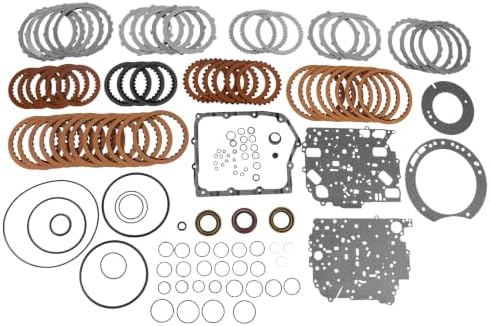
When the teardown confirms worn compounder ring lands or a delaminated direct clutch piston, this CoreTransmissionParts kit puts the frictions, steels, pistons and filter for a Journey 62TE overhaul in one box.
View the 62TE master rebuild kit at CoreTransmissionPartsLooking for something else? Browse rebuild kits at CoreTransmissionParts.
Need parts for this job?
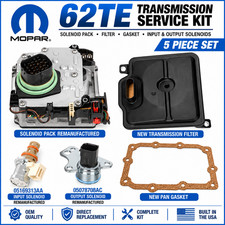
Our 62TE parts page has master rebuild kits, solenoid block packs, TCC solenoids, valve bodies and ATF+4 service kits that fit the Journey, all on our own checkout. The 62TE takes ATF+4 only; see the transmission fluid spec chart.
FAQ
What transmission is in a Dodge Journey?
Every V6 Journey, the 3.5L in the early years and the 3.6L Pentastar from 2011 on, uses the 62TE six-speed automatic. Four-cylinder Journeys mostly used a four-speed, but FCA bulletin 18-066-15 shows some 2012-2013 2.4L Journeys built with the 62TE (sales code DG2). The six-speed has a capped fill tube and no dipstick; the four-speed has a regular dipstick.
Why does my Dodge Journey clunk when it shifts?
On a 2012-2013 Journey, start with FCA bulletin 18-066-15. It reprograms the PCM to fix 1-2, 4-5 and 5-6 upshift clunks, 6-5 and 6-4 downshift clunks, a 3-4 harsh shift after a wide-open-throttle stab, and a jerk on cruise control. If the software is already current, check the fluid level hot with tool 9336A before looking at hard parts.
How do you check transmission fluid on a Dodge Journey six-speed?
The 62TE Journey has no dipstick. The fill tube is capped and the level is checked with service dipstick tool 9336A with the fluid at normal operating temperature, 82 C (180 F). Use ATF+4 only, and do not use flushes or additives.
Why is my Journey stuck in third gear?
Third gear is the six-speed Journey's limp home mode. The TCM holds third in every forward range after it detects a fault that could damage the transmission. The manual's reset is to stop, shift to park, turn the ignition off for about 10 seconds and restart, but if it comes back, read the stored codes and fix the actual fault.
Related guides
Sources
- FCA US LLC, Service Bulletin 18-066-15, "Flash: Diagnostic And System Improvements," September 25, 2015 (supersedes 18-008-13), 2012-2013 Dodge Journey (JC). Backs the 3.6L (ERB) and 2.4L six-speed (DG2) coverage, the October 23, 2012 build cutoff, the listed upshift/downshift clunks, cruise jerk and delayed downshifts, U0140 and P0108, and the 13.2 V battery requirement. static.nhtsa.gov (PDF)
- FCA US LLC, 2019 Dodge Journey Owner's Manual. Backs the capped six-speed fill tube with no dipstick, ATF+4 only, the no-flush/no-additive cautions, third-gear limp home mode and the reset procedure, towing ratings and the 45-minute towing service rule. vehicleinfo.mopar.com (PDF)
- Chrysler LLC, 2009 62TE Automatic Transmission Service Information (Dodge Journey). Backs the level check with tool 9336A at 82 C (180 F), the 4-quart initial refill after a pan drop, the 6 N-m valve body torque and the Quick Learn requirement. documents.cdn.ifixit.com (PDF)
- ATRA, 62TE Update technical webinar. Backs compounder low clutch drum ring land wear and the 100 percent failure rate on the original drum, P0792/P0735 symptoms, direct clutch piston delamination, the direct and low clutch clearances, the three speed sensors, and P2764 with TCC solenoid 5169313AA. atracom (PDF)
- Keith Clark, "Six-Speed Success: 62TE Things to Do to Deliver Them Right the First Time," GEARS magazine (ATRA). Backs P0732 and the transfer speed check, full compounder teardown and updated compounder 05078815AD, the ISS-versus-rpm TCC check, the no-movement cause list and the case check ball pipe plug repair. gearsmagazine.com
- Transmission Digest, "62TE Delayed Forward Engagement." Backs the 2016 Journey case: delayed forward engagement, fluid out the vent, P0740, the broken EMCC solenoid bracket, and the repair with solenoid 5169313AA. transmissiondigest.com