A 62TE that drives fine forward and will not back up is one of the more satisfying diagnoses on this unit, because the transaxle hands you most of the answer before the pan comes off. Reverse needs three clutches to hold at once, and two of those three are also used in forward gears. If first and second pull hard, you have already ruled out a lot. What is left is a short list: the reverse clutch, the low clutch and its drum, a worn switch valve in the valve body, or something as simple as the shift cable.
This guide walks the no-reverse complaint the way I work it on Caravans, Town and Countrys, Journeys and ProMasters, from the scan tool to the air test plate. The numbered references point to the Sources list at the bottom.
What has to hold for the 62TE to back up
Chrysler's service information lays out reverse power flow in two stages [1]. On the main centerline, the reverse clutch applies to drive the front sun gear, and the low/reverse (L/R) clutch applies to hold the front carrier/rear annulus assembly. The rear carrier/front annulus turns backward as the output member at 2.21:1. Power then crosses the transfer gears to the underdrive compounder, where the low clutch applies to hold the compounder sun gear for a 1.45:1 reduction. Multiply the two and you get the overall reverse ratio of 3.215:1 [1].
Now compare that to first gear. In first, the UD clutch drives, the same L/R clutch holds the front carrier, and the overrunning clutch holds the compounder sun gear. The low clutch only applies on coast in first [1]. Second gear also uses the L/R clutch [1]. That gives you a very useful elimination chart:
| Element | Used in reverse | Also used in | What good forward gears tell you |
|---|---|---|---|
| Reverse clutch | Yes (input) | Reverse only | Nothing. Forward gears cannot prove it good. |
| L/R clutch | Yes (reaction) | 1st, 2nd | Strong 1st and 2nd launches mean the pack and piston are probably fine. |
| Low clutch | Yes (compounder) | 1st coast only | Very little. The overrunning clutch carries 1st under power. |
That third row is the one that catches people. Wayne Colonna put it plainly in Transmission Digest: the low clutch is applied only under certain driving conditions going forward, but it is absolutely required for reverse to function [3]. A van can drive around for weeks with a dead low clutch and nobody notices until they try to back out of the driveway.
Step 1: Fluid, cable and codes
Do the cheap checks first, because they catch more of these than anyone likes to admit.
Fluid level and condition. The 62TE takes MOPAR ATF+4 only [1]. Chrysler's level check is done with the engine idling in park, after shifting through the ranges and waiting at least two minutes, using dipstick tool 9336A and the transmission fluid temperature read on a scan tool, then comparing the dipstick height against the temperature graph [1]. A unit that is a couple of quarts low will often lose reverse before it loses drive. Low fluid on these units is not rare even from the factory: FCA bulletin 21-046-15 (July 2015) covered 2015 Grand Caravan and Town and Country 62TE units shipped under-filled, and the only repair was correcting the level with ATF+4 part 05013457AA [7]. If the fluid smells burnt and carries metal or friction material, Chrysler's own guidance is that a complete recondition is probably required [1]. Our 62TE fluid type and capacity guide has the fill details.
Shift cable and range sensor. Make sure the manual valve lever at the case actually reaches the reverse detent when the shifter says R. A stretched or misadjusted cable can leave the manual valve between positions. The cable adjust bolt is tightened to 6 N-m (40 in-lb) [1]. A P0706 (transmission range sensor rationality) stored in the TCM points you straight at this area [2].
Codes. Read the TCM directly, not just the engine side. The codes that matter for a no-reverse or late-reverse complaint, from ATRA's 62TE DTC list [2]:
| Code | Description | What it points to |
|---|---|---|
| P0736 | Gear ratio error in reverse | A clutch slipping in reverse (reverse, L/R or low) |
| P0706 | Transmission range sensor rationality | Cable, TRS, manual lever |
| P0750 | L/R solenoid circuit | Solenoid pack or its feed |
| P0841 | L/R pressure switch rationality | Switch, valve body, L/R circuit leak |
| P1770 / P1771 | Inadequate element volume, L/R | Worn L/R clutch or leaking circuit |
| P1776 | Solenoid switch valve latched in L/R position | Switch valve bore wear |
| P0868 | Line pressure low | Low fluid, pump, major internal leak |
A P0736 on its own with good forward gears is classic for a reverse clutch or low clutch that is not holding. L/R codes alongside it push you toward the valve body or the L/R circuit. No codes at all with a true no-reverse is common too, because if the unit never picks up the ratio the TCM may never get a clean slip to judge.
Step 2: Use the forward gears as a test
Before you gauge anything, road test it with a purpose:
- Launch in drive. If first and second are firm with no flare, the L/R clutch is doing its job in those gears [1].
- Manual low, coast down. Select the lowest manual range and let off the throttle at low speed. The low clutch is supposed to apply on coast in first [1]. No engine braking at all, with a freewheel feel, is a strong hint the low clutch is not holding.
- Reverse engagement. Note whether reverse is completely dead, slow to engage, or engages and then slips under throttle. A delayed engagement that gets worse hot usually means a leak that bleeds apply pressure off, not a totally failed part.
Also watch the 1-2 shift. Colonna notes that when the sealing ring towers on the low drum wear, you can get a flared 1-2 shift or a neutral condition, because the direct clutch feed shares that tower [3]. A flared 1-2 plus no reverse points hard at the low drum.
Step 3: Air test with the valve body off
Chrysler's method for finding an inoperative clutch is to substitute air pressure for fluid pressure using Air Pressure Test Plate 9741 [1]. Remove the pan, filter and valve body, bolt the plate on at 6 N-m (50 in-lb), and use clean, dry air at 30 psi [1]. For each passage marked on the plate you are listening for a solid thud as the piston applies, and the piston should return when air is removed [1]. For a no-reverse, the three that matter are marked REV (reverse clutch), LR (low/reverse clutch) and LC (low clutch).
- REV hisses and never thuds: reverse clutch piston seal, the input clutch retainer seals, or a sealing ring leak on the input side.
- LC hisses badly: the low drum. This is where Colonna says the most common culprit lives, the roughly 0.020-inch air-bleed capsule pressed into the drum [3]. If it was not staked properly it walks out of its bore, and the leak is large enough to keep the low clutch from applying or to burn it up [3].
- All three thud cleanly: the clutches can apply. Look at the valve body, and at fluid supply before the valve body.
If every circuit hisses and line pressure is also low, do not overlook something missing. Colonna documented a rebuilt 2012 Caravan that would not move either direction with line pressure under 30 psi. Air into the main line port blew straight into the pan through a hole next to the filter suction port, where a pressed-in check ball that seals line pressure was missing. Plugging the hole fixed it [6]. Our 62TE line pressure testing guide covers the gauge side.
Step 4: The low clutch drum
If the LC circuit leaks, you are almost certainly looking at the drum. Bill Brayton, writing in GEARS, describes the low clutch drum as having gone through real growing pains since the 62TE arrived in 2007 [5]. The first drums used rotating sealing rings, and those rings wore into the aluminum ring grooves on the drum; Brayton calls them the weakest link in the transmission [5]. The factory then moved to tabbed, non-rotating rings, which fixed the groove wear but still left too much side clearance [5]. The aftermarket answer is to cut off the ring tower and install a steel sleeve with steel, tabbed ring grooves and tighter side clearance [5]. His advice is that the drum needs to be figured into every rebuild [5].
On the air-bleed capsule, Colonna's guidance from the bench is practical: if the capsule is undamaged, restake it and reuse it; if it is damaged, it is not sold separately, so save drums with good screened orifices from scrapped units for exactly this job [3]. Check the capsule on every low drum you touch, new or used.
Set the low clutch clearance when it goes back together. The spec is 0.48-0.76 mm (0.019-0.030 in.) [1], adjusted with select snap rings [5]. Too loose and the clutch is slow to apply, which reads as a delayed reverse.
Step 5: Reverse clutch and L/R clutch
If the LC circuit is tight and REV is the one that fails, go into the input clutch assembly. Chrysler checks reverse clutch clearance by applying 30 psi (206 kPa) to the reverse clutch hose on Input Clutch Pressure Fixture 8391, measuring at four points 90 degrees apart and averaging [1]. The spec is 0.76-1.245 mm (0.030-0.049 in.), set with a select snap ring [1]:
| Reverse clutch snap ring | Thickness |
|---|---|
| 4377195 | 1.53-1.58 mm (0.060-0.062 in.) |
| 4412871 | 1.77-1.83 mm (0.070-0.072 in.) |
| 4412872 | 2.02-2.07 mm (0.080-0.082 in.) |
| 4412873 | 2.27-2.32 mm (0.090-0.091 in.) |
The L/R clutch is rarely the sole cause when drive is good, but check it while you are in there. Clearance is 0.89-1.47 mm (0.035-0.058 in.), set with the selective reaction plate [1]. The L/R piston has bonded seals that are not serviced separately, and the piston retainer screws torque to 5 N-m (45 in-lb) with the retainer gasket holes lined up to the case [1].
Step 6: The valve body, when the clutches test good
Clutches that thud on air but still will not give you reverse in the vehicle point at the hydraulics feeding them. Chris Leach of Sonnax explains that the low/reverse switch valve acts as a one-way valve for L/R clutch apply in both reverse and drive, and the 62TE adds a separate low clutch switch valve doing the same job for the low clutch [4]. Those valves are heavily side-loaded, so the bores wear. Once they do, apply oil leaks past the one-way valve and exhausts through the manual valve, and the result is low apply pressure, burnt clutches, and delayed or no reverse, first or second [4].
The test is a bore vacuum check. Sonnax treats 18 in-Hg or better as acceptable and anything lower as worn, and notes you have to shuttle the manual valve during the 62TE test and cover long port tracks to get a true reading [4]. The Sonnax kits are 92835-43K (standard) and 92835-47K (oversize) for the 62TE [4]. If you also have a P1776, check the solenoid switch valve bore too; Sonnax lists failsafe, no lockup and burnt clutches among the symptoms of a worn switch valve on this family [4].
This is also why a low drum job sometimes comes back. Fix the drum without fixing a worn low clutch switch valve bore, and the new frictions burn from low apply pressure.
The fix, by what you found
- Low fluid or cable out of adjustment: correct level with ATF+4 and adjust the cable [1]. Road test before anything else.
- LC circuit leaks on air: low drum. Restake or replace the air-bleed capsule, and use an updated drum or steel-sleeved tower [3][5]. Set low clutch clearance [1].
- REV circuit leaks: input clutch assembly reseal, new reverse frictions if burnt, and set clearance with the right snap ring [1].
- Clutches good, bores fail vacuum: switch valve kit or a replacement valve body [4].
- Burnt fluid and metal: full overhaul. Replace the drum, frictions and seals, and vacuum test the valve body before it goes back in [1][4][5].
After any overhaul or clutch replacement, run the TCM Quick Learn [1]. Skipping it can leave a repaired unit with slow or harsh engagements that look like the original complaint.
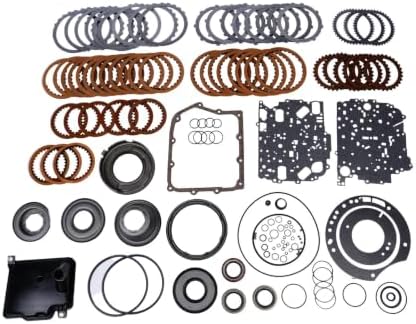
Shop the part for this fix: 62TE master rebuild kit with pistons
When the teardown shows burnt reverse or low clutch frictions and hard piston seals, this CoreTransmissionParts master kit covers frictions, steels, pistons, seals and the filter in one box.
View the 62TE master rebuild kit at CoreTransmissionPartsOr browse all 62TE parts at CoreTransmissionParts.
Need parts for this job?
Our 62TE parts page has valve bodies, master rebuild kits, overhaul kits and ATF+4 service kits, all on our own checkout. The 62TE takes ATF+4 only; see the transmission fluid spec chart.
FAQ
Why does my 62TE drive forward but have no reverse?
Reverse needs the reverse clutch, the L/R clutch and the low clutch to hold together. The L/R clutch is also used in first and second, but the reverse clutch is used only in reverse and the low clutch only applies on coast in first, so either one can fail while drive still feels normal. The low clutch drum and its air-bleed capsule are the most common cause.
Can low fluid cause no reverse on a 62TE?
Yes. A low ATF+4 level can starve the reverse circuits before drive is affected, especially when the fluid is hot. Check the level with the engine idling in park, using the dipstick and the scan tool fluid temperature against Chrysler's chart, before condemning any hard parts.
What code does a 62TE set for no reverse?
The most direct one is P0736, gear ratio error in reverse. You may also see P0706 for a range sensor or cable problem, or L/R codes such as P0841, P1770, P1771 or P1776 that point toward the valve body and L/R circuit. A total no-reverse can also set no code at all.
Is the 62TE low clutch drum worth replacing during a rebuild?
In most cases, yes. The original rotating sealing rings wore the aluminum ring grooves, and even the updated tabbed-ring drums have more side clearance than ideal. Rebuilders commonly use an updated drum or a steel-sleeved ring tower, and check the air-bleed capsule on every drum.
Related guides
Sources
- Chrysler LLC, 2009 62TE Automatic Transmission Service Information (Dodge Journey). Backs reverse, first and second gear power flow and the elements applied in each (reverse 2.21:1 x 1.45:1 = 3.215:1; low clutch applied only on coast in first), the air pressure test with plate 9741 at 30 psi and 6 N-m bolts, the REV/LR/LC test ports, reverse clutch clearance 0.76-1.245 mm and its snap ring part numbers, L/R clearance 0.89-1.47 mm, low clutch clearance 0.48-0.76 mm, L/R retainer screws at 5 N-m, ATF+4 and the scan tool fluid level procedure, the 6 N-m cable adjust bolt, and the Quick Learn requirement. documents.cdn.ifixit.com (PDF)
- ATRA Technical Seminar Manual 2008, Chrysler section, 62TE DTC list. Backs the P0736 (gear ratio error in reverse), P0706, P0750, P0841, P1770/P1771, P1776 and P0868 descriptions. atracom (PDF)
- Wayne Colonna, "62TE: No Reverse," Transmission Digest, October 2012. Backs the low clutch being required for reverse, the roughly 0.020-inch air-bleed capsule working out of the low drum, restaking and saving capsules, and worn ring towers causing a flared 1-2 or neutral. transmissiondigest.com
- Chris Leach, Sonnax, "Diagnosing 62TE, 68RFE Low/Reverse Switch Valve Issues," and Tory Royce, Sonnax, "All in the Family: Identification and Repair of Chrysler Solenoid Switch Valve Problems." Backs the L/R and low clutch switch valves acting as one-way valves, bore wear causing delayed or no reverse and burnt clutches, the 18 in-Hg vacuum test, kits 92835-43K and 92835-47K, and switch valve wear symptoms. L/R switch valve (sonnax.com); switch valve article (sonnax.com)
- Bill Brayton, "A Compound Solution," GEARS magazine (ATRA), October/November 2020. Backs the low clutch drum's rotating-ring groove wear, the tabbed non-rotating ring update, the steel-sleeve tower repair, and low clutch clearance set with select snap rings. gearsmagazine.com
- Wayne Colonna, "Another 62TE 'No-Move' Possibility," Transmission Digest, December 2020. Backs the 2012 Caravan with line pressure under 30 psi and a missing pressed-in check ball found by air testing the main line port. transmissiondigest.com
- FCA US LLC, Service Bulletin 21-046-15, "Low Transmission Fluid Level," July 14, 2015 (via NHTSA). Backs under-filled 2015 Grand Caravan and Town and Country 62TE (sales code DG2) units and the check-and-correct-level repair with ATF+4 part 05013457AA. static.nhtsa.gov (PDF)