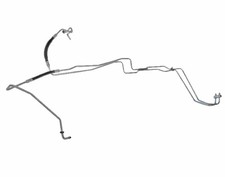
A 6L80 that shifts harsh, shudders, surges, or runs hot often gets a new cooler line installed as the fix, and sometimes that's correct. But GM's own bulletin on this exact complaint says the line is rarely bad out of the box. It's twisted. That distinction changes the whole job: untwisting a line takes ten minutes, while ordering and routing a new one takes an afternoon, and guessing wrong means the truck comes back with the same complaint.
This is the diagnostic order GM lays out in bulletin 22-NA-182, how to actually get a GM quick-connect cooler line off without damaging the fitting, and why the thermal bypass valve deserves a look in the same visit if overheating is part of the complaint.

What GM's Bulletin 22-NA-182 Actually Covers
Bulletin 22-NA-182 (current revision May 2025, replacing the earlier PIP5792 series) applies to 6L80 and 6L90 6-speeds along with the 8L90 8-speed and 10L80/10L90/10L1000 10-speeds, across Cadillac Escalade, Chevrolet Silverado 1500/2500HD/3500HD, Suburban, Tahoe, GMC Sierra 1500/2500HD/3500HD, and Yukon models from the 2021 through 2025 model years, filtered by specific RPO transmission codes (MHS, MHT, MQB, MQC, MQE, MYC for the 6-speed-adjacent trims, MKM/MGM/MGU/MYD for the heavy-duty diesel applications). GM describes the complaint as customers commenting on one or more of: harsh shifting, shudder, surging, stalling, neutral/flare, and transmission overheating, sometimes alongside above-normal transmission fluid temperature, and notes these can appear before or after the transmission has already been overhauled once.
The cause, in GM's own words, is that "this condition may be caused by a twisted cooler line on low mileage vehicles." That's a specific, narrow root cause, not a generic "inspect the cooling system" bulletin, and it's why jumping straight to a new line (or a new transmission) without checking for a twist first is the wrong first move on a truck that fits this description.
Check for a Twist Before You Order Anything
GM's inspection procedure is straightforward, and it starts before any tools come out: look at the full length of the cooler line from the transmission to the auxiliary cooler, removing under-body panels if that's what it takes to see the whole run. A twisted line usually shows as a visible spiral in the rubber section rather than a kink or a flat spot.
- If the line is twisted, disconnect it from the transmission auxiliary cooler and untwist it by hand, then reconnect it.
- If the rubber stays misshapen after untwisting, the line itself gets replaced. Check the fluid level per service information and add fluid if needed.
- If the rubber line shows no misshaping at all, the twist isn't the issue. Check fluid level and add fluid if needed, then look elsewhere, starting with the thermal bypass valve below.
One detail worth flagging for anyone chasing a code instead of a drivability complaint: on ETRS-equipped transmissions carrying RPO MHS or MQC, GM's bulletin specifically notes that a twisted cooler line can set DTC P27EC in the TCM. On other applications in this bulletin's scope, the complaint is more likely to show up as a felt symptom, harsh shift, shudder, surge, than as a stored code, so a clean scan doesn't clear the line as a suspect.
Removing a GM Quick-Connect Cooler Line Without Wrecking the Fitting
GM's 6L80 uses spring-clip quick-connect fittings at the transmission case and cooler, the same family of fitting GM has used across 4L60E and 4L80E cooler lines for years. The fitting is secured by a spring-steel retaining clip seated inside the female half, and it is not designed to be pried apart with a pick as a first choice, that's a workaround for when the proper tool isn't available, and it increases the odds of damaging the fitting or the O-ring seat.
The documented procedure, per the instruction sheet for the OTC 7937 disconnect tool built for this fitting family, runs like this:
- Remove the retaining clip or protective cap from the fitting, and slide back any dust cover.
- Seat the disconnect tool over the line with its slots facing the fitting.
- Squeeze the tool's ears together so it slides inside the fitting's bore, then rotate it until the clip's ears seat into the tool's slots.
- Turn the tool in either direction so its tangs spread the retaining clip open, then pull the line straight out of the fitting.
- Repeat on the second line if both are being serviced.
Have a drain pan ready before you start; fluid will run out of both the disconnected line and the open port on the transmission case. Inspect the O-ring in the female half of the fitting every time a line comes apart, a flattened or torn O-ring is a common source of a slow weep that gets mistaken for a bad line later, and it's cheap insurance to replace it while the fitting is already open.
The Thermal Bypass Valve Is Part of the Same Complaint
If the cooler line checks out straight and the complaint includes overheating or high fluid temperature, GM's bulletin points to the Thermal Bypass Valve (TBV) next. The TBV's job is to route fluid around the external cooler until the transmission reaches operating temperature, and GM gives the exact opening point for each platform in this bulletin's scope: 158 F (70 C) for the 6-speed 6L80/6L90, where the TBV sits external to the transmission; 194 F (90 C) for the 8-speed 8L90; and 143 F (61 C) for the 10-speed 10L80/10L90/10L1000, where the TBV lives inside the valve body on every covered application except the 3.0L diesel (LM2/LZ0) variants, which use an external TBV on the frame rail opening at 194 F (90 C).
GM TechLink carries a separate, more specific directive for the 6L80: on 2016-2019 Silverado and Sierra, and 2015-2020 Tahoe, Suburban, and Yukon equipped with the 6L80 (RPO MYC), any transmission repair performed for harsh shift, delayed shift, shudder, noise, or vibration should also include replacing the TBV. GM revised the valve's opening temperature down from 194 F (90 C) on the original part to 158 F (70 C) on the current one, and the updated valve carries the number 70 stamped into its bottom so a technician can identify it without pulling a parts catalog. GM is explicit that the TBV should be replaced this way only once per repair occurrence, including a Customer Concern Not Duplicated visit, and not swapped again unless normal diagnosis shows the valve itself has actually failed.
A failed-closed TBV is also a distinct, separate failure mode worth ruling out on any 6L80 that overheats even with a straight, correctly connected line: the valve's internal passages are narrow by design, and debris or mechanical failure can stick it shut, which stops fluid from reaching the external cooler at all.
Proving the TBV Works Before You Buy One
GM's PIP5882 (October 2022) gives a no-parts test for 2014-2021 6L80 trucks and SUVs with an overheat complaint. Per that document, the original valve starts to open at 180-187 F (82-86 C) and is fully open at 194 F (90 C), while a valve updated under TSB 21-NA-199 starts to open at 138-145 F (59-63 C) and is fully open at 158 F (70 C). Drive until the scan tool shows about 190 F, then use an infrared thermometer. The pan should read close to the scan tool temperature; if the displayed temperature is more than 15 degrees above the pan, GM says the sensor inside the TEHCM may be bad. Shoot both cooler lines about 6 inches from the valve: the line going to the cooler should be warmer than the pan and the return line cooler. If the pan runs 10-15 F hotter than the cooler lines, the TBV is not opening and gets replaced. If all three readings sit above engine coolant temperature, check auxiliary cooler flow and airflow across the cooler before blaming the valve.
Putting the Lines Back: Seal and Torque
When the TBV or cooler pipe assembly comes off the case, GM's bulletin 20-NA-142 is specific about reassembly on fill-tube trucks: reinstall the TBV and/or cooler lines with a new cooler line seal and tighten the retaining bolt to 22 N·m (16 lb-ft), then set the fluid level per service information. The same bulletin uses the DT-53040 adapter on the case cooler ports for its fluid exchange and calls for DEXRON VI. Reusing a flattened seal is how a correct repair turns into a weep at the case a week later.
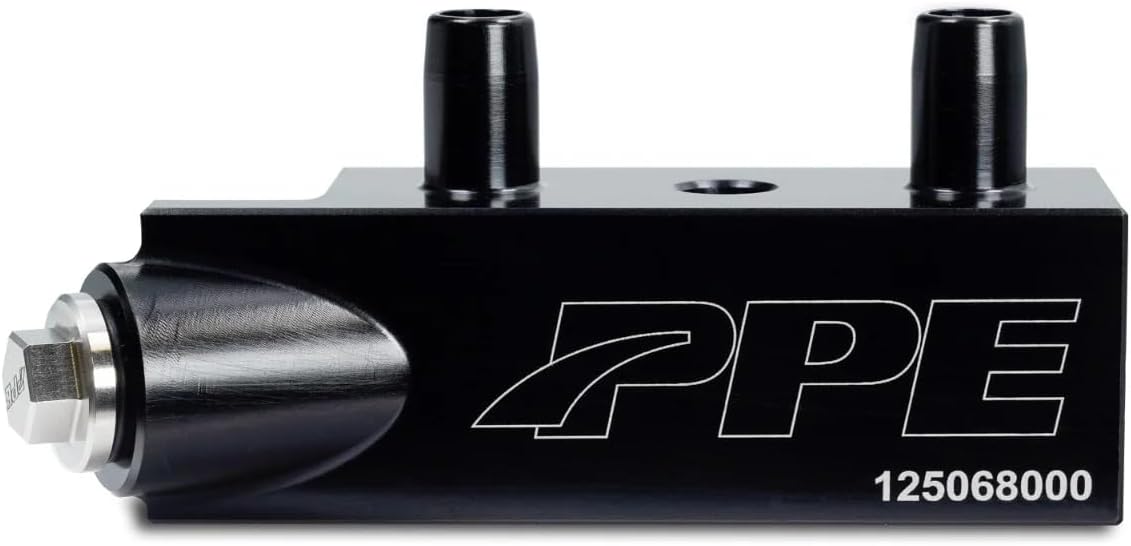
Get the cooler line adapter plate →
After the Repair: Confirm the Cooler Circuit Actually Flows
Reconnecting a line or swapping the TBV doesn't guarantee the cooler circuit is clear, especially on a truck that's been overheating for a while, since heat-cycled fluid can leave varnish in the cooler itself. Sonnax's vacuum test procedure for the 6L45/6L50/6L80/6L90 family covers exactly this: pulling vacuum on the circuit to confirm the pump, regulator, and cooler/converter flow path hold pressure correctly rather than just assuming a new line or valve solved an overheating complaint on its own. If the truck was hot enough to set a complaint before the repair, that circuit is worth checking rather than closing the job on the line swap alone.
Once you're confident the line, fitting, and TBV are correct, check the fluid level per GM service information for the specific model and refill as needed, then road test far enough to get the transmission to full operating temperature and confirm the original complaint, harsh shift, shudder, surge, stall, or overheating, is actually gone and not just quieter at idle in the bay.
Coolers, bypass kits, thermal bypass valves, filters, and master rebuild kits for 6L80 and 6L90 units.
Shop 6L80 parts →The Short Version for the Bench
- Check for a twist first. Per GM bulletin 22-NA-182, most low-mileage harsh shift/shudder/surge/stall/overheat complaints on this family trace to a twisted cooler line, not a bad one.
- Untwist before you replace. Disconnect, untwist, reconnect. Only replace the line if the rubber stays misshapen afterward.
- ETRS units can set P27EC (RPO MHS/MQC) from a twisted line; other applications usually show the complaint as a drivability symptom instead of a code.
- Use the right disconnect tool on GM's quick-connect fittings, and replace the O-ring in the female half whenever a line comes apart.
- If overheating is part of the complaint, check the TBV next: 158 F (70 C) on 6L80/6L90, stamped "70" on the current part, replace once per repair.
- Verify cooler flow after the fix, don't just assume a new line or valve cleared a heat-soaked cooler circuit.
FAQ
What actually causes most 6L80 cooler line complaints?
Per GM bulletin 22-NA-182, most harsh shift, shudder, surge, stall, neutral/flare, or overheating complaints tied to the cooler line on a low-mileage 6L80 come from a twisted line, not a cracked or worn one. GM's fix is to disconnect the line from the auxiliary cooler, untwist it, and reconnect it, and only replace the line outright if the rubber stays misshapen after untwisting.
Does a twisted 6L80 cooler line set a diagnostic trouble code?
On ETRS-equipped transmissions (RPO MHS or MQC), GM's bulletin notes that a twisted cooler line may set DTC P27EC in the TCM. On other 6L80 applications the symptom usually shows up as a drivability complaint, such as a harsh or flared shift, rather than a stored code, so a clean scan does not rule out a twisted line.
How do I know if my 6L80 has the old or the updated thermal bypass valve?
GM TechLink identifies the updated 6L80 TBV by the number 70 stamped into the bottom of the valve, which corresponds to its 158 F (70 C) full-open temperature. The earlier valve opened fully at 194 F (90 C) and has no 70 stamp. If you cannot find the stamp, treat the valve as the old, higher-opening-temperature version.
Can I replace a 6L80 cooler line without also checking the thermal bypass valve?
You can, but GM's own guidance ties the two together: when a 2016-2019 Silverado/Sierra or 2015-2020 Tahoe/Suburban/Yukon with a 6L80 (RPO MYC) comes in for harsh shift, delayed shift, shudder, noise, or vibration, GM TechLink calls for replacing the TBV as part of that repair, not just the line. If overheating or high fluid temperature is part of the complaint, GM bulletin 22-NA-182 specifically lists the TBV as the next suspect once the line itself is confirmed straight.
What tool do I need to disconnect a GM quick-connect cooler line fitting?
GM's quick-connect cooler line fittings on 4L60E, 4L80E, and 6L-family transmissions use a spring-steel retaining clip inside the fitting that a dedicated disconnect tool, such as the OTC 7937, is designed to collapse with a quarter turn. Without that tool, technicians report having to pick the clip's tangs out manually, which risks damaging the fitting.
Related 6L80 guides
Sources
- General Motors — Service Bulletin 22-NA-182, "Information on 6L80, 6L90, 8L90, 10L80, 10L90, 10L1000 Equipped Vehicles With A Harsh Shift, Shudder, Surge, Stall, Neutral/Flare, Transmission Overheating and/or High Transmission Fluid Temperature," May 2025 revision (NHTSA-hosted PDF). Backs the affected vehicle/RPO list, the full symptom list, the twisted-cooler-line root cause and repair steps, the DTC P27EC note for ETRS units, and the TBV opening temperatures by transmission type. static.nhtsa.gov
- GM TechLink — "Twisted Transmission Cooler Line." Backs the field-level description of the twisted-line condition and the inspect/untwist/replace repair sequence in GM's own words. gm-techlink.com
- GM TechLink — Thermal Bypass Valve service update for 6L80-equipped trucks and SUVs. Backs the directive to replace the TBV during harsh shift/shudder/noise/vibration repairs on 2016-2019 Silverado/Sierra and 2015-2020 Tahoe/Suburban/Yukon (RPO MYC), the 194 F to 158 F opening-temperature revision, the "70" stamp identification, and the replace-once guidance. gm-techlink.com
- Sonnax — GM 6L45/6L50/6L80/6L90 Vacuum Test Guide. Backs the post-repair vacuum test method used to confirm the pump, regulator, and cooler/converter flow path on this transmission family rather than assuming a line or valve swap alone cleared an overheating complaint. sonnax.com
- OTC/Bosch — Instruction sheet for the OTC 7937 GM Transmission Oil Cooler Line Disconnect Tool. Backs the documented step-by-step procedure for releasing GM's spring-clip quick-connect cooler line fittings. otctools.com
- General Motors — Preliminary Information PIP5882, "Diagnostic Tips - 2014 through 2021 6L80 MYC and 6L90 MYD Transmissions with an Overheat Concern," October 3, 2022 (NHTSA-hosted PDF). Backs the original and TSB 21-NA-199 TBV opening temperatures, the 190 F infrared test, the 15-degree TEHCM sensor rule, the 10-15 F pan-to-cooler-line rule and the auxiliary cooler flow check. static.nhtsa.gov
- General Motors — Service Bulletin 20-NA-142, "Shudder/Surging While Driving," May 2022 (NHTSA-hosted PDF). Backs the new cooler line seal and 22 N·m (16 lb-ft) bolt torque on TBV/cooler line reinstallation, the DT-53040 cooler port adapter and the DEXRON VI fill. static.nhtsa.gov