Search for a 6L80 pan bolt torque spec and you will find a pile of pages with the right title and no number in them. That is because GM's own figure for the stock stamped-steel pan lives inside paid Service Information, not on any page a search engine can index. What you can actually verify, from documents that are genuinely public, is the bolt pattern, one manufacturer's published torque figure for that exact pattern, and GM's own word on what gets reused versus replaced at the pan.
That is the honest version of this job: a real bolt count and size, a real torque number for that bolt pattern (from an aftermarket pan built to bolt straight onto the stock holes), and the sequence and inspection habits that keep an aluminum case from getting stripped or a flange from getting warped in the process.

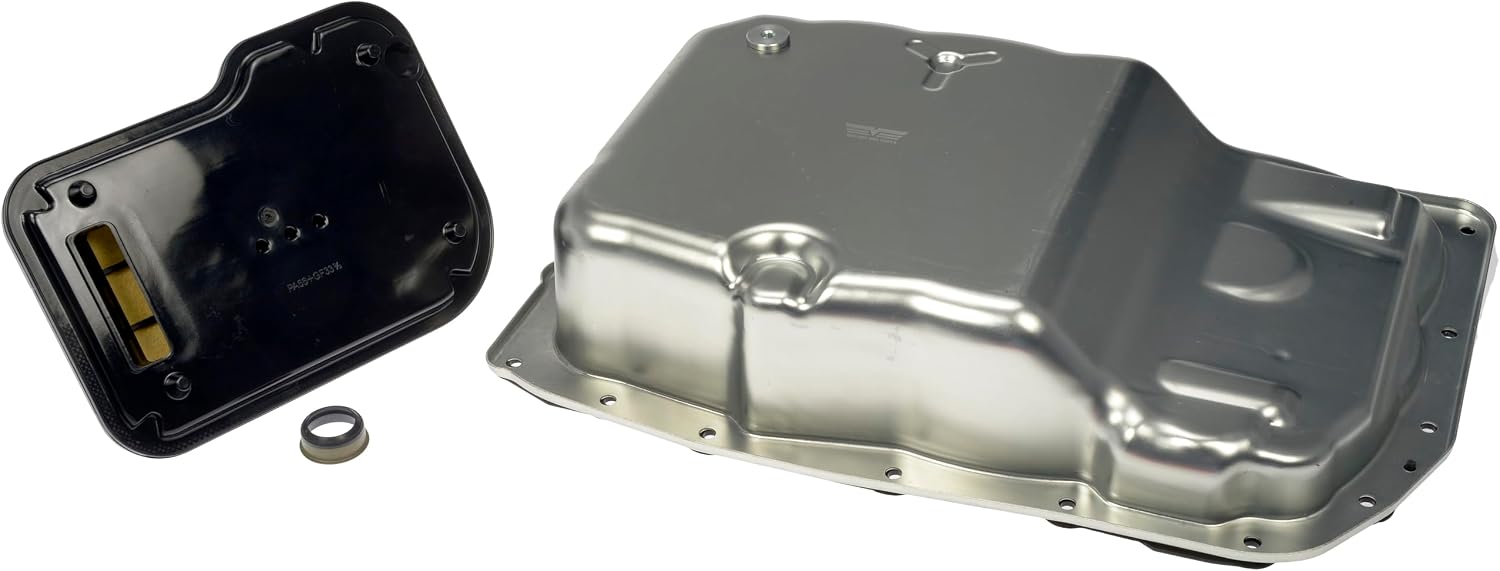

The Bolt Pattern: 18 Bolts, M6, Straight Into the Case
The stock 6L80 pan is a stamped-steel piece with no drain plug, which is one reason pan drops on this unit are messier than they need to be: there is no way to crack a plug and let it run into a drain pan first, so the last few bolts come out with fluid still sitting on top of the flange. Every drop on one of these is a catch-it-as-it-comes job.
The verified bolt count comes from Pacific Performance Engineering's installation guide for its direct-fit 6L80 replacement pan, which is built to bolt onto the same holes the factory pan uses. PPE's own contents list for the kit specifies 18 M6-1.0 x 25mm socket head cap screws with 18 matching M6 flat washers. That is an 18-bolt, M6-thread pattern threading directly into the aluminum transmission case, not into a separately threaded steel insert, which matters for how you think about torque in the next section.
Get the drain-plug pan →
The Torque Number That's Actually Published
GM's factory torque spec for the stamped-steel pan on the stock bolt pattern is not published anywhere free. It exists in GM's own Service Information system (TIS2Web, or a paid aggregator like ALLDATA or Mitchell1 pulling from it), which is the correct place to get it for warranty or dealer-level work. What this article will not do is invent a number and present it as GM's figure, because that is exactly the kind of unverifiable spec that turns a reference page into noise.
What is genuinely published, with a source anyone can check, is PPE's installation spec for the same 18-bolt M6 pattern: torque the hardware to 8 to 10 lb-ft, run up in a crossing pattern across the pan rather than bolt-by-bolt around the perimeter. PPE's own drain plug, where fitted, is specified at 25 lb-ft, with the companion 1/8 inch NPT plug simply snugged down. Because this spec is written for a pan that bolts to the identical factory hole pattern, it is a legitimate, checkable reference point for the torque class this fastener size actually runs at on this case — not a guess, and not a GM number being passed off as one.
If you are doing warranty-sensitive or insurance-documented work, pull the exact figure from GM Service Information for your specific model year rather than relying on an aftermarket pan's instruction sheet. For everyday shop and DIY service, 8 to 10 lb-ft on an M6 fastener threading into aluminum is consistent with what that fastener size can take before you are gambling with the case threads, and it lines up with the kind of torque GM specifies elsewhere on this same transmission family's aluminum-case hardware.
Why Overtightening Is the Mistake That Actually Happens
Nobody chases a transmission pan leak by loosening bolts. The instinct runs the other way: a seep shows up, so the next service gets another quarter turn on every bolt, and the one after that gets another. On a cast or stamped flange bolted into soft aluminum threads with an M6 fastener, that habit runs out of room fast.
Two things go wrong in order. First, the flange crushes unevenly around whichever bolt hole took the most extra torque, which can open a gap at the opposite side of the pan even though every bolt reads "tight." Second, keep going and the aluminum threads in the case itself start to give before the bolt does, which means the fix is no longer a gasket, it is a case repair. A leak that shows up after a pan service is far more often a crushed flange or a gasket that was never properly seated than it is a gasket that is simply worn out, and the fix for that is never more torque.
The crossing pattern PPE specifies is not an aesthetic choice. Running the sequence diagonally across the pan instead of around the perimeter pulls the flange down evenly against the gasket, the same logic as torquing a cylinder head or a wheel: opposite-corner sequencing prevents the flange from cocking against the case as it draws down. Bring every bolt to roughly a third of final spec in the crossing sequence, then to about two-thirds, then to the full 8 to 10 lb-ft on the final pass. Three passes in sequence beats one pass done bolt by bolt around the edge, every time.
What GM Says to Reuse, and What It Says to Replace
This is where a lot of techs over-service the job. A GM TechLink bulletin covering the 6L50 (RPO MYB), 6L80 (RPO MYC) and 6L90 (RPO MYD) transmissions states the position plainly: the fluid pan gasket is reusable, and should be replaced only if it is stuck to the case or the pan. These are sandwich-style gaskets, rubber bonded around a metal core, built specifically to tolerate being unbolted and reinstalled without taking a crush-set the way a cork or paper gasket would. Reflexively tossing a good one in the trash is not extra caution, it is just an unnecessary part purchase.
What GM does call for replacing at every service is the filter and its seal together, not the filter alone. The same TechLink bulletin documents a December 2023 packaging change: the Transmission Oil Filter and Seal Kit, part number 24236933, is now also available as two separate components, filter 24236517 and seal 24225347, with GM's Electronic Parts Catalog updated to match. The procedure itself has not changed: GM's current instruction is to install a new seal whenever the filter is removed, using the correct special tool for the seal, referring to the applicable Service Information for installation. Buying a new filter and reusing the old seal to save a few dollars is how a pan that goes back on with a "new filter" still weeps at the fill neck a week later.
If this job is paired with a pump replacement rather than just a filter and pan drop, check the pump's filter pickup bore before it goes in. Wayne Colonna's write-up in Transmission Digest documents a batch of new GM 6L80/6L90 pump assemblies that left the factory mis-machined: the step that creates the smaller-diameter bore for the filter pickup tube was never cut, so the filter neck sits loose in the bore even with the booted seal fitted correctly. The symptom shows up later as a car that falls out of gear at a stop with low line pressure, and the cause turns out to be the new filter lying in the bottom of the pan, not a bad seal or a bad filter. On a new pump, check that step in the bore before you button the pan back up, not after a comeback.
The Fill Side of the Same Job
A pan-and-filter service is also a fluid service, and the two most common mistakes on the fill side both come from treating this transmission like a dipstick unit with a simple quart count. Chevrolet Performance's own instruction sheet for the 6L80 crate transmission specifies DEXRON-VI only, GM P/N 88861037 in the US and 19264717 in Canada, and it carries a direct warning: an overfilled transmission may result in foaming or fluid expelled out the vent tube, and overfilling can damage the transmission. Because a pan drop on this unit never fully drains the converter or the cooler circuit, the right habit is to measure what actually came out and put that much back, then fine-tune against the temperature window rather than a fixed quart count.
That same instruction sheet lays out the level-check procedure: park level, engine running, shifter cycled through every range for about three seconds each before returning to Park, then an idle of 500 to 800 rpm for at least a minute before checking. The accurate check happens hot, with fluid temperature between 160 and 200 F (71 to 93 C); a cold check at 80 to 90 F (27 to 32 C) is only a safety reference until you can get it hot. Add fluid less than half a liter at a time and check twice, because it does not take much to move the level a long way in either direction.
For a starting number, GM's own 2012 Silverado owner manual lists the 6L80-E at 5.7 L (6.0 qt) for a pan removal and filter replacement, against 6.3 qt for the 6L90-E, and specifies DEXRON-VI (GM 2012 Silverado Owner Manual). Treat that as the ceiling for what goes back in after a pan drop, not a target to pour in blind. The same manual has the driver read TRANS TEMP on the Driver Information Center before checking, so on a truck you do not need a scan tool just to know whether you are in the 160-200 F hot window. The dipstick on those trucks sits at the rear of the engine compartment on the passenger side.
Filter and gasket kits, drain-plug replacement pans, fill adapters and master rebuild kits for 6L80 and 6L90 units.
Shop 6L80 parts →The Procedure, In Order
- Catch it as it comes. No factory drain plug, so the last bolts out mean fluid on your hands. Loosen the perimeter bolts first in reverse of the final torque sequence, leave two or three snug at one end, and let it drain controlled before pulling the rest.
- Inspect, don't assume. Clean the flange and the case mating surface. Check the gasket: if it is not stuck to either surface and shows no tearing, GM's own position is reuse it.
- New filter, new seal, every time. Use the correct tool to seat the new seal; do not reuse the old one just because the old filter still looked clean.
- Position and start by hand. Thread every M6 bolt a few turns by hand before torquing any of them, to avoid cross-threading soft aluminum.
- Torque in a crossing sequence, three passes. Roughly a third of spec, then two-thirds, then the full figure, moving diagonally across the pan rather than around the edge.
- Fill by what came out, then by temperature. Replace the measured volume, then finish the level against the hot check window, not a fixed quart count.
- Drive it, then recheck. A pan that looks dry in the bay can still weep once it has cycled through a full thermal range. Recheck after a real drive, not just after a cold start-up.
FAQ
What is the torque spec for 6L80 transmission pan bolts?
GM's own figure for the stock stamped-steel pan sits inside paid Service Information (TIS2Web or a subscription database), not in anything published free. The one torque number actually published for this exact 18-bolt M6 pattern comes from Pacific Performance Engineering's installation guide for its bolt-on 6L80 replacement pan: 8 to 10 lb-ft, run up in a crossing pattern. Treat that as the published reference for this bolt pattern, and confirm against your own service manual for warranty-sensitive work.
How many bolts hold the 6L80 transmission pan on, and what size are they?
Eighteen. PPE's installation guide for its direct-fit 6L80 pan lists the hardware as 18 M6-1.0 x 25mm socket head cap screws with 18 matching M6 flat washers, threading straight into the aluminum transmission case on the stock bolt pattern.
Does the stock 6L80 pan have a drain plug?
No. The factory stamped-steel pan has no drain plug, which is why a pan drop on a 6L80 always means catching fluid as the last bolts come out. Aftermarket pans built for this unit commonly add a magnetic drain plug and sometimes a second NPT port specifically to fix that.
Can I reuse the 6L80 pan gasket?
Yes, according to GM. A GM TechLink bulletin covering the 6L50, 6L80 and 6L90 (RPOs MYB, MYC, MYD) states plainly that the fluid pan gasket is reusable and should be replaced only if it is stuck to the case or the pan. What GM does call for replacing every time is the filter and its seal.
What happens if you over-torque a 6L80 pan bolt?
An M6 fastener threading directly into cast aluminum has a narrow margin before it either strips the case threads or crushes the flange unevenly around that bolt hole, which opens a leak path the gasket can no longer close. The fix for a leak is almost never more torque; it is checking the flange for flatness and running the correct sequence at the correct spec with a torque wrench, not a ratchet and a guess.
Related 6L80 guides
Sources
- Pacific Performance Engineering (PPE) — Heavy-Duty Cast Aluminum Transmission Pan, GM 6L80, Installation Guide (P/N 1280516XX, Rev. R10.25). Backs the 18-bolt count and M6-1.0 x 25mm socket head cap screw and flat washer hardware list, the 8-10 lb-ft torque specification run in a crossing pattern, the 25 lb-ft drain plug torque, and the instruction to retain and reuse the stock gasket on the replacement pan. cdn.shopify.com (PPEpower.com)
- GM TechLink — "6-Speed Automatic Transmission Oil Filter and Seal Now Available Individually," published December 15, 2023. Backs the statement that the fluid pan gasket is reusable and should be replaced only if stuck to the case or pan, the current instruction to install a new seal whenever the filter is removed, and the part numbers for kit 24236933, filter 24236517 and seal 24225347 on 6L50 (MYB), 6L80 (MYC) and 6L90 (MYD) transmissions. gm-techlink.com
- Chevrolet Performance — Supermatic 6L80 Transmission Controller Kit for LS Crate Engines, Installation Instructions, P/N 19366636 (PDF). Backs the DEXRON-VI requirement with GM P/N 88861037 US and 19264717 Canada, the overfill warning about foaming and fluid expelled from the vent tube, the approximate fluid capacity for a pan and filter service (5.7 L / 6.0 qt), and the hot (160-200 F) versus cold (80-90 F) fluid level check procedure including the shift-range cycling and idle sequence. www.chevrolet.com
- Chevrolet — 2012 Silverado Owner Manual (GM, PDF). Backs the 6L80-E pan-removal-and-filter-replacement capacity of 5.7 L (6.0 qt) against 5.0 qt for the 4L60-E and 6.3 qt for the 6L90-E, DEXRON-VI as the specified automatic transmission fluid, reading TRANS TEMP on the Driver Information Center before a level check, the 80-90 F cold and 160-200 F hot check windows, and the dipstick location at the rear of the engine compartment on the passenger side. assets.gm.com (PDF)
- Transmission Digest — "Keep an eye out for 6L80/90 defective oil pumps," Wayne Colonna, July 7, 2022. Backs the mis-machined replacement pump bore defect: some new GM 6L80/6L90 pump assemblies were missing the step that forms the smaller-diameter filter pickup tube bore, leaving the filter neck loose even with the booted seal fitted, which produces a low-line-pressure, falls-out-of-gear-at-a-stop complaint with the new filter found lying in the pan. transmissiondigest.com