A Super Duty that pulls hard in Drive but sits there in Reverse, or takes two or three seconds to catch it, is telling you something specific. The 6R140 only uses two clutches to make Reverse, and one of them works in two forward gears while the other does almost nothing in Drive. Read the forward gears correctly and you can usually tell which side of the unit is hurting before you drop the pan.
This guide walks through how Reverse is built inside the 6R140, the quick checks that catch the cheap causes (fluid level, a loose filter seal, range input), a line pressure test with real numbers, and how to split a valve body fault from a burned clutch. Every hard number is tied to a source listed at the bottom.
How the 6R140 makes Reverse
Ford Component Sales lists the 6R140 as a Lepelletier powerflow built from one simple planetary and one Ravigneaux gearset, with five clutch packs: three rotating clutches and two brake clutches. Gear ratios are 3.974 first, 2.318 second, 1.516 third, 1.149 fourth, 0.858 fifth, 0.674 sixth and 3.128 Reverse, and the unit is rated for 935 lb-ft of input torque (Ford Component Sales spec sheet).
Sonnax names the five clutches by the ranges they work in, which is the easiest way to keep them straight:
- Forward 1-2-3-4 clutch (rotating)
- Direct 3-5-R clutch (rotating)
- Overdrive 4-5-6 clutch (rotating)
- Intermediate 2-6 clutch (brake)
- Low/Reverse clutch (brake)
Reverse is the Direct 3-5-R clutch plus the Low/Reverse clutch. That is the whole story, and it gives you two diagnostic handles:
| Range | Clutches applied | What it tells you about Reverse |
|---|---|---|
| 1st (Drive) | 1-2-3-4 + one-way clutch | Launches fine even with a dead Low/Reverse clutch |
| Manual 1 | 1-2-3-4 + Low/Reverse | No engine braking points at the Low/Reverse circuit |
| 3rd | 1-2-3-4 + 3-5-R | 2-3 flare or 3rd slip points at the 3-5-R circuit |
| 5th | 3-5-R + 4-5-6 | 4-5 flare or 5th slip points at the 3-5-R circuit |
| Reverse | 3-5-R + Low/Reverse | Needs both; no one-way clutch backup |
The key point: in Drive, first gear is held by the one-way clutch, so a burned Low/Reverse pack can hide for a long time. Reverse has nothing to fall back on. That is why a lot of these trucks show up with "perfect forward gears, no Reverse."
Quick check 1: fluid level and the filter seal
Do not skip this because the dipstick looks fine. Sonnax documented a 2016 F-550 with an intermittent neutral in both Forward and Reverse that could only be duplicated climbing an incline. A line pressure gauge dropped to 0 psi on the grade. The fix was not a clutch: the filter snout seal had no grip at all, so the pump was sucking air when fluid moved away from the pickup. A proper seal plus one pint of fluid cured it, and the shop went on to fix several more trucks the same way (Sonnax, intermittent neutral article).
Check level with a scan tool on the transmission fluid temperature (TFT) PID. Ford wants the fluid at 91-102°C (196-216°F) for a valid reading. The fluid is MERCON LV. Sonnax gives the refill amounts as 7.8 L (8.2 qt) for a drain or pan drop, 9.7 L (10.2 qt) after valve body removal, and 15.3 L (16.2 qt) for a dry unit. Add in half-pint steps and never overfill; Ford warns overfill causes overheated fluid. Then drive nose-up on a 20-30 degree incline and confirm it holds gear.
If you are in the pan, pull the filter and feel the neck seal. If the filter drops out with no resistance, you may have found your no-Reverse right there.
Quick check 2: range input and wiring
If the controller does not see Reverse, it never commands the two clutches. With the scan tool on, move the selector through each position and confirm the transmission range (TR) PID matches the lever every time, with no flicker between positions. Check the shift cable end and bushing at the transmission lever; a worn bushing lets the manual valve sit short of the Reverse detent.
The internal harness is a known weak point. ATRA's GEARS Magazine reports that splices inside the 6R140 internal harness can fail and cause intermittent continuity problems, and notes the new OEM harness has the same splices. An open to the Low/Reverse or 3-5-R solenoid usually sets a circuit code, so read codes before you road test and look at freeze-frame for anything intermittent.
Line pressure test with real numbers
Put a gauge on the line pressure port. ATSG's Pete Luban, writing in Transmission Digest, gives the 6R140W spec as 90 psi at idle in both Drive and Reverse, 230 psi at wide-open throttle in Drive, and 240 psi at wide-open throttle in Reverse. Sonnax quotes the overall range as 90-260 psi (619-1790 kPa). Keep any stall reading short, under five seconds, and let the unit cool between runs.
- Low in Drive and Reverse: the problem is upstream of the reverse clutches: low fluid, the filter seal above, pump, line pressure control (LPC) regulator valve or the LPC solenoid.
- Normal in Drive, low or unstable in Reverse: a leak in a reverse-only feed. Suspect the Low/Reverse piston seals, the 3-5-R circuit sealing rings, or a worn Low/Reverse regulator valve bore.
- Normal everywhere but still no Reverse: the pressure is getting made but not holding a clutch. Go to the clutch split below.
Use the forward gears to split 3-5-R from Low/Reverse
This is where the table above earns its keep. Road test with the fluid hot and pay attention to 3rd and 5th.
3rd and 5th are bad too
If the 2-3 and 4-5 upshifts flare, or 3rd and 5th slip under load, and Reverse is delayed or gone, the common element is the Direct 3-5-R clutch. Sonnax's 6R140 vacuum test guide lists the exact symptom set for a worn Direct 3-5-R clutch regulator valve: delayed Reverse, 2-3 and 4-5 flare, bind-up, ratio codes, 3rd/5th/Reverse slip and a burned direct clutch. The Direct 3-5-R latch valve on the lower body carries the same "3rd, 5th, Reverse" complaint.
3rd and 5th are solid, Reverse is not
If every forward upshift is clean but Reverse is late, soft or missing, and Manual 1 gives you no engine braking on a downhill, the fault is on the Low/Reverse side. Sonnax lists low line pressure, a burned Low/Reverse clutch and delayed Reverse for a worn Low/Reverse regulator valve, and burned Low/Reverse clutch plus delayed Reverse for the Low/Reverse latch valve.
Confirm slip with speed sensors
Do not guess at slip from the seat. In Reverse at light throttle, divide turbine shaft speed (TSS) by output shaft speed (OSS). A healthy unit tracks close to the 3.128 Reverse ratio. A number that climbs above that as you add throttle is a clutch slipping, not a sensor fault. If TSS or OSS drops out or reads erratic, go after the sensor and harness first, since GEARS notes speed sensor and IMS codes are common on this unit and can be temperature-related.
Also check the other extreme: if the truck has no movement in any range, you are not looking at a reverse clutch. GEARS describes the input shaft spin weld breaking free of the 4-5-6 drum, held together only by the return spring, piston and snap ring. Grab the shaft and hold the drum; if the shaft turns, you found it. Sonnax adds cracks in the forward clutch drum, which carries both the 1-2-3-4 and the 3-5-R clutches, and a cracked 4-5-6 housing weld as known no-move failures.
Valve body and solenoid causes
The 6R140 valve body collects debris on a high-mileage, unserviced unit, and GEARS reports fine wear material sticking control valves in their bores. The fix is usually targeted: vacuum test the Low/Reverse and Direct 3-5-R regulator and latch valve bores per the Sonnax guide, and replace worn valves with oversized kits rather than swapping the whole body on a guess.
If you replace a solenoid, respect Ford's solenoid banding. Sonnax explains that each solenoid carries a band number from 1 to 5, and the PCM or TCM compensates for each position based on the valve body's 13-digit strategy number and 8-digit ID. Normally high solenoids have a black snout, normally low solenoids a brown one. Replace a solenoid with the same band and type in the same position, or load the new strategy file when you install a different valve body. ATSG notes all seven 6R140 solenoids are regulating types with no simple on/off units, so a wrong band shows up as a flare or bind rather than a clean no-shift.
For 2011 trucks specifically, Ford issued TSB 11-11-11 for early-build F-Super Duty 6.7L trucks showing a 2-3 flare, P0733 and/or delayed Reverse engagement, worse after an extended soak. The procedure checks build date and, on the earliest builds, replaces the three normally high solenoids along with a reprogram. Check the current version of that bulletin in Ford's service information before you order parts.
After any valve body or solenoid work, clear the keep alive memory and adaptive tables, then run the adaptive drive cycle Sonnax outlines: at operating temperature, shift Neutral to Reverse and Neutral to Drive with a 4-second pause each time, repeated at least three times, then the 50 mph stop cycles and the coast-down in L range.
Burned clutch: what you find on the bench
If pressure is good, the valves test tight and TSS/OSS still show slip, the unit is coming out. On teardown, air check the Low/Reverse and 3-5-R pistons before you strip them. A burned Low/Reverse pack is the classic "forward is fine" failure. For reference, Raybestos' 2015-2018 6R140 GPZ module (per Transmission Digest) uses five 0.070-inch Low/Reverse frictions.
Set clutch clearances carefully. GEARS points out that the original factory reference material gave incorrect clearance figures for this unit, so the ATRA spec is built from clearances measured in good working units. On a clutch-to-clutch transmission, a pack set too loose or too tight will bring you right back to a Reverse or shift complaint. Also plan for the weight: the unit is about 345-350 lb dry and the input assembly alone is about 75 lb, and ATRA recommends an engine hoist on the bench.
Diagnosis flow, in order
- Read all codes, including pending and freeze-frame. Note any solenoid circuit, ratio or TSS/OSS codes.
- Bring fluid to 196-216°F on the TFT PID and check level. Test on an incline.
- Watch the TR PID through every lever position; inspect the shift cable bushing.
- Gauge line pressure: 90 psi idle in Drive and Reverse, 240 psi WOT Reverse.
- Road test 3rd and 5th, and Manual 1 engine braking, to pick the 3-5-R or Low/Reverse side.
- Log TSS and OSS in Reverse; compare against 3.128.
- Pan off: check the filter seal, debris, and vacuum test the matching regulator and latch valves.
- Still slipping with good pressure: remove the unit, air check, rebuild the failed pack and set clearances.
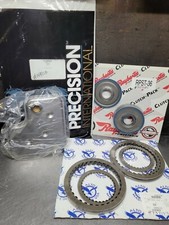
6R140 friction clutch kit, 2011-2025 (Raybestos)
When the air check or TSS/OSS data confirms a burned Low/Reverse or 3-5-R pack, this friction module covers the clutch packs for the rebuild. Sold by our sister store, CoreTransmissionParts.
Shop the part for this fix →Doing the whole unit? See the 6R140 overhaul kit with bonded pistons or the rebuild kits collection.
Need parts for this job?
Our 6R140 parts page has master rebuild kits, clutch modules, solenoid kits, valve bodies, filter kits and MERCON LV service kits for Super Duty trucks. Checkout is on site.
FAQ
Which clutches does a 6R140 use for reverse?
Reverse uses the Direct 3-5-R clutch and the Low/Reverse clutch. The 3-5-R clutch also works in 3rd and 5th, so if those gears shift cleanly, the 3-5-R side is probably healthy and the Low/Reverse side becomes the main suspect.
Why does my 6R140 drive forward but not reverse?
In Drive, first gear is held by a one-way clutch, so the truck can launch normally even with a burned Low/Reverse clutch. Reverse has no one-way clutch backup and needs the Low/Reverse clutch to hold. Missing engine braking in Manual 1 is the other clue that points to the Low/Reverse circuit.
What is the 6R140 line pressure spec in reverse?
ATSG lists 90 psi at idle in both Drive and Reverse, 230 psi at wide-open throttle in Drive, and 240 psi at wide-open throttle in Reverse. Pressure that is normal in Drive but low in Reverse points to a leak in a reverse-only circuit such as the Low/Reverse piston seals.
Can low fluid cause no reverse on a 6R140?
Yes. Sonnax documented 6R140 trucks that went to neutral in Forward or Reverse on an incline because a loose filter neck seal let the pump draw air. Check level at 196-216°F on the scan tool, inspect the filter seal, and never overfill.
Related guides
- 6R140 Slipping: Causes and Fix
- 6R140 Limp Mode Causes
- 6R140 Shift Solenoid Symptoms
- 6R140 Valve Body Wear and Fix
- 6R140 Fluid Type and Capacity
- 6R80 No Reverse: Diagnosis and Fix
Sources
- Ford Component Sales, "Ford 6R140: 6-Speed Automatic Transmission" technical specifications. Backs the Lepelletier powerflow, one simple plus one Ravigneaux gearset, five clutch packs (three rotating, two brake), all gear ratios including 3.128 Reverse, 935 lb-ft rating, 345 lb weight and MERCON LV fluid. fordcomponentsalesllc.com (PDF)
- Sonnax, "Ford 6R140 Vacuum Test Guide." Backs the clutch names, the Direct 3-5-R and Low/Reverse regulator and latch valve locations, and the symptom lists for each (delayed Reverse, 2-3/4-5 flare, 3rd/5th/Reverse slip, burned Low/Reverse clutch). sonnax.com
- Sonnax, "Ford 6R140 - Repairing Elusive Intermittent Neutral Condition," Jim Mobley. Backs the incline neutral caused by a loose filter neck seal, the 90-260 psi line pressure range, the 91-102°C check temperature, the 8.2/10.2/16.2 qt refill amounts, the overfill warning and the forward drum and 4-5-6 housing crack failures. sonnax.com
- Transmission Digest, "Similar but Different: A look at Ford's 6R140W," Pete Luban (ATSG). Backs the 90 psi idle Drive/Reverse, 230 psi WOT Drive and 240 psi WOT Reverse line pressure specs, and the seven regulating (normally high/normally low) solenoids. transmissiondigest.com
- GEARS Magazine (ATRA), "Problems and Fixes! Revisiting the 6R140 Transmission." Backs the internal harness splice failures, speed sensor and IMS codes, valve body debris, incorrect factory clutch clearance data, the broken input shaft spin weld no-move, and the 350 lb unit and 75 lb input assembly. gearsmagazine.com
- Sonnax, "6R140 Transmission Solenoid Strategy Code: Don't Break Up the Band," Jason Larochelle. Backs the 1-5 solenoid banding, black (normally high) and brown (normally low) snouts, 13-digit strategy and 8-digit ID numbers, and the adaptive drive cycle with Neutral-Reverse engagements. sonnax.com