Most people searching for a 6R140 "EPC solenoid" are looking for the part Ford calls the line pressure control (LPC) solenoid. EPC is the older Ford name, carried over from the 4R70W and 5R55 era. On the 6R140 it is one of seven variable bleed solenoids on the valve body, and its job is to set main line pressure. Every clutch in the box is fed from that line pressure, so when LPC control goes wrong, every shift goes wrong with it.
The short version: the LPC solenoid is normally high. With no current it gives full line pressure, so an open circuit makes the truck harsh, not soft. A soft, slipping, burning 6R140 usually has a line pressure problem downstream of the solenoid, in the valve body bores. And a harsh 6R140 with no codes can have nothing wrong in the transmission at all. Sources are listed at the bottom.

What the LPC solenoid does
Wayne Colonna's TorqShift 6 write-up describes the 6R140W as controlled by seven pulse width modulated solenoids, run by an external TCM on the 6.7L diesel and by the PCM on gas trucks. Ford Component Sales lists the same split: PCM for gas, TCM for diesel. Colonna describes the LPC as a normally high solenoid that controls main line pressure through the pressure regulator valve in the valve body.
Here is the chain. The pump makes flow. The main pressure regulator valve bleeds that flow back to set line pressure. The LPC solenoid puts a signal pressure on the end of that regulator, which tells it how hard to hold. The TCM changes LPC current constantly, based largely on calculated engine torque. More current on a normally high solenoid means less output and lower line pressure. Less current means more.
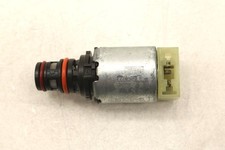
The Sonnax-made Rostra solenoid instructions show where it sits and how to spot it. On the 6R140 valve body the LPC position is marked as the line pressure solenoid, it has a black snout like the other normally high units, and normally high solenoids carry orange and red O-rings. Normally low solenoids have a brown snout with green and red O-rings.
| Item | 6R140 detail | Source |
|---|---|---|
| Ford name | Line pressure control (LPC) solenoid | Colonna / Rostra |
| Type | Variable bleed, normally high (full output at zero current) | Colonna / Rostra |
| Identifier | Black snout, orange and red O-rings | Rostra |
| Controlled by | TCM (6.7L diesel), PCM (6.2L gas) | Ford Component Sales |
| Calibration | Band number 1-5 on the solenoid, tied to a 13-digit strategy on the valve body tag | Transmission Digest / Rostra |
| Fluid | MERCON LV, about 4 gallons total | Ford Component Sales |
Why an open LPC circuit makes it harsh, not soft
This is the part that trips people up. The 6R140 failsafe is built around the normally high solenoids. Colonna quotes the Ford strategy: when the TCM or PCM sees a fault it goes into Failure Mode Effect Management and removes current from the solenoids. With no current, SSB and SSE apply their clutches, which is 5th gear, and LPC goes to full output, which is maximum line pressure. You get 5th and Reverse, with line pressure pinned at the top.
So an open LPC coil, a broken harness lead or a dead module driver all give full line pressure all the time: hard engagements, harsh upshifts and usually a code.
How high is high? Chris Adams at Certified Transmission logged a 6R140 with a gauge on it. Normal acceleration from 0 to 70 mph ran about 100-105 psi at around 2,000 rpm, rising to about 140 psi during each shift and about 167 psi with the converter clutch applied. On a reverse stall test the line pressure solenoid turned off and line pressure went to about 285 psi. That 285 is what the box does with the LPC doing nothing. If you see stall-level pressure at a light-throttle cruise, the LPC is not being commanded, is not responding, or the regulator is stuck.
Symptoms by failure type
Harsh everything
Hard garage shifts and firm upshifts across the board. This fits an LPC stuck at high output: open circuit, debris in the solenoid, or a module that thinks engine torque is much higher than it is.
Soft, slipping, flaring shifts that get worse hot
This is low line pressure. An LPC that has drifted toward low output can do it, but on a high-mileage 6R140 the valve body is the more common cause. More on that below.
Soft one day, harsh the next
Jim Dial at Sonnax writes that the variable bleed solenoids on the 6R80 and 6R140 tend to lose their calibration, or banding, over time. The TCM adapts to that drift up to a point, and then it runs out of room. A drifted LPC shifts the baseline for every clutch at once, so the complaint moves around: a firm 1-2 today, a flare on 2-3 tomorrow.
Codes
The generic SAE codes for the pressure control solenoid circuit are P0960 (control circuit open), P0961 (range/performance), P0962 (circuit low) and P0963 (circuit high). Circuit codes point at the coil, the internal harness, the case connector or the module driver. A range/performance code with a good circuit points at the solenoid output or the hydraulics it feeds.
Harsh shifts that are not the transmission
Because the TCM sets line pressure from calculated engine torque, a bad engine input can make a healthy 6R140 shift like a bad one. Mike Wiggins at Certified Transmission documented a 2015 F-350 6.7L with a harsh 1-2 shift under light throttle and a four to five second delay before the shift. It still did it after the transmission was replaced, with no codes stored. The exhaust back pressure sensor was reading 68.8 psi under light acceleration, where the article gives normal as under 30 psi. That false high-load signal led the PCM to mismanage the shift. A new Ford EBP sensor fixed it.
The lesson for LPC diagnosis: before you buy a solenoid for a harsh 6.7L, pull up engine load, calculated torque and the EBP reading on a light-throttle road test.
How to diagnose it
- Fluid first. Correct level hot, MERCON LV only, and check the pan for friction material.
- Codes and freeze frame. Note whether it is a circuit code (P0960, P0962, P0963) or a performance code (P0961), and what gear and temperature it set in.
- Circuit check. Measure the LPC circuit through the case connector and compare to the Ford workshop manual for the year. An open or short on the coil or the internal harness is your answer. A good reading only proves the coil is intact. These solenoids are current controlled, and one can measure fine and still put out the wrong pressure.
- Gauge it. Put a mechanical gauge on the line pressure tap and road test with the scan tool recording. Compare to the Adams figures above: roughly 100-105 psi cruising under light acceleration, a rise during shifts, and the full 285 psi range only on a reverse stall. High at light throttle means the LPC is not reducing pressure. Low everywhere, especially hot, means lost pressure somewhere in the regulator circuit.
- Watch commanded against actual. Log commanded gear, actual gear, turbine speed and output speed. Adams makes the point that you need a scope, not a meter, to look at solenoid activity on these units; a DVOM is too slow to show what the driver is doing.
The valve body problem that looks like a bad LPC
On a high-mileage 6R140, the bores the LPC works through wear out more often than the solenoid does. Sonnax says the line pressure control valve oscillates constantly and wears its bore, and the symptoms depend on where the wear is:
- Wear at the balance spool end leaks off critical fluid and gives high line pressure, harsh shifts, and overheating from reduced cooler and converter flow.
- Wear at the outboard spool robs converter feed pressure and lowers line pressure, which gives soft shifts and burnt clutches.
Sonnax lists poor shift quality, TCC apply and release complaints, erratic line pressure, low converter and lube flow and overheating for this bore, and its fix is the oversized line pressure control valve kit, part 126740-08K, reamed with tool kit F-126740-TL8. That kit is 6R140 only.
Upstream of the LPC is the solenoid feed pressure regulator, which supplies all seven solenoids. Sonnax lists delayed Reverse, delayed Forward, flare shifts and harsh shifts when its bore wears, fixed with oversized kit 126740-24K and tool kit F-126740-TL6. If the feed pressure to the solenoids is unstable, a brand-new LPC will not fix anything.
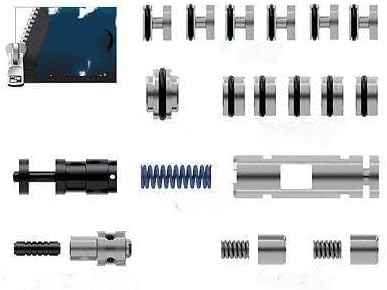
Both are confirmed with a vacuum test at the ports Sonnax specifies, with a 1/8 inch checkball dropped in the bore for the line pressure valve test and removed afterward. If a bore will not hold the minimum vacuum, ream it and fit the oversized valve. On a unit that is already apart, the Sonnax 6R140 zip kit covers the common wear points in one go.
Replacing the LPC solenoid the right way
The mistake that creates comebacks on this unit is putting in a solenoid with the wrong band. Jason Larochelle, writing for the TASC Force in Transmission Digest, explains that 6R140 solenoids are banded 1 through 5 based on flow, and the valve body tag carries a 13-digit strategy number and an 8-digit solenoid body ID that tell the module which band sits in each position. The Rostra instructions say the same: the replacement band must match the original, and so must the normally high or normally low calibration.
Larochelle's procedure for a single solenoid replaced with the same band in the same position:
- Engine at operating temperature.
- Shift Neutral to Reverse and Neutral to Drive, pausing about 4 seconds in each, three times.
- Accelerate to 50 mph in Drive and brake lightly to a stop, three times.
- Restart the engine.
- Accelerate to 25 mph, release the throttle, select L and coast below 10 mph, three times.
If the whole valve body is replaced, the new solenoid strategy has to be loaded into the module with a Ford scan tool or a J2534 pass-through, the adaptive tables cleared and keep-alive memory reset, then the drive cycle run. Rostra recommends resetting adapts after any solenoid service, even with a same-band replacement, because the old solenoid had drifted and the module had adapted to it.
One history note from Colonna: on early-build units, built before November 19, 2010, the LPC was one of three solenoids replaced to cure a 2-3 flare concern. If you are working on a very early 2011 truck with a flare, check whether that was ever done.
Preventing a repeat
Keep the fluid clean MERCON LV, keep temperature under Ford’s 250°F continuous rating, never mix bands, and fix the bores whenever the valve body is out instead of only swapping solenoids.
6R140 shift solenoid kit, 2011-up
A full solenoid set for the Super Duty TorqShift 6, for when the LPC is not the only drifted solenoid on the body. Match the band numbers to your valve body tag before install. Sold by our sister store, CoreTransmissionParts.
Shop the part for this fix →Need a single solenoid? The solenoids collection has individual solenoids and kits.
Need parts for this job?
Our 6R140 parts page carries the pressure control solenoid, complete solenoid kits, the Sonnax valve body zip kit, replacement valve bodies and MERCON LV service kits. Checkout is on site.
FAQ
What are the symptoms of a bad 6R140 pressure control solenoid?
The most common are harsh engagements and firm upshifts, because the LPC solenoid is normally high and gives full line pressure when it loses current. A drifted solenoid can also give shifts that change from firm to soft day to day. Soft, slipping shifts that get worse hot more often point to worn valve body bores than to the solenoid itself.
Is the EPC solenoid the same as the LPC solenoid on a 6R140?
Yes. EPC, electronic pressure control, is the older Ford name used on units like the 4R70W. On the 6R140 Ford calls it the line pressure control solenoid. It is a normally high variable bleed solenoid that controls main line pressure through the pressure regulator valve.
What should 6R140 line pressure be?
One gauge test logged by Certified Transmission showed about 100-105 psi at around 2,000 rpm during normal acceleration, about 140 psi during shifts and about 167 psi with the converter clutch applied. On a reverse stall test, with the line pressure solenoid off, it reached about 285 psi. Use the Ford workshop manual chart for pass or fail on your year.
Do I need to program the TCM after replacing the 6R140 LPC solenoid?
If the new solenoid has the same band number as the old one and goes in the same position, Transmission Digest describes a drive-cycle relearn instead of programming. If the valve body is replaced, the new solenoid strategy has to be loaded with a Ford scan tool or J2534 device and the adaptives cleared. Rostra recommends resetting adapts after any solenoid service.
Related guides
- 6R140 Shift Solenoid Symptoms and Replacement
- 6R140 Harsh Shift Causes
- 6R140 Limp Mode Causes
- 6R140 Valve Body Wear and Fix
- 6R140 Slipping Causes and Fix
Sources
- Ford Component Sales, LLC, Ford 6R140 6-Speed Automatic Transmission Technical Specifications. Backs PCM control on gas and TCM control on diesel, MERCON LV, the 4-gallon capacity and the 250°F continuous rating. fordcomponentsalesllc.com (PDF)
- Wayne Colonna, "Introducing Ford's TorqShift 6 Transmission," Vehicle Service Pros. Backs the seven PWM solenoids, the LPC as a normally high solenoid acting on the pressure regulator valve, the FMEM failsafe to 5th with maximum line pressure, and the pre-November 19, 2010 LPC replacement for 2-3 flare. vehicleservicepros.com
- Rostra Powertrain (Sonnax), Ford 6R80, 6R100, 6R140 Variable Bleed Solenoid Instructions. Backs the LPC position and black snout, normally high and normally low O-ring colors, band and calibration matching, and resetting adapts after any solenoid service. Rostra instructions (PDF)
- Transmission Digest, TASC Force Tips, Jason Larochelle, "6R140 Transmission Solenoid Strategy Code." Backs band numbers 1-5, the 13-digit strategy and 8-digit ID on the valve body tag, the same-band relearn procedure, and the scan tool or J2534 procedure for a replacement valve body. transmissiondigest.com
- Sonnax, Oversized Line Pressure Control Valve Kit 126740-08K. Backs the balance spool and outboard spool wear effects, the symptom list, the 1/8 inch checkball vacuum test and tool kit F-126740-TL8. sonnax.com
- Sonnax, Oversized Solenoid Feed Pressure Regulator Valve Kit 126740-24K. Backs the solenoid feed regulator wear symptoms (delayed Reverse and Forward, flare and harsh shifts) and tool kit F-126740-TL6. sonnax.com
- Sonnax, Jim Dial, "Troubleshooting Ford 6R80 and 6R140 Timing-Related Shift Issues." Backs variable bleed solenoids losing calibration or banding over time. sonnax.com
- Certified Transmission Transletter, Chris Adams, May 2020 (field data, not a spec). Backs the logged 100-105, 140, 167 and 285 psi line pressure readings and the scope-over-meter point. certifiedtransmission.com
- Certified Transmission Transletter, Mike Wiggins, June 2025 (field case). Backs the 2015 F-350 EBP sensor harsh 1-2 case and the 68.8 psi reading. certifiedtransmission.com